
Best online casino payment methods for Australians in 2026
 Available in US
The marketing reaches Australian readers regardless. Search for the best online casino payment methods and the results run to offshore operators promising fast withdrawals, crypto-friendly cashier pages and welcome packages that look Australian without saying so. The site itself will usually show a Curaçao licence, a Maltese licence or no licence at all; the small print names an offshore operator rather than anything Australian. The reason for that gap, and what it costs anyone considering it, is the read-aloud version of the marketing claim.

Data current as of 23 September 2026 · verified against the ACMA register of formal warnings and the Australian Payments Plus directory of participating institutions.
Table of Contents
- The shortlist: brands the ACMA itself has warned
- Fundamentals of how online casino payments work in Australia
- The prohibition: how the Interactive Gambling Act 2001 actually operates
- Where player safety sits, and where it doesn’t reach
- Cryptocurrency at offshore casinos: what the on-chain view actually shows
- Settlement: how money moves, and how quickly it actually arrives
- Brand-by-brand assessment
- How fast the blocklist has grown
- Frequently asked questions
The shortlist: brands the ACMA itself has warned
Eleven operators that Australian readers commonly encounter have all been the subject of formal ACMA warnings under the Interactive Gambling Act 2001 over the past four years. The table sets them out the way the ACMA itself published each action. None of them is licensed to provide online casino games anywhere in Australia; none can be, because no Australian jurisdiction issues such a licence. That is the entry condition for every row that follows.
| Casino | ACMA action | Operator named | Third-party listings naming the brand |
|---|---|---|---|
| RocketPlay | Formal warning, March 2026 | Pulsup Ltd | Listed as operator by Gambling Insider |
| Level Up Casino | Formal warning, May 2022 | Dama N.V. | Referenced on Westpac’s gambling-block page |
| Woo Casino | Formal warning, March 2025 | Dama N.V. | — |
| Spirit Casino | Formal warning, May 2025 | Dama N.V. | — |
| National Casino | Formal warning, July 2025 | Consolutetish S.R.L. | Named by ACMA, AUSTRAC and BetStop |
| Bizzo Casino | Formal warnings, July 2025 and 2022 | Consolutetish S.R.L. and TechSolutions (CY) | Listed as operator by Gambling Insider |
| Ignition Casino | Formal warning, July 2025 | Bamboo Media | — |
| Instant Casino | Formal warning, February 2025 | EOD Code SRL | Listed by ecoPayz and PayID as accepting those services |
| Jackbit | Formal warning, April 2026 | Ryker B.V. | — |
| Casino Intense | Formal warning, April 2025 | Sterplay Holding Ltd | Named by AUSTRAC, BetStop and Gambling Insider |
| Sky Crown | Formal warning, September 2022 | Hollycorn N.V. | — |
The em-dash cells in the right-hand column say nothing about what those brands actually accept at the cashier; the absence is its own information. Where a third-party listing named the brand – an industry directory, a payments-service merchant list, or an Australian bank’s gambling-block guidance – the table records that as the closest published record available. Instant Casino is the only row where a payments-service merchant directory (ecoPayz, PayID) directly names the operator as accepting that service. Dama N.V. recurs as the operating company in four rows – May 2022 for Level Up Casino, March 2025 for Woo Casino, May 2025 for Spirit Casino, and earlier RocketPlay as well. Consolutetish S.R.L. takes two rows: National Casino and Bizzo Casino in July 2025, with Bizzo also pulled up under the TechSolutions entity back in 2022. The repetition matters because the ACMA’s pattern is to warn an entity once, then again when a related brand opens.
Fundamentals of how online casino payments work in Australia
A casino payment is three things in motion at once: a way to get money in, a way to get money out, and the rules the operator applies while it sits in the middle. Each of the three responds to a different authority.

On the way in, an Australian player paying at a domestically licensed wagering service – sports and racing – cannot use a credit card, credit-related product or digital currency. Those routes were banned from 11 June 2024, with penalties up to A$247,500 for the operator. What remains legal is the debit side of the bank account, PayID, Osko and BPAY. Apple Pay, Google Pay and Samsung Pay are accepted to the extent they are backed by an eligible debit card, but they are not standalone payment methods; they are a way of presenting the card to a terminal. Bank-side gambling blocks at Westpac, ANZ and Commonwealth Bank operate at card level and refuse authorisation on the merchant code for betting and casino, including when that card sits inside a digital wallet.
On the way out, the same rules govern settlement. The winnings – what is left of them after the operator’s own withdrawal terms – must travel back through an Australian banking channel, because Australian-licensed operators cannot pay out to a credit facility and offshore operators do not have an Australian banking relationship to begin with. PayID and Osko both clear in under a minute, 24/7, when both banks are participating. BPAY operates in business hours and by next-day settlement for most billers.
In the middle sits the operator’s own rulebook: minimum and maximum deposits, maximum stakes, maximum win cashouts, “bonus” terms that lock the balance behind a wagering multiple, dormancy fees, weekly withdrawal caps and the verification checks the operator decides to apply. None of this is regulated by any Australian authority for an offshore site. That is the cost an Australian player is buying when the cashier accepts a deposit: the loss of every protection that comes with an Australian licence.
A second point sits underneath. The “best” payment method at an offshore casino is, in practice, the one the bank does not block on the way in and that the operator does not arbitrarily refuse on the way out. Visa, Mastercard and American Express, along with PayID and Osko where offered, are the common cashier routes Australian-facing affiliates list. ecoPayz and a handful of crypto wallets appear on the marketing pages of brands like Instant Casino. None of these is, by itself, a sign of legitimacy. They are signs of what the offshore operator has wired up.
The aggregate effect is striking. H2 Gambling Capital’s 2025 estimate puts Australians’ losses to illegal gambling sites at roughly A$3.9 billion a year, and the share of gambling moving through legal channels has fallen from 74% in 2021 to 64% over the same window. The volume is real; the lawful rails are not.
The prohibition: how the Interactive Gambling Act 2001 actually operates
The relevant law is the Interactive Gambling Act 2001, tightened by the Interactive Gambling Amendment Act 2017. The Act makes it an offence to provide a “prohibited interactive gambling service” to a person physically in Australia. “Prohibited” covers online casino games – roulette, blackjack, slots, baccarat and the rest – online pokies and in-play betting on sport. What is permitted is wagering on racing and on pre-match sport, lotteries, keno, and – in Western Australia only, and only for the state-owned TAB – limited casino-style products.
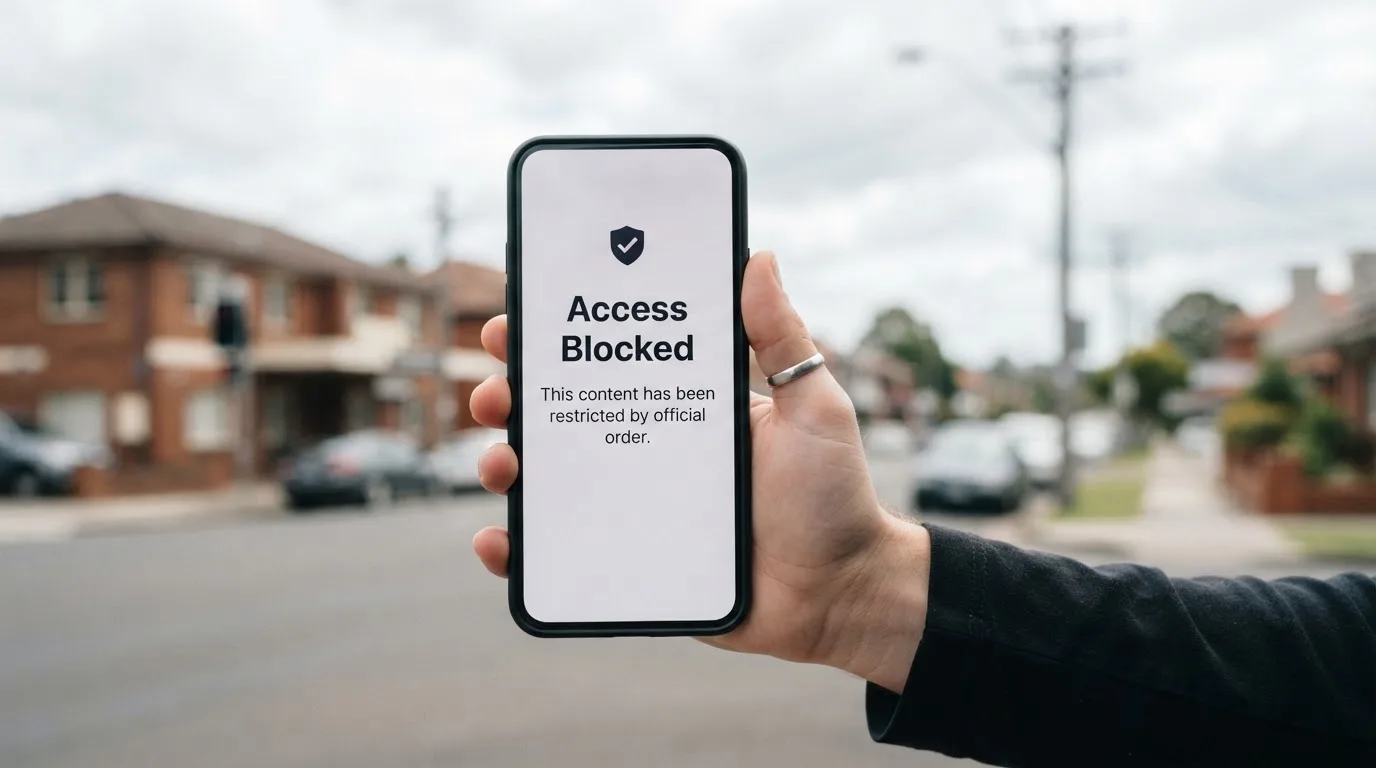
The individual player is not prosecuted. The Act targets the provider: the operator, the platform and the person responsible for the Australian-facing marketing. An offshore operator without an Australian presence is harder to reach than one with a local marketing contact, and the ACMA’s enforcement has accordingly been gradual rather than immediate. Three tools do most of the work.
Formal warnings are the first step in nearly every case. The ACMA names the operating entity, the brand and the URL, and gives the operator a window to stop providing the prohibited service to Australians.
Civil penalty proceedings follow where warnings are ignored. The ACMA can seek penalties up to A$1.56 million per day for individuals and tens of millions for companies.
Blocking requests are the most visible tool. The ACMA asks Australian internet service providers to make the offending site unreachable from Australian IP addresses.
The blocking track has done most of the visible work. As reported in June 2026, the ACMA had directed Australian ISPs to block 1,751 illegal gambling and affiliate-marketing websites since the first blocking request in November 2019, and more than 230 unlicensed services had voluntarily left the Australian market since enforcement was strengthened in 2017. The June 2026 round alone added twelve: 7Signs, ChromaBet, Donbet, Duospin, Freshbet, Slots Gem, Jacks Club, Lucky Start, Pointsbetz, Spinrise, Vinyl Casino and Wildsino.
None of these figures overlap with the warning register. The list above – RocketPlay, Level Up Casino, Woo Casino, Spirit Casino, National Casino, Bizzo Casino, Ignition Casino, Instant Casino, Jackbit, Casino Intense, Sky Crown – is the ACMA’s published-warnings register, not the blocking register. A warning is what the ACMA publishes before it asks ISPs to block. The thirteen blocks above come from a separate report.
The Interactive Gambling Amendment (Gambling Reform) Bill 2026 passed Parliament on 19 August 2026. Its advertising and inducement measures commence 1 January 2027. The reforms tighten what inducements an operator can offer and how an offshore site can market to Australians, but they do not legalise online casino. They take a law already in force and push the marketing end of it harder. On a 2026 read the reforms are law with a start date, not law in force.
The Northern Territory Racing and Wagering Commission sits in an odd position. It regulates 52 of Australia’s online bookmakers – Sportsbet, Bet365 and Ladbrokes included – because those operators took an NT licence for tax reasons. The commission has no full-time staff and meets once a month in Darwin. It is the regulator of the lawful wagering market, not the gatekeeper for online casino; no commission in Australia has that role, because no Australian licence for online casino exists.
The Interactive Gambling Act as amended in 2023 also bans credit cards and credit-related products for use at Australian-licensed online wagering. The same provision constrains gambling use of linked digital wallets like Apple Pay, because the wallet presents a credit-funded card. The ban is the substantive reason an Australian-licensed cashier looks nothing like an offshore cashier page.
Where player safety sits, and where it doesn’t reach
BetStop, the National Self-Exclusion Register, has been live since August 2023. A person registered with BetStop is barred from opening new accounts with Australian-licensed online and phone wagering services, and existing accounts are closed. The register binds Australian-licensed operators. It does not reach an offshore casino, because no offshore casino is connected to BetStop, and registration does not extend a ban to sites outside the Australian licensing perimeter. An Australian who self-excludes and then opens an account at one of the brands above has, by that act, stepped outside every consumer protection the register offers.
The National Gambling Helpline on 1800 858 858 is free, 24/7 and reaches Gambling Help Online chat. Both services are independent of any operator, Australian or otherwise, and both will talk through what an offshore site can and cannot deliver. They do not enrol a person with BetStop – the enrolment is a separate step – but they handle the case where someone at an offshore site wants to stop and finds the offshore site has no mechanism to honour it.
Bank-side gambling blocks are the second line. Westpac refuses authorisation on the merchant code for betting and casino on eligible personal credit and debit cards. ANZ extends the block to digital-wallet transactions backed by an eligible card once the block is on; once enabled, removing the ANZ block requires a 48-hour waiting period. Commonwealth Bank runs a “gambling lock” inside the CommBank app, which automatically blocks most gambling transactions. Each of the three banks publishes the caveat that not every gambling transaction will be blocked and some non-gambling ones may be caught in error.
For Australian readers weighing up offshore options, the practical effect of a bank-side block is that the bank can refuse the deposit at the cashier before any offshore site sees it. The block does not stop a BPAY transfer to a known biller, and it does not stop a direct bank transfer to a BSB and account number, which is why the offshore cashier pages list those routes prominently.
What none of these tools do is reach the balance already on the offshore site. Once a deposit is accepted at an offshore cashier, the consumer-protection framework that an Australian licence would have provided – dispute resolution, account closure on request, withholding of winnings only on terms the operator has registered with an Australian regulator – does not exist. The site will refund on its own terms or not at all, and the operator’s own dispute process is the only process.
The asymmetry is what the cost looks like in plain text. BetStop can close the Australian account in minutes. The same Australian’s offshore balance requires dealing with the offshore operator on its own terms, in its own time zone, with no escalation route beyond the operator’s own customer-service desk. Two operators, two rulebooks, two outcomes.
Cryptocurrency at offshore casinos: what the on-chain view actually shows
Crypto deposits and crypto withdrawals are advertised heavily at the brands further down this read. The marketing positions crypto as faster and more “private” than a bank transfer; both claims need qualifying.
On speed, a Bitcoin or stablecoin transfer on a public chain settles when the network confirms the transaction, which is anywhere from a few minutes to an hour depending on the chain and the fee paid. A PayID or Osko transfer between participating Australian banks clears in under a minute, 24/7, including weekends. Crypto is not faster on a like-for-like basis against the Australian instant-payments stack; it is faster against an international SWIFT wire, which is what an offshore cashier is sometimes compared against in the marketing copy.
On privacy, crypto on a public blockchain is pseudonymous, not anonymous. Every transaction is recorded on a public ledger with the sending and receiving wallet addresses. AUSTRAC’s threshold-transaction-report rule – the rule that requires reporting of transfers of A$10,000 or more – applies to physical cash; ordinary electronic bank transfers are not subject to that per-transaction reporting requirement, regardless of the amount sent. Crypto sits in a separate regime under the Anti-Money Laundering and Counter-Terrorism Financing Act 2006, with AUSTRAC-registered digital currency exchanges required to identify customers and report suspicious matters. The chain analysis a regulator or a tax authority can do is not available to the operator in the same form, but it is available to law enforcement.
What crypto does change, in practice, is the path between an Australian bank and the offshore site. The crypto route replaces the bank-to-bank transfer with a bank-to-exchange transfer, then an exchange-to-wallet transfer, then a wallet-to-casino transfer. Each hop is a point at which AUSTRAC-registered exchanges apply customer identification. The promise of “no bank knows” is false; the bank knows at the on-ramp and the off-ramp, which are the two ends the player cannot avoid. The middle is harder to read.
The credit-card ban that applies to Australian-licensed wagering from 11 June 2024 also covers credit-related products and digital currency. An Australian-licensed operator cannot accept crypto; an Australian player depositing at an Australian-licensed operator will not see a crypto button. An offshore operator faces no such restriction, and the cashier page will typically show BTC, ETH, USDT and sometimes a chain-specific coin alongside the card and bank-transfer routes. That asymmetry is the substantive reason crypto is so prominent in offshore marketing.
The privacy marketing makes one further leap the public record does not support. AUSTRAC’s exchanges apply the same customer identification requirements at the on-ramp and off-ramp, and the chain analysis tools available to regulators work on pseudonymous addresses. “Untraceable” is a marketing word, not a regulatory finding, and the difference matters to anyone who has to explain the source of funds to an Australian tax authority later.
Settlement: how money moves, and how quickly it actually arrives
For an Australian player reading this, the payment question is really two questions stacked: how does the deposit arrive at the offshore cashier, and how does any withdrawal come back to an Australian bank account? The two have different mechanics.
On the deposit side, the routes most commonly offered to Australian-facing affiliates are Visa and Mastercard debit, sometimes American Express, ecoPayz where the cashier lists it, and the operator’s nominated bank-transfer details – usually a BSB and account number, occasionally a PayID, occasionally a crypto address. Apple Pay and Google Pay appear at the cashier to the extent they are backed by an eligible debit card. By the end of 2025, Apple Pay, Google Pay and Samsung Pay transactions collectively accounted for around 45% of all card payments in Australia by number; that figure is for the cards themselves, which is why the wallet-versus-card distinction collapses at the cashier. Apple does not charge consumer fees for using Apple Pay, and the transaction limits and PIN requirements are set by the card issuer or merchant, not by Apple. The relevant practical constraint is still the card.
American Express is interesting here. It runs as a three-party scheme rather than the four-party Visa and Mastercard model – Amex traditionally issues cards and processes transactions itself, having been established as a freight-forwarding company in 1850 and launched its first charge card on 1 October 1958. The Reserve Bank of Australia’s July 2025 review proposes removing surcharges only on eftpos, Mastercard and Visa card transactions, explicitly leaving American Express outside the scope of the proposed surcharge ban. Amex surcharges at an Australian merchant are not the only oddity; an Amex-issued card at an offshore cashier is, like any other card, subject to the bank’s merchant-code block, which catches the betting and casino code.
On the withdrawal side, the operator’s own terms set the processing time. The fastest legitimate Australian-facing withdrawal is a PayID or Osko transfer from the operator’s bank back to the player’s; both clear in under a minute on a participating bank’s end. With Osko, a bank transfer between participating Australian banks arrives in under a minute, 24/7 including weekends, whether it is addressed to a BSB and account number or to a PayID. BPAY runs in business hours and settles next-day for most billers. Card refunds – the operator pushes the winnings back to the original card – run several business days because they sit on the card-network clearing cycle. Crypto sits in the same range as on the deposit side, modulo the exchange-to-bank step on the Australian end.
PayID-based instant transfers are available at over 100 Australian financial institutions, and more than 25 million PayID identifiers had been registered on the New Payments Platform as of April 2025. Paying to a PayID shows the name of the account holder before the transfer is sent – the visible protection that lets the payer confirm who they are paying before authorising the transfer. Australian Payments Plus warns that being asked to transfer to a PayID on an illegal gambling site almost certainly means a scam site. The New Payments Platform became accessible to the public on 13 February 2018 and is owned by New Payments Platform Australia Ltd, a non-profit whose 13 shareholders include the Reserve Bank of Australia and the country’s major banks; participants must keep the platform’s monthly outages to no more than two minutes.
BPAY is the second rail worth knowing on its own terms. It has operated since 1997, is available in the online banking of over 140 banks and financial institutions and is offered by over 95,000 businesses; the payer enters the Biller Code and the Customer Reference Number printed on the bill. BPAY was launched on 18 November 1997 and is owned equally, via parent company Cardlink Services Limited, by Australia’s four major banks: ANZ, Commonwealth Bank, National Australia Bank and Westpac. It is run by Australian Payments Plus, alongside PayID and Osko; in September 2021 the ACCC authorised the merger of BPAY Group, eftpos and NPP Australia under the new holding entity, Australian Payments Plus.
The part the marketing never puts on the front of the page is the verification hold. An offshore operator applying any kind of identity check will, on a first withdrawal, ask for documents: passport, driver’s licence, recent utility bill, sometimes a photo of the card used to deposit. The verification cycle routinely adds 24-72 hours to the first withdrawal and is the most common place the operator’s “fast payouts” promise breaks down. For an Australian player, the practical issue is not the rail – the PayID or the card refund – but the queue at the operator’s verification desk.
Two further points. First, deposits at offshore sites are routinely denominated in the operator’s house currency (USD, EUR, sometimes crypto) and converted at the operator’s rate on deposit and again on withdrawal. The spread is small per transaction but compounds over a session. Second, “instant withdrawal” at the cashier almost always means instant on the operator’s end, not instant on the Australian bank’s end; the bank still has to credit the account, which for Osko is sub-minute but for an international SWIFT wire is one to three business days.
The bank-side gambling blocks intercept a deposit before it reaches the cashier. The verification queue intercepts a withdrawal before it leaves the cashier. Between those two gates, the player is inside the operator’s own rulebook, and no Australian authority is reading over its shoulder.
Brand-by-brand assessment
The eleven operators named in the comparison table are listed because the ACMA itself issued a formal warning over each of them for providing prohibited services to Australians. Each write-up describes what is on the public file, what the ACMA’s warning record shows, and what an Australian player can and cannot recover if anything goes wrong.
RocketPlay: the freshest entry on the register
The March 2026 ACMA warning names Pulsup Ltd as the operating entity behind the Australian-facing Rocketplay. The 2022 cluster warning over Dama N.V. covered Rocketplay alongside five other brands. Two warnings to two operating entities across four years is the brand’s public record with the regulator. The third-party record is thin: Gambling Insider lists Rocketplay as an operating casino, which is the industry-directory entry that “listings-only” in this context means.
For a player at the cashier today, the relevant fact is the recency of the most recent warning and the persistence of the brand across two operating entities in the four years since. RocketPlay’s verification queue, dispute process and withdrawal policy sit outside any Australian framework, and any balance held with the operator on a future blocking date is at the operator’s discretion.
The cost sits at the front edge of the regulator’s current cycle. The brand was warned in March 2026, which puts it ahead of where Woo Casino and Spirit Casino were a year earlier; the block request is the next step on the ACMA’s pattern. A player depositing now is depositing into a brand whose enforcement arc has just begun.
Level Up Casino: part of the most-repeated operating-company cluster
The May 2022 ACMA warning names Dama N.V. as the operator of Level Up Casino, alongside Bambet, Dazard, Rocketplay, Wild Tornado and Cobra Casinos. Dama has since drawn two further ACMA warnings – over Woo Casino in March 2025 and Spirit Casino in May 2025. The third-party record carries Level Up Casino on Westpac’s gambling-block page, which is how an Australian bank identifies the brand in its merchant-code block guidance.
Dama N.V. is the most-repeated operating company in the ACMA’s warning register, and Level Up Casino is one of six Dama brands named in 2022. The cost of dealing with any Dama brand is the cost of dealing with an operator the regulator has told to stop and has told again.
Woo Casino: the warning sits mid-cycle
Dama N.V. drew a second ACMA warning in March 2025, this time naming Woo Casino, separate from the May 2022 cluster. The brand carries no third-party directory listing beyond the ACMA’s own publication; the right-hand column reads em dash for that reason. The casino runs the standard offshore cashier mix – cards, e-wallets, crypto – and the standard verification queue on first withdrawal.
Woo Casino’s situation sits between the regulator’s first and second steps. The warning has been issued for under a year on this 2026 read, no block has yet followed, and no civil penalty has been published. The ACMA’s pattern is to warn first, then progress to civil penalty and blocking where the operator persists. Woo Casino is mid-cycle on that pattern, which is the practical difference between it and a brand that has been blocked.
Spirit Casino: a third warning on a familiar operator
Spirit Casino is the third Dama N.V. brand to land on the ACMA’s warning register, in May 2025. Like Woo Casino, Spirit Casino carries no third-party directory listing beyond the ACMA’s own publication. The brand sits on Dama’s standard operator template.
What makes Spirit Casino worth separating from Woo Casino is the timing. The Dama cluster of 2022 named six brands; Spirit Casino is a 2025 brand that did not exist at the time of that cluster. The ACMA’s pattern on Dama brands – one cluster warning, then individual brand warnings as new ones launch – is itself the substantive signal.
National Casino: regulator-side material names it most often
Consolutetish S.R.L. is the operating entity named in the July 2025 ACMA warning over National Casino, with Bizzo Casino named in the same publication. National Casino carries the strongest third-party record of any brand on the table: ACMA, AUSTRAC and BetStop each name the brand in their respective material.
A “strong” third-party record on this list is not a clean bill of health. Each of those three Australian authorities names National Casino in a context that flags it as a brand operating outside the Australian licensing perimeter, not as a brand they endorse. The names appearing in the regulator’s material mean the brand is on the regulator’s radar; they do not mean the regulator considers it safe.
For an Australian player the result is the same as for any other brand on the list: no Australian licence, no Australian recourse, the operator’s own rules apply. The extra signal is that the regulator and the self-exclusion register have already taken the trouble to name the brand in their own material – a fact that says more about the operator’s persistence than about any change in its legal status.
Bizzo Casino: warned twice across two operators
Bizzo Casino sits on the ACMA’s register with two warnings: 2022 to TechSolutions (CY) Group Limited and TechSolutions Group N.V., and 2025 to Consolutetish S.R.L. Gambling Insider lists Bizzo Casino as an operating casino. Two warnings to two operating entities, four years apart.
The repeated-warning pattern is the relevant fact. A 2022 warning that produced a 2022 site exit, followed by a 2025 warning over a different operating entity, is the pattern that argues against reading any individual brand name as the operator’s final answer. The operator’s marketing strategy on this brand has been to move the brand across two corporate vehicles across four years. The player at the cashier pays for that continuity in the form of regulatory exposure that the marketing page does not describe.
Ignition Casino: the lightest third-party record
The July 2025 ACMA warning names Bamboo Media as the operator of Ignition Casino. The brand surfaces through affiliate aggregators rather than its own Australian-facing address. The third-party record carries no listings beyond the ACMA’s own publication.
Ignition Casino’s profile is the lighter side of the table: one warning to one operating entity, no Australian-facing address on record, no payments-service directory listing. The lighter record is not the same as a clean one. The absence of a directory listing says only that ecoPayz, PayID and Gambling Insider have not included the brand in the lists consulted, not that the brand is operating outside the ACMA’s record. It is, in fact, on that record.
Instant Casino: the only brand a payments service names directly
The February 2025 ACMA warning names EOD Code SRL as the operator of Instant Casino. Instant Casino is the one row on the list where a payments-service directory directly names the brand: ecoPayz and PayID each list Instant Casino as accepting their services.
The asymmetry of Instant Casino’s payment-method record is informative. The brand is reachable through PayID, which is also the rail through which a bank gambling block can refuse the deposit. An Australian player’s experience of Instant Casino at the cashier is shaped by the bank’s merchant-code block as much as by the operator’s page. Whether the deposit clears is, in practice, decided before the operator sees it. That is the meaningful payment-method fact for an Australian player at this brand, and it is the inverse of what the marketing copy implies.
Jackbit: a cashier built to bypass card-level blocks
Ryker B.V. drew the April 2026 ACMA warning over Jackbit, alongside CasinOK. Jackbit sits in the crypto-heavy corner of the offshore market: BTC, ETH and stablecoins at the cashier rather than cards and bank transfers. The third-party record carries no listings beyond the ACMA’s own publication.
The crypto-led cashier is the relevant detail. A bank-side gambling block works at the card-merchant-code level; a crypto deposit does not pass through a card. Jackbit is, on this read, the brand least reachable through the Australian banking protections the regulator and the banks have wired up. The lack of an Australian-facing banking relationship on the operator’s side is mirrored by the lack of a card-merchant-code anchor on the player’s side. That is not a recommendation; it is a description of where the bank-level protection does not reach.
Casino Intense: the most Australian-context name-recognition
Sterplay Holding Ltd drew the April 2025 ACMA warning over Casino Intense. AUSTRAC, BetStop and Gambling Insider each name the brand in their respective material. Casino Intense runs the standard offshore cashier and the standard verification queue on first withdrawal.
Casino Intense is, on the third-party record, the brand most often named in the Australian regulator and self-exclusion register material – the same regulators whose remit excludes offshore casinos. That is the substance of the “stronger” third-party record: more Australian-context mentions, none of them endorsements. The fact that Australian authorities take the trouble to name the brand is the warning, not the reassurance.
Sky Crown: the oldest warning still on the register
The ACMA’s “Formal Warning – Hollycorn N.V. (Sky Crown and Blue Leo)” dates to September 2022 and remains on the register. The Hollycorn entity also operates Blue Leo, named in the same publication. The third-party record carries no listings beyond the ACMA’s own publication.
Sky Crown is the oldest warning on the read by publication date. Whether the warning is also current is a different question; the ACMA’s register carries warnings as published, and a brand from 2022 may have changed hands or stopped Australian-facing activity since. What remains on the public file is that Hollycorn was warned over Sky Crown and Blue Leo in 2022. A player at the cashier today would need to assume the warning is current unless they had evidence otherwise.
How fast the blocklist has grown
From the first blocking request in November 2019 to the June 2026 reporting round, the ACMA directed Australian ISPs to block 1,751 illegal gambling and affiliate-marketing websites. Spread across roughly eighty months, that cumulative volume runs at twenty to twenty-five sites per month, or about two hundred and forty to three hundred per year.
The figure carries two conditions. It is cumulative rather than concurrent, so some sites on the list have since had the block lifted or have stopped Australian-facing activity. And it includes affiliate pages that redirected users to prohibited services, not only the casino sites themselves; stripping those out would lower the per-site count further. The band, with those conditions stated, is the rate at which the ACMA’s pipeline has run.
The practical reading is that the ACMA’s pipeline runs faster than any single operator’s launch cycle. A brand entering the Australian-facing market today sits on a warning within months and on a block within the year, on the regulator’s pattern. For a player choosing where to deposit, that horizon is the relevant one: the site reachable today is the site the regulator has either not yet reached or has chosen to warn rather than block.
The 1,751 figure also understates the volume. It is the blocking count; the warning register, which is the source of the brands on the comparison table, runs in parallel. The two tracks reinforce each other rather than substitute. The next round reported may add another dozen blocks and a fresh warning or two, and the brand that today sits in front of an Australian player may, on that timeline, be one of them.
Frequently asked questions
What payment methods do offshore casinos commonly list at the cashier for Australians?
The standard mix at an offshore cashier targeting Australians is Visa and Mastercard debit, sometimes American Express, e-wallets like ecoPayz where the brand has the integration, the operator’s nominated bank-transfer details – usually a BSB and account number, occasionally a PayID – and a crypto button covering BTC, ETH and a stablecoin. Apple Pay and Google Pay appear where the cashier supports them. The presence of any of these methods at the cashier is not, by itself, a sign of legitimacy; the Australian-licensed market accepts only some of them.
How does an Osko transfer compare with a card payment on speed?
Osko, run by Australian Payments Plus, clears a participating-bank-to-participating-bank transfer in under a minute, 24/7 including weekends, whether addressed to a BSB and account number or a PayID. A card payment at an offshore cashier clears on the card-network’s batch cycle – effectively real-time on Visa and Mastercard rails for the authorisation, but the settlement into the operator’s account runs separately. For an Australian player, the visible difference is on the deposit: Osko arrives at the operator in the same minute the player confirms; a card authorisation arrives in seconds but the operator’s balance may not credit instantly.
Is it legal for an online casino to process payments from a player in Australia?
No. Under the Interactive Gambling Act 2001 as amended in 2017, providing a prohibited interactive gambling service to a person in Australia is an offence. Online casino games, online pokies and in-play betting are prohibited services. The Act targets the provider, not the player. The consequence for the player is practical rather than legal: no Australian consumer protection, no complaints body, no recourse if a withdrawal is refused.
Are cryptocurrency payments harder to trace than a bank transfer?
On a public blockchain, every transaction is recorded with the sending and receiving wallet addresses. Crypto is pseudonymous rather than anonymous. AUSTRAC-registered digital currency exchanges apply customer identification at the on-ramp and the off-ramp, which are the two ends an Australian player cannot avoid. Chain analysis tools available to law enforcement are not available to ordinary counterparties, but they are available to regulators. The crypto route replaces a single bank-to-bank transfer with three hops, each of which is a point at which AUSTRAC’s identification rules apply.
Does PayID offer any extra protection compared with a BSB and account number?
PayID displays the name of the account holder before the transfer is sent. That is the visible protection: it lets the payer confirm who they are paying before authorising the transfer. Australian Payments Plus warns that being asked to transfer to a PayID on an illegal gambling site almost certainly means a scam site. Beyond the name check, PayID runs the same instant-payments rail as Osko – sub-minute settlement, 24/7, on participating banks. Bank-side gambling blocks still apply at merchant-code level if the PayID resolves to a merchant the bank has flagged.
Published by the Crypto Casino Hub AU team.