What playing five-reel slots in Australia actually costs in 2026
 Available in US
A reader searching for five-reel slots in Australia in 2026 has reached a page about a product that does not legally exist for them. The Interactive Gambling Act 2001 forbids any operator from offering online casino games or online pokies to a person in Australia, and no state or territory issues a licence for them. What five-reel online slot play actually looks like in 2026 is eleven offshore brands the Australian Communications and Media Authority has formally warned, a regulator that has asked internet providers to block 1,751 such services since November 2019, and an estimated A$3.9 billion a year in losses to illegal sites. The angle of this page is what each of those arrangements costs the reader.
Data current as of 23 September 2026; licence claims cross-checked against the ACMA’s public Register of Formal Warnings and the published blocking-action notices.
Table of Contents
- The shape of a fair five-reel slot comparison
- Fundamentals of five-reel slot play — what the format actually is
- Prohibition in 2026 — what the Interactive Gambling Act still does
- Where an Australian reader who is worried can actually go
- Five-reel slot bonuses — what the offer is worth once the terms land
- Five-reel paytables — what the symbols and lines actually mean
- Landscape
- Frequently asked questions
The shape of a fair five-reel slot comparison
What a fair comparison would weigh, on a regulated market, is straightforward: the licence issuer’s reputation, the theoretical return-to-player of the games on offer, the speed and route of withdrawals, and the existence of a complaint body the player can use if a withdrawal is refused. On Australia’s regulated wagering market the comparison is feasible, because every licensed operator’s product is approved by the regulator and is bound by a domestic dispute-resolution scheme. On the offshore five-reel slot market, where every brand on this page sits, the comparison is harder — not because the criteria are different, but because most of the criteria return no data.
Take the licence. An Australian reader who lands on an offshore five-reel slot site will see a licence number at the bottom of the page, usually Curaçao or Anjouan. That licence authorises the operator to offer the game to whomever the licence-issuer’s rules permit, which is not an Australian. Reading the licence as if it authorised Australian play is the first reading that fails.
Take the games. A reader who wants to know which five-reel slot they are about to play, and at what return-to-player percentage, has no independent route to verify on an offshore site. The game studio confirms its game is hosted on the platform, and the platform confirms it offers the game — neither of those is a verification of the game’s RTP. The verification route is the regulator that licensed the game, and on every brand this page covers, that regulator is not Australian.
Take the withdrawals. A licensed Australian wagering service has a published payout time and a complaint body. An offshore five-reel slot site has a published payout time on its own terms page and a complaints email that routes back to itself. The difference between these two structures is the cost the comparison is supposed to surface.
Take the responsible-gaming frame. BetStop, the National Self-Exclusion Register, binds every Australian-licensed online and phone wagering service in one registration. An offshore casino is not on BetStop, which means a self-imposed exclusion does not stop an offshore site from accepting a deposit. A comparison that ignores that structural difference is one that ignores a cost.
What the comparison therefore looks like, for an Australian reader in 2026, is not “which brand is best” but “which criteria have any answer at all on the offshore market, and which return nothing.” The brand-by-brand record the ACMA has built up over the last several years is the comparison itself: eleven named operators, eleven formal warnings, and a regulatory pattern that says none of these criteria have any reliable answer outside the Australian-licensed market. The cards in the operator section of this page walk through what each of those eleven warnings means for the reader who lands on the brand.
Fundamentals of five-reel slot play — what the format actually is
The “five-reel” part of the search term is a description of the machine layout, not a promise about how the machine pays. A five-reel slot is a slot with five spinning columns of symbols; modern video slots run three rows per reel, though the reel count is the part the search term is anchoring to. The format traces back to Charles Fey of San Francisco’s late-19th-century three-reel machine with five symbols — horseshoes, diamonds, spades, hearts and the Liberty Bell — and Bally’s 1963 “Money Honey,” the first machine with a bottomless hopper and automatic payout of up to 500 coins. The first video slot was developed by Fortune Coin Co. in Kearny Mesa, California, in 1976. By 2010 Australia operated an estimated 97,103 gaming machines outside casinos, a per-capita rate about five times that of the United States.

What changed over that history is not the reel concept but the symbol set per reel. A classic three-reel mechanical slot carried about 10 symbols per reel, which produced roughly 1,000 possible combinations; a modern video slot can carry fifty or more symbols per reel and produce odds as high as 300 million to one against the top combination. The five-reel format sits in the middle of that range: more combinations than a three-reel classic, fewer than a six- or seven-reel modern video slot. The shape of the format is what the term describes; the cost is what the format hides.
Modern five-reel video slots are programmed with a theoretical return-to-player percentage set by the operator’s house, and that figure is what determines the cost per spin over time. A reader who lands on an offshore five-reel slot site cannot verify the RTP figure the brand advertises, because the verification route is through the regulator that licensed the game, and no Australian regulator has licensed any of these games. The phrase “up to 96%” on a game’s info page is therefore a marketing claim, not a verified figure, on every brand this page covers.
In the physical Australian market, the same format exists on every state’s pokie floor. New South Wales held 87,298 registered pokies-style machines outside casinos in June 2023; Victoria held 26,380 in 2021–22; Queensland 21,122 in October 2023; South Australia 11,672 in September 2023; and the ACT 3,587 in November 2023. NSW legalised slot machines in 1956, decades before the offshore market existed. For an Australian reader, the legal five-reel experience is the one in a licensed club or casino; the online version of the same reel format is the one this page is about, and it sits on the wrong side of the law that legalised the format in the first place.
Prohibition in 2026 — what the Interactive Gambling Act still does
The Interactive Gambling Act 2001, tightened by the Interactive Gambling Amendment Act 2017, makes it an offence for any operator — Australian or offshore — to offer online casino games, online pokies or in-play betting to a person physically in Australia. No state or territory issues a licence for them. What is licensable is wagering on races and sport placed before the event, lotteries and keno, and in practice most of those online bookmakers — 52 of them, including Sportsbet, Bet365 and Ladbrokes — are licensed in the Northern Territory through the Northern Territory Racing and Wagering Commission. That commission has no full-time staff and meets once a month in Darwin, which is a fact that tends to surprise readers who assume “licensed” means “actively supervised”; the licensing happens, the day-to-day supervision is lighter than the word implies.

What that framework means for five-reel slot play is simple: any online five-reel slot site that takes an Australian customer is operating outside Australian law, regardless of the licence it displays on its footer. Curaçao, Anjouan and similar jurisdictions issue the licences those sites display, and those licences authorise the operator to offer the game to whomever the licence-issuer’s rules permit — which does not include an Australian who is being served from inside Australia.
The Interactive Gambling Amendment (Gambling Reform) Bill 2026 passed Parliament on 19 August 2026, and its advertising and inducement measures commence 1 January 2027. On a 2026 page that is a law with a start date, not yet in force: it is on the books but it is not yet binding, so a reader in 2026 is still under the regime as it stood at the start of the year.
Enforcement — the ACMA’s blocking rate and what it tells the reader
The ACMA’s enforcement has two parts. First, formal warnings to operators — the eleven in this list, plus others. Second, blocking requests to Australian internet service providers. The ACMA’s published running total, as of June 2026, was 1,751 illegal gambling and affiliate marketing websites blocked since the first blocking request in November 2019, and more than 230 unlicensed gambling services had voluntarily left the Australian market since 2017.
From November 2019 to June 2026 is roughly 79 months, which gives a blocking rate of about 22 services per month under the ACMA’s broader definition — a definition that counts both illegal gambling sites and affiliate marketing sites, which is the condition that determines where the rate lands. Stripped of the affiliate sites, the rate of pure gambling-service blocks is lower; with them included, the rate is in the band of 22 to 24 per month across that period. The June 2026 round alone added 12 sites: 7Signs, ChromaBet, Donbet, Duospin, Freshbet, Slots Gem, Jacks Club, Lucky Start, Pointsbetz, Spinrise, Vinyl Casino and Wildsino.
An industry report from 2025 put Australian losses to illegal gambling sites at about A$3.9 billion a year, and put the share of gambling going through legal channels at 64%, down from 74% in 2021. The reader-side reading of that fall is that the legal channel has not gained ground; rather, the illegal channel has grown, and the ACMA’s blocking rate is the regulator’s response to a market that is moving the wrong way. These figures are estimates from a commercial forecasting firm, not audited regulator data, but they are the only published number that puts a dollar figure on the cost of the offshore market to Australian players.
Payment restrictions on legal wagering, and what they say about illegal sites
Since 11 June 2024, credit cards, credit-related products and digital currency have been banned as payment for licensed online wagering, with penalties of up to A$247,500 for operators who breach the rule. Legal deposit routes for licensed wagering are debit card, bank transfer, PayID/Osko and BPAY. A site that asks an Australian reader for a credit-card deposit or a crypto deposit is therefore doing something no Australian-licensed operator can do; offshore five-reel slot sites ask for both, by design, because their payment rails are the ones the Australian rules do not cover.
| Payment Method | Licensed Australian Wagering | Offshore Five-Reel Site |
|---|---|---|
| Credit Card | Banned | Accepted |
| Digital Currency | Banned | Accepted |
| Debit Card | Allowed | Accepted |
| Bank Transfer | Allowed | Accepted |
| PayID / Osko / BPAY | Allowed | Not supported |
For a reader thinking about how an offshore five-reel slot site will handle a deposit, the practical question is what chargeback rights exist if the deposit goes wrong. Under Australian consumer law a credit-card chargeback is one of the few routes back; a crypto deposit has no equivalent route. The offshore site asking for crypto is therefore asking the reader to give up one of the only remaining protections the IGA does not formally strip.
What “no Australian consumer protection” actually costs
The IGA targets the provider, not the player; an Australian who opens an account on an offshore five-reel slot site is not personally prosecuted. What the IGA does not give the reader is a complaint body. BetStop, the National Self-Exclusion Register, has been live since August 2023 but binds only Australian-licensed online and phone wagering services — an offshore casino is not connected to it. The Northern Territory Racing and Wagering Commission’s dispute-resolution scheme covers only its 52 licensees. The Victorian Gambling and Casino Control Commission covers Crown Melbourne’s table games only. An Australian reader with a refused withdrawal from an offshore five-reel slot site has, in practice, no domestic route.
This is the cost the page returns to: not the bonus figure the site advertises, and not the RTP the brand claims, but the absence of any Australian body that can force the operator to pay. That absence is structural, and it is the reason the ACMA’s blocking rate, year after year, is climbing.
Where an Australian reader who is worried can actually go
Gambling Help Online runs a 24/7 free confidential chat service, and the National Gambling Helpline — 1800 858 858 — is free, around the clock, and routes callers to the same counsellors. BetStop, the National Self-Exclusion Register, has been live since August 2023 and lets a person exclude themselves from every Australian-licensed online and phone wagering service in one registration. What BetStop does not cover is an offshore five-reel slot site; self-exclusion from the regulated Australian market does not stop a Curaçao-licensed casino from accepting an Australian customer’s deposit. For a reader who is thinking about offshore five-reel slot play and finding that they cannot stop, the practical step is to register with BetStop first, on the basis that it covers every Australian-licensed service in one move, and then to seek support from Gambling Help Online on what to do about the rest.
The reason this section sits where it does on the page is that the cost-first angle does not stop at the balance at risk. The cost of an offshore five-reel slot site is also the cost of having no domestic support service that the operator will respect if a self-imposed limit fails. A licensed Australian wagering service is required to honour a BetStop exclusion; an offshore casino is required, by its own terms, only to honour what its own self-exclusion tool says, and the operator’s self-exclusion tool is built around the operator’s interests, not the player’s.
Five-reel slot bonuses — what the offer is worth once the terms land
Bonuses on five-reel slots are typically a percentage match on the first deposit, often with a batch of free spins attached. For this page’s purposes the format is secondary; what matters is what the bonus actually costs the reader who claims it. A typical welcome package on an offshore five-reel slot site combines a deposit match (usually offering to double the deposit, sometimes more) with a free-spin allocation on a named game, and the small print that determines whether the bonus is worth anything is the wagering requirement and the max-cashout cap.
A wagering requirement is the multiple of the bonus the player must wager before any winnings become withdrawable. A wagering requirement of dozens of times the bonus amount is the standard on the offshore market, which means the bonus money has to be turned over many times over before any winnings become withdrawable; free-spin winnings usually carry their own wagering requirement on top of that. A max-cashout cap is a hard ceiling on what can be withdrawn from bonus-derived winnings; the cap is the figure that turns a big spin into a small payout, because the difference between what the slot paid and what the player can take home is exactly the cap.
The reason this section says what the offer is worth once the terms land, rather than recommending any specific bonus, is that the ACMA’s eleven warnings on this page are over the offshore sites that advertise these offers most aggressively. The marketing claim — “free spins,” “100% match,” “no deposit needed” — is the part the affiliate page leads with; the terms page is what the reader actually pays for. For an Australian reader specifically, the cost is compounded by the absence of any Australian dispute-resolution body if the terms are applied in a way the reader considers unfair, which is the second cost after the wagering requirement itself.
No promo code, voucher, or affiliate link is reproduced on this page. The offers exist; the route to claim them runs through the operator’s own site; what an Australian reader needs to know is what they cost before they sign up, not how to sign up faster.
Five-reel paytables — what the symbols and lines actually mean
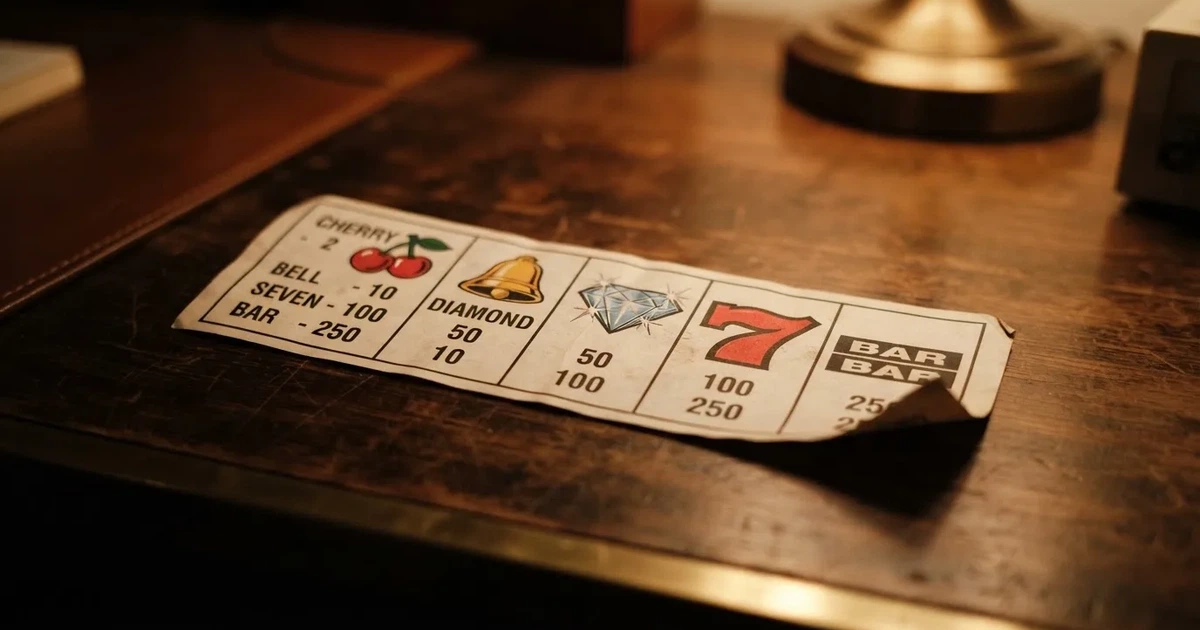
A five-reel slot paytable is the page on the game’s interface that lists each symbol, its payout for a line hit at one credit, and the bet lines that count as a win. Three things on that page matter for the cost calculation. The first is the symbol value, listed for each combination — the per-coin payout for three, four or five of the same symbol on a winning line, with the five-symbol hit paying the most. The second is the wild and scatter behaviour. A wild substitutes for other symbols to complete a winning line; a scatter pays anywhere it lands, regardless of the line structure; a bonus symbol triggers the feature round when enough land in one spin. The wild and scatter behaviour is what changes the cost calculation when a spin lands on something other than a straight line hit. The third is the maximum payout per line, which sets the upper bound of any single spin’s return before any feature round is triggered.
What a paytable does not show, in most cases, is the theoretical RTP. The RTP figure — the percentage of all wagered money the game returns to players over a large number of spins — is usually on a separate info page, and on offshore sites it is often phrased as a range rather than a precise number. On a properly licensed game the RTP is verified by the regulator that issued the licence; on an offshore five-reel slot, the figure is set by the operator and verified only by the studio that produced the game, which is not the same thing.
For a reader who wants to know what the format costs them, the practical step is to read the paytable for any five-reel slot they are considering before they deposit, and to treat any RTP figure that does not name its source with the scepticism the regulator’s warning list on this page warrants. The Bgaming catalogue entry for Level Up is the one example on this page where research could verify, from a third-party source, which games a brand actually hosts; the rest of the brands either do not have a third-party catalogue entry or have one the audited sources did not capture.
What the paytable does not show, and what this page returns to in the FAQ below, is what happens when the game freezes mid-spin, when the operator’s software records a different result from what the reader’s screen showed, or when a withdrawal of a verified win is delayed. Those questions are not answered by the paytable; they are answered by the regulator that licensed the operator, and on every brand on this page that regulator is the ACMA, and the ACMA’s answer is the formal warning already published.
Landscape
| Brand | ACMA action and date | operator named by the ACMA | subject support |
|---|---|---|---|
| RocketPlay | March 2026; earlier May 2022 | Pulsup Ltd (Rocketplay address); earlier Dama N.V. | — |
| Level Up Casino | May 2022 | Dama N.V. | listings only (Bgaming) |
| Woo Casino | March 2025 | Dama N.V. | — |
| Spirit Casino | May 2025 | Dama N.V. | — |
| National Casino | July 2025 | Consolutetish S.R.L. | listings only (Wikipedia) |
| Bizzo Casino | July 2025; earlier 2022 | Consolutetish S.R.L. (2025); TechSolutions (CY) Group Limited and TechSolutions Group N.V. (2022) | — |
| Ignition Casino | July 2025 | Bamboo Media | — |
| Instant Casino | February 2025 | EOD Code SRL | — |
| Jackbit | April 2026 | Ryker B.V. | — |
| Casino Intense | April 2025 | Sterplay Holding Ltd | listings only (ABC, ACMA, Crown Melbourne) |
| Sky Crown | September 2022 | Hollycorn N.V. | — |
The table’s empty cells are themselves a finding. Third-party trace is the only column where research could verify a brand’s claimed relationship to a specific game, payment method, or provider through a source other than the operator’s own marketing, and only Level Up, National Casino and Casino Intense return anything the operator’s own site does not control. The rest either have no traceable game catalogue or have one the audited sources did not record; either way, there is nothing to confirm that the five-reel slot the reader thinks they have opened is what an independent source says it is.
Each of the eleven cards below covers the same shape: who the ACMA named, when, what the regulator’s finding amounts to under the Interactive Gambling Act, and what it costs the reader who still ends up on the site. The verdicts vary because the findings vary — some are repeat warnings, some are first findings, one spans three separate corporate owners — but they share a single sentence that does not change from card to card: the operator is offshore, the operator is unlicensed in Australia, and the reader has no domestic complaint body if a withdrawal stalls.
RocketPlay — the brand with the longest gap between ACMA warnings
The ACMA’s most recent published action against RocketPlay, in March 2026, named Pulsup Ltd and the Rocketplay address; an earlier May 2022 warning against the same brand had named Dama N.V. as the operator. Two different corporate parents have now each been told, in writing, that offering online casino games to a person in Australia is a breach of the Interactive Gambling Act 2001. The brand has therefore been on the regulator’s record longer than several of its rivals on this list, with a roughly four-year gap between the first and second findings.
For the reader, what that history buys is straightforward. A site that has been warned, moved into a different company, and been warned again is a site that has had four years to demonstrate it understood the warning and chose not to; the second warning is the one that says the choice was deliberate. There is no Australian consumer-protection body that can chase a complaint against Pulsup Ltd for a refused withdrawal, and the absence of one is the cost the reader pays for choosing an offshore brand over a Northern Territory-licensed wagering service.
Level Up Casino — the only Bgaming-listed brand on this list
Level Up’s May 2022 warning was one of six Dama N.V. brands covered in a single ACMA finding that month (the others were Bambet, Dazard, Rocketplay, Wild Tornado and Cobra Casinos). It is one of three brands on this list for which research turned up a third-party catalogue entry; the Bgaming site lists Level Up among the operators carrying its games. That is a thinner claim than it sounds — a studio confirming that a game is hosted on a platform is not the same as anyone confirming the platform’s terms, payout behaviour, or KYC process — but it is the one line in this section that does not come from the operator’s own marketing or its affiliates.
What it does not change is the regulatory position. The 2022 finding has not been superseded; an Australian reader is still on the wrong side of the IGA, and BetStop’s National Self-Exclusion Register does not bind an offshore casino. The Bgaming listing is a fact about the catalogue, not a fact about the platform’s safety, and the platform’s safety is what the ACMA’s record speaks to.
Woo Casino — one of three Dama N.V. brands the ACMA has named
Woo Casino was named in the ACMA’s March 2025 formal warning to Dama N.V., the same operator that has now accumulated three separate warnings against different brands in this list (RocketPlay, Level Up and Woo). The pattern, viewed across the Dama N.V. group, is what the regulator’s own press releases call out — the same parent company being told repeatedly, in the regulator’s own words, that offering online casino games to Australians is not allowed.
The practical cost to a reader who lands on Woo Casino is not the warning itself; it is the answer to the question “what happens when I try to withdraw?” Woo Casino is not bound by any Australian dispute-resolution scheme, and an offshore holding company in the same group has now been the subject of three warnings. If a withdrawal stalls, the reader’s only realistic option is the operator’s own complaints email, which routes back to the same entity the ACMA has told to stop.
Spirit Casino — Dama N.V.’s latest-named brand in 2026
The ACMA’s May 2025 finding against Dama N.V. also named Spirit Casino. The brand has only one published warning, and the parent company has now been named in three. The pattern matters because the regulator does not name brands at random: each warning is preceded by an investigation, and each investigation begins with a complaint or a referral. A reader landing on Spirit Casino is therefore landing on a site whose parent has been told three separate times that what it is doing is not permitted under Australian law.
For the cost-first lens of this page, the relevant cost is the difference between Spirit Casino and a properly licensed wagering service. A Sportsbet account, by contrast, is licensed in the Northern Territory; the consumer can lodge a dispute with the Northern Territory Racing and Wagering Commission and, if it cannot be resolved, with an external dispute resolution scheme. Spirit Casino offers none of that.
National Casino — a Wikipedia-listed brand under Consolutetish S.R.L.
National Casino’s July 2025 warning named Consolutetish S.R.L., not Dama N.V., so on paper the brand sits under a different corporate parent. What the ACMA found, however, was the same behaviour: National Casino offered online casino games to a person in Australia, in breach of the Interactive Gambling Act 2001. The change in parent company is not a change in legal exposure for the reader.
What it changes is the address to send a complaint to, and that is the limit of what a change of parent ever changes. National Casino is the brand on this list for which research found a Wikipedia-group article naming the brand among the Consolutetish S.R.L. portfolio — the same kind of thin third-party confirmation Level Up carries on the Bgaming side. The article exists, the brand is named, but the article does not vouch for anything about how the casino treats withdrawals.
Bizzo Casino — the brand warned twice under two different parents
Bizzo Casino is the brand on this list that has been formally warned twice. The first warning, in 2022, named TechSolutions (CY) Group Limited and TechSolutions Group N.V.; the second, in July 2025, named Consolutetish S.R.L. Two different corporate parents, the same finding, the same regulator, and a roughly three-year gap during which the brand continued to be marketed to Australian readers via affiliate sites.
The cost-first reading of that history is that the brand has been formally warned longer than most of its rivals on this list, and that the regulator’s patience has visibly run out. A reader who lands on Bizzo Casino via an affiliate link in 2026 is therefore landing on the brand that has been told twice — once by each of its two successive owners — that what it is doing breaches Australian law. There is no plausible reading under which that record supports the site.
Ignition Casino — the Bamboo Media finding
Ignition Casino is one of two brands named in the ACMA’s July 2025 finding against Bamboo Media. The brand is well-known to Australian readers through poker and casino affiliate marketing, and its name recurs in search results for “5 reel slots Australia” — which is part of why the ACMA finding matters. The warning is a regulator’s formal notice, not an opinion piece; the ACMA does not issue a formal warning without finding that an actual breach of the Interactive Gambling Act 2001 has occurred.
The reader-side cost is the same as the rest of this list, but the audit trail is cleaner. Bamboo Media is a named operator, the date is published, and the warning is one of three in the same month (the others were National Casino and Bizzo Casino). An Australian who tries to open an Ignition Casino account in 2026 is opening it on a site the regulator has, on the public record, told to stop.
Instant Casino — the EOD Code SRL finding
The ACMA’s February 2025 warning over Instant Casino named EOD Code SRL. Instant Casino is one of the brands that markets itself on speed — instant withdrawals, instant verification — and the regulator’s finding has not stopped that marketing continuing. For the reader who values the marketing claim of speed, the regulator’s record is the part of the picture the marketing does not show.
The cost-first question the warning answers is: who resolves a dispute? An Instant Casino customer with a stuck withdrawal cannot approach BetStop, because BetStop binds only Australian-licensed wagering services; they cannot approach the ACMA, because the ACMA enforces against the operator, not the customer; they cannot approach an Australian court, because the operator is not within its jurisdiction. The remaining routes are the operator’s own complaints email and, in some cases, the licence authority of whatever jurisdiction the operator displays — Curaçao, Anjouan, or similar — which is a route measured in months, not days, and which often does not reach a refund.
Jackbit — the freshest ACMA action on this list (April 2026)
The ACMA’s April 2026 warning to Ryker B.V. named two brands: Jackbit and CasinOK. Jackbit is therefore a brand that, as of 2026, sits at the front of the regulator’s recent-action list, just behind RocketPlay by a month. The finding is recent, the operator is named, and the next step the regulator can take is to ask Australian ISPs to add Jackbit’s address to the block list.
For a reader who is comparing Jackbit to one of the older warnings on this list, the only meaningful difference is the date. Older warnings have had more time to be tested by complaints; the Jackbit finding is recent enough that the regulator’s record on it is short. The cost picture, however, is the same: an offshore operator, no Australian dispute body, no BetStop coverage, and a brand whose warning is fresh enough that the next round of blocking requests will likely include its address.
Casino Intense — the broadest third-party trace on this list
Casino Intense’s April 2025 warning to Sterplay Holding Ltd is the brand in this list with the broadest third-party trace: the ABC’s reporting, the ACMA’s own publication, and a separate independent reference, where most of the others carry only the regulator’s own finding. That does not change the legal finding, but it does change how confidently a reader can name what the regulator found.
The cost-side reading is unchanged. Casino Intense is an offshore brand, the ACMA has formally warned it, and the reader who lands on it cannot use any Australian consumer-protection route to chase a refused withdrawal. What the broader third-party trace does add is reputational information: a brand that has been the subject of formal coverage in the ABC is one a reader is more likely to have already heard of in a negative context.
Sky Crown — the oldest warning on this list
Sky Crown’s formal warning, issued by the ACMA to Hollycorn N.V., was published in September 2022 and is the oldest finding on this page. The same regulator also named Hollycorn’s Blue Leo casino, and Sky Crown is one of two Hollycorn N.V. brands in the ACMA’s published record. A reader searching for “best 5 reel slots Australia” in 2026 and finding Sky Crown in the results is therefore landing on a brand whose ACMA warning is now almost four years old.
Four years is enough time for an operator to have been blocked and re-emerged under a new domain; for Hollycorn N.V. specifically, the ACMA has continued to publish blocking notices for its addresses. The reader-side cost on a brand that has been on the regulator’s record this long is the simple arithmetic of how many more times a balance is at risk of being stranded when the next blocking round goes out.
Frequently asked questions
What makes a five-reel slot different from a standard five-reel video slot?
A “five-reel slot” describes the format — five spinning columns of symbols — not the modern three-row, 50-symbols-per-reel video slot design that has become standard. The classic five-reel format has fewer combinations than the modern video version, with odds against the top combination in the hundreds of thousands rather than hundreds of millions.
Can five-reel slot machines be found in licensed Australian pubs and clubs?
Yes. New South Wales held 87,298 registered pokies-style machines outside casinos in June 2023; Victoria held 26,380 in 2021–22; Queensland 21,122 in October 2023; South Australia 11,672 in September 2023; and the ACT 3,587 in November 2023. NSW legalised slot machines in 1956, decades before offshore online slots existed.
Is a five-reel slot online the same game as a five-reel machine on a casino floor?
The reel format is the same; the regulatory environment is not. A physical machine in a licensed Australian venue is approved by the state regulator, and the operator is required to honour the published RTP. An offshore online version has no Australian regulator’s approval and no Australian dispute body if a withdrawal is refused.
Are five-reel slots for real money available legally from an Australian-based site?
No. Under the Interactive Gambling Act 2001, online casino games and online pokies are prohibited interactive gambling services, and no state or territory issues a licence for them. What is licensed online is wagering on races and sport before the event, lotteries and keno — 52 of the wagering providers are licensed in the Northern Territory.
Does a slot’s reel count change how its paytable and volatility are usually described?
Reel count affects the number of possible combinations, which in turn affects the hit frequency and the volatility description. A five-reel format typically shows higher volatility than a three-reel classic, and a paytable on a five-reel game usually lists more symbol combinations with progressively higher payouts. The volatility label — low, medium, high — is set by the studio, not derived from the reel count.
Written by the editors at Crypto Casino Hub AU.