
Plinko casino Australia: what the drop actually costs, and why the ACMA keeps naming names
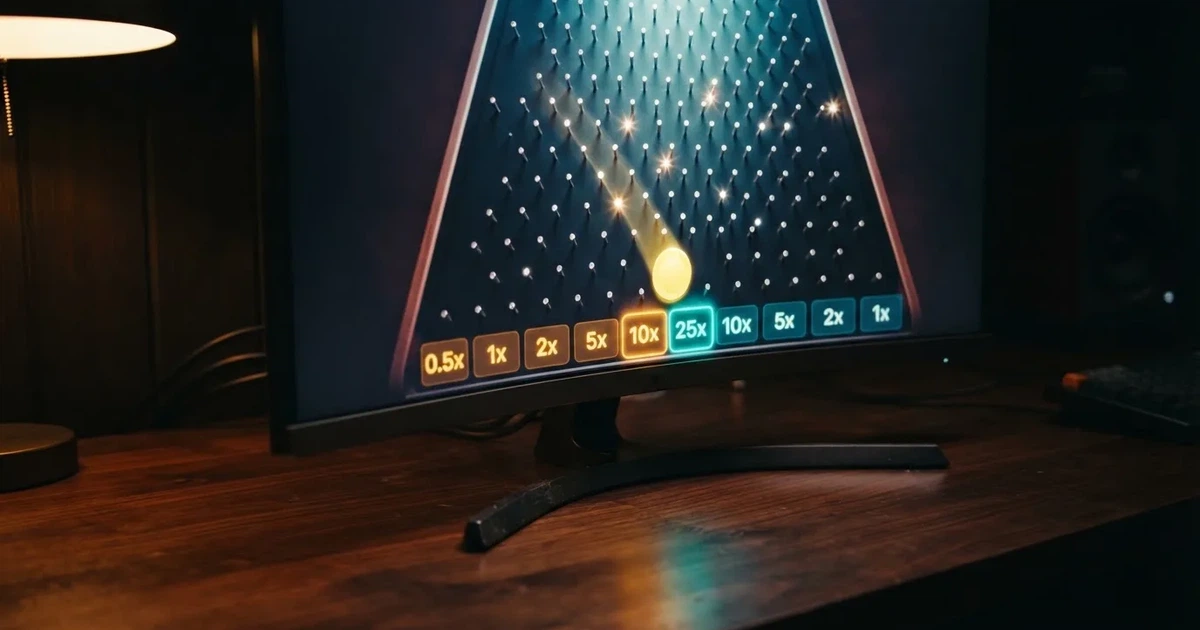
Ball drops, pegboard, slot at the bottom — the visual is borrowed wholesale from a 1983 American television game show and resold, in 2026, as if it were a serious gambling product. The pitch is straightforward enough: a chip falls through a pegboard and lands in a multiplier slot, the bigger the slot’s number the smaller the chance of catching it, and the smaller the number the more often it pays out. Australian readers searching for a “plinko casino” meet a wall of offshore sites offering the game for real money, none of which is licensed in any Australian state or territory. The page below sets out what that product looks like on the screen, what the maths says about it, and what the Australian Communications and Media Authority has already done about the brands running it.
Current as of 29 October 2026; data checked against the Australian Communications and Media Authority’s published enforcement actions.
Table of Contents
- How the Plinko casino game actually pays
- Operators the ACMA has named: what is actually being offered
- What the offshore Plinko casino market looks like from Australia
- Legality: what the IGA actually says and what it does
- Responsible gambling and where to get help
- Crypto, anonymity and what crypto actually buys an Australian player
- Payments, payout speed and what “instant withdrawal” actually means
- The math, plain
- Frequently asked questions
How the Plinko casino game actually pays
The Plinko casino game is not a reel slot and not a table game. It is a pegboard with chips. Each chip is dropped from the top of a triangular peg field, bounces between pegs on the way down and lands in one of the slots arranged along the base. The slot the chip enters multiplies the stake for that drop. The player’s choice is what to risk per drop and how the slot distribution is set; the chip’s path is otherwise a sequence of pseudo-random deflections.
BGaming’s version of the game, the version most offshore Plinko casinos currently advertise, sets out three risk levels (low, normal and high) and lets the player pick the number of lines between eight and sixteen. Auto-bet is offered for players who want the system to keep dropping chips while they watch, and manual mode lets them release each chip by hand. The advertised return-to-player is 99%, with the top slot paying a multiplier of ×1,000 on a maximum-risk line. The 99% figure and the ×1,000 figure are pulled directly from the developer’s own page; they are also the same two figures plastered across the marketing for almost every Plinko casino review that wants to sound authoritative. The headline number is real to the developer; whether an operator’s deployed version pays the same rate is not something the page, the operator or any affiliate marketing page can verify from outside.

The 99% RTP figure deserves a careful look. A 1% house edge is thinner than almost every other casino product on the Australian market, and that is the entire reason it gets quoted in marketing copy. For comparison: baccarat’s banker bet carries a 1.06% edge, blackjack under liberal Las Vegas Strip rules sits around 0.28%, and the don’t-pass bet in craps runs at 1.36%. The Plinko number is competitive, on paper. What the paper does not say is which risk setting and which line count were used to compute the 99%, and that pair of parameters changes the actual distribution of landing slots far more than the headline implies. A sixteen-line high-risk board distributes almost all of its mass toward the centre, where the top multipliers sit at vanishing probability. A wide-board, low-risk run pays more often but at lower multipliers, and the resulting “session feel” is closer to a slow drip than to the multiplier screenshot the marketing uses.
The paytable in plain terms
The paytable is shaped like a triangle with the longest row at the bottom. Centre slots pay the most and catch the fewest chips; outer slots pay the least and catch the most. On a sixteen-line board at high risk, the centre slot is the ×1,000 row and the outermost slots pay fractions of the stake. The narrower the line count, the more skewed the distribution becomes: an eight-line board is closer to a coin flip than a true bell curve, because there are fewer landing positions for the chip to occupy. Players who drop one chip at a time see the extreme outcomes frequently because variance is large per drop; players running auto-bet across hundreds of drops see the advertised return pull the actual results back toward the 99% average.
The interesting design question is why the developer let the player pick both the risk and the line count. The two controls together let the player dial variance up or down before each session. A player who wants long, flat sessions picks low risk with the maximum number of lines; a player hunting the ×1,000 screenshot picks high risk with the minimum number of lines. Neither setting changes the 99% RTP materially, but they change how often the player sees the centre slot hit and how much the bankroll moves during a typical run. The marketing material tends to lead with the ×1,000 figure because it photographs well; it tends to leave out the parameter choices that determine whether the player ever sees one.
Where the format came from
The pegboard is older than the casino game. Plinko premiered as a pricing game on the American television show The Price Is Right on 3 January 1983 and remained a fixture of the show’s pricing-game lineup for decades afterwards. On the show, contestants drop chips into a board with nine bottom slots. The outermost slots pay $100, the next pair pay $500, the next $1,000 and the centre slot pays $10,000, with a maximum possible win per chip of $50,000. Before 1998 the centre slot paid $5,000 and the maximum was $25,000, which gives a feel for how long the format has been around unchanged.
Casino Plinko is a translation of that pegboard into a math-driven gambling product. The television version is entertainment with no house edge: every chip has a defined payout based on where it lands and the contestant does not pay to drop. The casino version is the same shape with a house edge bolted on and a stake attached to every drop. It is also the only adaptation in which the operator has an interest in how the chip lands, since every drop is a wager on a random variable. The visual fidelity to the show is part of the marketing, and the marketing is what the page below keeps coming back to.
Operators the ACMA has named: what is actually being offered
The brand list that follows is not a recommendation. Every entry on it is on the page because the ACMA itself issued a formal warning to its operator for offering prohibited online casino services to Australians. The site names are repeated from the ACMA’s published actions; the descriptions below are what the regulator’s record shows, set beside what the marketing claims.
RocketPlay
Pulsup Ltd was hit with a formal warning by the ACMA regarding RocketPlay in March 2026, the regulator’s published record states. The same brand had earlier been the subject of an ACMA warning to Dama N.V. in May 2022, alongside five other Dama-operated casino brands, meaning the operator behind the site changed hands at least once while the site kept running. No information is publicly available on whether RocketPlay carries BGaming’s Plinko specifically; the brand is named here on the ACMA action alone.
Level Up Casino
Dama N.V. was issued a formal warning over Level Up Casino in May 2022. The Dama N.V. action also named Bambet, Dazard, Rocketplay, Wild Tornado and Cobra Casinos, all of them in the same regulator action. Level Up’s public-facing marketing pages have been listed by aggregator pages as carrying BGaming content, which is how the developer’s Plinko reaches an Australian-facing search.
Woo Casino
Dama N.V. received an ACMA formal warning over Woo Casino in March 2025, a separate action from the 2022 round. The brand keeps running from an offshore licence, accepts deposits in fiat and crypto, and has been promoted by affiliate marketing pages as a Plinko-friendly casino. No verifiable link between Woo Casino’s deployed games and BGaming’s Plinko specifically was located.
Spirit Casino
Dama N.V. received a further ACMA formal warning in May 2025 over Spirit Casino. The 2025 action names Spirit Casino as a separate Dama-operated brand, distinct from the 2022 list. No public source confirms Spirit Casino’s deployed Plinko variant, if any.
National Casino
Consolutetish S.R.L. received a formal ACMA warning in July 2025 concerning National Casino. The same action named Bizzo Casino; both brands sit on the same operator entity per the regulator’s record. Aggregator pages list National Casino as carrying BGaming content, which is the path through which the developer’s Plinko is advertised on the brand’s page.
Bizzo Casino
The ACMA’s July 2025 warning to Consolutetish S.R.L. covered Bizzo Casino alongside National Casino. Bizzo had already been the subject of an earlier 2022 formal warning to TechSolutions (CY) Group Limited and TechSolutions Group N.V., which means the brand has been the subject of ACMA action under two different operator entities. The aggregator pages reviewed do not specifically attest to BGaming Plinko on Bizzo’s deployed lobby.
Ignition Casino
Bamboo Media faced a formal ACMA warning in July 2025 for Ignition Casino. The regulator’s record names the operator entity as Bamboo Media, not the more familiar Ignition Casino brand. The deployed games on the Australian-facing brand page could not be confirmed against BGaming’s Plinko specifically.
Instant Casino
EOD Code SRL received a formal warning from the ACMA in February 2025 regarding Instant Casino. The brand is named on the regulator’s list and continues to operate offshore. Whether Instant Casino carries BGaming’s Plinko is not stated by the brand’s own page or any operator-facing marketing material located in the consulted sources.
Jackbit
Ryker B.V. received a formal warning from the ACMA in April 2026 for Jackbit and CasinOK in the same enforcement round. Jackbit is one of the more heavily marketed crypto-casino brands on Australian-facing affiliate pages, but the deployed lobby’s specific Plinko variant could not be verified from the consulted sources.
Casino Intense
Sterplay Holding Ltd received an ACMA formal warning over Casino Intense in April 2025. Aggregator pages list Casino Intense as carrying BGaming content, alongside the developer titles the brand publicises directly. Whether Casino Intense’s deployed Plinko variant matches BGaming’s published 99% RTP figure is not stated on the brand’s own materials.
Sky Crown
Hollycorn N.V. was issued a formal warning by the ACMA over Sky Crown and Blue Leo, both brands covered in the same regulator action. The brand continues to operate offshore under a Curaçao-issued licence. No public source attests to BGaming Plinko on Sky Crown’s deployed lobby specifically.
The shape that the list above draws is the shape of the ACMA’s enforcement ledger, not the shape of the Plinko casino market. Most of the brands on it are large multi-brand operators with overlapping company structures; the regulator’s actions are made against the operator entity, not against the casino skin, so a brand dropped from one entity can reappear under another within months. A reader looking at this list should not infer that any of these brands is “safer” because its ACMA warning is older, and a brand not on the list has not been cleared — it has simply not yet been the subject of a published warning.
| Brand | ACMA action and date | Operator named by the ACMA | Subject support |
|---|---|---|---|
| RocketPlay | Formal warning — March 2026; earlier Dama N.V., May 2022 | Pulsup Ltd (March 2026); Dama N.V. (May 2022) | — |
| Level Up Casino | Formal warning — May 2022 | Dama N.V. | Listings-only (BGaming) |
| Woo Casino | Formal warning — March 2025 | Dama N.V. | — |
| Spirit Casino | Formal warning — May 2025 | Dama N.V. | — |
| National Casino | Formal warning — July 2025 | Consolutetish S.R.L. | Listings-only (en.wikipedia.org) |
| Bizzo Casino | Formal warning — July 2025; earlier TechSolutions, 2022 | Consolutetish S.R.L. (July 2025); TechSolutions Group N.V. (2022) | — |
| Ignition Casino | Formal warning — July 2025 | Bamboo Media | — |
| Instant Casino | Formal warning — February 2025 | EOD Code SRL | — |
| Jackbit | Formal warning — April 2026 | Ryker B.V. | — |
| Casino Intense | Formal warning — April 2025 | Sterplay Holding Ltd | Listings-only (ABC, ACMA, Crown Melbourne) |
| Sky Crown | Formal warning — September 2022 | Hollycorn N.V. | — |
The “Subject support” column is where the page’s own claim either finds a footing or does not. “Listings-only” means the only places a brand’s name appears alongside BGaming’s Plinko are third-party aggregator pages, and the brand’s own page or the developer’s own catalogue has no public confirmation. The em-dash entries are brands where the consulted sources carry no Plinko-specific link at all. The table is the audit trail for every line that follows about a brand and its games.
What the offshore Plinko casino market looks like from Australia
The Plinko casino game exists inside a market that does not officially exist. There is no Australian licence category for an online casino offering Plinko-style multiplier games for real money; the Interactive Gambling Act 2001, reinforced by the Interactive Gambling Amendment Act 2017, makes the supply of online casino games, online pokies and in-play betting to a person physically in Australia an offence. Penalties on conviction reach A$220,000 per day for individuals and A$1.1 million per day for corporations. The 11 brands listed above are not rogue outliers; they are the visible portion of a market that operates entirely outside the Australian licensing system.
The product is therefore defined by what its operators cannot guarantee. There is no Australian complaints body for an offshore operator that refuses a withdrawal, no local regulator to which a player can escalate a dispute, no compensation fund if the operator disappears, and no guarantee that the site the player registered with this week will be reachable next week. The ACMA’s enforcement is also asymmetric in a way the player should understand: enforcement acts against the provider, not the player. An Australian who signs up, deposits and plays is not personally at risk of prosecution, but the money on the site is at risk of being stranded when the regulator asks Australian ISPs to block the domain, which is exactly what the regulator has done with 1,751 sites since November 2019.
The marketing material does not advertise these features because they would not sell the product. Affiliate marketing pages reviewed in the consulted set describe bonuses, free spins and welcome packages; none of them describe the legal status of the offer, the regulator’s enforcement history, or the absence of a complaint route. A reader relying on those pages alone has no view of what they are actually buying.
What “Plinko casino app” really means
A separate search-cluster concern is the “plinko casino app” framing. Australian-facing marketing distinguishes between a website and a downloadable mobile application, and the application is often advertised with phrases like “exclusive” or “tailored” as if the app version were a different game. In practice the Plinko casino game is the same HTML or compiled binary regardless of whether it runs in a mobile browser, an Android package or an iOS app store listing. The developer ships a single game and operators package it. The “app” framing is part of the same marketing pressure that pushes everything else on the page: a downloadable artefact suggests permanence and trust that the website does not, and the operator has every incentive to use that framing.
A practical difference does exist, and it is on the operator side rather than the game side. Apps distributed outside the official Apple App Store and Google Play Store are sideloaded, which means the install process itself routes around the platform protections that a regulated app would inherit. A reader who downloads a Plinko casino app from a brand’s own page is installing an unsigned or self-signed application on their phone, granting it the permissions the operator’s installer requests, and bypassing the platform’s normal review. That is a different relationship with the software than installing the regulated Bet365 or Sportsbet app from an Australian app store, and the marketing rarely flags the difference.
The cost of a Plinko drop versus the marketing line
The 99% RTP figure quoted by BGaming is the headline number; what it actually means in dollar terms is a separate calculation. At a 1% house edge, a player who drops A$1,000 worth of chips over a session loses on average A$10, with the rest of the stake returned through winning drops. The marketing uses “99% RTP” because the round number is friendly; the casino term for the same number is “1% house edge”, and the latter phrasing makes the cost legible. The 1% edge is low by online-casino standards, but it is still a one-way cost on every dollar the player drops, and the cumulative cost scales linearly with the size of the bankroll.
A 1% edge also assumes the game runs at the developer’s published rate. An offshore operator has no obligation to deploy the game at the rate the developer advertises; the operator chooses a certified return-to-player and certifies it to whatever testing house licences its jurisdiction. The certified rate is rarely audited by anyone with jurisdiction over the Australian player, which means the “99% RTP” displayed in the marketing is the developer’s published rate, not the rate the player is actually receiving. Two players on two different offshore Plinko casinos paying for the same developer’s game may be receiving two different returns without any way of telling from inside the game.
Legality: what the IGA actually says and what it does
The Interactive Gambling Act 2001 is the federal statute that defines the prohibition. As amended in 2017, it makes it an offence to provide online casino games, online pokies or in-play betting services to a person in Australia. The list of prohibited services covers the product class: a Plinko-style multiplier game falls inside “online casino game” because it is a gambling-style game offered over the internet for real-money stakes. The amendment’s drafting was deliberately broad — anything that resembles a casino product is covered — and Plinko sits squarely inside it.
What is licensable in Australia is wagering on races and sport placed before the event, lotteries and keno. The licence for wagering sits, in practice, with the Northern Territory Racing and Wagering Commission. The NTRWC regulates 52 of Australia’s online bookmakers, including Sportsbet, Bet365 and Ladbrokes, the licence issued in the Territory for tax reasons. The commission has no full-time staff and meets once a month in Darwin, a structural feature that has been criticised in the parliamentary record but does not change the underlying fact: those 52 bookmakers are the only category of online gambling operator with any claim to Australian licensing for the products they offer, and the products they offer do not include Plinko.
Enforcement of the IGA runs through the ACMA. The regulator investigates complaints, issues formal warnings to operators, and directs Australian internet service providers to block illegal sites. The block list is published and updated. As reported in June 2026, the ACMA’s running total of blocked illegal gambling and affiliate marketing websites since the first blocking request in November 2019 was 1,751, with more than 230 unlicensed gambling services having left the Australian market since enforcement was strengthened in 2017. The same enforcement round added 12 more sites to the block list: 7Signs, ChromaBet, Donbet, Duospin, Freshbet, Slots Gem, Jacks Club, Lucky Start, PointsBetz, Spinrise, Vinyl Casino and Wildsino.
The 1,751 cumulative figure, taken against the roughly 80 months between November 2019 and June 2026, gives an average blocking rate of about 22 sites per month across the entire enforcement programme. The figure is a band, not a precise rate, because the ACMA does not issue a fixed monthly number; some months bring twelve or more blocks, others bring none. What the band shows is that the regulator is not conducting a one-off enforcement action — it is running a continuous operation against a continuous supply of new offshore sites. A reader assuming the enforcement will eventually exhaust the offshore market is reading a trend that the data does not support; the supply has held roughly steady across seven years of blocking.
The 2026 reform package sits on top of this. The Interactive Gambling Amendment (Gambling Reform) Bill 2026 passed Parliament on 19 August 2026. Its advertising and inducement measures commence on 1 January 2027 — law with a start date, not yet in force on a 2026 page. The reform does not legalise Plinko or any other online casino product; it tightens the rules around advertising and inducements around the licensed bookmaking sector. A reader in 2026 looking at the law as it stands today reads the 2001 Act plus the 2017 amendment, with the 2026 reform as a future-state change to watch for but not to rely on.
Responsible gambling and where to get help
The Plinko casino game is a gambling product regardless of how it is packaged, and the house edge applies to every dollar deposited into it. The Australian responsible-gambling framework is built around the licensed bookmaking sector and does not reach offshore operators. BetStop, the National Self-Exclusion Register, has been live since August 2023 and binds every Australian-licensed online and phone wagering service; an offshore Plinko casino is not connected to it, so a self-excluded Australian who signs up at an offshore site has used a system that does not apply to the operator they have chosen.
The support services themselves are not conditional on which operator the player was using. The National Gambling Helpline on 1800 858 858 is free, available 24/7, and connects to Gambling Help Online, which provides web chat and counselling. The helpline is the right first contact regardless of the player’s situation: the counsellors are not affiliated with any operator, the call is not recorded for marketing, and the service is funded by the states and territories rather than by the gambling industry. State-level services exist for ongoing support — Gambler’s Help in Victoria, GambleAware in New South Wales, and equivalents in every other state and territory — and the helpline can route to the right one for the caller’s postcode.
A point worth stating plainly: an offshore Plinko casino has no duty of care toward an Australian player and no obligation to honour any responsible-gambling commitment the player has made elsewhere. The site does not check BetStop, does not check the helpline, does not check any self-exclusion the player has set up with a licensed bookmaker, and does not require the player to set deposit limits before play. The Australian framework’s protections stop at the Australian border, and the offshore site is on the other side of it.
Crypto, anonymity and what crypto actually buys an Australian player
The “crypto casino” framing around Plinko is a marketing wrapper that addresses the operator’s payment friction more than the player’s anonymity. Crypto deposits do clear faster than bank transfers in many cases, and they do not pass through a card network that would log the transaction against an Australian bank account. What they do not do is change the legal status of the activity or the licence the operator holds.
The Australian position on crypto deposits for gambling is set out in the credit-card and digital-currency prohibition that took effect on 11 June 2024. The prohibition applies to licensed wagering services, with penalties up to A$247,500 for operators that breach it. An offshore Plinko casino is not a licensed wagering service and is not subject to the prohibition, which is one reason crypto deposits are heavily marketed on offshore brands — they are the operator’s way of routing around the Australian card network’s blocklist. From the player’s side, paying in crypto does not move the offshore site into the licensed system; it just removes the bank statement that would have recorded the deposit. That is not the same thing as anonymity in any legal sense, and it is not the same thing as protection if the operator refuses the withdrawal.
A useful way to read the crypto-casino frame is as a parallel to the “plinko casino app” frame. Both are marketing wrappers that take a product already on offer and add a layer of apparent differentiation. The game is the same Plinko game; the payment rail is a different payment rail; the licence is the same offshore licence (or absence of one); the operator’s regulatory exposure is the same as it was before the crypto marketing was added. The crypto wrapper does not convert an unlicensed offshore operator into a regulated one.
Payments, payout speed and what “instant withdrawal” actually means
The “instant withdrawal” claim that runs through Plinko casino affiliate marketing is usually about the operator’s own processing time, not about the time the funds reach the player’s bank. The fastest part of the pipeline is the operator’s internal queue: once the player requests a withdrawal, the operator’s payment team approves or denies it, and the time to that decision is what the operator controls. The downstream leg — bank rails, payment processors, currency conversion, the player’s bank crediting the account — is outside the operator’s control and frequently takes longer than the marketing suggests.
For a player at an offshore site, the practical risks sit at the approval step, not the speed step. An operator that delays approval has effectively frozen the balance, and the player has no Australian complaint route to escalate. An operator that approves a withdrawal and then asks for “verification” — repeated KYC submissions, source-of-funds checks on deposits that were already accepted — is using the verification process as a delay tactic, and the player has no regulator to complain to. None of these failure modes are visible in the marketing language, all of them are common enough that the ACMA’s enforcement history reflects them, and an Australian player has no contractual lever to shorten them.
For licensed Australian wagering, the legal deposit routes are debit card, bank transfer, PayID/Osko and BPAY. A licensed bookmaker cannot accept a credit card or a crypto deposit, and any offshore site that does accept either is operating outside the Australian rules, not inside them. The prohibition is on the licensed side, not the offshore side; the practical effect is that a player paying by credit card to an offshore Plinko casino is making a payment that an Australian-licensed operator would be forbidden to accept, with the offshore operator’s bank taking the corresponding risk. This is structural, not a per-transaction decision.
The math, plain
The single calculation the page owes the reader is the blocking-rate figure derived from the ACMA’s published running total. As of the June 2026 reporting round, the ACMA’s cumulative total of blocked illegal gambling and affiliate marketing websites since the first blocking request in November 2019 stood at 1,751. The interval between November 2019 and June 2026 is roughly 80 months. The arithmetic yields an average blocking rate of about 22 sites per month across the enforcement programme — a band rather than a precise figure, because the ACMA does not publish a fixed monthly block quota. Some months bring a dozen or more additions to the block list; others bring none. The 22-per-month average describes the enforcement pace across the programme’s lifetime, not the pace any single month will follow, and a reader using it as a forecast for next month’s block list will be wrong more often than right.
What the figure does establish is that the ACMA’s enforcement has been continuous, not episodic. A reader assuming the offshore market is shrinking because the regulator has been blocking for seven years is reading a trend the data does not show; the supply has held roughly steady against the blocks, and the running total has grown by roughly two dozen sites a month on average. The block list is the regulator’s response to a continuing supply of new operators, not the end of that supply.
Frequently asked questions
What is the Plinko casino game, and how does the ball-drop mechanic actually determine a payout?
A chip is dropped from the top of a triangular peg field, deflects off pegs as it falls, and lands in one of the slots arranged along the bottom of the board. The slot the chip enters multiplies the stake for that drop, with the largest multipliers sitting in the centre slots that catch the fewest chips. On BGaming’s published version, the player sets the risk level (low, normal or high) and the line count (8 to 16), and the game advertises a 99% return-to-player with a ×1,000 top multiplier. The outcome of each drop is independent, and the chip’s path is generated by a pseudo-random sequence rather than by physics.
Does a crypto version of Plinko pay out any differently to a standard real-money version?
The crypto version is the same game running on the same RNG with the same published return-to-player. The payment rail changes — the deposit is in bitcoin or another cryptocurrency rather than in fiat — but the game’s payout table and house edge do not. The marketing around “crypto Plinko” is about deposit and withdrawal mechanics, not about a different game or a different return; a player paying in crypto at an offshore Plinko casino is receiving the same product as a fiat-paying player on the same site, with the operator’s risk that the Australian side cannot reach the balance if the operator refuses a withdrawal.
Is playing Plinko for real money at an offshore casino something Australians are legally allowed to do?
The Interactive Gambling Act 2001 prohibits the supply of online casino games — including Plinko-style multiplier games — to a person in Australia, with penalties up to A$220,000 per day for individuals and A$1.1 million per day for corporations. The Act targets the provider, not the player; an Australian who signs up and plays is not personally prosecuted. No state or territory licenses an online casino to offer Plinko for real money. The legal status of an offshore Plinko casino operating in Australia is therefore defined by the prohibition on supply rather than by any explicit prohibition on play.
What return-to-player rate do offshore sites typically advertise for their Plinko game?
BGaming’s Plinko is advertised at 99%, with a ×1,000 top multiplier. Most affiliate marketing pages reviewed copy that 99% figure because it is the developer’s published rate. The rate an offshore operator has actually deployed is rarely auditable from outside the operator’s certification, and a player on one site cannot tell from inside the game whether the certified rate matches the developer’s catalogue. The advertised 99% is therefore the developer’s figure, not a figure the player can independently verify on any given operator.
Why do Plinko casino apps get advertised separately from ordinary Plinko casino websites?
The Plinko casino game is the same software regardless of whether it runs in a mobile browser, an Android package or an iOS app. The “app” framing is marketing rather than a different product; the operator packages the same developer’s game inside a downloadable artefact and uses phrases like “exclusive” to imply a separate offering. The practical difference is that apps distributed outside the official Apple and Google stores are sideloaded and bypass the platform protections that a regulated app would inherit. A reader downloading a Plinko casino app from a brand’s own page is installing the application directly, not through a platform review process.
How does a Plinko game’s payout table differ from a pokies reel in terms of the odds involved?
A pokies reel pays according to symbol combinations across multiple paylines, with the house edge built into the symbol weights and the line structure. A Plinko game’s payout is determined by where a single chip lands in a slot, with the house edge built into the slot distribution and the risk and line-count settings the player has chosen. The two products share a house edge concept but not a payout mechanic: pokies rewards pattern matches across reels, Plinko rewards a single landing position on a pegboard. The 99% RTP BGaming advertises for Plinko is competitive against most pokies titles but is parameter-sensitive in a way that pokies RTP figures typically are not.