
What a VPN actually changes for an Australian reaching an offshore casino
A virtual private network is sold, in the casino affiliate space, as a magic doorway. Tunnel out, change the IP, walk into the site as if you were somewhere else. The marketing rarely lingers on what the tunnel does and does not do. For someone sitting in Sydney or Perth or Cairns, the practical question is narrower than the adverts suggest: does the VPN change anything about the legality of what is happening at the other end, and does it change anything about what the casino can see. The answer to the first question is short. The answer to the second is more interesting than the marketing lets on, and it is the place this page starts.
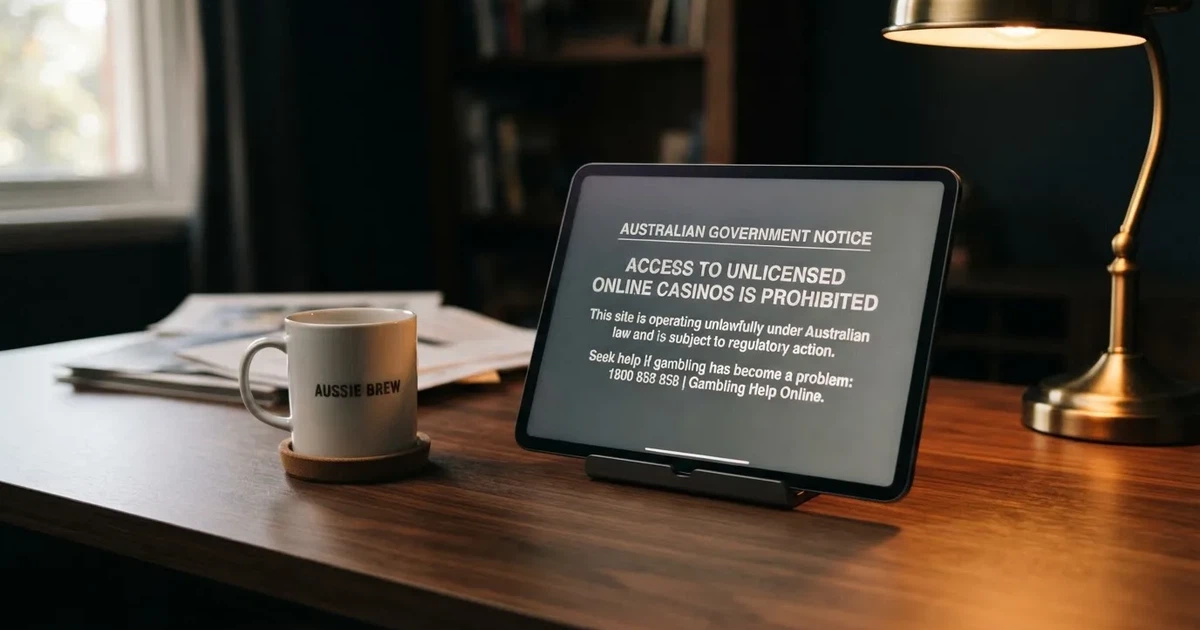
Current as of 29 October 2026, cross-checked against the ACMA’s register of formal warnings and blocking actions.
Table of Contents
- The choice that the phrase “VPN friendly” is hiding
- What Australian law actually says about online casino games
- How the ACMA enforces the prohibition
- Where a casino that “allows VPN” actually sits
- The payments angle the marketing almost never covers
- Wellbeing tools that only reach part of the picture
- Eleven brands the ACMA has acted against
- What each of the eleven looks like up close
- The price of a session that the marketing never quotes
- Thea broader landscape beyond the eleven
- Where the page lands
- Frequently asked questions
The choice that the phrase “VPN friendly” is hiding
A reader who lands here is usually weighing three things at once. Whether the offshore casino they have seen advertised will let them register, deposit and withdraw. Whether the act of doing so is something Australian law reaches. Whether, if anything goes wrong, there is any Australian body they can complain to. | Aspect | Reality for the player |

| Aspect | Reality for the player |
|---|---|
| VPN access | Technical connection only |
| Legal status | Remains prohibited in Australia |
| Consumer protection | None (no Australian body) |
| Dispute resolution | None |
That is the shape of the page. It walks through what the VPN actually changes technically, what the ACMA has already done to the offshore sites Australians most often meet, where a player who runs into trouble ends up, and what self-exclusion and payment-side blocks can and cannot stop. Eleven brands the ACMA has already acted against sit beside each other in a single comparison, because comparing them is the only useful thing to do with a set the regulator has already named. The page closes on a few practical questions a reader is likely to be asking anyway, and on the support lines that exist for the moment someone decides the cost is not worth paying.
What Australian law actually says about online casino games
No state or territory in Australia licenses an online casino. The Interactive Gambling Act 2001, hardened by the Interactive Gambling Amendment Act 2017, makes it an offence to provide online casino games, online pokies or in-play betting to a person who is physically in Australia. What is licensable is wagering on races and sport placed before the event, lotteries, and keno. In practice most licensed online bookmakers — Sportsbet, Bet365, Ladbrokes among them — run under a Northern Territory licence administered by the Northern Territory Racing and Wagering Commission, a body the ABC has described as having no full-time staff and meeting once a month in Darwin. The framework was built around wagering, and it shows.
The IGA targets the provider, not the player. That detail is often quoted as if it were a free pass, and it is not quite that. An individual punter in Australia is not going to be prosecuted for placing a bet through an offshore site. What they do give up, by going offshore, is the entire layer of Australian consumer protection that sits behind a licensed bookmaker. No complaints body. No local dispute resolution. No guarantee that a withdrawal will be processed on any particular timetable. If the site is blocked mid-session, the balance on it can become difficult to retrieve.
The Interactive Gambling Amendment (Gambling Reform) Bill 2026 passed Parliament on 19 August 2026, with its advertising and inducement measures commencing on 1 January 2027. It is law with a start date, not yet in force. On a 2026 page it is the next thing to land rather than the present regime, and the present regime is what the rest of this page is built against.
How the ACMA enforces the prohibition
The ACMA investigates, issues formal warnings and directs Australian internet service providers to block illegal services. By June 2026 the running total sat at 1,751 illegal gambling and affiliate marketing websites blocked since the first blocking request in November 2019, and more than 230 unlicensed services had left the Australian market since the 2017 amendments came into force. That is the size of the enforcement record a reader is stepping into when they ask whether a particular offshore site is “safe”.
In the round reported on 26 June 2026 alone, the ACMA asked ISPs to block another twelve names: 7Signs, ChromaBet, Donbet, Duospin, Freshbet, Slots Gem, Jacks Club, Lucky Start, Pointsbetz, Spinrise, Vinyl Casino and Wildsino. The pace has not slowed. The list is not the same list a reader sees when an affiliate blog ranks “VPN friendly” brands, and the divergence is the editorial point of the comparison later on this page.
A formal warning is the step before blocking. It is published by the ACMA on its own site, naming the operator and the brand. A blocked site is one an Australian ISP is required to make unreachable. Both are visible to anyone who looks, and the set of warnings below is the set a reader would meet if they did.
Where a casino that “allows VPN” actually sits
A site that calls itself VPN friendly is doing one of two things, and the difference matters. Some are simply not checking the IP their visitors arrive with, because the technical work of geolocation is patchy at the country level and they have decided not to bother. Others are advertising that they accept Australian-dollar accounts through payment methods that themselves do not gate on jurisdiction. In neither case does the operator carry an Australian licence. In neither case does the activity become licensed for the player.
Is a casino that allows VPN use any different from one that simply doesn’t check? Technically, no. The set of player attributes the site can see — account name, payment instrument, betting pattern, device fingerprint — is essentially the same. The VPN changes the IP address and not much else. A site that advertises “we allow VPNs” is, in operational terms, a site that has chosen not to enforce a check that other sites enforce, and that is the entire substance of the claim.
What a VPN does change, and what it doesn’t:
- The IP the site sees during the session. That is the only attribute a VPN reliably alters.
- The DNS lookups the player’s machine sends out, which ordinarily go to Australian resolvers and become another signal of location.
- The payment method used, which is not changed by a VPN at all and is the single most reliable jurisdiction signal a casino actually receives.
- The legal status of the activity, which is set by the location of the person, not by the location their IP claims to be.
That last point is the one the marketing tends to leave at the door. The IGA applies to the provision of prohibited services to a person in Australia, and the VPN does not move the person.
The payments angle the marketing almost never covers
A licensed Australian online wagering service cannot accept payment by credit card, by credit-related products or by digital currency. The credit-card ban took effect on 11 June 2024, with penalties for operators of up to A$247,500. Legal deposit routes for a licensed wagering service are debit card, bank transfer, PayID/Osko and BPAY. An offshore site asking for a credit card or a crypto deposit is, in the same gesture, telling the player it is operating outside the Australian rules.
PayID, run by Australian Payments Plus, shows the name of the account holder before a transfer is sent, and AP+ warns that being asked to transfer to a PayID on an illegal gambling site almost certainly means a scam. A bank transfer between participating Australian banks via Osko arrives in under a minute, twenty-four hours a day, weekends included. Over a hundred Australian financial institutions make PayID-based instant transfers available. By April 2025 more than 25 million PayIDs had been registered on the New Payments Platform. The plumbing is fast, the names are visible, and the choice of payment method is the most reliable jurisdiction signal a casino has.
BPAY, the bill-payment service inside online banking, has been running since 1997 and is available at more than a hundred and forty Australian banks and financial institutions, offered by over ninety-five thousand businesses. It is owned, through Cardlink Services Limited, in equal shares by ANZ, Commonwealth Bank, National Australia Bank and Westpac. The big-four ownership is a reminder that the legal deposit routes for licensed wagering are not a fringe set of payment methods. They are the same ones a player uses to pay any other Australian bill.
What bank-side gambling blocks reach, and what they miss
The major Australian banks run gambling transaction blocks at the card level. Westpac refuses authorisation of transactions registered under the merchant category code “Betting/Casino Gambling” on eligible personal credit and debit cards. Commonwealth Bank lets a customer apply a gambling lock to eligible cards through the CommBank app, with the same caveat that not every gambling-related purchase will be stopped. ANZ’s gambling block, once switched on through the ANZ app, also blocks gambling transactions made through a digital wallet such as Apple Pay on the eligible card, not only on the physical card. Removing ANZ’s block requires a forty-eight-hour waiting period.
None of these blocks reach an offshore casino that takes payment by crypto, by an overseas-issued card, or by an instant-payment rail the bank has not classified as gambling. Apple Pay, Google Pay and Samsung Pay together accounted for around 45% of all card payments in Australia by number at the end of 2025, and the Reserve Bank of Australia’s July 2025 review proposes removing surcharges only on eftpos, Mastercard and Visa — explicitly leaving American Express outside the scope of the proposed surcharge ban. The plumbing for digital-wallet gambling is ordinary Australian plumbing. The block sits at the merchant category code, not at the wallet.
The Reserve Bank of Australia and the major banks are shareholders in Australian Payments Plus, which runs the New Payments Platform. The platform must keep monthly outages to no more than two minutes. In 2021 the ACCC authorised the merger of BPAY Group, eftpos and NPP Australia into a single holding entity. The shape of legal payments in Australia is a closed loop, and an offshore casino operating outside it is operating outside more than just the gambling law.
Wellbeing tools that only reach part of the picture
BetStop, the National Self-Exclusion Register, has been live since August 2023. It binds Australian-licensed online and phone wagering services — exactly the services the IGA permits. An offshore casino is not connected to BetStop. Registering with BetStop will not stop an account at an offshore site from being opened, and it will not stop a session at one from continuing. It is the strongest tool available to a player who wants to step back from legal wagering, and it is silent on the offshore side of the line.

The National Gambling Helpline is 1800 858 858, free, twenty-four hours a day, with chat at Gambling Help Online. It is the line a reader in trouble reaches for whether the gambling that caused the trouble happened at a licensed bookmaker or at an offshore casino. The line itself does not draw that distinction. The practical effect is that the help side of the Australian framework is available whatever the site, while the protective side of it — the disputes body, the consumer law, the self-exclusion register — is available only on the licensed side.
The gambling block on the bank card is the most useful single safeguard for a player who is trying to keep themselves away from offshore sites. It does not, by itself, make the activity legal, and it will not stop every transaction. It does close off the deposit routes that an Australian bank can see.
Eleven brands the ACMA has acted against
The set below is not a ranking and not a recommendation. Each brand is on this page because the ACMA has issued a formal warning over it for offering prohibited services to Australians. The date and the operator named in the warning are the ACMA’s own. The “subject support” column records whether the casino itself is listed, in the consulted set, as advertising acceptance of the payment methods a reader might use. Where the consulted set carries nothing, the cell is empty — the brand’s stance on the subject is unknown rather than denied.
A reader comparing these names is comparing formal warnings from one regulator. That is the only comparison the consulted material supports. The columns are the brand, the action and date as published by the ACMA, the operator named in the action, and whether the consulted listings describe the brand as supporting a particular payment subject.
| Brand | ACMA action and date | Operator named by the ACMA | Subject support |
|---|---|---|---|
| RocketPlay | Formal warning, March 2026 | Pulsup Ltd (Rocketplay); earlier Dama N.V., May 2022 | listings-only (Gambling Insider) |
| Level Up Casino | Formal warning, May 2022 | Dama N.V. | listings-only (Westpac) |
| Woo Casino | Formal warning, March 2025 | Dama N.V. | — |
| Spirit Casino | Formal warning, May 2025 | Dama N.V. | — |
| National Casino | Formal warning, July 2025 | Consolutetish S.R.L. | listings-only (ACMA, AUSTRAC, BetStop) |
| Bizzo Casino | Formal warning, July 2025; earlier 2022 to TechSolutions | Consolutetish S.R.L. | listings-only (Gambling Insider) |
| Ignition Casino | Formal warning, July 2025 | Bamboo Media | — |
| Instant Casino | Formal warning, February 2025 | EOD Code SRL | listings-only (ecoPayz, PayID) |
| Jackbit | Formal warning, April 2026 | Ryker B.V. | — |
| Casino Intense | Formal warning, April 2025 | Sterplay Holding Ltd | listings-only (AUSTRAC, BetStop, Gambling Insider) |
| Sky Crown | Formal warning | Hollycorn N.V. | — |
Reading the table side by side, the spread is the point. The names the ACMA has acted against do not line up neatly with the names an affiliate ranking promotes. Of the eleven brands above, the consulted listings record anything at all on the payment-subject dimension for six, and the remaining five sit on the page with no claim either way. None of them is licensed to take an Australian customer. None of them sits inside the Australian dispute and consumer framework. The set exists because the regulator named it, and that is the editorial reason it is on this page.
What the table does not show
The “subject support” column is a thin column. It records only what the consulted listings say, and the consulted set is not a complete audit of any brand’s payment page. A dash in that cell is the consulted set saying nothing about the brand on that subject, not the brand denying it. A “listings-only” entry is the consulted set carrying a third-party description, not the operator confirming a feature. The whole column is a small sample of how the affiliate ecosystem describes the brand, taken alongside the regulator’s own record. A reader using it to decide where to play is using it for something it does not support.
The blocking record behind the warning record
A formal warning is the ACMA’s step before a blocking direction. The 1,751 blocked sites since November 2019 sit behind the eleven named warnings above. The arithmetic the consulted material supports is a rate, not a count: of the roughly eighty months between the first blocking request and the June 2026 total, the ACMA has been directing blocks at an average of close to twenty-two sites per month. The exact monthly figure drifts from month to month, and the band sits around that average rather than on it.
That is the pace of the offshore casino market being closed off in Australia. The set of names a reader can reach through a VPN today is, in part, the set the ACMA has not yet blocked. The set the ACMA has already acted against is the set on this page.
What each of the eleven looks like up close
The eleven write-ups below carry what the ACMA’s own publication says about each brand, what the operator’s situation is at the moment of writing, and where the consulted listings support a description of the brand’s payment-subject stance. Where the consulted set has nothing on the subject, the write-up says so plainly rather than guessing.
RocketPlay
Pulsup Ltd received a formal warning from the ACMA in March 2026 over RocketPlay. The same brand had earlier drawn a formal warning to Dama N.V. in May 2022, one of six names under the same operator at that time. The consulted listings describe the brand in passing as part of a wider set the affiliate ecosystem tracks, with no further claim about what the brand accepts or refuses. A reader who arrives at RocketPlay via a VPN is arriving at a brand whose regulator has twice put its name on a public warning. The brand is not licensed to take Australian play, the warning does not become retroactively inapplicable because of the tunnel, and the published record is what a future dispute will rest against.
Level Up Casino
Dama N.V. drew a formal warning in May 2022 covering Level Up alongside five sister brands. The ACMA’s action names the operator, not just the brand, and the operator-level warning is the one that travels when the brand changes hands or rebrands. The consulted listings describe the brand only as part of the Westpac gambling-block narrative, which is a context rather than a feature. A reader weighing Level Up is weighing a brand whose operator has been on the regulator’s record for years.
Woo Casino
A formal warning to Dama N.V. in March 2025 over Woo Casino followed the earlier 2022 round. The consulted set makes no claim on this brand’s payment-subject stance. The reader-facing fact is that the operator has been warned more than once, and the ACMA’s pattern is to escalate when warnings are ignored.
Spirit Casino
A formal warning to Dama N.V. in May 2025 over Spirit Casino is a separate action from the earlier Woo Casino warning, even though the operator is the same. The consulted set has nothing on the brand’s payment-subject stance. A reader looking at Spirit Casino is looking at a brand whose operator has accumulated two warnings in two years.
National Casino
Consolutetish S.R.L. drew a formal warning in July 2025 over National Casino. The consulted listings place the brand alongside the ACMA’s own material, alongside AUSTRAC’s threshold-transaction-report rule, and alongside BetStop. Those are three different angles on the Australian framework, each surfacing a different safeguard. The brand is named in each because each angle is what the consulted set reached for when discussing it.
Bizzo Casino
Consolutetish S.R.L. drew a formal warning in July 2025 over Bizzo Casino, with the additional note that the brand had already drawn a 2022 warning to TechSolutions (CY) Group Limited and TechSolutions Group N.V. The same brand on two operators’ records, separated by three years, is one of the longer enforcement trails in the ACMA’s published list. The consulted listings describe the brand in affiliate coverage; they do not support a feature claim on payment subjects.
Ignition Casino
A formal warning to Bamboo Media in July 2025 over Ignition Casino is the ACMA’s action on the brand. Information on this brand’s payment-subject stance is unavailable in the consulted set. The reader-facing position is the warning itself.
Instant Casino
A formal warning to EOD Code SRL in February 2025 over Instant Casino. The consulted listings describe the brand alongside ecoPayz and PayID, which are two payment-rail names that sit on opposite sides of the Australian framework — PayID is a legal deposit route into licensed wagering and is also the rail that exposes a recipient name, while ecoPayz is an e-wallet that sits outside the Australian regime. The fact that both names surface in the consulted set is itself the editorial signal: Instant Casino’s payment-subject footprint crosses the line.
Jackbit
Ryker B.V. drew a formal warning in April 2026 over Jackbit and over CasinOK. The consulted set is silent on the brand’s payment-subject stance. Jackbit is the most recent entry on this page and the one whose trajectory under the ACMA’s enforcement is still early.
Casino Intense
A formal warning to Sterplay Holding Ltd in April 2025 over Casino Intense. The consulted listings describe the brand alongside AUSTRAC’s threshold rule, BetStop, and affiliate coverage. Each of those is a separate Australian-framework handle on the brand, and the fact that the consulted set reaches for three of them is more commentary than any single one would be.
Sky Crown
A formal warning to Hollycorn N.V. over Sky Crown and Blue Leo casino services. This brand’s payment-subject stance remains unconfirmed by the consulted set. The reader-facing position is the warning.
The price of a session that the marketing never quotes
None of the eleven brands above runs on a published RTP that an Australian player can audit through an Australian body. None of them carries an Australian licence. None of them connects to BetStop. None of them is subject to the credit-card ban that applies to a licensed wagering service. The price of a session is whatever the site quotes, and the dispute path on a refused withdrawal is whatever the site’s own terms page says it is.
The marketing word to puncture here is “VPN friendly” itself. Read narrowly, it means the site does not block Australian IP ranges — or, equivalently, it does not enforce a check that other sites enforce. It does not mean the site is licensed for Australians, and it does not mean the activity at the other end has become something an Australian consumer protection body reaches. The economic substance of “VPN friendly” is that the door is open, and the regulatory substance is that the door opens onto a floor that no Australian regulator stands on.
What self-exclusion reaches, and what a player has to set up themselves
A player who wants to step back from legal wagering in Australia registers with BetStop. A player who wants to step back from offshore casino play has, in practice, three Australian-side levers: the bank gambling block, the bank’s removal cool-off (forty-eight hours at ANZ), and the choice not to keep an offshore account funded. None of these is automatic. Each requires the player to put it in place.
The bank-side block is the strongest of the three because it closes the deposit route that an Australian bank can see. The 48-hour cool-off is the design choice ANZ has put in place to make the block harder to undo in a moment of impulse. The third lever — the player’s own choice — is the one no framework can substitute for. The consulted material does not support any further Australian-side tool against an offshore site specifically. The help line is the one number that always applies.
Thea broader landscape beyond the eleven
The 1,751 blocked sites since November 2019 are not the eleven brands on this page. They are the long tail of names an Australian reader would meet if they searched for any one of the eleven. The 230-plus unlicensed services that left the Australian market since 2017 is a separate number, measuring exits rather than blocks, and it tells the same story from a different angle. Both numbers are the regulator’s, both are public, and both sit behind the specific warnings on the table.
H2 Gambling Capital’s 2025 estimate puts Australians’ annual losses to illegal gambling sites at around A$3.9 billion, and reports that the share of gambling going through legal channels fell from 74% in 2021 to 64%. The first number is the size of the offshore market a reader is being invited into. The second is the share migrating away from it. The two together describe a market that is large, contested, and losing ground to the offshore side, which is the editorial reason a page like this exists at all.
What the “VPN friendly” claim looks like when it is set against the legal deposit routes
A licensed Australian wagering service accepts debit card, bank transfer, PayID/Osko and BPAY. The bank-side gambling block is the protective shell around those four rails. An offshore casino that accepts any of those four on an Australian card is running on a rail the player’s own bank may decline; one that accepts credit card or crypto is, in the same gesture, telling the player the rules do not apply. The consulted material does not record a brand-by-brand matrix of which rail each of the eleven accepts. The general shape, drawn from the regulator’s record and the affiliate listings, is that an offshore casino either takes an Australian-issued debit card through a payment processor that has not classified it as gambling, or it does not take an Australian payment at all. The shape, not the matrix, is the editorial point.
Where the page lands
The phrase “VPN friendly casino Australia” describes a door, and the rest of this page describes the floor on the other side of it. The door is open, in many cases, because the operator has chosen not to enforce the check that other operators enforce. The floor is unlicensed, unprotected by Australian consumer law, untouched by BetStop, and named on the ACMA’s published list for the brands an Australian reader most often meets.
A reader who has reached this page weighing whether to use a VPN to reach one of these sites has three Australian-side levers in front of them: the bank gambling block, the bank’s cool-off on removing it, and the choice not to fund an offshore account. The help line is 1800 858 858, free, twenty-four hours a day. The two facts a reader acts on, after reading this page, are the regulator’s name on the brand and the support line that does not depend on which side of the line the play happened on.
The remaining questions a reader is likely to be asking sit below.
Frequently asked questions
Why would a casino specifically advertise itself as “VPN-friendly” in the first place?
Because the affiliate market for Australian-facing traffic rewards sites that promise access where the licensed market is closed. The “VPN friendly” label is a recruitment message, not a technical specification — it tells the reader that the operator has chosen not to enforce an IP-based jurisdiction check that other offshore sites enforce. It does not change anything about the site’s licensing or about whether the ACMA has put it on the published warning list.
Does using a VPN to access an offshore casino change whether the activity is legal for someone in Australia?
No. The Interactive Gambling Act 2001 targets the provision of prohibited services to a person in Australia, and the test is the location of the person, not the IP address their tunnel claims. The individual player is not prosecuted under the IGA, but going offshore forfeits the Australian consumer protection layer — disputes body, complaints route, recourse on a refused withdrawal — that sits behind a licensed bookmaker. The VPN changes nothing on either of those points.
How does a VPN change what an offshore casino site can actually see about where a player is connecting from?
A VPN changes the IP address the site sees during the session, and it changes the DNS lookups the player’s machine sends out. It does not change the payment method used, and the payment method is the most reliable jurisdiction signal the casino actually receives. A site that accepts Australian-issued cards on a rail the player’s bank has classified as gambling is exposing itself; a site that takes crypto or an overseas-issued instrument is signalling it is operating outside the Australian rules.
What risk does a player take on by using a VPN to reach a casino that has been formally warned before?
The risk is not that the player will be prosecuted. It is that the site can be blocked mid-session, that the balance on the account becomes difficult to retrieve once it is, that there is no Australian disputes body to take a complaint to, and that the site can change its payout terms or its operator structure without recourse. The ACMA’s record on the brands above is a public warning that the regulator considers the provision prohibited. It does not, by itself, predict what the site will do with a particular withdrawal.
Is a casino that “allows VPN use” any different, technically, from one that simply doesn’t check?
No. The set of player attributes the site sees — account name, payment instrument, betting pattern, device fingerprint — is essentially the same in both cases. The VPN changes the IP and not much else. A site that advertises “we allow VPNs” is, operationally, a site that has decided not to enforce a check that other sites enforce. The technical difference between the two positions is smaller than the marketing suggests.
What should someone consider before treating VPN access as a safe workaround rather than a legal one?
That the legal status is set by the location of the person, not by the IP address their tunnel claims. That BetStop does not reach an offshore site. That the bank-side gambling block reaches some deposit routes and not others. That a balance on an offshore account can become hard to retrieve if the site is blocked. And that the help line — 1800 858 858, twenty-four hours a day — is the one number that does not depend on which side of the line the play happened on.