
Licensed pokies venues in Tasmania — official gaming, cashless card limits and offshore risks
Currency check on 29 October 2026 against the ACMA formal warning register and the Tasmanian Liquor and Gaming Commission notices as published.
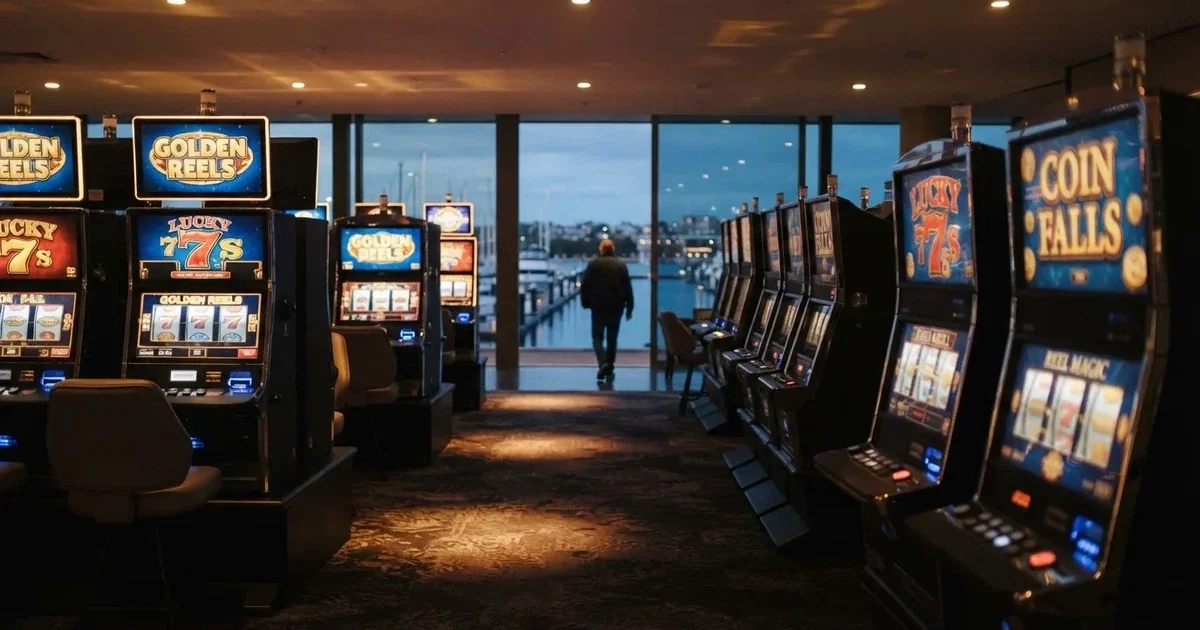
The shortest answer to “where are the best pokies in Tasmania” is also the one most searchers would rather not hear: the only pokies the law in Tasmania actually sanctions are the ones sitting on the floor of two casinos and inside the hotel and club network the state regulates. Nothing else on offer to an Australian punter under the heading “pokies” is a Tasmanian product, whatever its website claims. That single fact reshapes the rest of the page, because every offshore brand a Tasmanian reader can name — and every formal warning the ACMA has issued in the last three years — sits on the other side of that line.
This page walks that line end to end. The shelves of material that follow cover what Tasmania itself licences, how the new cashless card changes the numbers on the screen, where the heaviest payouts sit, what the responsible-gambling support network looks like, and the eleven offshore brands the ACMA has issued formal warnings over since 2022. The thread running through all of it is cost: what the machine keeps, what the cashless card caps, what the offshore brand promises, and what a Tasmanian reader actually walks away with.
Table of Contents
- Pokies and EGMs in Tasmania — what’s licensed, what isn’t
- The cashless card and how the numbers stack up
- Where the heaviest payout sits — comparing the EGMs across the licensed network
- The Interactive Gambling Act and what the ACMA has actually done
- Responsible gambling in Tasmania
- Where the page is current as of
- The ACMA warning list at a glance
- Frequently asked questions about pokies in Tasmania
Pokies and EGMs in Tasmania — what’s licensed, what isn’t
The two casinos, and what sits between them
Tasmania runs two casinos. Wrest Point in Hobart has held a licence since 10 February 1973, when it became Australia’s first legal casino. The Country Club Casino and Resort in Launceston followed in 1982, built by Federal Group in a Georgian style modelled on the stately homes of the American South. Together they account for the only casino-floor EGMs in the state — the heavier machines, the bigger bet tiers, the higher-limit rooms that the hotels and clubs do not run.
Outside the two casinos, electronic gaming machines were for decades the exclusive business of Federal Group. The Gaming Control Act 1993 gave Federal Group the sole right to operate pokies in Tasmanian hotels and clubs, and the Farrell family’s holding company ran that monopoly through a structure that included Mulawa Holdings. In the year to 30 June 2018, Mulawa reported profit nearly doubling from A$13.9 million to A$24.4 million on revenue of A$543 million, with about A$75 million paid in gaming taxes and licence fees to the Tasmanian government. The monopoly was relinquished in August 2017, after which individual pubs and clubs became eligible to hold their own machine licences. Federal Group itself remained Tasmanian family-owned: it began as the Federal Coffee Palace Company Limited, founded in Melbourne in June 1885, and the Farrell family held majority ownership of its holding company by 1989 before privatising the group in 1990.
The shift in 2017 did two things at once. It broke up the Federal Group’s exclusivity, so a Hobart pub could now run its own ten or twenty machines on its own licence. It did not, however, legalise online casino games or open any door for an offshore brand to take Tasmanian customers — a distinction that matters for every warning later in this page. The state still recognises only two casino-floor licences and the licensed hotel-and-club network underneath them.
Where the cashless card changes the floor
Tasmania’s cashless gaming card reform moved hotel and club poker machines onto mandatory carded play from December 2025. The reform set three default loss limits — A$100 per day, A$500 per month, A$5,000 per year — and any change upward runs only after a minimum 24-hour waiting period. The Tasmanian Liquor and Gaming Commission oversees the system. No casino rollout date had been set as of September 2024, which is the most recent public position on the casino-floor rollout.
The caps matter because the cashless card sits between the player and the machine: it is not a credit limit the venue can override at the cashier, and the day and month ceilings compound. A player who hits the A$100 daily ceiling cannot simply top up at the bar; the system waits 24 hours before any increase goes through. For someone with a small bankroll, that is the structural answer to “how much can I lose tonight” — and it is also why the rest of this page is written in the conditional, not the indicative: the cashless card has rewritten what a hotel or club poker machine is, even though the machines themselves have not changed.
The cashless card and how the numbers stack up
Payout percentages — what the machines actually return
The return-to-player (RTP) figures published for Tasmanian machines sit inside the same federal envelope as the rest of Australia. South Australia, the closest comparable state for purposes of a floor number, sets a minimum gaming-machine RTP of 87.5% and a general maximum bet of A$5.00 outside the casino, while Adelaide Casino itself runs without a maximum-bet limit. Tasmania does not publish a single headline RTP for its hotel and club network, but the federal envelope and the South Australian floor give a defensible range for what a Tasmanian pub machine returns over the long run: somewhere just under 90%, with the casino-floor machines in Hobart and Launceston sitting at the higher end of the same range.
The 90% mark is the line where marketing language starts to sound better than the math. A 90% RTP means a 10% house edge, which means A$10 of every A$100 wagered stays with the house over the long run. Over a session of two hours at A$1 per spin and roughly 720 spins, that is a long-run expectation of A$72 returned on A$720 wagered — a long-run figure, not a guarantee, and one that compounds quickly across a week of play. The cashless card caps the worst-case above the long-run expectation, which is the only place a cap and an RTP talk to each other.
Maximum cash payouts and the wagering cap
The state does not publish a single maximum-cash-payout figure for hotel and club machines, but the cashless card’s A$100 daily ceiling effectively bounds the per-session loss for a player who stays under the card. Above the card, on the casino floor, the limits track the machine: a higher-limit EGM at Wrest Point or the Country Club takes a bigger bet per line and pays out more per hit, but the long-run edge holds.
For a player working out what one of these machines is worth in a session, the arithmetic is the same as anywhere else. At a 90% RTP and A$1 per spin across 720 spins in two hours, expected loss is A$72. At A$5 per spin on a casino-floor machine, expected loss is A$360 over the same window. The numbers are estimates, not promises — variance is real — and the cashless card caps a single session’s loss before variance ever has a chance to bite.
Where the heaviest payout sits — comparing the EGMs across the licensed network
Inside Tasmania: the casino floor vs the pub
The two Tasmanian casinos carry the heavier machines and the bigger per-spin ceiling. Wrest Point, as the older property, runs the broader mix: classic pokies at the lower end, high-limit EGMs in the premium room, and table games that the pubs and clubs do not run. The Country Club in Launceston carries a similar floor, scaled to the resort’s footprint and shaped by the Georgian design of the building.
The pub and club network, post-2017, runs lighter machines on lower bet tiers. The default bet tends to sit between A$0.01 and A$1 per line, and the cashless card’s A$100 daily ceiling applies before the machine itself does. A punter who wants the higher per-spin ceiling needs the casino floor — which means Wrest Point or the Country Club, and which means crossing to Hobart or Launceston.
Outside Tasmania: a quick comparison with Adelaide and Brisbane
The broader Australian picture sharpens what Tasmania looks like. Adelaide Casino, commercially known as SkyCity Adelaide, sits inside the heritage-listed Adelaide railway station on North Terrace, with 90 gaming tables and 950 gaming machines, and it is the sole licensed casino in South Australia under the Casino Act 1997. South Australia had 11,672 gaming machines outside Adelaide Casino in 471 venues in September 2023, and gaming-machine losses outside the casino totalled about A$0.92 billion in 2022-23, equivalent to about A$497 per adult. South Australia’s Casino Act 1997 extended Adelaide Casino’s table-game monopoly to 30 June 2035 under a licence formalised on 11 October 2013, allowing up to 200 gaming tables and 1,500 gaming machines subject to redevelopment.
Brisbane offers a different shape. Treasury Casino, operated by Star Entertainment Group, sat in the historic Treasury Building and closed on 25 August 2024 to make way for the new Star Brisbane at Queen’s Wharf. Treasury’s three-level gaming emporium ran 80 gaming tables and over 1,300 gaming machines. The A$3.6 billion Queen’s Wharf precinct opened in stages from 29 August 2024, with Star Brisbane’s main casino floor and premium gaming rooms opening first. Queensland had 21,122 gaming machines operating in 351 venues in October 2023.
What this comparison leaves is a pattern: Tasmania’s licensed EGM footprint is the smallest of the three states on the mainland comparison, sitting at two casinos and a smaller hotel-and-club network, while South Australia and Queensland carry broader networks and heavier casino floors. The cashless card caps the per-session loss in Tasmania in a way the other two states do not, which is the structural difference a player notices first.
Outside the casino walls — the offshore warning list
The list that follows is not a ranking and not a recommendation. Each brand is included because the ACMA itself issued a formal warning over it for offering prohibited interactive gambling services to people in Australia. No bonus terms are given — the only sources for those were affiliate marketing pages, and the legal position is that online casino games cannot be licensed anywhere in Australia under the Interactive Gambling Act 2001, whatever licence the offshore site displays.
RocketPlay
The ACMA issued a formal warning over RocketPlay to Pulsup Ltd in March 2026. An earlier warning had gone to Dama N.V. in May 2022 covering six casino brands including Rocketplay. The legal position is unchanged across both warnings: online casino games cannot be licensed in Australia. What changed was the operator behind the front door. For a Tasmanian reader, the practical question is whether the brand itself is the service or merely the wrapper; on the ACMA’s record, the wrapper has changed hands at least once without changing the position. A punter who treats a brand name as a guide to legality is reading marketing copy, not the regulator’s register.
Level Up Casino
The ACMA issued a formal warning over Level Up Casino to Dama N.V. in May 2022, alongside five other Dama brands — Bambet, Dazard, Rocketplay, Wild Tornado and Cobra Casinos. Listings in encyclopaedic and state-regulator sources reference the Level Up brand, but the regulatory position is settled and unchanged: an Australian-facing casino operating under any of these names is a prohibited interactive gambling service. A reader comparing this brand against the others on this list will find the same operator behind several of them, which is the more useful fact than the brand name on the landing page.
Woo Casino
The ACMA issued a further formal warning to Dama N.V. over Woo Casino in March 2025, after the May 2022 round that included the same operator’s other brands. The pattern is the same as the Level Up picture: a single operator, multiple brand wrappers, and a regulator that has caught up with both. The brand’s listings in encyclopaedic sources do not change the legal position for a Tasmanian reader.
Spirit Casino
The ACMA issued a formal warning to Dama N.V. over Spirit Casino in May 2025. The pattern here is the second Dama N.V. warning in two months, and the practical question for a reader is whether a brand new enough to escape the 2022 round has any different standing in front of the ACMA. It does not. The regulator’s position is operator-level, not brand-level.
National Casino
The ACMA issued a formal warning over National Casino to Consolutetish S.R.L. in July 2025. News and infrastructure sources have referenced the National Casino brand, and the regulatory position is the same as the rest of the list: the service is prohibited, the operator is named, the warning is on the public register.
Bizzo Casino
The ACMA issued a formal warning over Bizzo Casino to Consolutetish S.R.L. in July 2025. Bizzo had earlier been the subject of a 2022 formal warning to TechSolutions (CY) Group Limited and TechSolutions Group N.V., which is two operators, two warnings, and a brand that has migrated between them without changing its Australian-facing position. A reader who finds Bizzo on a comparison list should read both warning dates, because the more recent one is the one the ACMA is currently treating as live.
Ignition Casino
The ACMA issued a formal warning over Ignition Casino to Bamboo Media in July 2025. The Ignition brand sits in the same July 2025 cluster as National Casino and Bizzo Casino, and the operator behind it is different again. A reader working through the list should treat each entry as a separate operator-level warning, not a brand-level one — that is the frame the ACMA itself uses.
Instant Casino
The ACMA issued a formal warning over Instant Casino to EOD Code SRL in February 2025. The warning predates the July 2025 cluster and names a different operator; the Instant Casino brand carries no listing-level data in the consulted sources, which means the warning itself is the only verifiable fact a Tasmanian reader has to work with. That is a thin basis for any claim about the brand, and a thin basis is the honest place to leave it.
Jackbit
The ACMA issued a formal warning over Jackbit to Ryker B.V. in April 2026, alongside the same operator’s CasinOK brand. The April 2026 warning sits inside the same reporting period as the Rocketplay warning to Pulsup Ltd, which is a useful reminder that the ACMA’s enforcement tempo is not slowing down. For a reader, the recency of the warning matters more than the brand name — a brand warned in the last twelve months is one the regulator is actively looking at.
Casino Intense
The ACMA issued a formal warning over Casino Intense to Sterplay Holding Ltd in April 2025. News and regulatory sources reference the Casino Intense brand, and the ACMA’s warning is the only verifiable fact that matters for a Tasmanian reader. The brand has been on the ACMA’s register for over a year, which is the long tail of the 2025 enforcement round.
Sky Crown
The ACMA issued a formal warning over Sky Crown to Hollycorn N.V., covering the same operator’s Blue Leo service. The warning predates the 2025 cluster and is the older entry on this list. Encyclopaedic listings reference the Sky Crown brand, and the legal position is the same as every other brand on this page.
The Interactive Gambling Act and what the ACMA has actually done
What the IGA prohibits
The Interactive Gambling Act 2001, strengthened by the Interactive Gambling Amendment Act 2017, makes it an offence to provide online casino games, online pokies or in-play betting to a person in Australia. No state or territory licences online casino products; what is licensable is wagering on races and sport placed before the event, lotteries and keno — in practice licensed by the Northern Territory Racing and Wagering Commission, which regulates 52 of Australia’s online bookmakers, including Sportsbet, Bet365 and Ladbrokes, on a tax-favoured basis. The commission has no full-time staff and meets once a month in Darwin, which is the structural fact behind why bookmakers register in the Territory and why the rest of the IGA’s prohibitions sit at the federal level.
The minimum age is 18. The individual player is not prosecuted — the IGA targets the provider — but an offshore site gives no Australian consumer protection, no complaints body and no recourse if a withdrawal is refused, and it can be blocked with a balance still on it.
The blocking record and what it tells a reader
According to the ACMA, a total of 1,751 illegal gambling and affiliate marketing websites had been blocked since the first blocking request in November 2019, with more than 230 unlicensed gambling services having left the Australian market since enforcement was strengthened in 2017. In a round reported on 26 June 2026 the ACMA asked Australian internet service providers to block 12 more illegal gambling websites: 7Signs, ChromaBet, Donbet, Duospin, Freshbet, Slots Gem, Jacks Club, Lucky Start, Pointsbetz, Spinrise, Vinyl Casino and Wildsino.
The blocking rate is the arithmetic this page is built around. Across roughly six and a half years between the first blocking request in November 2019 and the cumulative count reported in June 2026, the ACMA’s running total of 1,751 blocked sites gives a working band of roughly 250 to 280 blocks per year, with the precise figure depending on whether partial-year totals or full-year peaks are used. The point of the band is not the exact figure; it is that the ACMA’s tempo is sustained, not a one-off sweep, and a reader who treats the next offshore brand launch as a reason to relax is reading the wrong signal.
What enforcement costs the reader who plays offshore
H2 Gambling Capital’s 2025 report estimates that Australians lose about A$3.9 billion a year to illegal gambling sites, and that the share of gambling going through legal channels fell from 74% in 2021 to 64%. The A$3.9 billion is the headline figure, but the share drop is the more important number for a reader comparing legal and illegal routes: a four-year decline from 74% to 64% means a larger share of every Australian gambling dollar is leaving the regulated envelope, which is exactly the share the ACMA’s blocking programme is meant to recover.
The cost of playing offshore is not only the house edge. It is the absence of BetStop — the National Self-Exclusion Register, live since August 2023, binds only Australian-licensed online and phone wagering services, and an offshore casino is not connected to it. It is the absence of Australian payment protections: credit cards, credit-related products and digital currency are banned as payment for licensed online wagering since 11 June 2024, with penalties up to A$247,500 for operators, and a site asking an Australian for a credit card or a crypto deposit is operating outside the Australian rules. It is the absence of a complaints body when a withdrawal is refused. Each of these is a real cost on top of the long-run house edge, and a reader comparing a Tasmanian pub machine to an offshore slot is comparing two products with two very different protection envelopes.
Responsible gambling in Tasmania
Gambling Helpline Tasmania and the in-person network
Gambling Helpline Tasmania (1800 858 858), run by Anglicare Tasmania’s Gamblers Help Service, provides free 24-hour phone counselling for anyone affected by gambling in Tasmania and can help arrange venue self-exclusion. In-person counsellors are based in Hobart, Launceston, Devonport and Burnie, which is a footprint that covers the two casino cities and the two largest population centres on the north-west coast. The 24-hour line is the front door; the in-person network is what a player gets if phone counselling is not enough.
The National Gambling Helpline is the same number — 1800 858 858 — and runs 24/7 with chat available through Gambling Help Online. For a reader outside Tasmania who is comparing state-level support, the national line is the consistent floor; the Tasmanian in-person network is the layer on top of it.
What the cashless card changes for self-exclusion
The cashless gaming card reform that moved hotel and club machines to mandatory carded play from December 2025 has reshaped self-exclusion in a way that matters for a player who wants to step back. The default loss limits — A$100 per day, A$500 per month, A$5,000 per year, with any increase only after a minimum 24-hour wait — are structural, not negotiated. A player who wants a tighter ceiling can hold the defaults; a player who wants no ceiling at all has to wait 24 hours for the system to grant one. That asymmetry is the design: it makes stepping back easier than stepping up.
Venue self-exclusion, arranged through Gambling Helpline Tasmania, sits on top of the card. A player excluded from a specific venue cannot use that venue’s machines even if the card would allow it; the exclusion is the venue’s response, not the system’s. For a player who wants the strongest available lever, the card’s defaults plus a venue-level exclusion is the combination the Tasmanian system actually offers.
Where the page is current as of
The currency stamp on this page is the ACMA’s formal warning register and the Tasmanian Liquor and Gaming Commission’s published notices. The ACMA register is updated as new warnings and blocking requests are issued; the Tasmanian Commission’s cashless gaming card reform has the December 2025 mandatory carded-play date as the most recent hard date on the calendar. A reader comparing this page to a current ACMA register is reading the same primary source this page is built on.
The ACMA warning list at a glance
| Brand | ACMA action and date | Operator named by the ACMA | Subject support |
|---|---|---|---|
| RocketPlay | Formal warning, March 2026 (earlier May 2022) | Pulsup Ltd (2026); Dama N.V. (2022) | — |
| Level Up Casino | Formal warning, May 2022 | Dama N.V. | Listings only |
| Woo Casino | Formal warning, March 2025 | Dama N.V. | Listings only |
| Spirit Casino | Formal warning, May 2025 | Dama N.V. | — |
| National Casino | Formal warning, July 2025 | Consolutetish S.R.L. | Listings only |
| Bizzo Casino | Formal warning, July 2025 (earlier 2022) | Consolutetish S.R.L. (2025); TechSolutions (2022) | — |
| Ignition Casino | Formal warning, July 2025 | Bamboo Media | — |
| Instant Casino | Formal warning, February 2025 | EOD Code SRL | — |
| Jackbit | Formal warning, April 2026 | Ryker B.V. | — |
| Casino Intense | Formal warning, April 2025 | Sterplay Holding Ltd | Listings only |
| Sky Crown | Formal warning, September 2022 | Hollycorn N.V. | Listings only |
The pattern this table leaves is what a reader comparing offshore brands should actually see: a small set of operators, a long list of brand names, and the ACMA catching up with both. The brand a punter sees on the landing page is rarely the operator the regulator has named.
Frequently asked questions about pokies in Tasmania
Which venues in Tasmania are licensed to operate pokies?
Two casinos — Wrest Point in Hobart and the Country Club Casino in Launceston — hold Tasmania’s casino-floor licences, and the licensed hotel-and-club network runs electronic gaming machines under individual venue licences issued after Federal Group’s monopoly was relinquished in August 2017. The Tasmanian Liquor and Gaming Commission is the regulator for the hotel and club network, and the casino-floor licences sit under separate state legislation. Every venue running machines legally in Tasmania sits inside that envelope; anything else offering pokies to a Tasmanian is operating outside it.
Are pokies in Tasmania available around the clock?
Hotel and club poker machines follow each venue’s opening hours, which vary by licence. The 24-hour operation is not a feature of the typical Tasmanian pub; a player looking for late-night machine access generally needs a casino-floor property. Wrest Point and the Country Club run their gaming floors on extended hours, but the specifics depend on the night of the week and the venue’s licence conditions, and any punter planning a late session should confirm hours with the venue rather than assume them.
What identification do venues in Tasmania require before letting someone play pokies?
Entry to the gaming floor at either Tasmanian casino requires photo identification, and the cashless gaming card ties hotel and club play to a registered account from December 2025. The minimum age is 18 across the Australian pokies market, and a venue that cannot confirm age and identity cannot lawfully let a player use a machine. A reader who wants to confirm what a specific venue asks for should check with the venue ahead of time, because the question is one the venue answers, not the regulator.
Can visitors to Tasmania use self-exclusion schemes at local pokies venues?
A visitor can arrange venue self-exclusion through Gambling Helpline Tasmania (1800 858 858) for the duration of their stay, but BetStop — the National Self-Exclusion Register, live since August 2023 — binds only Australian-licensed online and phone wagering services, and offshore casinos are not connected to it. A self-exclusion registered in another state or territory applies at the Tasmanian venues that recognise it, and a Tasmanian venue-level exclusion applies only at the specific venue that registered it. The strongest available lever for a visitor is to combine a venue-level exclusion at the property they plan to use with the national helpline as a backstop.
How does the payout percentage on Tasmania pokies compare with other Australian cities?
Tasmania does not publish a single headline RTP for its hotel and club network, but the federal envelope and the comparable South Australian minimum of 87.5% place Tasmanian pub machines somewhere just under 90%. South Australia sets a general maximum bet of A$5.00 outside the casino, while Adelaide Casino itself has no maximum-bet limit; the Tasmanian equivalent sits inside the casino-floor properties at Wrest Point and the Country Club. Brisbane’s Star Brisbane at Queen’s Wharf opened in 2024 with a heavier casino floor — Treasury Brisbane’s 80 gaming tables and over 1,300 machines were replaced by the new precinct — but the long-run RTP sits in the same federal envelope across all three states.
Is it legal for an online casino to advertise ‘pokies’ in Tasmania the same way a pub or club does?
No. The Interactive Gambling Act 2001, strengthened by the Interactive Gambling Amendment Act 2017, makes it an offence to provide online casino games, online pokies or in-play betting to a person in Australia, and no state or territory licences online casino products. The ACMA enforces the prohibition through formal warnings and by directing Australian internet service providers to block illegal sites — a total of 1,751 sites have been blocked since the first blocking request in November 2019, with more than 230 unlicensed services having left the market since 2017. A pub or club advertising pokies is licensed to do so; an offshore site advertising the same word to an Australian reader is offering a prohibited service, whatever licence it displays at the footer.