
Fast Payout Online Casinos in Australia: Where the Law, the ACMA Record and the Banking Rails Actually Land
A reader chasing “fast payout online casino Australia” usually wants a shortlist. The honest answer for someone sitting in Australia is that no such list exists in the form the search assumes, because the Interactive Gambling Act 2001 prohibits offering online casino games to anyone physically in Australia, and no state or territory issues a licence for it. The brands a search results page promotes as “fast payout” are the same brands the Australian Communications and Media Authority has spent the last several years formally warning, and several of them have been ordered blocked at the internet-service-provider level with player balances still attached. That is the gap the page exists to lay out, not to dress up. Fast Payout Online Casinos in Australia — More on this topic at crypto casino au

Currency and licence register current as of 29 October 2026, cross-checked against the ACMA formal warnings register, the Australian Payments Plus operator page and the Reserve Bank of Australia’s payments publications.
Table of Contents
- The Shortlist a Reader Cannot Have — and What It Replaces
- What the Interactive Gambling Act Actually Prohibits
- What the ACMA Has Done, and How Often
- Responsible Gaming in a Market With No Licensable Online Casino
- Crypto and Anonymity: A Faster Rail With No Local Protection
- How Money Actually Moves on the Australian Side
- How Each Brand the ACMA Has Acted Against Actually Sits
- What the Offshore Brand Promises, and What It Cannot Deliver for an Australian Reader
- Tax: What a Win Means at the Australian Tax Office
- What a Reader in Australia Should Actually Do
- Frequently Asked Questions
The Shortlist a Reader Cannot Have — and What It Replaces
Eleven brands turn up on most “casino fast payout” shortlists aimed at Australian players. RocketPlay, Level Up Casino, Woo Casino, Spirit Casino, National Casino, Bizzo Casino, Ignition Casino, Instant Casino, Jackbit, Casino Intense and Sky Crown are the names the affiliate pages keep cycling. Every one of them has been the subject of a formal warning from the ACMA, most within the last eighteen months. A formal warning is the regulator’s first step before a blocking request, not a marketing badge.

For an Australian resident, the practical replacement is not another offshore brand. It is one of three things. A licensed land-based casino or pokie venue in a state or territory where the reader lives. A licensed online wagering service for sports and racing, where licence allows it, taken before the event starts (in-play betting is prohibited to Australian customers). Or BetStop, the National Self-Exclusion Register, for a reader who wants the spending taps shut off rather than another site on their phone.
The page closes that gap in detail below — the enforcement record first, then the responsible-gaming tools, the payment rails and a brief assessment of each brand the ACMA has acted against, side by side.
What the Interactive Gambling Act Actually Prohibits
The Interactive Gambling Act 2001, as tightened by the Interactive Gambling Amendment Act 2017, makes it an offence for an operator to provide online casino games, online pokies or in-play betting to a person in Australia. No state or territory issues a licence for those products. What is licensable is wagering on racing and sport placed before the event, lotteries and keno. The minimum age is 18.
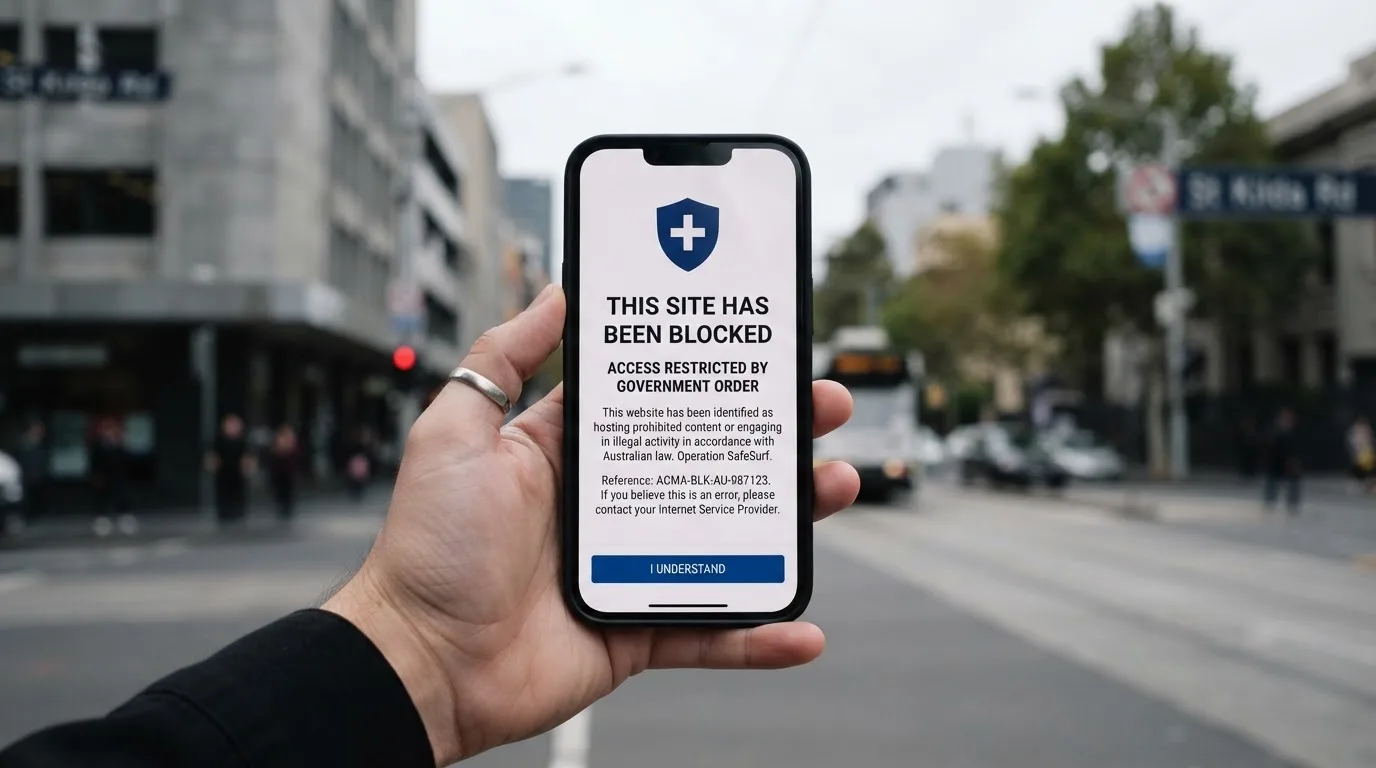
The target of the Act is the provider, not the player. An individual punter is not prosecuted for opening an account or placing a bet. The practical downside sits with whoever takes the deposit. An offshore site offers no Australian consumer protection, no local complaints body and no recourse if a withdrawal stalls or is refused — and a site can be blocked by an Australian internet service provider at the regulator’s direction with the player’s balance still sitting in it.
The Northern Territory wrinkle
Most of Australia’s licensed online bookmakers — Sportsbet, Bet365, Ladbrokes among them — are licensed by the Northern Territory Racing and Wagering Commission, the NTRWC. The reason is tax, not substance: the Territory has historically offered favourable terms. The commission has no full-time staff and meets once a month in Darwin. The reader should know that the NTRWC regulates wagering services that take bets on sport and racing, not online casino games. Casino-style products are not on its licence.
The 2026 reform that has not yet commenced
The Interactive Gambling Amendment (Gambling Reform) Bill 2026 passed Parliament on 19 August 2026. Its advertising and inducement measures commence on 1 January 2027. On a page read in 2026 this is a law with a future start date, not a rule a reader can act on now. It matters for the direction of travel; it does not change what is licensable today.
What the ACMA Has Done, and How Often
The Australian Communications and Media Authority enforces the Interactive Gambling Act on the provider side. Its three tools are formal warnings to the operator, blocking requests to Australian internet service providers and civil penalty proceedings. As reported in June 2026, a total of 1,751 illegal gambling and affiliate marketing websites had been blocked since the first blocking request in November 2019, and more than 230 unlicensed gambling services had left the Australian market since enforcement was strengthened in 2017.
The most recent published round, reported the same day, asked Australian ISPs to block another twelve sites: 7Signs, ChromaBet, Donbet, Duospin, Freshbet, Slots Gem, Jacks Club, Lucky Start, Pointsbetz, Spinrise, Vinyl Casino and Wildsino.
A blocking request is a regulator telling every major Australian ISP to make the named domain unreachable for customers on Australian networks. The brand still exists offshore; it just stops resolving for a reader who is at home on Telstra or Optus. The block does not return the player’s money.
Loss estimate to illegal channels
H2 Gambling Capital’s 2025 report estimates that Australians lose about A$3.9 billion a year to illegal gambling sites, and that the share of gambling spend going through legal channels fell from 74 per cent in 2021 to 64 per cent. That is the size of the market the affiliate shortlists are chasing. It is also the size of the hole in Australian consumer protection, because none of those A$3.9 billion is covered by an Australian complaints body.
Blocking rate, since the first request
The arithmetic that belongs on this page is the rate at which the ACMA has had to act. The first blocking request was issued in November 2019. By the June 2026 round, the cumulative number of blocked sites and affiliate pages had reached 1,751. That works out at a long-run average of roughly 262 sites and affiliate pages blocked per year, or about five per week across the six-and-a-half-year window. The actual pace is not even: most of those blocks arrived in batches tied to specific enforcement rounds, and a quiet quarter does not mean the regulator has stopped. The number the reader should keep is the running total — 1,751 by mid-2026 — and the fact that each blocking round names a new batch of brands, most of them unknown to Australian readers six months earlier.
Responsible Gaming in a Market With No Licensable Online Casino
The Australian responsible-gaming frame was built around licensed wagering services. It does not, and was not designed to, extend to the offshore brands the “fast payout” search results push at Australian readers.
BetStop, the National Self-Exclusion Register
BetStop went live in August 2023. A person registers once and every Australian-licensed online and phone wagering service is bound to refuse their account for the period they choose, from three months up to a permanent exclusion. BetStop works against licensed operators only. An offshore casino is not connected to it. A punter who excludes through BetStop is still welcome at the brands the ACMA has been formally warning.
National Gambling Helpline
The National Gambling Helpline is 1800 858 858 — free, 24/7, with web chat at Gambling Help Online. It is staffed for anyone affected by gambling harm, whether the gambling took place through a licensed operator, an offshore site or a pokie venue.
The bank-level gambling blocks
Australia’s major banks have added card-level blocks that sit on top of the operator’s own controls. ANZ’s gambling transaction block, activated in the ANZ app, refuses transactions registered under the gambling merchant category code on an eligible card, including transactions routed through a digital wallet such as Apple Pay on that card. Westpac’s gambling block operates on the same logic. Commonwealth Bank’s gambling lock, applied through the CommBank app, blocks most gambling transactions on eligible cards and warns that it cannot guarantee all gambling-related purchases will be stopped.
ANZ’s block has a deliberate cooling-off built in: once the block is on, removing it requires a 48-hour wait. The bank also warns that the block is best-effort — some gambling transactions will get through and some non-gambling transactions will be caught in error. None of these blocks reach an offshore operator that processes through a non-Australian acquirer. A punter who has registered with BetStop and turned on a card-level block has still left a door open to the brands the ACMA has warned against.
Crypto and Anonymity: A Faster Rail With No Local Protection
The “fast payout crypto casino” search cluster is the same product cluster the search cluster above describes, with a different rail. The operator is still outside the Australian framework. The difference is that the deposit and the payout move on a blockchain rather than through a bank, which means no Australian bank block reaches them, no bank can refuse the transaction, and no Australian consumer protection applies on the way out either.
What crypto actually changes for an Australian reader
Three things. Speed, in the marketing sense — a confirmed transfer on the Bitcoin network settles in around ten minutes, faster on other chains, and the operator’s marketing page calls that “instant.” Anonymity from the player’s bank, not from the operator — the operator still holds the funds until the player withdraws, and the player still has to pass the operator’s own identity checks when the time comes. And reach, which is the actual point: a card-level gambling block at ANZ, Westpac or CommBank does not stop a transfer that never went through those banks in the first place.
What crypto does not change
Crypto does not change the underlying prohibition. An Australian-licensed online wagering service cannot accept payment by credit card or by credit-related products, and digital currency is on the same banned list for licensed wagering, a restriction in force since 11 June 2024. Penalties for licensed operators that breach it reach A$247,500. An offshore operator is not bound by the rule; the rule’s effect on a reader who uses crypto at an offshore site is only that the reader has left the Australian protection frame entirely.
A crypto deposit that wins and a crypto withdrawal that loses are both outside Australian jurisdiction. The same absence of recourse applies as with any offshore site, with the added wrinkle that the value of the winnings between withdrawal and conversion back into Australian dollars is whatever the market did in between.
How Money Actually Moves on the Australian Side
The “fast payout” question collapses into a simpler question for a reader in Australia: how quickly does the money land in an Australian bank account? The answer is set by the Australian payments rails, not by the offshore casino, and the relevant rails are Osko, PayID and BPAY.
Osko, the near-instant bank transfer
Osko is a service run by Australian Payments Plus. A bank transfer between participating Australian banks arrives in under a minute, 24/7 including weekends, addressed either to a BSB and account number or to a PayID. For a reader in Australia, that is the floor on “fast payout” — anything an offshore casino calls fast has to be measured against a rail that already moves in under a minute within the country.
PayID, the name-checked identifier
A PayID is a name-checked identifier — a phone number, an email or an ABN — that an Australian customer can register against a bank account. Paying to a PayID shows the name of the account holder before the transfer is sent. Australian Payments Plus warns that being asked to transfer money to a PayID on an illegal gambling site almost certainly means a scam site. The point is that the name check cuts both ways: a reader can verify the payee, and a scam operator cannot easily impersonate one.
PayID-based instant transfers are available at more than 100 Australian financial institutions. By April 2025, more than 25 million PayID identifiers had been registered on Australia’s New Payments Platform, the platform that runs underneath Osko and PayID.
The New Payments Platform underneath
The New Payments Platform became accessible to the public on 13 February 2018 and is owned by New Payments Platform Australia Ltd, a non-profit whose shareholders include the Reserve Bank of Australia and the major banks. In 2021 the ACCC authorised the merger of NPP Australia with BPAY and eftpos into a single company, Australian Payments Plus. Participants in the platform are required to keep its monthly outages to no more than two minutes, which is why Osko transfers land at the times they do.
BPAY, the older rail
BPAY is a bill-payment service that runs inside Australian online banking: the payer enters a Biller Code and a Customer Reference Number printed on the bill. It has been operating since 1997, is available in the online banking of more than 140 Australian banks and financial institutions and is offered by more than 95,000 businesses. It is run by Australian Payments Plus, the same operator as PayID and Osko, and is owned equally, through the parent Cardlink Services Limited, by the four major banks: ANZ, Commonwealth Bank, National Australia Bank and Westpac.
BPAY is the rail the legal Australian wagering services use for deposits. It does not return money the way Osko does — BPAY is a push-to-payee model, not a pull-from-payer model — and an offshore casino asking a reader to “pay via BPAY to this biller code” is asking the reader to push money to a stranger on the strength of a code printed on a page.
Apple Pay, Google Pay and the card-network block
By the end of 2025, Apple Pay, Google Pay and Samsung Pay together accounted for around 45 per cent of all card payments in Australia by number. None of them is a separate payment network — they sit on top of the underlying card — and that matters for the gambling block. ANZ’s gambling block, when activated, covers transactions routed through a digital wallet such as Apple Pay on an eligible card, not just the physical card. The same logic applies at Westpac and CommBank. Apple itself does not charge fees to consumers for using Apple Pay, and any surcharge is the merchant’s card-processing fee, not Apple’s. Apple also states that transaction limits and PIN requirements for Apple Pay purchases are set by the card issuer or the merchant, not by Apple.
The Reserve Bank’s July 2025 review of merchant card-payment costs proposes removing surcharges only on eftpos, Mastercard and Visa transactions, explicitly leaving American Express outside the scope of the proposed ban. American Express runs as a three-party scheme — issuer, network and processor under the one roof — rather than the four-party model Visa and Mastercard use, and the RBA has not put it on the same footing for the purposes of the surcharge ban.
AUSTRAC thresholds and ordinary transfers
AUSTRAC’s threshold-transaction-report rule, which requires reporting of transfers of A$10,000 or more, applies only to physical cash. Ordinary electronic bank transfers are not subject to that per-transaction reporting requirement, regardless of the amount. A reader who wires A$15,000 from a CBA account to an offshore casino’s account does not, by that act, trigger a threshold report.
How Each Brand the ACMA Has Acted Against Actually Sits
The eleven brands the affiliate shortlists keep recycling are the same eleven the ACMA has had to write formal warnings to. The table below sets them out side by side, with the ACMA action and the operator named by the regulator. No brand on this list is recommended to an Australian reader — the product is prohibited under the Interactive Gambling Act 2001 — and the table is here because the comparison a reader cannot make on the operator’s own site is the one that matters.
| Brand | ACMA action and date | Operator named by the ACMA | Subject support |
|---|---|---|---|
| RocketPlay | Formal warning, March 2026; earlier warning to same parent, May 2022 | Pulsup Ltd; earlier Dama N.V. | listings-only |
| Level Up Casino | Formal warning, May 2022 | Dama N.V. | listings-only |
| Woo Casino | Formal warning, March 2025 | Dama N.V. | — |
| Spirit Casino | Formal warning, May 2025 | Dama N.V. | — |
| National Casino | Formal warning, July 2025 | Consolutetish S.R.L. | listings-only |
| Bizzo Casino | Formal warning, July 2025; earlier warning to prior operator, 2022 | Consolutetish S.R.L.; earlier TechSolutions | listings-only |
| Ignition Casino | Formal warning, July 2025 | Bamboo Media | — |
| Instant Casino | Formal warning, February 2025 | EOD Code SRL | listings-only |
| Jackbit | Formal warning, April 2026 | Ryker B.V. | — |
| Casino Intense | Formal warning, April 2025 | Sterplay Holding Ltd | listings-only |
| Sky Crown | Formal warning, September 2022 | Hollycorn N.V. | — |
The cluster of Dama N.V. brands — RocketPlay, Level Up, Woo Casino, Spirit Casino — has been warned four times across four years for the same parent company. That is the longest enforcement trail in the table. Consolutetish S.R.L. takes two of the more recent warnings, for National Casino and Bizzo Casino, with Bizzo having already been warned once before under a different operator. RocketPlay was warned again in March 2026 under a new operator, Pulsup Ltd, which is the same product re-skinned after the previous operator’s name appeared on the ACMA register. The ACMA does not publish whether RocketPlay has been ordered blocked; the names on the blocking-request rounds read differently.
The “Subject support” column is what the operator’s own listings pages and the comparison sites say about each brand — for the Australian market specifically, and only on the basis of the listings themselves, never as the operator’s own representation. Where the column is an em dash, neither the operator nor the listings carry anything an Australian reader can rely on, and the brand is presented on its ACMA record alone.
A formal warning is the ACMA’s first step under the IGA. The next step is a blocking request, after which the brand is unreachable on Australian networks without a VPN. A reader who has a balance on any of these brands when the blocking request lands loses the rail, not the balance.
RocketPlay — the brand that has been warned twice under two parents
RocketPlay has been the subject of two ACMA formal warnings. The first, in May 2022, named Dama N.V. as the operator and covered RocketPlay alongside five other Dama N.V. brands. The second, in March 2026, named Pulsup Ltd as the operator of RocketPlay specifically. The same product has been warned twice under two different corporate parents, which is what happens when an offshore operator rebrands after a regulator’s first action. The brand’s own listings page does not carry anything the Australian reader can rely on, and the operator’s offshore licence is not a substitute for an Australian one because no Australian licence exists for the product.
Level Up Casino — the original 2022 Dama N.V. cluster
Level Up Casino was named in the May 2022 ACMA formal warning to Dama N.V. alongside Bambet, Dazard, Rocketplay, Wild Tornado and Cobra Casinos. The parent company has since been warned four times across its stable of brands, which is a longer ACMA trail than any other operator in the table. The listings-only subject support rating means the comparison pages that carry Level Up are not a basis for an Australian reader to act on.
Woo Casino and Spirit Casino — the Dama N.V. follow-on warnings
Woo Casino was the subject of a Dama N.V. formal warning in March 2025, and Spirit Casino in May 2025. Both warnings name the same parent company as the original 2022 cluster. None of the listings pages the comparison sites run carry anything an Australian reader can verify. The pattern is the one the ACMA has been writing about for four years: an operator warned, the brand rebrands or shifts parent, the same product is warned again.
National Casino and Bizzo Casino — the Consolutetish S.R.L. pair
National Casino and Bizzo Casino were both named in a July 2025 ACMA formal warning to Consolutetish S.R.L. Bizzo had already been the subject of a 2022 formal warning to TechSolutions (CY) Group Limited and TechSolutions Group N.V., which is the same operator migrating to a new parent after the first warning. The two-brand pair is the clearest example in the table of an offshore group that has been formally warned twice under two corporate parents for what is recognisably the same product.
Ignition Casino — the Bamboo Media warning
Ignition Casino was the subject of a July 2025 ACMA formal warning to Bamboo Media. The brand name is shared with a long-running US-facing poker and casino product; the Australian-facing operator, per the ACMA, is Bamboo Media, and the IGA applies regardless of which market the brand was originally set up to serve.
Instant Casino — the EOD Code SRL warning
Instant Casino was the subject of a February 2025 ACMA formal warning to EOD Code SRL. The comparison listings the brand appears on carry an ecoPayz option alongside the PayID option, which is the Australian reader’s only signal in the listings as to what payment methods the brand claims to offer. The ecoPayz entry in the listings is not a verification of the brand’s own claim; it is what the comparison page reports the brand claims.
Jackbit — the Ryker B.V. warning
Jackbit was the subject of an April 2026 ACMA formal warning to Ryker B.V., alongside another Ryker B.V. brand, CasinOK. Neither brand carries anything the listings pages can verify for an Australian reader. The April 2026 warning is the most recent in the table apart from RocketPlay.
Casino Intense — the Sterplay Holding Ltd warning
Casino Intense was the subject of an April 2025 ACMA formal warning to Sterplay Holding Ltd. The brand’s listings entry is the longest in the table, drawing on AUSTRAC’s threshold-transaction-report guidance, the BetStop register and Gambling Insider’s industry coverage. The longer listings entry does not translate into an Australian licence, because none exists for the product.
Sky Crown — the Hollycorn N.V. warning
Sky Crown was the subject of an ACMA formal warning to Hollycorn N.V., alongside another Hollycorn N.V. brand, Blue Leo. The Hollycorn warning predates the rest of the table; the formal warning document was published in September 2022. The brand has not been re-warned in the table’s later rounds, which is the one piece of information the ACMA register carries that runs in the brand’s favour, and it is information about the regulator’s record, not about the product’s legality.
What the Offshore Brand Promises, and What It Cannot Deliver for an Australian Reader
The “fast payout” pitch collapses into four claims. Each claim has a counter-claim the ACMA register makes harder to ignore.
The first claim is speed. A “fast payout” is a transfer from the operator’s wallet to the player’s nominated account. On the Australian side the rail is Osko or PayID, which settle in under a minute between participating banks. The brand’s contribution to the speed is the time it takes to approve the withdrawal on its side, which is what the affiliate shortlists are actually comparing when they rank “fast payout” brands. An Australian reader comparing one brand against another on withdrawal speed is comparing the operator’s internal approval queue, not the rail.
The second claim is the licence. The brand displays a Curaçao or Malta licence at the foot of its home page. The Interactive Gambling Act 2001 prohibits offering online casino games to anyone in Australia; no Australian jurisdiction issues a licence for the product. The displayed licence is a licence in another jurisdiction and does not put the brand within the Australian frame.
The third claim is recourse. The brand’s terms commit to a complaints process and an alternative dispute resolution provider. The provider is overseas, the disputes are governed by the licence jurisdiction’s law, and an Australian reader with a held withdrawal has no Australian body to escalate to. The Offshore brand’s complaints process is the only recourse, and the offshore brand’s complaints process is the reason the dispute exists.
The fourth claim is anonymity. A crypto deposit removes the bank from the loop and removes the bank-level gambling block with it. The same removal takes the Australian complaints body out of the loop as well, because no bank was involved to flag the transaction. Anonymity from the bank is anonymity from the regulator’s consumer-protection side too.
Tax: What a Win Means at the Australian Tax Office
A recreational player’s gambling winnings are not assessable income under section 6-5 of the Income Tax Assessment Act 1997, and losses are not deductible. The rule applies whether the gambling took place at a licensed Australian venue or at an offshore site. The exception is a person who carries on a business of gambling — a professional punter — for whom the winnings are assessable and the losses are deductible. The dividing line is the ATO’s, and the ATO’s view on any individual case is something the punter has to confirm with the ATO itself.
For an Australian reader who has had a winning session at an offshore site and now wants to bring the money back through an Australian account, the tax position is the same as for a punter at a licensed venue: not assessable, not deductible, no reporting obligation triggered by the amount alone. The reporting obligation that does exist is AUSTRAC’s threshold-transaction-report rule, which applies to physical cash of A$10,000 or more and not to ordinary electronic transfers. A reader who wires a large balance home through Osko does not, by that act, file a threshold report.
What a Reader in Australia Should Actually Do
The page closes where it opened. The “best fast payout online casino Australia” search asks for a shortlist. The honest answer is that the shortlist is the list of brands the ACMA has been formally warning since 2017, and the actual shortlist is the licensed alternatives.
For a reader who wants to play casino-style games: a licensed pokie venue in the state or territory where they live. The venues are regulated by the state or territory’s gaming authority, the payout rails are the venue’s own, and the responsible-gaming obligations sit with the venue operator.
For a reader who wants to bet on sport or racing: a licensed online wagering service, registered with the NTRWC or the relevant state regulator, taken before the event starts. In-play betting is prohibited to Australian customers under the IGA.
For a reader who wants the spending taps shut off: BetStop, the National Self-Exclusion Register, free, with exclusions from three months to permanent, covering every Australian-licensed online and phone wagering service at once. The National Gambling Helpline, 1800 858 858, is free, 24/7, with web chat at Gambling Help Online.
For a reader who wants the bank rails shut off: the card-level gambling block at ANZ, Westpac or CommBank, activated in the bank’s app, with a 48-hour cooling-off at ANZ if the reader wants to reverse it. The block covers digital-wallet transactions on the same card.
The “fast payout” question, in the form the search assumes, has no answer in Australia. The page closes that gap by saying so plainly and pointing to what is actually available.
Frequently Asked Questions
How quickly does an Osko bank transfer arrive between Australian banks?
An Osko transfer between participating Australian banks arrives in under a minute, 24/7 including weekends, addressed either to a BSB and account number or to a PayID. The rail is run by Australian Payments Plus and sits on top of the New Payments Platform, which participants are required to keep available with no more than two minutes of monthly outages. That is the floor on “fast payout” for a reader in Australia — anything an offshore casino calls fast has to be measured against a rail that already moves inside the minute within the country.
Is it legal for an online casino to offer fast payouts to players in Australia?
No. The Interactive Gambling Act 2001 prohibits offering online casino games to anyone in Australia, and no state or territory issues a licence for the product. The target of the Act is the provider, not the player, so an individual punter is not prosecuted for opening an account or placing a bet. The brand’s own offshore licence does not change the prohibition, because the prohibition is on offering the product to an Australian customer, not on operating the product in another jurisdiction. A brand that displays a Curaçao or Malta licence is operating under that licence; it is not licensed in Australia, because no Australian licence for the product exists.
What payment method typically settles quickest into an Australian bank account?
Osko, addressed to a PayID or to a BSB and account number, settles in under a minute between participating Australian banks, 24/7 including weekends. PayID-based instant transfers are available at more than 100 Australian financial institutions. PayID also shows the name of the account holder before the transfer is sent, which is the point Australian Payments Plus makes about illegal gambling sites asking for a PayID — the name check cuts both ways. BPAY is the older rail for pushing money to a biller; it is not a same-minute rail for receiving money back.
Do faster payout claims make an offshore casino any safer to use?
No. Speed is the operator’s internal approval queue, not a measure of safety. The Interactive Gambling Act 2001 still applies, the ACMA still has the brand on its enforcement register, and an Australian reader with a held withdrawal at an offshore site has no Australian complaints body to escalate to. A “fast payout” claim is a marketing claim about how quickly the operator releases the funds on its side; it does not change the regulatory frame the funds move in. The licensed alternatives in Australia — pokie venues, licensed wagering services, BetStop — are the frame in which an Australian reader’s money is actually protected. See also Understanding “instant payout” casino claims and Australian law .
Where can someone check whether a payment provider is genuinely trustworthy?
Three checks an Australian reader can make directly. The Australian Payments Plus operator page lists PayID, Osko and BPAY under the one corporate roof, with the underlying New Payments Platform regulated by the Reserve Bank of Australia and owned by a non-profit whose shareholders include the RBA and the major banks. The ACMA’s formal-warnings register lists the brands the regulator has had to warn, with the operator named and the date of the warning. AUSTRAC’s threshold-transaction-report guidance explains which transfers trigger reporting and which do not — physical cash of A$10,000 or more, not ordinary electronic transfers. None of the three is a substitute for the absence of an Australian licence for online casino games, which is what the underlying gap on this page actually is.