
The Honest Truth About “Best Aussie Pokies Online” in 2026
No ranked list of legal online pokies exists for Australians. That is not a gap in the research; it is the answer to the question. Under the Interactive Gambling Act 2001, online casino games — including online pokies — are prohibited for anyone physically in Australia, and no state or territory issues a licence for them. Every site promising “the best Aussie pokies online” is an offshore operation, unlicensed by any Australian regulator, and therefore operating outside Australian consumer law.
What this page does instead is lay out the legal frame, explain what the ACMA has actually done about the offshore brands that market heavily here, and describe the mechanics of pokies and the inducements on offer so a reader can see what they are signing up for if they decide to ignore the prohibition. The closest legal equivalent is a poker machine inside a licensed pub, club, or casino — a different product, with different rules, and a different protection regime.
Data current as of 29 October 2026, verified against ACMA formal warning publications and the Interactive Gambling Act 2001.
Table of Contents
- How Online Pokies Work: A Paytable and a Catalogue
- What the Law Actually Says: The Interactive Gambling Act 2001
- What the ACMA Has Actually Done
- The Operators the ACMA Has Warned
- What Offshore Bonuses Actually Cost
- PayID, BPAY, and the Payment Picture
- Responsible Gambling: What Help Looks Like
- Land-Based Pokies: The Legal Alternative
- The 2026 Reform and What It Will Change
- Tax: What the ATO Says
- The Comparison That Cannot Be Made
- Where to Get Help
- Frequently Asked Questions
How Online Pokies Work: A Paytable and a Catalogue
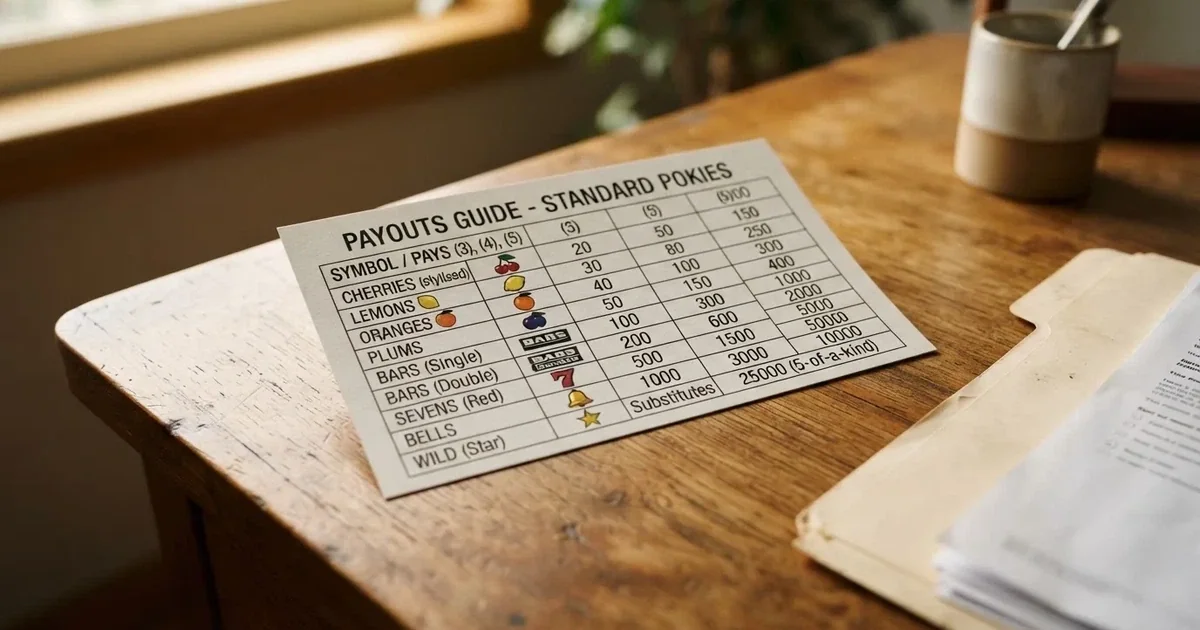
A pokie is an electronic gaming machine. On a land-based machine in a licensed venue, the screen shows a set of reels — typically five — covered in symbols. A paytable, printed on the machine or accessed through a menu, tells the player what each combination of symbols pays. Three matching low-value symbols might return a small multiple of the stake; five matching premium symbols might return a large one. A line that passes through matching symbols across adjacent reels, from left to right, is a “payline,” and most modern machines offer dozens or hundreds of them.

Online, the same mechanics apply. A digital reel set spins, the paytable governs the payouts, and a Random Number Generator (RNG) determines the outcome of each spin independently of the last. The catalogue at an online casino is organised by theme, by provider, and by mechanical feature. Free-spin rounds, expanding wilds, cascading reels, and progressive jackpots are all standard library categories. None of these features changes the underlying math: the house keeps a percentage of every dollar wagered, and that percentage is the Return to Player (RTP) read backwards.
The legal minimum RTP for poker machines varies by jurisdiction in Australia. New South Wales, the Northern Territory, Queensland, and most of Victoria set it at 85% (Crown Melbourne operates at 87%). The Australian Capital Territory and Tasmania require 87%, South Australia 87.5%, and Western Australia 90%. Those floors apply to land-based machines in licensed venues. Offshore online pokies are not bound by them, and the RTP shown on any offshore site’s paytable is whatever the operator chose to publish — verifiable by independent testing laboratories at best, self-reported at worst.
The point of knowing the mechanics is not to beat the machine — no system of bet sizing, timing, or “due” symbols changes the expected return — but to read a paytable critically. A game advertised as “96% RTP” still keeps 4 cents in the dollar on average across millions of spins. For an individual session, the variance is enormous: a player can be well ahead or well behind in the short run and still be exactly on the long-run percentage.
What the Law Actually Says: The Interactive Gambling Act 2001
The Interactive Gambling Act 2001 (IGA), tightened by the Interactive Gambling Amendment Act 2017, makes it an offence to provide online casino games, online pokies, or in-play betting to a person in Australia. The offence sits with the provider, not the player — no Australian has been prosecuted for placing a bet on an offshore site — but the practical consequence for the player is that no offshore casino is licensed by any Australian regulator, is not bound by Australian consumer law, and offers no Australian complaints body if a withdrawal is refused or a bonus term is enforced against the player.

What is licensed under Australian law is wagering on races and sporting events placed before the event begins, lotteries, and keno. In practice, the bulk of Australia’s online bookmakers — Sportsbet, Bet365, Ladbrokes, and others — hold their licence from the Northern Territory Racing and Wagering Commission (NTRWC). The NTRWC regulates 52 of those operators. It runs with no full-time staff and meets once a month in Darwin, a fact that has drawn parliamentary criticism but does not change the legal status of the licence itself. None of those 52 licences covers online casino games or online pokies.
Online casino is prohibited. Online pokies are online casino games. There is no carve-out for “Aussie-themed” branding, no exemption for sites that accept Australian dollars, and no loophole for an operator registered in a jurisdiction perceived as friendly. A Curaçao or Anjouan licence displayed on an offshore site is a licence issued by that jurisdiction; it is not an Australian licence and confers no Australian protection.
Minimum age for any gambling activity in Australia is 18.
What the ACMA Has Actually Done
The Australian Communications and Media Authority (ACMA) is the federal regulator tasked with investigating complaints about illegal gambling services and directing Australian internet service providers to block them. As of June 2026, the ACMA had asked ISPs to block 1,751 illegal gambling and affiliate marketing websites since the first blocking request in November 2019, and more than 230 unlicensed gambling services had left the Australian market since enforcement was strengthened in 2017.
A blocking request is not the only tool. The ACMA also issues formal warnings — public notices naming the operator behind an illegal service, the date of the warning, and the section of the IGA the service is alleged to have breached. These warnings are published on the ACMA’s website and remain there permanently. They are the most reliable public record of which offshore brands the regulator has acted against.
The pace is steady. In a single round reported on 26 June 2026, the ACMA requested ISPs block 12 more sites: 7Signs, ChromaBet, Donbet, Duospin, Freshbet, Slots Gem, Jacks Club, Lucky Start, Pointsbetz.com, Spinrise, Vinyl Casino, and Wildsino. Earlier in 2026, formal warnings had gone out to Ryker B.V. over Jackbit and CasinOK (April 2026) and to Pulsup Ltd over Rocketplay.com.au (March 2026). In 2025 alone, the regulator warned Dama N.V. over Woo Casino (March) and Spirit Casino (May); Bamboo Media over Ignition Casino and Consolutetish S.R.L. over National Casino and Bizzo Casino (July); EOD Code SRL over Instant Casino (February); and Sterplay Holding Ltd over Casino Intense (April).
Bizzo Casino had already been warned once — in 2022, when the ACMA addressed the warning to TechSolutions (CY) Group Limited and TechSolutions Group N.V. That earlier warning did not stop the brand from continuing to market to Australians; it merely changed which corporate entity the regulator named.
The Blocking Rate Since 2019
Between November 2019 and June 2026 — roughly 79 months — the ACMA moved from its first blocking request to a cumulative total of 1,751 blocked sites. That works out to roughly 22 blocked sites per month across the period, though the rate is not uniform: enforcement accelerated after 2017 and has produced larger batches as the ACMA’s investigative capacity has grown. The 1,751 figure is a running total that includes both gambling sites and affiliate marketing pages that promoted them; the affiliate pages are blocked because they are part of the supply chain that delivers customers to the prohibited services.
The rate matters less than what it represents. Every site on the list is one the ACMA found to be offering prohibited interactive gambling services to Australians. Every month a new batch is added. The list is public, and the curve has not bent downward.
The Operators the ACMA Has Warned
What follows is every brand the ACMA has formally warned over for offering online casino games — including online pokies — to Australians, in the order the regulator’s own publications place them. This is not a ranking and not a recommendation. Each brand is here because the ACMA named it. The online casino product on offer is not licensed in Australia, whatever licence the site itself displays. No bonus terms are reproduced, because the only sources for those terms were affiliate marketing pages whose reliability the ACMA’s actions implicitly question.
RocketPlay
The ACMA issued a formal warning to Pulsup Ltd over Rocketplay.com.au in March 2026. Dama N.V., an earlier operator of the same brand, had already been warned in May 2022 as part of a batch that also named Bambet, Dazard, Level Up, Wild Tornado, and Cobra Casinos. The fact that the brand moved between operators without changing its Australian marketing is itself the pattern the regulator is trying to discourage.
Level Up Casino
The ACMA warned Dama N.V. over Level Up Casino in May 2022. The brand appears in industry listings as a client of BGaming, a game provider — that is the only verifiable subject link, and it says nothing about whether the casino itself is licensed to operate in any given country.
Woo Casino
The ACMA warned Dama N.V. over Woo Casino in March 2025. No verifiable game-provider or payment-method data is on the public record for the brand beyond the regulator’s own warning.
Spirit Casino
The ACMA warned Dama N.V. over Spirit Casino in May 2025. Like Woo Casino, the brand carries no public data on its operator beyond what the ACMA’s warning discloses.
National Casino
The ACMA warned Consolutetish S.R.L. over National Casino in July 2025. The brand appears in general Wikipedia listings of offshore casino operators; that is the extent of the verifiable trail.
Bizzo Casino
The ACMA warned Consolutetish S.R.L. over Bizzo Casino in July 2025. Bizzo had already been the subject of a 2022 formal warning, addressed to TechSolutions (CY) Group Limited and TechSolutions Group N.V. Two warnings, two operators, one brand still marketing to Australians.
Ignition Casino
The ACMA warned Bamboo Media over Ignition Casino in July 2025. The brand is best known in the United States market, where it operates under different rules; its Australian-facing activity falls squarely inside the prohibition.
Instant Casino
The ACMA warned EOD Code SRL over Instant Casino in February 2025. No further public data on the operator is available beyond the warning itself.
Jackbit
The ACMA warned Ryker B.V. over Jackbit in April 2026. The same operator was warned at the same time over CasinOK, a second brand under the same corporate umbrella.
Casino Intense
The ACMA warned Sterplay Holding Ltd over Casino Intense in April 2025. The brand appears in mainstream Australian press coverage and in ACMA publications; neither constitutes an endorsement, and the offshore status of the operator is unchanged.
Sky Crown
The ACMA warned Hollycorn N.V. over Sky Crown (and its sister brand Blue Leo) in a formal warning published in September 2022. Hollycorn is a known white-label operator running multiple brands under shared corporate infrastructure; the warning applied to the corporate entity, not just the brand.
The Pattern Behind the Names
Read across, the operator list tells a consistent story. The same corporate groups — Dama N.V., Hollycorn N.V., Consolutetish S.R.L. — appear repeatedly, sometimes warning the same regulator under different brand names, sometimes changing corporate shells and starting again. The ACMA’s enforcement acts on the entity it can name; the industry responds by spinning up a new entity. The player, who only sees the brand, has no easy way to know which corporate shell is behind a given site on any given day.
| Brand | ACMA action and date | Operator named by the ACMA |
|---|---|---|
| RocketPlay | Formal warning, March 2026 | Pulsup Ltd (Rocketplay.com.au); earlier Dama N.V., May 2022 |
| Level Up Casino | Formal warning, May 2022 | Dama N.V. |
| Woo Casino | Formal warning, March 2025 | Dama N.V. |
| Spirit Casino | Formal warning, May 2025 | Dama N.V. |
| National Casino | Formal warning, July 2025 | Consolutetish S.R.L. |
| Bizzo Casino | Formal warning, July 2025 | Consolutetish S.R.L.; earlier TechSolutions, 2022 |
| Ignition Casino | Formal warning, July 2025 | Bamboo Media |
| Instant Casino | Formal warning, February 2025 | EOD Code SRL |
| Jackbit | Formal warning, April 2026 | Ryker B.V. |
| Casino Intense | Formal warning, April 2025 | Sterplay Holding Ltd |
| Sky Crown | Formal warning, September 2022 | Hollycorn N.V. |
What Offshore Bonuses Actually Cost
The inducements on offer at offshore casinos — deposit-match bonuses, free-spin packages, “no deposit” credits — are not illegal in themselves. They are illegal to advertise to Australians, and they exist on sites that are themselves illegal to operate for Australians, but the headline numbers get attention precisely because they are designed to.
A “100% match up to A$500” means the casino doubles a deposit, up to a cap. The cost is in the wagering requirement — the number of times the bonus (and sometimes the deposit) must be turned over before any of it can be withdrawn. A typical requirement is 35x to 50x the bonus. At 40x on a A$500 bonus, the player must wager A$20,000 before the bonus funds convert to withdrawable cash. A maximum-bet clause usually applies (often A$5 per spin), and a game-weighting clause usually means only slots count at 100% toward the requirement; table games contribute less or nothing.
The free-spin offer works similarly. “100 free spins on a named game” sounds like a gift. In practice the spins are usually locked to one or two low-RTP games, the winnings are credited as bonus funds, and the same wagering requirement applies before withdrawal. A max-cashout cap — “winnings from free spins capped at A$100” — is common. The headline number is the spin count; the real number is the cap.
“No deposit” credits — a small bonus credited without requiring a deposit — carry the highest effective wagering requirements because the casino is giving away something for nothing and pricing for it. A A$10 no-deposit bonus at 60x wagering means the player must place A$600 in bets before the A$10 (minus whatever was lost along the way) becomes withdrawable. Most players never reach that point.
The arithmetic on these offers is straightforward. Every bonus is a loan with terms. The terms are written to make the loan expensive to clear. The player who treats a bonus as a way to extend play rather than as a way to make money is closer to the truth of what is on offer.
PayID, BPAY, and the Payment Picture
For licensed Australian wagering — sports and racing — the legal deposit routes are debit card, bank transfer, PayID/Osko, and BPAY. Credit cards, credit-related products, and digital currency have been banned as payment for licensed online wagering since 11 June 2024, with penalties up to A$247,500 for operators that accept them.
An offshore casino is not bound by those rules. Most offshore sites will accept a credit card; many will accept cryptocurrency. Some will accept PayID. The fact that an offshore site accepts PayID does not make it licensed — PayID is a payment rail operated by Australian banks, and the receiving account can be held anywhere. A site that advertises PayID deposits while being unlicensed for online casino is using an Australian payment method to lend credibility to an operation the ACMA has explicitly warned Australians against.
The withdrawal picture at an offshore site is where the absence of Australian consumer protection becomes concrete. A withdrawal request can sit pending for days while “verification” documents are requested — passport, utility bill, proof of source of funds — multiple times. Some sites process e-wallet withdrawals in 24 hours and bank transfers in 3-5 business days; others quote those timelines and then ignore them. There is no Australian regulator to escalate to. The only recourse is the operator’s own complaints process, and the operator has no obligation to respond.
Responsible Gambling: What Help Looks Like
If playing offshore pokies is starting to feel like a problem, the Australian help network is the same one that serves players of licensed products. Gambling Help Online offers free, confidential support 24/7 via chat and email. The National Gambling Helpline — 1800 858 858 — is free and available around the clock.
BetStop, the National Self-Exclusion Register, has been live since August 2023. A player who registers with BetStop is excluded from every Australian-licensed online and phone wagering service. The exclusion does not extend to offshore casinos, which are not connected to the register. A person who has registered with BetStop and then opens an account at an offshore site has not technically breached their BetStop exclusion — they have stepped outside the system that exclusion covers. The offshore site has no way to check.
Pre-commitment cards, which would let a player set a hard dollar limit before they sit down at a machine, are being rolled out state by state. Tasmania planned nation-leading mandatory pre-commitment cards, but implementation of the reform was delayed until late 2025. New South Wales is phasing in similar technology for venues above a threshold size. These tools apply to land-based machines in licensed venues — not to offshore online play.
Land-Based Pokies: The Legal Alternative
The 1956 introduction of poker machines to New South Wales registered clubs marked the start of legal pokie play in Australia. By every measure, the country now has one of the highest concentrations of machines per capita in the world — about 3% of the world’s pub and club poker machines, with 0.3% of the global population. In 2020–21, Australians bet close to A$150 billion through gaming machines and lost A$12.18 billion on them.
The machines are licensed state by state. New South Wales had 87,298 gaming machines outside casinos across 2,195 venues as of June 2023, with player losses of A$8.18 billion in 2022–23. Queensland had 21,122 machines in 351 venues in October 2023. Victoria had 26,380 outside Crown Casino in 488 venues in 2021–22, under a statewide cap of 30,000. Western Australia banned poker machines in pubs and clubs when Crown Perth opened in 1985; the Perth casino’s own count has since grown from about 200 to roughly 2,500, all approved by the state’s Gaming and Wagering Commission.
Tasmania’s poker-machine market was a monopoly held by Federal Group from 1968 until legislation passed in November 2021 ended that arrangement and moved oversight to the Tasmanian Liquor and Gaming Commission. The reform was paired with the pre-commitment card rollout that has since been delayed.
The legal minimum return-to-player on these machines varies by jurisdiction — 85% in NSW, the NT, Queensland, and most of Victoria; 87% in the ACT and Tasmania; 87.5% in South Australia; 90% in Western Australia. Those are floors, not averages. A venue can offer machines above the floor; a player who knows the difference can choose to play only machines with published RTPs at or above 90%.
None of this is online. The IGA’s prohibition is specific to interactive (online) gambling services. A poker machine inside a Crown casino or a suburban RSL club is a licensed product, regulated by a state authority, with a complaint pathway and a self-exclusion option. It is not the product the search “best aussie pokies online australia 2026” is asking about, and the article language about RTPs, paytables, and free spins still applies — but the legal frame around it is entirely different.
The 2026 Reform and What It Will Change
The Interactive Gambling Amendment (Gambling Reform) Bill 2026 passed Parliament on 19 August 2026. Its advertising and inducement measures commence on 1 January 2027 — law with a start date, not yet in force on a page read in 2026.
The reform tightens what licensed operators may advertise and what inducements they may offer. It does not legalise online casino games or online pokies. The prohibition stands. What changes is the perimeter around how licensed wagering is marketed to Australians, with the intent of reducing the harm that aggressive promotional content can cause. Offshore operators, who are not bound by Australian law in the first place, are unaffected by the reform on its face; the practical question is whether the reform’s restrictions on licensed operators push more players toward offshore sites, and how the ACMA responds to any resulting increase in offshore activity.
Tax: What the ATO Says
Gambling winnings of a recreational player are not assessable income in Australia, and losses are not deductible — that is the position under section 6-5 of the Income Tax Assessment Act 1997. The model only changes if the ATO concludes a person is carrying on a business of gambling, in which case the activity becomes assessable.
For a reader who plays offshore pokies casually, the practical answer is no tax is owed on winnings and no deduction is available for losses. The ATO’s guidance is general and does not differentiate between licensed and offshore play; it differentiates between recreational and business activity. A player who treats offshore pokies as a side income and who keeps careful records is taking a position the ATO may or may not accept. A player who plays occasionally and withdraws winnings to a bank account is well within the recreational model.
The “check with the ATO” caveat is not a dodge; it is the only honest framing for what is, at the margin, a fact-specific question.
The Comparison That Cannot Be Made
A traditional casino comparison ranks operators by game selection, bonus terms, payment speed, and customer support. That comparison cannot be made here, because the product itself is prohibited. Ranking unlicensed operators would be ranking them on how well they evade Australian law, which is not a metric a guide should publish. Describing their bonus terms would require sourcing those terms from affiliate marketing pages whose reliability the ACMA’s enforcement record calls into question. And recommending one over the others would imply that any of them is a sensible place for an Australian to play, when the legal position is that none of them is.
What can be said is this: every brand in this guide has been formally warned by Australia’s federal regulator for offering prohibited services to Australians. Some have been warned more than once. Several share corporate ownership with brands also on the list. None holds an Australian licence for the product on offer. The deposit and withdrawal experience is governed by the operator’s own terms, with no Australian complaints body to escalate to if those terms are enforced against the player.
A reader who has decided to play anyway should treat the ACMA warning list as the floor of due diligence, not the ceiling.
Where to Get Help
If the information in this guide has prompted a reader to reconsider, the Australian help network is free and confidential. Gambling Help Online runs 24/7 chat and email support. The National Gambling Helpline — 1800 858 858 — is free from any Australian phone, any time of day or night. BetStop, the National Self-Exclusion Register, excludes a person from every Australian-licensed online and phone wagering service, though not from offshore sites.
For readers concerned about someone else’s gambling, the same helpline takes calls from family members and friends. State-level gambling support services exist in every jurisdiction and can be reached through the national number.
Frequently Asked Questions
Does calling an online pokies site “Aussie” change where it is actually licensed?
No. Branding is a marketing choice, not a regulatory one. A site that calls itself “Aussie” or uses Australian imagery, accepts Australian dollars, or markets in Australian English is not, by virtue of any of those, licensed in Australia. The Interactive Gambling Act 2001 makes it an offence to provide online casino games to a person in Australia; “Aussie-themed” is not one of the available defences.
Are the bonus credits and free spins on an “Aussie pokies” site legal to advertise here?
No. Under the Interactive Gambling Act 2001 and the reform measures commencing 1 January 2027, advertising inducements to use prohibited interactive gambling services is unlawful. The bonus itself is not the offence — offering the prohibited service is. The inducement is evidence of the offer, and the ACMA’s enforcement record shows it acts on both.
Is there a dedicated app for Aussie-branded online pokies that’s legal to install locally?
No. The Google Play and Apple App Store policies for Australia both block apps that facilitate online casino gambling, which the IGA prohibits. A site offering a downloadable app or a mobile-optimised browser experience is operating offshore; installing the app, in itself, is not the offence, but using it to play is to use a prohibited service.
Do state gaming regulators recognise any “Aussie online pokies” brand as licensed?
No. State and territory regulators — Liquor & Gaming NSW, the Victorian Gambling and Casino Control Commission, the Queensland Office of Liquor and Gaming Regulation, and the others — license land-based venues and, in the Northern Territory, online bookmakers. None of them licenses an online casino or an online pokies site. A “licensed by a state regulator” claim on an offshore site’s footer is either a misstatement or a reference to a different product (a wagering licence, a lottery licence) the regulator did issue.
How does an Aussie-branded online pokies catalogue differ from a licensed pub’s machines?
The mechanics are similar — reels, paylines, bonus features, an RTP figure. The differences are regulatory. A licensed pub’s machines have an RTP at or above the state-mandated floor, are physically located in a venue with responsible-gambling signage and trained staff, and are connected to state-level self-exclusion and pre-commitment systems. An offshore online pokie has none of those guardrails. The spin is the same; the environment around it is not.
Can an Aussie-branded online pokies site accept a PayID deposit and still be unlicensed?
Yes. PayID is a payment rail operated by Australian banks; the receiving account can be held by any entity with an Australian bank account, including an offshore operator. The payment method is not the licence. A PayID deposit at an unlicensed site is not illegal for the player under the IGA, but it funds a prohibited service, and the deposit has none of the consumer protections that come with a deposit at a licensed Australian wagering operator.