
Best Online Pokies in Australia: What the 2026 Landscape Actually Looks Like
The honest answer up front: there is no licensed, ranked list of online pokies sites for Australians, because online pokies cannot be licensed anywhere in this country. What exists offshore is a market the Australian Communications and Media Authority has spent the better part of a decade winding down. This page works through what that means for someone who has typed this search — what an online pokie actually is, why the legal landscape looks the way it does, what ACMA enforcement has done to the offshore market, and what the eleven brands on the regulator’s recent warning list actually represent.
Currency and enforcement status checked against the ACMA’s published actions as of 29 October 2026, with H2 Gambling Capital’s 2025 market estimate and the ABC’s reporting on state-level machine regulation used as supporting references.
Table of Contents
- What an Online Pokies Paytable Shows
- Why No Ranked List of Online Pokies Sites Exists for Australians
- The Landscape: How Big the Market Actually Is
- How the Prohibition Actually Works
- What That Costs Someone Playing on an Offshore Site
- Where a PayID Deposit Fits
- What Bonus Credit on an Offshore Site Actually Involves
- Responsible Play and Where to Get Help
- The Operators on the ACMA’s Recent Warning List
- Comparison Across the Featured Brands
- Tax on Gambling Winnings
- The Calculation in One Place
- Frequently Asked Questions
What an Online Pokies Paytable Shows
Every slot machine, online or land-based, runs on the same skeleton: a paytable. Reading one is the difference between thinking a game is paying well and knowing it is not.

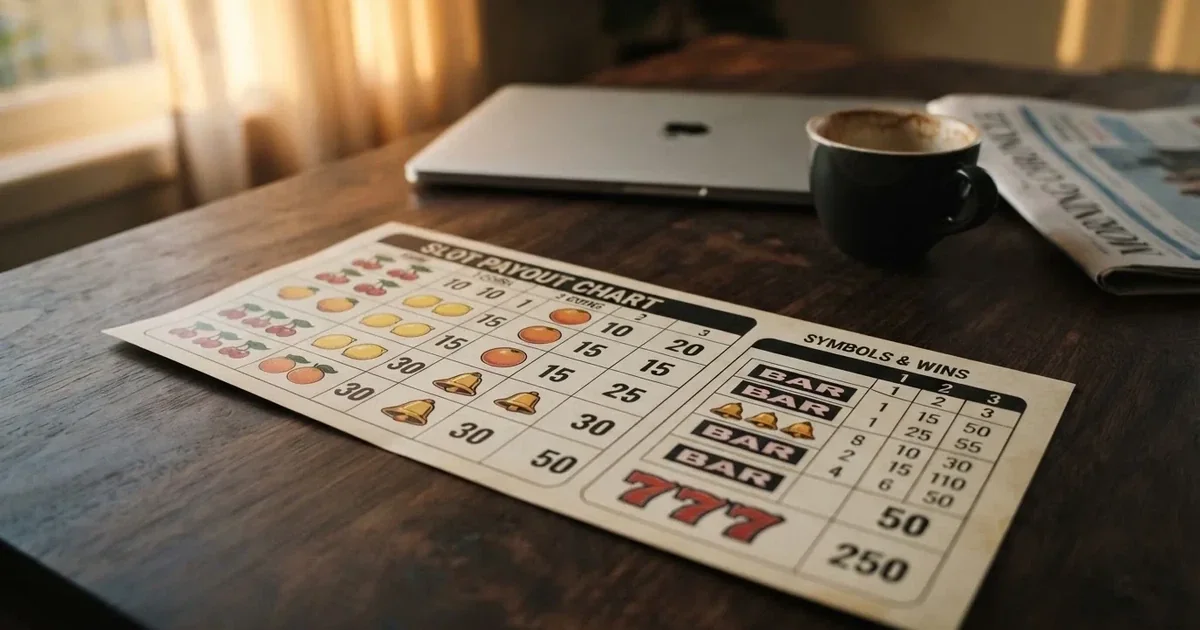
A printed strip of generic slot symbols and payout numbers laid on a desk, like a reference chart rather than a live game. The ACMA issued formal warnings over Woo Casino in March 2025 and Spirit Casino in May 2025.
Symbol values sit at the top. Each icon — a fruit, a bell, a styled “7” — has a value attached to it, and the rarer the symbol the higher that value climbs. Five low-tier cherries on a payline might return a fraction of the stake; five of the top symbol can return hundreds or thousands of times the line bet. Wilds substitute for other symbols to complete a line; scatters trigger free-spin rounds or bonus features without needing to land on a particular payline.
Paylines are the second column. A classic three-reel game might run a single horizontal line across the middle; a modern five-reel video slot runs anything from ten fixed lines to several hundred “ways to win,” where adjacent matching symbols anywhere on adjacent reels count. The number of lines is rarely the deciding factor in what a game pays back — that figure lives in the return-to-player number further down the sheet.
The return-to-player figure, or RTP, is the percentage of all wagered money a game is mathematically programmed to return over an enormous number of spins. A 96% RTP means that, across millions of spins, the machine returns $96 of every $100 wagered; the remaining $4 is the house edge. RTPs vary by game and by jurisdiction. For Australian land-based poker machines, the minimum return is set state by state — 85% in New South Wales, the Northern Territory and Queensland, 87% in the Australian Capital Territory and Tasmania, 87.5% in South Australia, and 90% in Western Australia (Crown Perth). Online pokies hosted offshore are not bound by those floors; the figure is whatever the operator publishes.
Volatility, sometimes called variance, sits next to RTP and matters more for the experience of playing. A low-volatility game pays small wins frequently; the bankroll drifts gently downward. A high-volatility game pays rarely and large; long losing stretches punctuated by bigger hits. Two games at 96% RTP can feel completely different depending on which volatility class they sit in.
The progressive jackpot is the last item worth understanding. Some pokies feed a percentage of every wager into a pooled jackpot that grows until someone hits the triggering combination. The trade-off is a slightly lower base RTP to fund the pool. The jackpot itself is real money; the path to it is the same mathematical house edge as any other spin.
Why No Ranked List of Online Pokies Sites Exists for Australians
The short answer: the Interactive Gambling Act 2001, strengthened by the Interactive Gambling Amendment Act 2017, makes it an offence to provide online casino games — online pokies included — to a person physically in Australia. No state or territory issues a licence for them. What is licensable is wagering on races and sport placed before the event, lotteries and keno; in practice that wagering is licensed by the Northern Territory Racing and Wagering Commission, which regulates 52 of Australia’s online bookmakers (including Sportsbet, Bet365 and Ladbrokes) despite having no full-time staff and meeting once a month in Darwin.
Any site ranking “the best online pokies for Australian players” is therefore ranking offshore operators that the regulator has been working to block. Some of those operators do carry a gambling licence from Curaçao, Anjouan or Malta; none of those licences authorise them to take Australian customers. The licence displayed in a site’s footer is a business-licence, not a passport to this market.
The eleven brands reviewed in the operator section below are all on the ACMA’s published formal warning list. They are not a top ten in any normal sense of the phrase — they are the most recent warnings the regulator has issued, and the only honest way to present them is as the regulator’s own list rather than as a recommendation.
The Landscape: How Big the Market Actually Is
Australia has roughly 0.3% of the world’s population and about 3% of the world’s pub and club poker machines. In 2020–21 Australians bet almost A$150 billion through gaming machines and lost A$12.18 billion on them. Those figures cover the legal land-based machines, of which New South Wales alone runs 87,298 outside casinos across 2,195 venues (June 2023) and recorded player losses of A$8.18 billion in 2022–23.
| State/Territory | Gaming Machines | Annual Losses (approx) |
|---|---|---|
| New South Wales | 87,298 | A$8.18 billion |
| Queensland | 21,122 | Not stated |
| Victoria | 26,380 | Not stated |
Registered clubs operated Australia’s first legal poker machines from 1956, in New South Wales. Western Australia banned poker machines in pubs and clubs when Crown Perth opened in 1985; the casino’s own machine count has since grown from about 200 to roughly 2,500, all approved by the state’s Gaming and Wagering Commission. Tasmania’s machines were run under a Federal Group monopoly from 1968 until legislation passed in November 2021 moved oversight to the Tasmanian Liquor and Gaming Commission. Tasmania also planned nation-leading mandatory pre-commitment cards for its machines, but implementation of the reform was delayed until late 2025.
The legal market is huge. The illegal offshore market is larger still by some measures. H2 Gambling Capital’s 2025 report estimates that Australians lose about A$3.9 billion a year to illegal gambling sites, and that the share of gambling going through legal channels fell from 74% in 2021 to 64%. The fall is partly ACMA enforcement, partly a market migration: every site blocked in Australia simply re-opens under a new domain the following week, and the regulator’s blocking requests only apply to Australian internet service providers.
How the Prohibition Actually Works
The Interactive Gambling Act 2001 targets the provider, not the player. An Australian punter who places a bet on an offshore poker machine is not prosecuted; the operator offering the service to Australians is the one the ACMA goes after. The regulator has three tools: investigations, formal warnings, and directions to Australian internet service providers to block illegal sites at the DNS level.

A tidy desk with a laptop open on a plain search-results page, a notebook and a coffee cup beside it, no screens showing any casino branding. In July 2025 the ACMA issued formal warnings over Ignition Casino, National Casino and Bizzo Casino, the last of which had already been warned in 2022.
The blocking tool is the most visible. By June 2026 the ACMA had asked Australian ISPs to block 1,751 illegal gambling and affiliate marketing websites since the first blocking request in November 2019, and more than 230 unlicensed gambling services had left the Australian market since enforcement was strengthened in 2017. The most recent round, reported on 26 June 2026, added 12 more sites to the block list: 7Signs, ChromaBet, Donbet, Duospin, Freshbet, Slots Gem, Jacks Club, Lucky Start, Pointsbetz, Spinrise, Vinyl Casino and Wildsino.
The arithmetic on that record is a useful way to see the scale of the market. From November 2019 to June 2026 is roughly six and a half years, or about seventy-nine months. Dividing 1,751 blocked sites across that window produces a rate of around 22 blocked domains a month, or roughly 265 a year. That figure covers only the sites the regulator has formally moved against; the actual market churn is higher, since single operators commonly run multiple mirror domains at once and the block list catches them as they are identified.
The formal-warning tool is slower and more public. A formal warning puts the operator on notice that the ACMA considers its activity a contravention of the Interactive Gambling Act; subsequent breaches can lead to civil penalty proceedings in the Federal Court. The warnings published on the ACMA’s site are the source material for the operator section further down.
The 2026 reform extends the regulator’s reach. The Interactive Gambling Amendment (Gambling Reform) Bill 2026 passed Parliament on 19 August 2026; its advertising and inducement measures commence 1 January 2027. On a 2026 page those provisions are law with a future start date rather than in force.
What That Costs Someone Playing on an Offshore Site
The arithmetic of offshore play does not start and end with the house edge. Three costs sit on top of the wager.
The first is the absence of Australian consumer protection. An offshore site gives no Australian complaints body, no Australian regulator to escalate to, and no recourse if a withdrawal is refused. Some sites will simply decline to pay a large win, citing a clause in their terms that an Australian reader has no practical way to enforce.
The second is the block risk. The ACMA’s block list is updated frequently, and a site blocked while a balance is still sitting on it leaves the player in an awkward position: the balance exists, the site is reachable only through a VPN, and the operator knows the player has no alternative route to dispute the funds. The blocking rate of roughly 22 sites a month means the site a reader opens this week may be unreachable next month without warning.
The third is the payment-method risk. A site asking an Australian for a credit card or a crypto deposit is operating outside the Australian rules. Credit cards, credit-related products and digital currency have been banned as payment for licensed online wagering since 11 June 2024, with penalties up to $247,500 for operators. Legal deposit routes for licensed wagering are debit card, bank transfer, PayID/Osko and BPAY; offshore pokies sites that take credit cards or cryptocurrency are not bound by that ban, which is precisely because they are not licensed here.
The combination is straightforward: an Australian player at an offshore site is paying the game’s house edge, accepting no local protection, and betting that the site will not be blocked before any winnings are withdrawn. That is the cost the marketing does not list.
Where a PayID Deposit Fits
PayID is the New Payments Platform address used by Australian banks — a phone number, an email or an ABN linked to a bank account, routing an Osko payment in seconds. For licensed Australian wagering it is the standard deposit route. For offshore pokies sites, it is largely irrelevant: most offshore operators do not list PayID as a deposit option, and those that do are routing through a payment processor rather than through the Australian payments system proper.
A reader who sees PayID on an offshore casino’s cashier page should read it as a payment-processor relationship, not as a sign the site is Australian or regulated. The deposit clears through the player’s bank as a normal Osko transfer, but the operator on the other end remains outside Australian jurisdiction. The PayID label does not change the legal status of the gambling on offer.
What Bonus Credit on an Offshore Site Actually Involves
The standard structure of an offshore pokies welcome package runs in three parts: a deposit match (the site adds a percentage of the player’s first deposit as bonus money), free spins (a fixed number of spins on a named game at a fixed stake), and occasionally a no-deposit credit (a small amount credited for registration alone).
The cost sits in the terms behind the offer. Three numbers matter:
- The wagering requirement. Bonus money is rarely withdrawable as cash. The player has to wager the bonus amount — sometimes the bonus plus the deposit — a fixed multiple of times before any winnings can be cashed out. A 40x requirement on a $100 bonus means $4,000 of wagers before the bonus balance converts.
- The maximum cashout cap. Many offers cap the amount convertible from bonus play, so a player who hits a large win during the wagering period may only be able to withdraw a fraction of it.
- The game weighting. Pokies almost always contribute 100% to the wagering requirement; table games contribute a fraction. A player using bonus money on baccarat or blackjack will clear the requirement much more slowly than the same stakes on a slot would clear it.
The marketing word for this is “free.” The arithmetic on it is not free. The wagering requirement is the price of admission, and the maximum cashout cap is the ceiling on what the player can take away from a bonus-funded session. A player who reads only the headline number — “$1,000 welcome bonus” — and not the terms behind it has not seen the offer yet.
Responsible Play and Where to Get Help
If thinking about gambling ever starts to feel compulsive or stressful, free confidential help is available around the clock through Gambling Help Online and the National Gambling Helpline on 1800 858 858. Both services cover all of Australia, both are free, and both are confidential.
BetStop, the National Self-Exclusion Register, has been live since August 2023. It binds Australian-licensed online and phone wagering services; an offshore casino is not connected to it. A player who has registered with BetStop and then opens an offshore account has not excluded themselves from that offshore site — only from the Australian-licensed bookmakers and wagering operators that participate in the register. The distinction matters: self-exclusion only works where the system that holds it can see the account being opened.
A red triangular warning sign icon on a laptop screen next to a stack of legal papers, symbolising an official caution rather than any specific website. In February 2025 the ACMA issued a formal warning over Instant Casino.
For someone worried about their own play or someone else’s, the practical sequence is: contact Gambling Help Online or the helpline, register with BetStop if the wagering is going through Australian-licensed services, and avoid offshore sites entirely — they cannot be excluded from, they cannot be complained about locally, and a balance on them is at the operator’s discretion.
The Operators on the ACMA’s Recent Warning List
What follows is not a ranking. Each of the eleven brands is named because the Australian Communications and Media Authority itself has issued a formal warning over it for offering prohibited online casino services to Australians. These sites are not authorised to take Australian customers, regardless of any licence they may display.
The information below is taken from the ACMA’s published formal warnings. Where research carries no figure on a brand, that is recorded as unknown rather than estimated.
RocketPlay
Pulsup Ltd is the operator cited by the ACMA regarding Rocketplay, following a March 2026 formal warning. The site was previously included in a May 2022 action against Dama N.V. — one of six brands then under scrutiny. These services are prohibited in Australia.
A reader who reaches RocketPlay through a search result or an affiliate link is being routed to a site the Australian regulator has twice warned and continues to name in its published actions. The site’s claim to a Curaçao licence is a business-licence from another jurisdiction, not an Australian authorisation. There is no Australian body to complain to if a withdrawal stalls, and the site is a candidate for the next round of blocking requests.
Level Up Casino
In May 2022, the ACMA published a formal warning covering six brands: Bambet, Dazard, Level Up, Rocketplay, Wild Tornado and Cobra Casinos. All were associated with Dama N.V. They hold no valid authorisation for the Australian market.
Level Up has appeared in Bgaming’s published game-distribution listings, which is the only subject-support data the research carries for this brand — not a licence, not an Australian endorsement, simply a slot studio’s list of where its games are integrated. A reader who values the studio behind the games rather than the operator behind the cashier is making a sensible distinction; the operator’s regulatory position in Australia is unchanged.
Woo Casino
Woo Casino received a formal warning from the regulator in March 2025, directed at Dama N.V. The site is not licensed to operate in this country.
The site’s Australian position is the same as the other Dama N.V. brands reviewed here: a formal warning on the regulator’s record and no Australian licence available to apply for. A reader who has been redirected to Woo Casino from an affiliate page or a search result is being routed to a site whose Australian availability the regulator has already addressed.
Spirit Casino
Spirit Casino also saw regulator intervention in May 2025, when the ACMA warned Dama N.V. No valid Australian licence exists for this service.
The May 2025 warning is the regulator’s most recent action against this brand. The site is a candidate for a future blocking request if it continues to accept Australian customers, and any balance on it carries the same withdrawal risk as the other offshore brands in this list.
National Casino
In July 2025, the ACMA warned Consolutetish S.R.L. regarding National Casino. It is not licensed by any Australian authority.
The site has appeared in general reference coverage of the offshore casino market — the only subject-support data the research carries. National Casino’s Australian position is identical in regulatory terms to the other brands in this section: a formal warning, no Australian licence, and no local complaints body.
Bizzo Casino
Bizzo Casino was also subject to a July 2025 warning against Consolutetish S.R.L. The brand had previously been warned in 2022 under TechSolutions (CY) Group Limited. The site lacks an Australian licence.
Two formal warnings across four years make Bizzo one of the longer records on this list. The pattern — same brand, different operator entity — is itself a feature of the offshore market: a site that the regulator warns under one corporate name re-emerges under another.
Ignition Casino
Bamboo Media, the operator behind Ignition Casino, received a formal warning from the ACMA in July 2025. It is not licensed to operate in Australia.
The site’s name and presentation are pitched at the Australian and US markets; the regulatory position is identical to every other brand in this section. A reader who has been routed to Ignition from an affiliate link or a search result is being pointed at a brand the ACMA has already named in a published action.
Instant Casino
Instant Casino’s operator, EOD Code SRL, was formally warned in February 2025. This brand is not authorised here.
The February 2025 warning was the regulator’s first published action against this brand, and the site is a candidate for a blocking request if it continues to accept Australian customers. The same caveats on withdrawals and consumer protection apply as to the rest of the list.
Jackbit
Ryker B.V. was the operator named by the ACMA in a formal warning issued in April 2026 over Jackbit and CasinOK. Online casino games cannot be licensed anywhere in Australia, whatever licence the site displays.
The April 2026 warning is recent and the brand sits high on the regulator’s current watch list. Any Australian balance on Jackbit faces the same block-and-withdrawal risk as every other offshore operator reviewed here.
Casino Intense
Sterplay Holding Ltd was the operator named by the ACMA in a formal warning issued in April 2025 over Casino Intense. Online casino games cannot be licensed anywhere in Australia, whatever licence the site displays.
Casino Intense has appeared in the ABC’s reporting on the Australian illegal-gambling market and on the ACMA’s own enforcement pages — the only subject-support data the research carries. The regulator’s April 2025 action is on the record, and the brand’s Australian position follows the same pattern as the rest of this section.
Sky Crown
Hollycorn N.V. was the operator named by the ACMA in a formal warning issued in September 2022 over its Sky Crown and Blue Leo casino services. Online casino games cannot be licensed anywhere in Australia, whatever licence the site displays.
Sky Crown is the longest-running warning on this list, with the ACMA’s published formal warning going back more than three years. A pattern of repeated warnings without Australian withdrawal of service suggests the regulator’s actions are not, on their own, closing the market — which is consistent with the blocking rate arithmetic earlier in the page.
Comparison Across the Featured Brands
The table below summarises what the ACMA has published on each of the eleven brands reviewed above. The columns are the regulator’s actions, the named operator on each warning, and any external reference data the research carries on the brand. Where a column is not applicable or the research carries no data, the cell is left blank rather than estimated.
| Brand | ACMA action and date | Operator named by the ACMA | Subject support |
|---|---|---|---|
| RocketPlay | Formal warning, March 2026; earlier May 2022 | Pulsup Ltd (Rocketplay); earlier Dama N.V. | — |
| Level Up Casino | Formal warning, May 2022 | Dama N.V. | Bgaming game-distribution listings |
| Woo Casino | Formal warning, March 2025 | Dama N.V. | — |
| Spirit Casino | Formal warning, May 2025 | Dama N.V. | — |
| National Casino | Formal warning, July 2025 | Consolutetish S.R.L. | General reference coverage |
| Bizzo Casino | Formal warning, July 2025; earlier 2022 | Consolutetish S.R.L.; earlier TechSolutions | — |
| Ignition Casino | Formal warning, July 2025 | Bamboo Media | — |
| Instant Casino | Formal warning, February 2025 | EOD Code SRL | — |
| Jackbit | Formal warning, April 2026 | Ryker B.V. | — |
| Casino Intense | Formal warning, April 2025 | Sterplay Holding Ltd | ABC and ACMA references |
| Sky Crown | Formal warning, September 2022 | Hollycorn N.V. | — |
The pattern in the table tells the story. Six of the eleven warnings name Dama N.V. or its successors (RocketPlay, Level Up, Woo, Spirit, plus Bizzo and National through Consolutetish S.R.L.), suggesting the offshore market is concentrated in a small number of operator groups rotating brand names. The ACMA’s actions span 2019 to 2026 — every brand here was on the regulator’s record before the 2026 window opened.
Tax on Gambling Winnings
Gambling winnings of a recreational player in Australia are not assessable income under section 6-5 of the Income Tax Assessment Act 1997, and losses are not deductible. The exception is a person who carries on a business of gambling — a professional punter, in the tax office’s framing — whose activities may be treated as a business and taxed accordingly. The model is “check with the ATO”: the ATO’s published guidance on this is the only safe reference, and it is a reader’s own circumstances that determine which side of the line they sit on.
The Calculation in One Place
Blocking rate from November 2019 to June 2026: 1,751 blocked domains across roughly 79 months works out to a rate of around 22 sites blocked per month — between 250 and 280 a year depending on how the window is counted. The condition is that this is only the sites the ACMA has formally moved against through the blocking-request process; it does not include the sites that left the Australian market after a warning without being formally blocked, nor the mirror domains that re-emerge under a new address after each block.
Frequently Asked Questions
Is there a licensed, ranked list of online pokies sites for Australian players?
No. Online pokies cannot be licensed anywhere in Australia under the Interactive Gambling Act 2001, so no regulator in the country publishes a ranked list of operators. Any “best online pokies Australia” ranking is ranking offshore sites that the ACMA has been working to block.
Does a PayID deposit option make an offshore pokies site more Australian or legal?
No. PayID is the New Payments Platform used by Australian banks, and licensed Australian wagering services accept it. Offshore pokies sites that display PayID at the cashier are routing through a payment processor, not through the Australian system proper; the deposit still lands at an unregulated operator outside Australian jurisdiction.
What separates a licensed pub or club poker machine from an offshore “online pokies” site?
A licensed pub or club machine is approved by a state or territory regulator, sits inside Australia’s consumer protection regime, and has a regulated minimum return-to-player (85% to 90% depending on jurisdiction). An offshore “online pokies” site is none of those — it operates outside Australian law, displays a foreign business licence, and gives an Australian player no local complaints body or withdrawal guarantee.
Can an offshore site legally advertise a sign-up bonus to Australians?
No. The Interactive Gambling Act 2001 prohibits the supply of online casino games to Australians, and offering a bonus to induce sign-up is part of that supply. The ACMA has issued formal warnings over the affiliate marketing pages as well as the operators, and the 2026 reform extends the regulator’s reach further from 1 January 2027.
How would payouts on an offshore site be verified as fair?
They cannot be, in any practical sense. Offshore sites publish return-to-player figures but they are not audited by an Australian regulator, and an Australian player has no standing to compel a payout. Independent testing labs (eCOGRA, GLI, iTech Labs) audit some offshore operators, but those audits are voluntary and the player has no recourse if the site ignores the audit finding. The safest answer is that fair verification is not available in this market.
Is online pokies play covered by the same ban as online casino table games?
Yes. The Interactive Gambling Act 2001 prohibits the supply of “online casino games” to Australians, and the ACMA’s published guidance treats online pokies as a sub-category of online casino games rather than as a separate class. Both are prohibited under the same provision, both attract the same enforcement tools, and both are the subject of the same blocking requests.