Casinos that accept Ethereum in Australia — what the offer actually costs in 2026
Currency stamp: Data is current as of 29 October 2026, checked against the ACMA formal-warning register, the AUSTRAC digital currency exchange register and the Interactive Gambling Act 2001 as published. Casinos that accept Ethereum in Australia — More on this topic at crypto casino au .
An Australian player typing “casinos that accept ethereum” into a search bar is not really shopping for a payment method. They are looking for a workaround — a way to fund an account at an offshore site that local banks and local debit rails refuse to touch, or that the punter prefers to fund through a wallet they already hold. The coin is the entry point; the choice they are making is whether to play at an unlicensed site at all. Every other comparison on this page sits underneath that one decision, and the answer to it does not change because the deposit was made in ETH instead of dollars.
This page works the offer the way an offer works: it costs money, it costs time, and it has consequences after the win button is pressed. The reader profile here is an Australian adult weighing whether to fund an offshore casino with ether from a wallet they control. They want to know what confirmation actually means on the Ethereum network, what the network fee does to a small deposit, what an ACMA warning over a brand translates into in practice, and which kind of player each reviewed brand still suits even though none of them is licensed in Australia. Eleven brands surface below because the ACMA itself has acted against each of them; they are not ranked, they are not endorsed, and no bonus code is printed because none of them could be verified against any source other than affiliate marketing pages.
The honest reading is short. No Ethereum casino is lawful for an Australian resident because the activity — online casino games and online pokies — is the prohibited service, not the payment rail. The currency does not change the law. What the coin changes is the cost of getting money in and the trail left behind on a public blockchain once it is there.
Table of Contents
- How an Ethereum casino actually works for an Australian player
- The licensing question, and why no operator on this page has an answer
- What an ACMA formal warning actually means in practice
- The blocking rate, and what a blocked site costs a player with a balance
- Eleven brands the ACMA has acted against
- How an Ethereum deposit behaves on-chain once it has been made
- Taxation, conversion and what an Australian player reports to the ATO
- Responsible play, and why offshore breaks the safety net
- What an Australian player walks away with
- Frequently asked questions
How an Ethereum casino actually works for an Australian player
Ethereum the network launched in July 2015, after Vitalik Buterin conceived the project in 2013. It is a public blockchain on which every transaction is recorded in a block added to the chain; since the network switched from proof-of-work to proof-of-stake on 15 September 2022 — an upgrade known as “the Merge” — a new block has appeared roughly every 12 seconds, and energy consumption dropped by more than 99%. Ether (ETH), the network’s native asset, has no fixed maximum supply, and around 120,520,000 ETH were in circulation at the time of the Merge. None of that is gambling-specific. It is what makes the deposit work, and what makes the deposit visible.

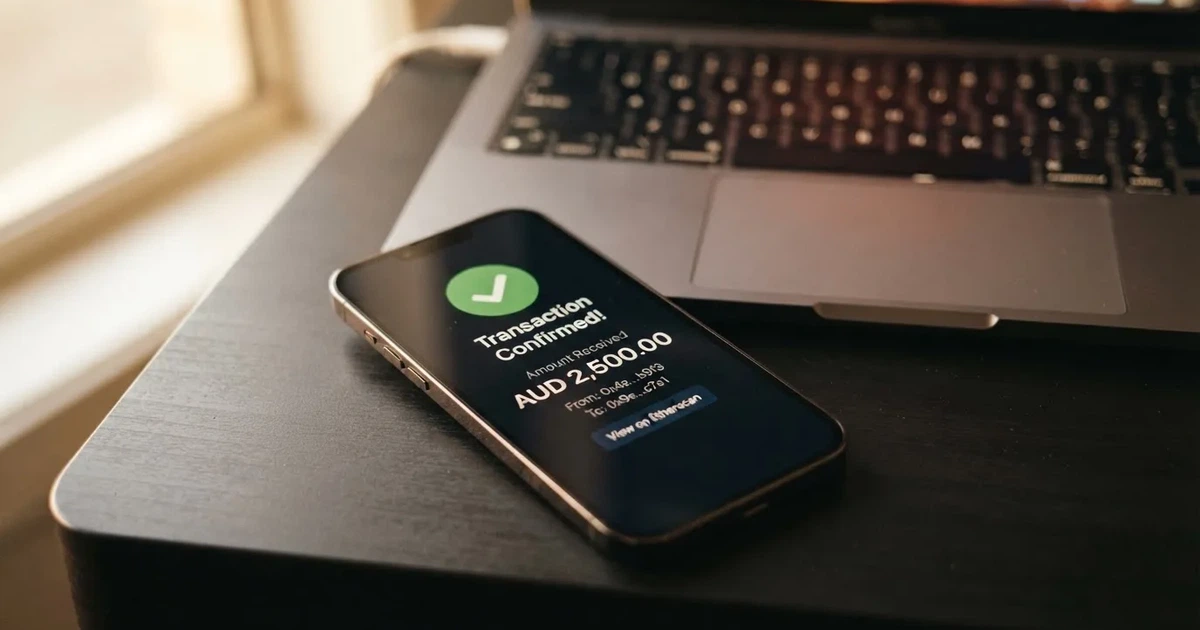
When an Australian player funds an offshore casino with ETH, the path is short and mechanical. The casino generates a deposit address — a long hexadecimal string tied to its own wallet. The player sends ETH from their own wallet to that address. The transaction is broadcast to the Ethereum network, picked up by validators, and included in a block. From the moment the transaction is included, it is publicly visible on the blockchain. Confirmation depth matters: most operators credit only after a small number of subsequent blocks have been added, which is what “waiting for confirmations” means on a deposit screen. The longer the wait, the harder it is to reverse the transaction — though on a proof-of-stake network the reversal calculus is different from proof-of-work chains because finality behaves differently across client implementations.
What the player sees is a balance in their casino account denominated in either ETH or a converted dollar figure. What the player does not see is the network fee paid to validators for the block inclusion — a fee that is set by congestion on the network at the moment of the transaction, not by the casino. On a quiet day that fee is small. On a busy day — when an NFT mint or a popular token launch crowds the mempool — the fee can rise far above the value of the deposit a small-balance player is trying to make. This is the single most predictable way an Ethereum casino costs more than the marketing page suggests.
The withdrawal path runs in reverse: the casino sends ETH from its treasury wallet to the player’s wallet address. The same fee dynamic applies in the other direction, and the same on-chain visibility applies in both directions. Every transaction, deposit and withdrawal, is a permanent public record.
The licensing question, and why no operator on this page has an answer
The Interactive Gambling Act 2001, tightened by the Interactive Gambling Amendment Act 2017, makes it an offence to provide online casino games, online pokies or in-play betting to a person physically in Australia. No state or territory licences those products. What can be licensed is wagering on races and sport placed before the event, lotteries and keno — in practice licensed through the Northern Territory Racing and Wagering Commission, which regulates 52 of Australia’s online bookmakers including Sportsbet, Bet365 and Ladbrokes, runs with no full-time staff and meets once a month in Darwin. Minimum age is 18.
The implication for an Ethereum casino is straightforward and absolute. There is no Australian licence a casino displaying a Curaçao or Anjouan seal can convert into a lawful Australian operation by accepting ETH. The licence it shows covers its incorporation, its server hosting and sometimes the integrity of its random-number generator. It does not cover offering prohibited interactive gambling services to an Australian resident. The coin is irrelevant to that calculation. The 2023 amendment to the Interactive Gambling Act 2001 added digital currency to the list of payment methods that Australian-licensed wagering services are prohibited from accepting, alongside credit cards and other credit-related products. The prohibition sits with the licensed side: an Australian-licensed bookmaker cannot take your ETH. An unlicensed offshore casino that does take your ETH is, on the Australian side of the law, in the same position it would be if it took your dollars.
The enforcement picture is the second half of the licensing answer. The Australian Communications and Media Authority (ACMA) investigates, issues formal warnings, and directs Australian internet service providers to block illegal services. By June 2026, a running total of 1,751 illegal gambling and affiliate marketing websites had been blocked since the first blocking request in November 2019, and more than 230 unlicensed gambling services had left the Australian market since enforcement was strengthened in 2017. A round reported on 26 June 2026 alone added 12 more domains to the blocking list: 7Signs, ChromaBet, Donbet, Duospin, Freshbet, Slots Gem, Jacks Club, Lucky Start, Pointsbetz.com, Spinrise, Vinyl Casino and Wildsino. A site that was accessible yesterday can be blocked tomorrow. A balance sitting on a blocked site is, in practice, a balance the player may struggle to retrieve.
The IGA targets the provider, not the individual player. Australian residents are not prosecuted for placing bets at an offshore site. They are, however, outside every layer of consumer protection that an Australian licence brings: no Australian complaints body, no recourse when a withdrawal is refused, no local deposit guarantee, no BetStop binding because BetStop — the National Self-Exclusion Register, live since August 2023 — connects only Australian-licensed online and phone wagering services.
What an ACMA formal warning actually means in practice
The ACMA’s formal-warning register is the closest thing Australia has to a public ledger of offshore brands that have crossed the line. Each warning names the operator company the ACMA believes is providing the prohibited service and the brand name visible to Australian customers. A warning is not a prosecution and is not a conviction. It is a published statement that the ACMA has formed the view that the named service is being offered in breach of the IGA, and it is followed, where the service does not remediate, by a blocking request to Australian ISPs.
Eleven brands reviewed below all carry a formal warning. The pattern is consistent: a Curaçao- or Anjouan-incorporated company, a website reachable from Australia, a payment page that accepts crypto including ETH, and an ACMA letter published on the authority’s website. Two companies appear twice in this list because the ACMA has returned to them. Dama N.V. was warned in May 2022 over six brands including Level Up and Cobra Casinos, then warned again in March 2025 over Woo Casino and in May 2025 over Spirit Casino. TechSolutions Group was warned in 2022 over Bizzo Casino; the same brand surfaced again in July 2025 under Consolutetish S.R.L. alongside National Casino. The repetition tells the reader something the warning letter itself does not: the same operator entity is willing to keep offering the service under a new brand once the warning is published.
The remaining warnings are spread across the period: Pulsup Ltd over Rocketplay.com.au in March 2026; Bamboo Media over Ignition Casino in July 2025; EOD Code SRL over Instant Casino in February 2025; Ryker B.V. over Jackbit and CasinOK in April 2026; Sterplay Holding Ltd over Casino Intense in April 2025; Hollycorn N.V. over Sky Crown and Blue Leo in September 2022.
H2 Gambling Capital’s 2025 report estimates that Australians lose about A$3.9 billion a year to illegal gambling sites, and that the share of gambling going through legal channels fell from 74% in 2021 to 64%. The offshore Ethereum casino sits squarely inside that figure. The reader should treat the warning register not as a blacklist of bad actors but as a record of the law being enforced at the edges.
The blocking rate, and what a blocked site costs a player with a balance
The arithmetic that belongs to this page is the rate at which the ACMA turns an accessible site into an inaccessible one. The first blocking request went out in November 2019. By June 2026, 1,751 illegal gambling and affiliate marketing websites had been blocked across the intervening years, with more than 230 unlicensed services having left the market entirely since 2017. The figure is a running total over roughly 80 months — not a per-month average, because enforcement happens in rounds of varying size, and because exits and blocks are two different paths to the same outcome.
Read as a band rather than a point: between November 2019 and June 2026, the ACMA blocked somewhere on the order of 20 to 25 illegal gambling and affiliate websites per month on a long-run average, with substantial month-to-month variation. The 26 June 2026 round alone added 12 names. Some rounds add one. The point is not the precise monthly count but the predictability of the trend: each passing month makes it more likely that any given offshore brand on this list will join the blocked set. The blocking rate is also the rate at which a player holding a balance at one of those brands loses their access channel — and the rate at which the casino’s customer-support email and live-chat link go dark.
A reader who treats this rate as the page’s most consequential number is reading the page correctly. The cost of playing at an unlicensed offshore site is not only the house edge. It is the probability that the site itself stops being reachable from Australia while the balance is still sitting on it.
Eleven brands the ACMA has acted against
Each brand below carries an ACMA formal warning over the operator company the ACMA names in its publication. The product is prohibited under the Interactive Gambling Act 2001, so no licence a brand displays changes the picture for an Australian resident. The brands are presented in the ACMA’s order, not as a ranking, and no bonus terms are given because the only sources for bonus terms on these brands were affiliate marketing pages, which is not a source the page draws on.
RocketPlay
Pulsup Ltd was the operator named by the ACMA in a formal warning over Rocketplay.com.au in March 2026; the Dama N.V. entity behind an earlier warning in May 2022 overlaps with parts of the Rocketplay operation. The brand is one of the most recently warned on this list. For a player who arrived at RocketPlay because it appears on affiliate comparison pages, the warning is the part that matters: the ACMA has stated its view, the IGA exposure is the same as for any other brand on this page, and the offshore company structure gives no Australian recourse on a withdrawal dispute. The brand suits a reader who has already accepted the offshore trade-off and is looking for a recently active site — but that activity is precisely what brings an ACMA round.
Level Up Casino
Dama N.V. was named in the May 2022 warning that covered six brands including Level Up. Level Up sits inside a wider Dama N.V. portfolio that the ACMA has returned to twice since — in March 2025 over Woo Casino and in May 2025 over Spirit Casino. The pattern is the same one a reader sees across the offshore market: one operator entity, multiple brand fronts, repeated warnings. For a player who values variety across Dama N.V. brands, Level Up is one option; for a player who reads the ACMA register as a signal, the repetition is itself the signal.
Woo Casino
Dama N.V. over Woo Casino, March 2025. Listings that mention Woo Casino alongside Ethereum deposits exist on third-party tracker pages, but no operator-side confirmation of Ethereum support at Woo Casino was found in research; the subject is reported only as listings describe it. The warning is recent enough that the brand is likely to remain on the ACMA’s radar in 2026. For a player who values currency breadth at an offshore casino, the listings-only Ethereum framing means the reader is relying on what comparison pages report, not on what the operator has published in its own payments page.
Spirit Casino
Dama N.V. over Spirit Casino, May 2025. Spirit is the third Dama N.V. brand to receive a fresh ACMA letter in this list, and the timing — within two months of Woo Casino — suggests the ACMA treated the portfolio as a single file rather than as one warning per URL. No Ethereum confirmation at the operator level was found in research; the brand appears in third-party comparison content only. For a reader who cares about freshness of warning, Spirit is recent; for a reader who cares about whether the coin actually works on the deposit page, research carries no answer.
National Casino
Consolutetish S.R.L. over National Casino, July 2025. National Casino appears in third-party listings as accepting Ethereum, and that framing is what the page reports — not as the operator’s own claim. The Consolutetish warning sits alongside a Bizzo Casino warning issued the same month, which suggests the ACMA again treated two brands as one operator file. For a player who reads comparison pages closely, the listings-side Ethereum framing is the available information; for a player who wants confirmation at the cashier, the cashier itself was not in the research.
Bizzo Casino
Consolutetish S.R.L. over Bizzo Casino, July 2025 — and TechSolutions (CY) Group Limited and TechSolutions Group N.V. over Bizzo Casino earlier, in 2022. Bizzo is the brand on this list with two distinct warning entities behind it, separated by three years. The operator-side handover is the kind of detail an offshore company makes quietly, and the ACMA’s publication of both warnings makes the chain visible. No Ethereum support was confirmed at the operator level in research. For a reader who values brand longevity, Bizzo’s survival across two warning rounds is itself the data point.
Ignition Casino
Bamboo Media over Ignition Casino, July 2025. Ignition sits inside a small cluster of ACMA warnings that year; the brand is well known in the Australian-affiliate market because of its long-running US-facing identity. No Ethereum support was found in research at the operator level. For a reader who recognises the brand from other affiliate content, the ACMA warning is the part of the picture that has changed since those comparisons were written.
Instant Casino
EOD Code SRL over Instant Casino, February 2025. Instant Casino is among the more aggressively marketed Ethereum-friendly brands in the comparison-page ecosystem, and the ACMA warning predates the brand’s wider Australian exposure by roughly a year. No operator-side Ethereum confirmation was found in research. For a reader drawn to Instant Casino by its brand presentation, the warning is the part of the picture that the marketing does not lead with.
Jackbit
Ryker B.V. over Jackbit and CasinOK, April 2026. Jackbit is the most recently warned brand in this list alongside RocketPlay. The April 2026 letter names two brands in one warning, again pointing to an operator file rather than a per-URL approach by the ACMA. No Ethereum support was confirmed at the operator level. For a reader who treats recency of warning as a freshness signal, Jackbit and RocketPlay are the freshest; for a reader who treats it as a risk signal, those two brands are the ones the ACMA is most actively looking at in 2026.
Casino Intense
Sterplay Holding Ltd over Casino Intense, April 2025. Casino Intense is a smaller brand on this list — fewer affiliate references, less brand recognition — but the ACMA warning applies the same way. No Ethereum support was confirmed in research. For a reader shopping for less-trafficked offshore brands on the assumption that lower profile means lower enforcement risk, Casino Intense is the counter-example: the ACMA’s enforcement does not follow traffic rankings.
Sky Crown
Hollycorn N.V. over Sky Crown and Blue Leo, in a formal warning published in September 2022. Sky Crown is the oldest formal warning on this list, and Hollycorn N.V. is an operator entity that has continued to run brands through to 2026. No Ethereum support was confirmed at the operator level. For a reader who weighs warning age, Sky Crown has had three years to remediate or to relocate its Australian-facing infrastructure; the fact that the warning is still on the ACMA’s published register is itself information.
Across all eleven brands, no operator-side confirmation of Ethereum support was found at the cashier for any brand except as third-party listings describe it. The reader comparing these brands on the coin alone is comparing what affiliate pages report, not what the operators publish. Where Woo Casino and National Casino appear in listings as Ethereum-accepting, that is what the listings say; the page reports it on that basis.
How an Ethereum deposit behaves on-chain once it has been made
Once ETH leaves a player’s wallet and lands in a casino’s deposit address, the transaction is permanent. The casino may credit the balance instantly on seeing the broadcast, or after a set number of confirmations — typically a small integer, since each Ethereum block appears every 12 seconds. From the player’s side, the credit is fast on a healthy network. From the casino’s side, the credit decision is automated and irreversible.
The on-chain trail is the second-order cost. Every ETH deposit and every ETH withdrawal is a publicly readable record: sender address, receiver address, amount, timestamp, transaction hash. An Australian player’s wallet address is not, by default, linked to a name. But every deposit a player makes ties that wallet to a casino, and every withdrawal ties that wallet to whatever address the player sends the winnings to. The wallet’s history becomes a profile. Australian-licensed bookmakers cannot take ETH, so the on-chain record is not paired with an Australian identity check at deposit — but the player’s exchange on the AUD side of the trade is. AUSTRAC has required cryptocurrency exchanges that let customers swap ETH for AUD to register as a digital currency exchange (DCE) provider since 3 April 2018, and from 31 March 2026 the registration requirement was expanded to crypto-to-crypto exchange platforms, custody providers and stablecoin issuers. Operating an unregistered exchange is a criminal offence. The exchange on the player’s fiat on-ramp and off-ramp is the point where the wallet gets a name attached to it, not the casino.
Network fees are the third cost. They are paid by the player initiating the transaction, in ETH, and they are not refunded by the casino. On a quiet network they are small — fractions of a cent at typical ETH prices. On a congested network they can rise to several dollars or more. A player making a small deposit from a wallet that holds a few dollars’ worth of ETH can find the fee consumes most of the balance before the deposit lands. This is the predictable mechanical cost the marketing pages do not put on the front.
Taxation, conversion and what an Australian player reports to the ATO
The ATO classifies crypto assets including ETH as property, not as money or foreign currency, so most disposals — selling ETH for AUD, swapping ETH for another crypto, or using ETH to fund a gambling account — are capital gains tax (CGT) events. A 50% CGT discount currently applies to crypto held longer than 12 months, but from 1 July 2027 that flat discount is replaced by CPI indexation of the cost base plus a 30% minimum tax rate on net capital gains. A player who buys ETH at one price, deposits it, withdraws winnings in ETH later, and converts back to AUD has at minimum two CGT events to track: the AUD purchase, and the AUD sale at the end. A player who treats gambling winnings in ETH as a windfall is treating them as a CGT disposal — and the tax treatment follows.
Recreational gambling winnings are not assessable income under section 6-5 of the ITAA 1997, and losses are not deductible, unless the person carries on a business of gambling. The page notes that as the ATO’s position, not as advice: any reader with non-trivial sums moving through ETH should check with a registered tax agent.
Responsible play, and why offshore breaks the safety net
BetStop — the National Self-Exclusion Register, live since August 2023 — binds Australian-licensed online and phone wagering services only. An offshore Ethereum casino is not connected to it. A player who signs up to BetStop and then funds an offshore casino with ETH has not self-excluded from the offshore casino, and the offshore casino has no obligation to honour an Australian register it is not part of. This is the part of the responsible-play frame that gets lost in the offshore pivot.
The National Gambling Helpline on 1800 858 858 is free, 24/7, with chat available at Gambling Help Online. It is the right first call for any Australian whose gambling has stopped being a choice they are making. The page does not gloss over this: the offshore route does not protect a player from themselves, and the protections the Australian framework does offer — BetStop, the helpline, the licensed-operator deposit limits — stop at the border an offshore site crosses.
For a player funding an account with ETH specifically, two practical disciplines sit alongside the framework. Network fees and confirmed transfers cannot be undone, so a firm budget set before the deposit — denominated in ETH, converted to AUD at the moment of decision — is more important at an ETH casino than at a debit-card casino where a chargeback is at least nominally available. And the wallet’s history is permanent, so the choice of wallet matters: a wallet the player uses for casino deposits is a wallet whose on-chain history will, in time, describe the player’s gambling.
What an Australian player walks away with
The arithmetic of an Ethereum casino for an Australian resident is short. The activity is prohibited under the Interactive Gambling Act 2001, the ACMA enforces it through warnings and ISP blocking, and 1,751 illegal gambling and affiliate sites have been blocked since November 2019 — a running rate that makes any offshore brand a candidate for the next blocking round. No licence the brand displays converts the activity into a lawful one. The Interactive Gambling Amendment (Gambling Reform) Bill 2026 passed Parliament on 19 August 2026, with its advertising and inducement measures commencing 1 January 2027 — a future tightening that does not change 2026 practice but signals the direction of travel.
The Ethereum-specific costs are the fee, the confirmation wait and the on-chain trail. The fee is mechanical and varies with network congestion. The confirmation is roughly 12 seconds per block on average. The trail is permanent and visible on a public ledger to anyone who can tie a wallet to a name — which an AUSTRAC-registered exchange will do on the AUD leg. The 2023 IGA amendment that added digital currency to the prohibited-payment list at the Australian-licensed side does not retroactively legitimise ETH deposits at unlicensed sites; it makes the licensed alternative unavailable.
The right way to read the eleven brands on this page is as a list of sites the ACMA has already moved against, ordered by the ACMA’s own publication dates. The coin in the cashier does not change the law. The wallet in the player’s pocket does not change the location the player is in. The marketing page does not change the fact that an Australian player holding a balance at a blocked site has no local recourse.
Frequently asked questions
Is it legal for a casino site to accept Ethereum from a player in Australia?
No. The Interactive Gambling Act 2001 prohibits offering online casino games and online pokies to a person in Australia, regardless of the currency used to pay. A 2023 amendment added digital currency to the list of payment methods Australian-licensed wagering services cannot accept, so an Australian-licensed bookmaker will not take ETH; an unlicensed offshore casino that does is in the same legal position as one that takes dollars. The player is not prosecuted, but the provider is, and the offshore site gives no Australian consumer protection.
How does an Ethereum deposit get confirmed before it is credited to a casino account?
The player sends ETH from their wallet to the casino’s deposit address. The transaction is broadcast to the Ethereum network and included in a block; since the Merge on 15 September 2022 a new block appears roughly every 12 seconds. Most casinos wait for a small number of additional blocks before crediting the balance, so the player sees a “waiting for confirmations” status during that window. Credit is automated and irreversible once granted. See also What an Australian punter actually gets from a Litecoin casino in 2026 .
Are network fees deducted from an Ethereum deposit before it reaches a casino balance?
Yes, and the casino does not refund them. The fee is paid in ETH to the validators who include the transaction in a block, and the amount is set by network congestion at the moment of the transaction. On a quiet network the fee is a small fraction of a cent; on a congested one it can be several dollars. For a small deposit the fee can consume most of the value before any of it lands as a casino balance, which is the most predictable mechanical cost the marketing pages do not put on the front.
Do Ethereum slot titles pay out any differently from the same game funded with cash?
No. The slot runs the same reels, paylines and rules regardless of the funding rail. The return-to-player percentage, the volatility band and the bonus features are properties of the game, not of the deposit method. What changes between an ETH and a fiat deposit is the cost of getting money in and out, not the mathematics of the game once the balance is funded.
Is an Ethereum wallet address linked to a person’s identity by the casino?
Not by the casino itself, in the offshore case. An Ethereum wallet is a pseudonym on a public blockchain. But the on-ramp and off-ramp — the AUD exchanges where the player converts dollars to ETH and back — are required to register with AUSTRAC as digital currency exchange providers, and that registration has covered crypto-to-crypto and custody providers since 31 March 2026. The wallet gets a name attached to it on the fiat leg of the trade, not at the casino cashier.