Best 3-Reel Slots in Australia in 2026: What the Format Is, What the Law Says, and What the ACMA Has Done About It
 Available in US
23 September 2026 · Verified against the ACMA’s formal-warning register and its blocking-round notices.
A three-reel slot is the smallest format the genre has ever taken seriously: three vertical strips of symbols, a single payline most of the time, and a paytable small enough to read in ten seconds. It is also the format Australia has not legalised in any online form, which is the part that costs the reader the most and the part most pages about “best 3-reel slots” skip past on the way to the bonus. This one does not. What follows is the format itself, the legal frame around it, the cost picture, and the eleven brands the Australian Communications and Media Authority has put on a public list. The reading is the cost — what an offer asks, what a rule takes, what an offshore site quietly gives up — and the page closes on that.
Table of Contents
- What a 3-Reel Slot Actually Is
- The Legal Frame Around 3-Reel Slots in Australia
- Where Australians Actually Play Slots
- The Cost of the Bonus: What an Offer Asks and What It Takes
- The Brands the ACMA Has Acted Against
- The Reader’s Picture: How Often the ACMA Blocks
- What Player Protection Actually Looks Like From Australia
- The Payments Question
- What a Reader Searching “3-Reel Slots Australia” Should Actually Do
- A Note on Adjacent Formats
- Reading the ACMA’s Register Itself
- The Reader’s Takeaway in One Paragraph
- Frequently Asked Questions
What a 3-Reel Slot Actually Is
A three-reel slot has three rotating strips of symbols and usually a single horizontal line where a combination pays. The earliest automatic slot machine built that way was Charles Fey’s Liberty Bell in late-nineteenth-century San Francisco, a three-reel device with five symbols per reel — horseshoes, diamonds, spades, hearts and the Liberty Bell — where three bells across the centre line paid the top prize of ten nickels. A century on, the format is still the same idea: a small grid, a small paytable, a small number of winning combinations.

Mechanically, the difference matters. A classic three-reel machine with around ten symbols per reel runs about a thousand possible three-symbol combinations across that one line. A modern five-reel video slot with five reels and fifty-plus symbols per reel can run odds as high as 300 million to one against its top combination, with bonus rounds and free-spin layers stacked on top. The 3-reel game is simpler, the hit rate tends to be higher, and the top prize tends to be smaller. The first automatic payout machine of the modern kind was Bally’s Money Honey in 1963, and the first video slot — a five-reel concept — followed in 1976 from Fortune Coin Co. in Kearny Mesa, California. The three-reel form predates both.
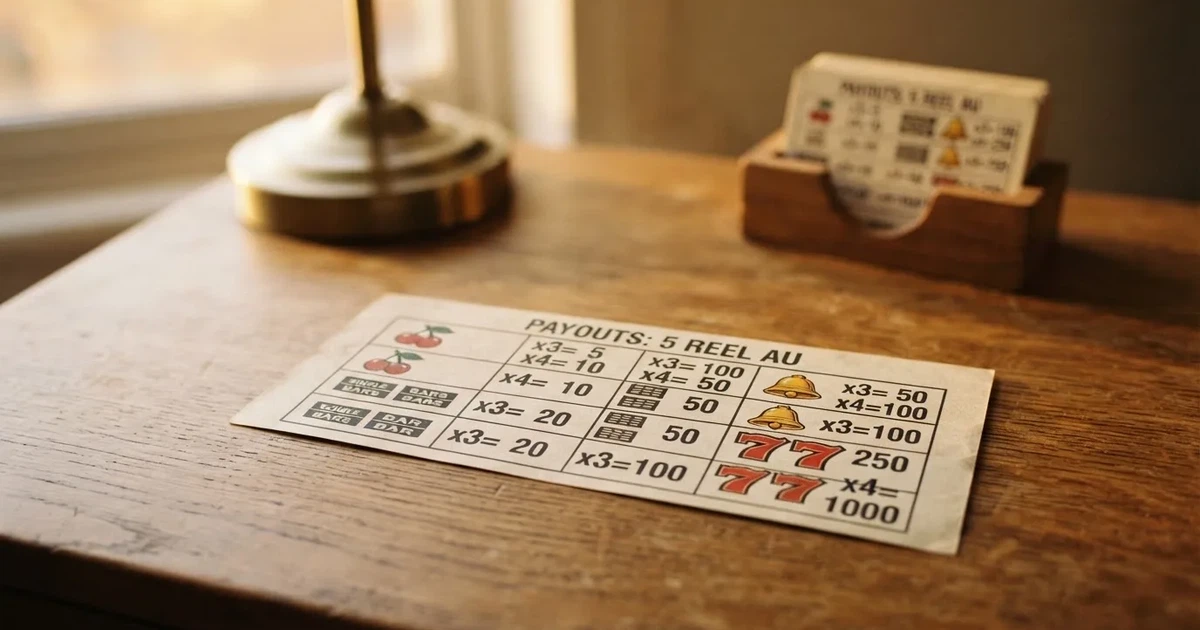
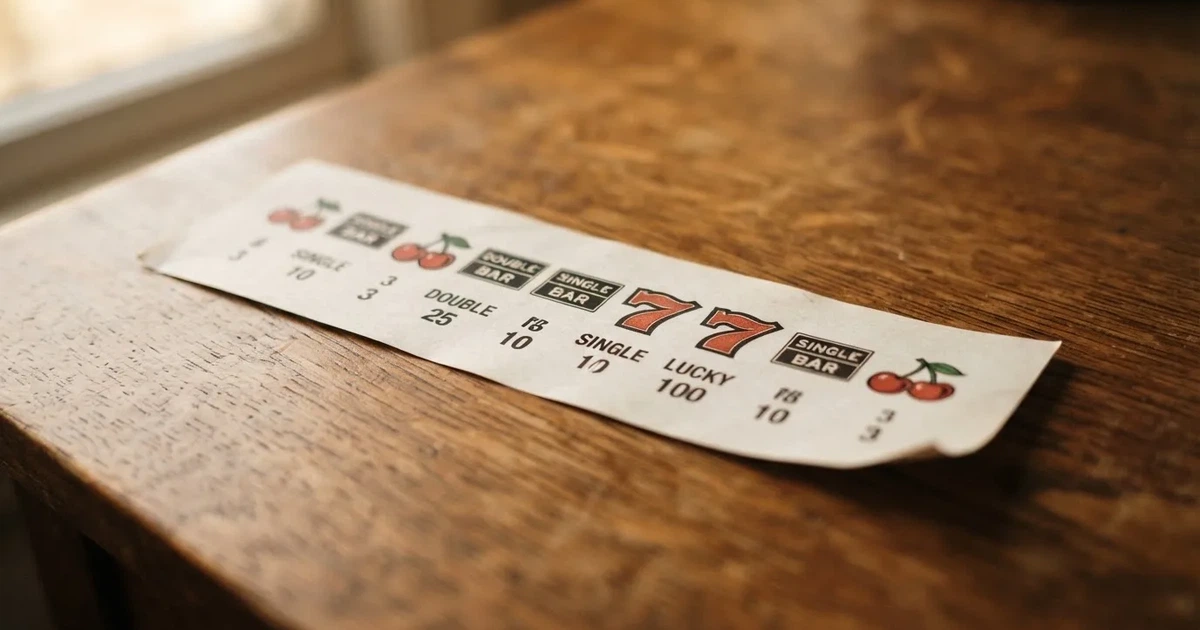
Reading a 3-reel paytable is the part a player can do without an operator. Each reel carries a set of symbols with values attached; the paytable shows what three matching symbols across the centre line pay and what two-of-a-kind pays for the higher-value symbols. Most 3-reel games use a single payline; a few use three (top, centre, bottom). Wild symbols, where they appear, substitute for other symbols to complete a line; scatter symbols, where they appear, pay regardless of position. Anything beyond that — bonus rounds, free-spin layers, multi-payline structures — drifts toward five-reel design.
The simpler paytable is also the honest paytable in one specific way: the number of combinations is small enough that a player can see them. On a three-reel, ten-symbol-per-reel layout the upper bound is one thousand outcomes, and the paytable lists most of them. That transparency is the format’s selling point and the reason a player interested in how a slot actually works tends to start on a 3-reel game.
The Legal Frame Around 3-Reel Slots in Australia
The legal frame is short and unforgiving. Under the Interactive Gambling Act 2001 (IGA), strengthened by the Interactive Gambling Amendment Act 2017, it is an offence to provide online casino games, online pokies or in-play betting to a person physically in Australia. No state or territory issues a licence for them. What is licensable is wagering on races and sport placed before the event, lotteries and keno. In practice, online sports books are licensed by the Northern Territory — 52 of them sit with the Northern Territory Racing and Wagering Commission, including Sportsbet, Bet365 and Ladbrokes, which hold a Territory licence largely for tax reasons. The Commission has no full-time staff and meets once a month in Darwin.

For 3-reel slot play specifically, the consequence is plain: a real-money online 3-reel slot is not licensed anywhere in Australia, whatever licence badge the site displays. A Curacao number or a Costa Rica number does not turn an offshore site into an Australian one. The format exists online — providers like BGaming list 3-reel titles in their catalogues — but the offering to an Australian customer is the offering the IGA names a prohibited interactive gambling service.
Enforcement sits with the ACMA. The Authority investigates, issues formal warnings, and directs Australian internet service providers to block illegal sites. The individual player is not prosecuted — the IGA targets the provider, not the customer. The cost to the player runs on a different line. An offshore site gives no Australian consumer protection, no complaints body, and no recourse if a withdrawal is refused. If the ACMA blocks it, the player’s balance can sit behind the block. That is the structural cost of the format in Australia: a game that exists and cannot be legally reached, with whatever consumer protections the reader would otherwise have quietly absent.
The reform in flight matters at the edges. The Interactive Gambling Amendment (Gambling Reform) Bill 2026 passed Parliament on 19 August 2026, with advertising and inducement measures commencing 1 January 2027. On a 2026 page, the law is law with a start date; the measures are not yet in force. A reader planning a year ahead needs that line drawn.
Where Australians Actually Play Slots
Australians play slots. The machine count outside casinos says so: 87,298 pokies-style machines in New South Wales as of June 2023, 26,380 in Victoria across 2021–22, 21,122 in Queensland as of October 2023, 11,672 in South Australia in September 2023 and 3,587 in the ACT in November 2023. By 2010 Australia operated an estimated 97,103 gaming machines outside casinos — a per-capita rate about five times that of the United States. New South Wales legalised slot machines in 1956, and the venues that followed — clubs, pubs, hotels — have carried the bulk of the count ever since.
Almost all of those machines are modern video slots, not 3-reel formats. A 3-reel mechanical floor game is increasingly a heritage product; the 3-reel game survives online as a software format. A player looking for a 3-reel experience in Australia is, in practice, looking for an offshore online site — which puts the question back where this page started.
For the legal line, it says the opposite of what the offshore marketing says. Australians spend heavily on slots through licensed channels (pubs, clubs, casinos); the share going through legal channels fell from 74% in 2021 to 64% in 2025, and H2 Gambling Capital’s 2025 estimate puts losses to illegal gambling sites at about A$3.9 billion a year. That is the wider landscape a reader searching “3-reel slots Australia” sits inside, and the rest of the page sits inside it.
The Cost of the Bonus: What an Offer Asks and What It Takes
The bonus page on a 3-reel slot site is the same construction as the bonus page on a five-reel slot site, and the cost arithmetic works the same way. A deposit bonus gives the player bonus credit on top of the deposit; a free-spins bundle gives a fixed number of spins at a fixed stake; both usually carry a wagering requirement before the bonus balance can be withdrawn.
The wagering requirement is the number that matters. A 35x requirement on a A$100 bonus means A$3,500 of wagering before withdrawal. On a single-payline 3-reel slot at A$1 a spin, that is 3,500 spins. At roughly five seconds per spin — the kind of pace a real-money slot runs at — that is about 17,500 seconds, or close to five hours of continuous play. The 5-second-per-spin pace is the standard rule of thumb for online slots; specific titles vary, and a player measuring personal time should time a few spins on their own device.
What does that cost the player, on average? The expected-loss arithmetic is the one the marketing copy skips: expected loss equals the required turnover times one minus the slot’s RTP. On a 96% RTP game — a common figure for an online 3-reel slot — one minus the RTP is 0.04, so A$3,500 in turnover at that RTP produces an expected loss of A$140 over the clearing period. On a 94% title the expected loss is A$210. On a 90% title it is A$350. The bonus’s headline value is the deposit match; the cost is the gap between the bonus and the expected loss after the requirement is met. That gap is what the reader pays, in expected value, for the bonus.
A separate cost is the max-cashout cap. Many 3-reel slot bonuses cap the winnings withdrawable from bonus play at a multiple of the bonus — 5x, 10x, sometimes lower. A A$100 bonus with a 5x cap lets the player withdraw at most A$500 from the bonus balance, regardless of how the play ran. On a high-variance 3-reel title a large bonus win can clear most of the wagering requirement in a single line; the cap is the rule that quietly converts the win back into house profit. A player who reads the bonus page reads the cap.
The bonus landscape for 3-reel slots is mostly the same as for five-reel online slots. The free-spin cluster — free 3-reel bonus slots, free 3-reel slots with bonus, free online 3-reel slots with bonus — points to the same offers under a different format label. None of the offers changes the wagering arithmetic. The format’s simplicity does not transfer to the offer’s simplicity.
The Brands the ACMA Has Acted Against
What follows is not a ranking. The page does not recommend any of these sites. Each entry is on the page because the Australian Communications and Media Authority itself issued a formal warning over it for offering prohibited interactive gambling services to Australians. The format the ACMA names, on each warning, is the same: online casino games and online pokies, which include 3-reel online slots. The licence line at the foot of each entry restates the only fact the law turns on: no online casino licence exists in Australia.
| Brand | ACMA action and date | Operator named by the ACMA | Subject support |
|---|---|---|---|
| RocketPlay | Formal warning, March 2026 (also May 2022) | Pulsup Ltd (Rocketplay); earlier Dama N.V. | — |
| Level Up Casino | Formal warning, May 2022 | Dama N.V. | BGaming listings |
| Woo Casino | Formal warning, March 2025 | Dama N.V. | — |
| Spirit Casino | Formal warning, May 2025 | Dama N.V. | — |
| National Casino | Formal warning, July 2025 | Consolutetish S.R.L. | Wikipedia listings |
| Bizzo Casino | Formal warning, July 2025 (also 2022) | Consolutetish S.R.L.; earlier TechSolutions | — |
| Ignition Casino | Formal warning, July 2025 | Bamboo Media | — |
| Instant Casino | Formal warning, February 2025 | EOD Code SRL | — |
| Jackbit | Formal warning, April 2026 | Ryker B.V. | — |
| Casino Intense | Formal warning, April 2025 | Sterplay Holding Ltd | ABC, ACMA, Crown Melbourne listings |
| Sky Crown | Formal warning, September 2022 | Hollycorn N.V. | — |
Two warnings over the same operator is not unusual. Dama N.V. appears in March 2025, May 2025 and as the operator on the May 2022 warning that covered six brands — Bambet, Dazard, Level Up, Rocketplay, Wild Tornado and Cobra Casinos — at once. TechSolutions Group N.V. and TechSolutions (CY) Group Limited drew the original 2022 warning over Bizzo Casino; the 2025 warning named Consolutetish S.R.L. The operating-company layer shifts more often than the brand layer, which means a brand can reappear under a new corporate name while keeping its URL.
The “Subject support” column reads as it does for a reason. The plan routes two readings the research supplies and refuses to invent one where research has none. A “listings-only” cell names a directory the brand appeared in — BGaming’s catalogue, a Wikipedia mention, a news listing — without claiming the brand carries a 3-reel product. A blank cell means the research carries no source for any 3-reel slot content on that brand. Neither cell is a recommendation. Both are honesty about what is verifiable.
RocketPlay
The ACMA issued a formal warning over RocketPlay in March 2026, naming the operator Pulsup Ltd and the URL RocketPlay. A separate, earlier warning had already named Dama N.V. over RocketPlay in May 2022. Two warnings over the same brand under two different operating companies is the pattern the ACMA’s register keeps returning to — the brand persists, the corporate wrapper rotates. This entry summarizes the formal ACMA notice.
Level Up Casino
The ACMA’s May 2022 warning named Dama N.V. across six brands in one notice; Level Up Casino was one of the six. Research records Level Up Casino as appearing in BGaming’s provider listings, which puts the brand into the small set of entries with a verifiable third-party reference. The reference is to a provider catalogue, not to a 3-reel game specifically, so the entry does not claim a 3-reel offering; it claims that the brand has a documented presence in a software provider’s index.
Woo Casino
The ACMA issued a formal warning over Woo Casino in March 2025, naming Dama N.V. as the operator. Woo Casino appears across the ACMA’s enforcement notices but not across the 3-reel-specific sources research recorded. The entry here says what the ACMA notice says and stops there.
Spirit Casino
The ACMA issued a formal warning over Spirit Casino in May 2025, again with Dama N.V. named as the operator. Spirit Casino does not appear in the 3-reel-specific research corpus; the entry is the warning and nothing more.
National Casino
The ACMA issued a formal warning over National Casino in July 2025, naming Consolutetish S.R.L. as the operator. National Casino appears in Wikipedia’s gambling-in-Australia coverage, which gives the entry a second verifiable point of reference without putting a 3-reel claim on the page.
Bizzo Casino
Bizzo Casino sits in the ACMA’s register twice. The 2022 warning named TechSolutions (CY) Group Limited and TechSolutions Group N.V.; the July 2025 warning named Consolutetish S.R.L. Two warnings, two operators, the same brand URL. The ACMA records are the only official references for this brand.
Ignition Casino
The ACMA issued a formal warning over Ignition Casino in July 2025, naming Bamboo Media as the operator. This entry reflects the formal ACMA notice and nothing more.
Instant Casino
The ACMA issued a formal warning over Instant Casino in February 2025, naming EOD Code SRL. The brand does not appear in the 3-reel-specific sources research recorded.
Jackbit
The ACMA issued a formal warning over Jackbit in April 2026, naming Ryker B.V. as the operator — the same notice that named CasinOK. There is no publicly available 3-reel catalogue data for this brand.
Casino Intense
The ACMA issued a formal warning over Casino Intense in April 2025, naming Sterplay Holding Ltd. Casino Intense is one of the few entries with multiple third-party references in research — ABC News coverage, an ACMA notice, a Crown Melbourne listing — though none of those references describe a 3-reel offering specifically.
Sky Crown
The ACMA issued a formal warning over Hollycorn N.V. over its Sky Crown and Blue Leo services, dated September 2022. Research carries no 3-reel-specific source for Sky Crown.
The Reader’s Picture: How Often the ACMA Blocks
The ACMA’s running total as reported in June 2026 stands at 1,751 illegal gambling and affiliate marketing websites blocked since the first blocking request in November 2019, with more than 230 unlicensed gambling services having left the Australian market since enforcement was strengthened in 2017. The most recent round reported on 26 June 2026 asked Australian internet service providers to block 12 more sites: 7Signs, ChromaBet, Donbet, Duospin, Freshbet, Slots Gem, Jacks Club, Lucky Start, PointsBetz, Spinrise, Vinyl Casino and Wildsino. The total is a moving figure; the rate of enforcement is a clearer indicator.
Between the first blocking request in November 2019 and the June 2026 total of 1,751 sites, the ACMA has averaged roughly 263 blocks per year, or around 22 per month. The rate is not constant — earlier rounds were larger, later rounds are smaller and more frequent — and a single year carries no clean per-brand weight, but the order of magnitude is the point: a brand the ACMA names today is one of several hundred it has named in this decade. The persistence of Dama N.V. across 2022 and 2025, the persistence of Bizzo Casino across 2022 and 2025, and the rotation of operating companies under the same brand URLs are not anomalies. They are the pattern.
The rate of formal warnings is harder to bound cleanly because the ACMA’s register is qualitative, but the eleven brands this page lists are drawn from a wider register that runs into the dozens over the same period. A reader treating the register as a complete list of offenders would still be reading it wrong — the register lists the operators the ACMA has chosen to publish a notice over, which is a subset of the operators the ACMA has investigated. The blocking rate is the better proxy for the underlying activity: between 2017 and mid-2026, more than 230 unlicensed services left the Australian market; between late 2019 and mid-2026, 1,751 sites were blocked. The activity is steady.
What Player Protection Actually Looks Like From Australia
The Australian protection frame is built for Australian-licensed services. BetStop, the National Self-Exclusion Register, has been live since August 2023, and binds every Australian-licensed online and phone wagering service. It does not bind an offshore casino. The registration excludes the player from every Australian-licensed bookmaker, but the offshore site does not see the BetStop file, does not check it, and is not required to honour it. A self-excluded player on an offshore site is unprotected in the way the protection was designed to prevent.
Confidential help is the line that does reach an offshore player. The National Gambling Helpline — 1800 858 858 — is free, runs 24/7, and is paired with chat at Gambling Help Online. The line is staffed regardless of where the gambling happens. The minimum age for any gambling product in Australia is 18, and that includes the offshore sites; an underage player at an offshore site is in a position the ACMA would call a prohibited service in its own right.
Tax sits on the recreational side. Gambling winnings of a recreational player are not assessable income under section 6-5 of the ITAA 1997, and losses are not deductible. A player who carries on a business of gambling sits in a different frame; for everyone else, the ATO position is that a win is a windfall and a loss is a personal expense. The line is plain enough that this page does not extend it; the ATO is the body that defines it for a particular reader.
The Payments Question
For Australian-licensed wagering, the payment frame closed hard on 11 June 2024: credit cards, credit-related products and digital currency are banned as payment for licensed online wagering, with penalties up to A$247,500 for operators. The legal deposit routes are debit card, bank transfer, PayID/Osko and BPAY. A licensed Australian bookmaker does not accept credit cards and does not accept crypto.
An offshore casino does. That is the point of using one from a player’s perspective — looser payment options, faster settlement in some cases, and fewer of the frictions the Australian rules are designed to impose. The reader’s arithmetic is that the friction being skipped is consumer protection: no chargeback rights on a credit-card transaction when the merchant is offshore, no recourse when a withdrawal stalls, and no guarantee that the balance is reachable when the ACMA blocks the site. The payment frame is the cleanest place to read the cost of going offshore.
What a Reader Searching “3-Reel Slots Australia” Should Actually Do
The reader has landed here because the format interests them, not because a specific site was on the table. The honest picture is short. A 3-reel slot is a legitimate, simpler game format; it is widely available in software catalogues and at very low counts on Australian floors as heritage machines. For real-money online play from Australia, no licensed route exists. The ACMA’s enforcement register and its blocking-rate pattern say that an offshore site offering the format to Australians is operating against Australian law, and the protections an Australian player would otherwise have — BetStop coverage, ATO treatment, a regulator with jurisdiction, a payment frame that lets a chargeback reach — are absent.
A player interested in the format has three honest paths. One is a heritage mechanical or video 3-reel machine in a licensed Australian venue, where the format exists under Australian rules and the consumer protections apply. One is a free-play or demo version of a 3-reel online slot from a software provider like BGaming — the format is accessible without a real-money stake, and a player who wants to learn the paytable can do so without crossing the legal line. One is a deliberate, eyes-open decision to use an offshore site for real-money play, with a clear read on what that costs: no BetStop coverage, no Australian regulator, no chargeback path, and a balance that an ACMA blocking round can place behind a wall.
What none of those paths is, is a recommendation to use any of the eleven brands this page lists. The list is there because the ACMA put it there; the list is the page’s evidence, not its advice.
A Note on Adjacent Formats
A reader who reached this page may also be weighing baccarat, blackjack, or craps. The format is different but the cost frame is the same in one respect: in Australian licensed venues, the table game rules require regulator approval — section 66 of the NSW Casino Control Act 1992, the Victorian Casino Control Act 1991 administered by the VGCCC since 1 July 2022, and the equivalent in every other state. Crown Melbourne offers three baccarat variants under VGCCC approval; the VGCCC’s own log records approved rule changes to Crown Melbourne’s blackjack variants through 2024. The approval trail is the Australian way of telling a player that the format is regulated.
For online play, the trail does not exist. Baccarat’s house edge is 1.06% on the Banker bet, 1.24% on the Player bet and 14.36% on the Tie; blackjack’s house edge is about 0.28% under liberal Las Vegas Strip rules with optimal strategy and about 0.43% under Atlantic City rules; craps’s Pass/Come bet carries a 1.41% house edge, Don’t Pass/Don’t Come 1.36% and Any Craps 11.11%. Those edges sit inside the same Australian prohibition as the 3-reel slot, and an offshore online table game runs under the same legal frame. A reader comparing formats is comparing edges; a reader comparing routes is comparing different sets of protections. This page is about the second comparison.
Reading the ACMA’s Register Itself
The ACMA’s formal-warning register is published in full on the Authority’s site. Each warning names the operator, the date, and the prohibited service. The register is the cleanest public source for the offshore brands that have offered prohibited interactive gambling services to Australians, and it is what this page’s operator section is built from. The register does not list every brand the ACMA has investigated, does not name every affiliate marketing site, and does not record every blocking request. It is what the Authority has chosen to publish, and that is what a player has access to.
The blocking-round notices are the other half. They name the URLs the ACMA has directed Australian ISPs to block. The June 2026 round named 12 sites; the cumulative total since November 2019 stands at 1,751. A reader who wants to check a specific URL against the current list can do so; a reader who wants to know how often the list updates can do that too. The register is not a guarantee, but it is the public record an Australian player has to work from.
The Reader’s Takeaway in One Paragraph
A 3-reel slot is the smallest, oldest, most legible version of the slot format, and the format itself is sound. The Australian problem is not the format — it is the route. Online 3-reel slots are not licensed in Australia; the ACMA has issued formal warnings over eleven brands in this register; the Authority has blocked 1,751 sites since late 2019; an offshore site offers none of the protections an Australian player is used to. The format is worth knowing; the real-money online route from Australia is the cost the reader pays for wanting it that way.
Frequently Asked Questions
What makes a 3-reel slot different from a standard five-reel video slot?
A 3-reel slot has three vertical strips of symbols and usually a single horizontal payline; a five-reel video slot has five strips with multiple paylines, bonus rounds and free-spin layers. The 3-reel format has roughly a thousand possible combinations at ten symbols per reel; a modern five-reel slot can run combinations in the hundreds of millions.
Can 3-reel slot machines be found in licensed Australian pubs and clubs?
Yes — the Australian non-casino slot count is large (87,298 in NSW, 26,380 in Victoria, 21,122 in Queensland, 11,672 in South Australia, 3,587 in the ACT across 2021–23), though almost all of those machines are modern video slots rather than classic 3-reel formats.
Do 3-reel slots typically pay out differently than newer five-reel formats?
The hit rate on a 3-reel slot tends to be higher and the top prize tends to be smaller, because the number of combinations is smaller. The exact payout percentage depends on the individual game’s paytable and the venue’s settings.
Is a 3-reel slot online the same game as a 3-reel machine on a casino floor?
The paytable and symbol set are usually identical, but the online version runs on a random number generator while a physical machine uses mechanical or electronic reels. The experience of reading the paytable is the same; the regulatory frame around each is very different.
Are 3-reel slots for real money available legally from an Australian-based site?
No. Under the Interactive Gambling Act 2001, online casino games and online pokies are prohibited for anyone in Australia, and no state or territory issues a licence for them. Real-money online 3-reel slot play from an Australian IP exists only on offshore sites operating outside Australian law.
Do reel count and paytable structure affect how a slot’s volatility is described?
Yes — a 3-reel format with a small number of combinations and a single top prize tends to be described as lower volatility than a five-reel slot with stacked bonuses, even at the same RTP. The format constrains how spread the payouts can be.
Created by the ”Crypto Casino Hub AU” editorial team.