
Playson Online Casinos in Australia — What the Law, the ACMA Warnings and the Studio’s Own Licence Add Up To
Anyone searching for a Playson-branded online casino in Australia is searching for something the Interactive Gambling Act 2001 was written to stop. Playson is a real slot studio with a UK Gambling Commission software licence that has run since 1 July 2015, and its games sit on offshore casino sites all over the world. What it does not sit on is any Australian-licensed online casino, because no such licence exists. Online casino games and online pokies are a prohibited interactive gambling service under Australian law; the only online wagering Australia licences is pre-event racing and sport, lotteries and keno. Every offshore casino that markets Playson titles to a person in Australia is breaking the same prohibition, and the Australian Communications and Media Authority has spent the last several years issuing formal warnings about exactly that.
Current as of 29 October 2026 and checked against the ACMA’s public register of formal warnings and blocking requests.
Table of Contents
- How Playson slots end up on offshore sites advertising to Australians
- The order in which this page covers the material
- What Playson actually is — the studio behind the slots
- How the legality frame actually works in Australia
- What responsible-gambling supports apply to a Playson title
- How deposits and withdrawals move on offshore Playson sites
- How the bonuses and free spins work — and what they cost the player
- How the same games play on a mobile phone
- The eleven brands the ACMA has warned about
- What all eleven brands share
- The closing read
- Frequently asked questions
How Playson slots end up on offshore sites advertising to Australians
The mechanism is short and worth seeing in one place. A studio in Malta gets certified. It integrates its games through aggregators that supply hundreds of casino operators worldwide. Those operators hold licences from Curaçao, Anjouan or similar jurisdictions — none of them Australian. Some of those operators then run “Australia-facing” marketing, accept AUD deposits through PayID or cryptocurrency, and list Playson titles in their lobby. From an Australian punter’s screen, that looks like a normal online casino with a normal game provider. From the regulator’s screen, it is a prohibited interactive gambling service being supplied to a person physically in Australia.

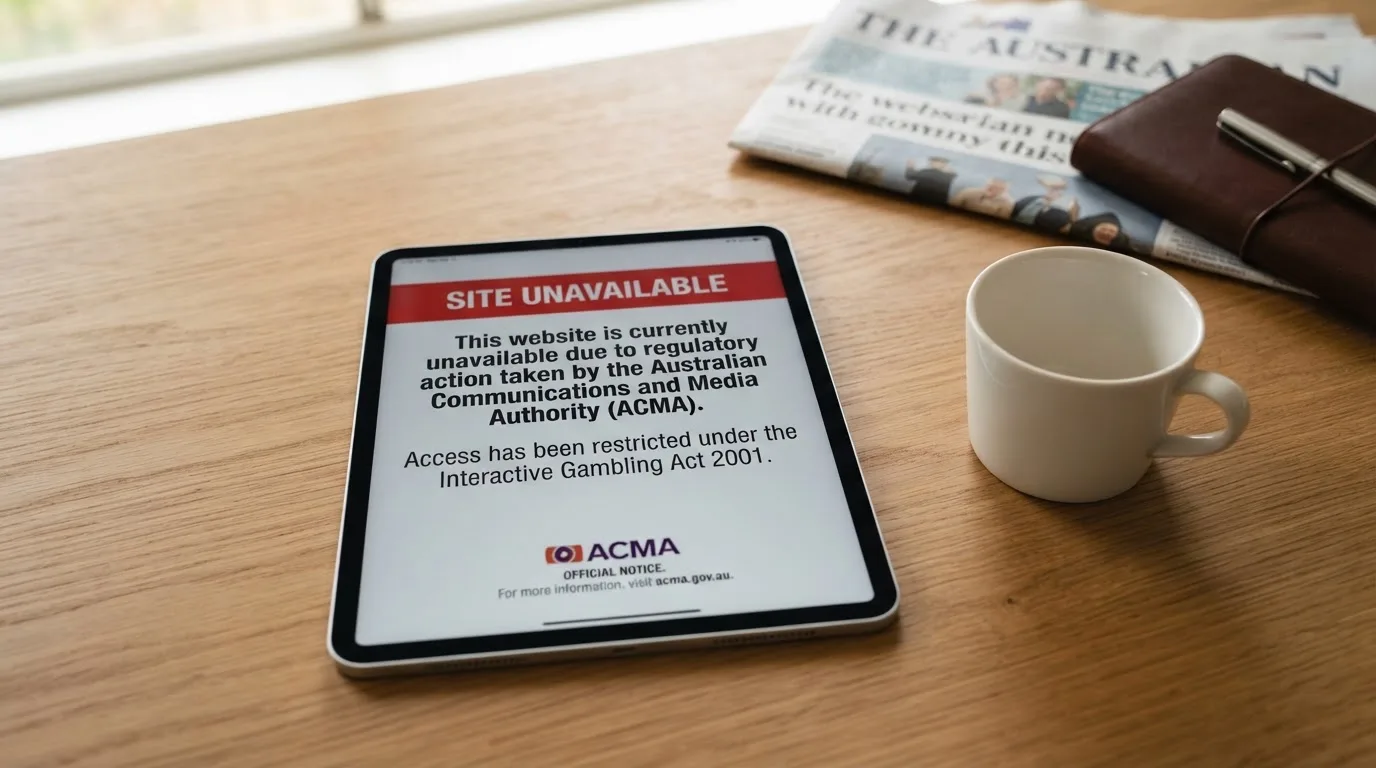
The ACMA’s enforcement arm has been working through that pipeline for years. As of June 2026 it had asked Australian internet service providers to block 1,751 illegal gambling and affiliate marketing websites since the first blocking request in November 2019, and more than 230 unlicensed gambling services had left the Australian market since enforcement was strengthened in 2017. The most recent reported round, dated 26 June 2026, added another twelve: 7Signs, ChromaBet, Donbet, Duospin, Freshbet, Slots Gem, Jacks Club, Lucky Start, Pointsbetz.com, Spinrise, Vinyl Casino and Wildsino. That is one round, not the total. The cumulative figure matters because it shows how much supply is being churned through the same offshore channels.
H2 Gambling Capital’s 2025 estimate puts annual losses to illegal Australian-facing sites at about A$3.9 billion, and the share of gambling going through legal channels fell from 74 per cent in 2021 to 64 per cent. Those numbers are about the offshore industry as a whole, not Playson specifically, but they are the scale Playson titles ride on when they reach Australian screens.
The order in which this page covers the material
The remaining sections work through what research actually turns up: what Playson the studio looks like and what kinds of games it makes; how the legality frame and the ACMA’s enforcement arm fit together; what responsible-gambling supports apply to a player who has wound up on one of these sites; how deposits and withdrawals move on offshore sites compared with Australian-licensed ones; how the bonus mechanics on those sites are constructed and what they cost the player; how the same games perform on a phone; and a shortlist of the offshore brands the ACMA itself has warned about, including the ACMA action card that shows operator name, date and the studio support research could confirm. Each block carries its own weight and closes with the page’s own judgement on the material.
What Playson actually is — the studio behind the slots
Playson Limited is a slot developer based at 12 Tigne Place, Office M4, Tigne Street, Sliema, Malta. It holds an active UK Gambling Commission remote gambling software licence (reference 041337-R-321523-016) that has run continuously since 1 July 2015, and the same account also covers an active remote casino licence in force since 14 April 2016. Those are real licences with a real regulator behind them, and they qualify Playson to supply games to operators that themselves hold UK Gambling Commission remote operating licences.
What Playson does not hold, because no such document exists, is any kind of Australian interactive gambling licence. The Australian regime does not issue one for the products Playson makes. The studio’s UK standing is the reason its games appear on sites that target UK players; it is not, and has never been, a basis for supplying Australian players. The distinction matters because the offshore casino sites that carry Playson titles tend to display a Curaçao or Anjouan e-gaming badge in their footer and let the studio’s regulatory standing imply a level of oversight that does not in fact extend to the operator’s treatment of Australian customers.
The studio is also not the only supplier on these sites. Research names several that share the offshore casino shelves with Playson, and the table later in this page is built around that. 1spin4win, founded in 2021 by industry veterans and headquartered at Scharlooweg 39, Willemstad, Curaçao, reports a portfolio of more than 190 online slots built in HTML5 for low-bandwidth connections, more than 1,000 casino and aggregator partnerships, and a 46 per cent increase in total bet sum between the first halves of 2024 and 2025. Betsoft, founded in 2006, catalogues more than 200 RNG games and names Italy’s ADM and Quinel/GLI RNG certification in its compliance page, with partnerships it puts at more than 500 operators across regulated European, Scandinavian, Latin American and African markets. BGaming, the Stable Games Ltd brand out of Valletta, holds an MGA Critical Gaming Supply Licence (MGA/B2B/785/2020) issued 18 March 2021, lists 250-plus certified games and proprietary mechanics such as TRUEWAYS, MultiDice X and Merge UP, and states its games are used by 3,000-plus operators including Blaze, Pin-Up and Gamdom. None of those studio licences is an Australian licence, and none of those studio counts is an Australian player count.
Aristocrat Leisure is the comparison that does belong in this discussion, because it is Australian, headquartered in North Ryde in Sydney, and the largest gambling-machine manufacturer in Australia and the second-largest slot-machine manufacturer worldwide behind International Game Technology. Founded in 1953 by Leonard Ainsworth and ASX-listed since 1996 under the ticker ALL, Aristocrat reported 2025 revenue of A$6.30 billion, normalised net profit after tax and amortisation of A$1.55 billion, and 7,400 employees. Its online real-money business, Aristocrat Interactive, was formed in April 2024 by combining the Anaxi unit with the NeoGames group acquired in a deal worth roughly US$1 billion. That is the kind of studio Australian-licensed wagering platforms would integrate if online casino games were licensable here. They are not, and Aristocrat’s Australian-licensed products remain the electronic gaming machines that sit in pubs and clubs under state and territory regulation.
How the legality frame actually works in Australia
The Interactive Gambling Act 2001, tightened by the Interactive Gambling Amendment Act 2017, makes it an offence to provide online casino games, online pokies or in-play betting to a person in Australia. No state or territory issues a licence for those products. Wagering on races and sport placed before the event, lotteries and keno — those are licensable, and in practice most of the licensed online bookmakers (Sportsbet, Bet365, Ladbrokes and the rest) are licensed in the Northern Territory through the Northern Territory Racing and Wagering Commission. That commission regulates 52 online bookmakers for tax reasons, has no full-time staff and meets once a month in Darwin. The point of the structure is not that the NT grants a casino licence; it is that the NT grants a wagering licence and the operator pays Territory tax on the turnover. Casino-style games are not part of that arrangement.
Enforcement runs through the ACMA. The authority investigates, issues formal warnings, and can direct Australian internet service providers to block illegal sites. The blocking mechanism is administrative rather than criminal: a request to ISPs, who then route the named domains to a sinkhole. The 1,751 blocking requests since November 2019 are the cumulative count of that administrative action. The individual player is not the target — the IGA targets the provider — but an offshore site gives an Australian customer no local consumer protection, no complaints body, and no recourse if a withdrawal is refused. The site can also be blocked while a balance is still on it, and the player has no Australian channel to escalate through.
A 2026 reform worth flagging, because it shows the direction of travel: the Interactive Gambling Amendment (Gambling Reform) Bill 2026 passed Parliament on 19 August 2026, with its advertising and inducement measures commencing 1 January 2027. On a page read in 2026 those measures are law with a start date, not yet in force. They do not change the existing prohibition on providing online casino games; they change how those games can be advertised.
The ACMA’s formal warning record — what the register actually shows
The ACMA publishes the formal warnings it issues, and the register is the cleanest evidence of which offshore operators have marketed prohibited services to Australians. Reading it as a list rather than as headlines gives a useful shape.
| Brand | ACMA action and date | Operator named by the ACMA | Subject support |
|---|---|---|---|
| RocketPlay | Formal warning, March 2026 (Pulsup Ltd); earlier warning May 2022 to Dama N.V. covering Rocketplay among six brands | Pulsup Ltd; Dama N.V. | — |
| Level Up Casino | Formal warning, May 2022 (Dama N.V.) | Dama N.V. | listings reported by Wazdan |
| Woo Casino | Formal warning, March 2025 (Dama N.V.) | Dama N.V. | — |
| Spirit Casino | Formal warning, May 2025 (Dama N.V.) | Dama N.V. | — |
| National Casino | Formal warning, July 2025 (Consolutetish S.R.L.) | Consolutetish S.R.L. | listings reported by Betsoft, Wikipedia, Pragmatic Play |
| Bizzo Casino | Formal warning, July 2025 (Consolutetish S.R.L.); earlier 2022 warning to TechSolutions Group | Consolutetish S.R.L.; TechSolutions (CY) Group Limited and TechSolutions Group N.V. | — |
| Ignition Casino | Formal warning, July 2025 (Bamboo Media) | Bamboo Media | — |
| Instant Casino | Formal warning, February 2025 (EOD Code SRL) | EOD Code SRL | — |
| Jackbit | Formal warning, April 2026 (Ryker B.V.) | Ryker B.V. | — |
| Casino Intense | Formal warning, April 2025 (Sterplay Holding Ltd) | Sterplay Holding Ltd | listings reported by 1spin4win, Wikipedia, UK Gambling Commission register |
| Sky Crown | Formal warning, September 2022 (Hollycorn N.V.) | Hollycorn N.V. | — |
The “Subject support” column follows the rule the research set out: where the studio itself names the operator among its partners or in a public catalogue, the cell reports what those listings say; where no such listing was found, the cell carries the no-data marker rather than pretending one exists. A few of these brands do appear in third-party studio catalogues (Wazdan for Level Up; Betsoft, Pragmatic Play and Wikipedia listings for National Casino; 1spin4win, Wikipedia and the UK Gambling Commission register for Casino Intense), which is enough to say they exist on the shelves of several offshore studios at once, but none of it changes what the ACMA found about how they treated Australian customers.
What the register also shows, and what an editorial reading needs to surface, is that several operators keep appearing under different corporate names. Dama N.V. was warned in May 2022 over a six-brand batch and again in March and May 2025 over two more brands. Consolutetish S.R.L. was warned in July 2025 over two brands on the same day. TechSolutions was warned in 2022 over what became Bizzo Casino before the same brand was warned again in 2025 under Consolutetish S.R.L. The pattern is the same offshore holding company rotating brand names and corporate addresses while continuing the same line of business. A punter who recognises one of these names has not necessarily recognised the entity actually holding the customer relationship.
What responsible-gambling supports apply to a Playson title
The Australian responsible-gambling framework was built for the products the IGA does allow, and that gap is the practical reason offshore Playson sites are riskier than Australian-licensed wagering operators in the same category.
BetStop, the National Self-Exclusion Register, has been live since August 2023 and binds every Australian-licensed online and phone wagering service. The mechanism is registration with the operator, which then has to refuse service. It does not bind an offshore casino. An Australian who has registered with BetStop and then lands on a Playson-branded offshore site has no protection from that registration, because the offshore operator has no integration with BetStop and no obligation to honour it. The Gamblers Anonymous, Gambling Help Online and the National Gambling Helpline on 1800 858 858 — free, 24/7, with online chat — are the supports that apply regardless of where the gambling took place, and they are the ones to use.
State and territory self-exclusion registers also exist for land-based venues, including the pub and club pokies that Aristocrat and similar manufacturers supply. Those registers are how a person can exclude themselves from physical gambling machines in their jurisdiction. They do not extend to offshore online sites either, for the same reason: the offshore operator is not licensed in the jurisdiction running the register.
The wider point is that the responsible-gambling system in Australia is structured around the legal channels, and the offshore Playson sites sit outside it. The supports that do reach an offshore player — Gambling Help Online, the helpline, state-level Gamblers Anonymous meetings — are the ones to keep in mind if the question is where to get help rather than where to play.
How deposits and withdrawals move on offshore Playson sites
The payment story on offshore sites is the mirror image of the Australian licensed one. The 11 June 2024 credit-card ban applies to Australian-licensed wagering operators and covers credit cards, credit-related products and digital currency used to fund a licensed account, with penalties of up to A$247,500 per breach. Legal deposit routes for a licensed Australian wagering account are debit card, bank transfer, PayID and Osko, and BPAY. An Australian punter on an Australian-licensed sports book cannot pay with a credit card or with crypto.
The offshore Playson sites run on the opposite list. They accept credit cards, e-wallets, and a heavy share of cryptocurrency — Bitcoin, Ethereum, Tether and the rest. That is what an Australian punter sees when the site asks for a deposit: a payment menu that no Australian-licensed operator is allowed to offer. The reason those routes are usable is that the offshore site is not subject to the 11 June 2024 rules. The price of using them is that the same protections the rules provide — the chargeback route, the credit-card issuer’s interest in fraudulent or unauthorised transactions, the local complaints channel — do not apply. A chargeback through an Australian bank against an offshore casino that has refused a withdrawal is harder to win than a chargeback against a domestic merchant, and the operator’s customer support team is not subject to any Australian dispute resolution scheme.
Withdrawal times are the other half of the picture. Offshore sites typically quote e-wallet withdrawals in 24 to 48 hours and bank transfers in three to five business days, with cryptocurrency withdrawals clearing once the network confirms. The figures look competitive next to a domestic sports book, which can be slower because of identity verification and anti-money-laundering checks. The qualifier is what happens when something goes wrong. A pending withdrawal, a max-cashout cap, a bonus balance that has not yet cleared its wagering requirement — any of those can hold funds past the advertised window on an offshore site, and the punter has no Australian regulator to escalate to. The speed on a normal day is not the issue; the absence of recourse on the abnormal day is.
How the bonuses and free spins work — and what they cost the player
The offshore Playson sites put a “welcome bonus” and “free spins” in front of new sign-ups as the standard acquisition mechanism. The page treats these as marketing constructions rather than as good deals, because what the construction actually moves is the player’s expected loss.
The shape is the same across the segment. A deposit match — say 100 per cent up to a stated cap — credited as bonus funds, with a wagering requirement (typically in the 35x to 50x range on the bonus amount, sometimes on bonus plus deposit) before any winnings become withdrawable. A free-spin bundle attached to a specific Playson title, with the same kind of conversion cap on whatever the spins win. Game-weighting clauses that count slots at 100 per cent but table games at a reduced percentage, often zero. A max-bet rule during wagering — usually something like A$5 to A$10 per spin — that voids the bonus if breached. A time limit, often seven to fourteen days. A max-cashout cap on free-spin winnings, often capped at a small multiple of the bonus.
The arithmetic of what the bonus costs the player is mechanical. Required turnover equals the bonus amount multiplied by the wagering multiple. Spins equals that turnover divided by the stake-per-spin that the bonus terms allow. Play time, in hours, equals the number of spins multiplied by a five-second interval and divided by 3,600. The expected loss over that play equals the turnover multiplied by one minus the RTP of the game being played. Plug in a deposit match of A$500 with a 40x wagering requirement on the bonus alone, at a stake of A$1 per spin on a 96 per cent RTP slot, and the calculation says 20,000 spins of required play, around 27.8 hours at five seconds a spin, and an expected loss in the order of A$400 against the bonus turnover alone. The headline value is A$500 in bonus funds; the realised cost is roughly 80 per cent of that in expected losses before the bonus even clears.
That arithmetic holds in shape across the segment even where the numbers differ. The marketing word for these offers is “free”. The realised word is “expected loss of most of the bonus value before it converts”. A punter who treats the offer as worth taking needs to know the multiple, the weighting, the max-bet rule, the time limit and the max-cashout cap before claiming, because those are the levers that decide what the bonus actually pays out.
The blocking rate — what the cumulative figure means in pace
The research asks the page to compute a blocking rate from the ACMA’s running total and the date of the first blocking request. As of June 2026 the ACMA had asked Australian ISPs to block 1,751 illegal gambling and affiliate marketing websites, with the first blocking request issued in November 2019. That is a span of roughly 79 months, which works out to an average of about 22 blocking requests per month, or one every 1.4 days, across the whole period. The pace is not even: enforcement was strengthened in 2017 and the blocking mechanism ramped up from November 2019, so the early years carried very few requests and the recent years carry most of them. As a band, the running rate is somewhere in the order of one site blocked every working day, with the exact figure depending on which slice of the timeline the reader is asking about. That is the pace at which Australian-facing offshore casino supply is being knocked over, and it is also the pace at which the offshore industry is rotating brand names to replace the ones that went down. The blocking figure measures the regulator’s output, not the industry’s input.
How the same games play on a mobile phone
Playson builds its games in HTML5, which is the same technical choice 1spin4win and most of the modern slot catalogue makes, and the games run in a phone browser without a separate download. That is also how the offshore casino sites that carry Playson titles are typically built: mobile browser, no native app, with the casino’s full lobby reachable from the same URL the desktop site uses. A dedicated casino app is rare on the offshore Playson sites, because the Australian app-store distribution rules and the offshore licensing question together make a native app more trouble than it is worth. What the punter gets instead is a responsive web wrapper that scales to a phone screen, portrait or landscape, with the spin button and balance readout positioned for thumbs.
The honest comparison is with Australian-licensed wagering apps, which are well-built and well-maintained because the operators behind them have to comply with local app-store and consumer-law rules. An offshore Playson site on a phone browser is functional and the games load at normal mobile-network speeds, but the experience is not the same — the lobby is wider, the cashier takes longer to render, the deposit flow asks for information a regulated app would not, and customer support is reachable only through the in-site chat rather than through a published local contact. None of that is a defect of Playson the studio; it is a defect of the wrapper the offshore casino puts around the games.
Live tables and other game types on these sites
The Playson catalogue is slots-first. Live dealer tables on the offshore Playson sites are typically supplied by a separate studio — Pragmatic Play Live, Evolution, Ezugi and the rest — and integrated alongside the slot library rather than by Playson itself. The slots are what Playson brings to the partnership; the live tables are what the casino site adds to fill out the lobby. A punter who sees a live dealer room on the same site as Playson titles is looking at a casino that aggregates several B2B suppliers and presents them under one roof, with Playson supplying only the RNG slot portion. The page does not carry specific RTP or volatility figures for Playson titles because research does not provide them; figures research does provide (Betsoft’s Good Girl Bad Girl 2 at 96.22 per cent RTP, very high volatility, 15.59 per cent hit rate; Betsoft’s The Slotfather at 95.69 per cent RTP, medium volatility, 8.17 per cent hit rate) are for a different studio and are stated here only to show what the format of a published slot spec looks like, not as Playson figures.
The eleven brands the ACMA has warned about
The list below is not a ranking and not a recommendation. Each brand is in this page because the ACMA itself issued a formal warning over it for offering prohibited interactive gambling services to people in Australia. The page describes what the ACMA found; the page does not tell the reader to play.
RocketPlay
RocketPlay was warned by the ACMA in March 2026, with Pulsup Ltd named as the operator of Rocketplay.com.au. The same brand had earlier been the subject of a May 2022 warning to Dama N.V., which covered six casino brands in a single batch. Two warnings, four years apart, from two different corporate addresses, against the same brand name are the kind of evidence that says rebranding has been tried and has not changed the conduct. Research does not show RocketPlay listed as a partner on any of the studio catalogues examined, so the page carries no subject-support entry for it. Regulator records show this brand has been flagged twice for the same behaviour, suggesting no change in its approach to the Australian market.
Level Up Casino
Level Up Casino was named in the May 2022 batch warning to Dama N.V. covering six brands. Wazdan’s public catalogue lists Level Up among its partner casinos, which is enough to say the brand sits on at least one major studio’s shelves. None of that changes what the ACMA found in 2022. It remains a flagged entity, and the fact that studio partnerships persist indicates that the operator’s status is known.
Woo Casino
Woo Casino was warned in March 2025 as part of Dama N.V.’s second round of ACMA attention. The 2022 batch and the 2025 batch together cover eight Dama N.V. brands; Woo is one of the two added in 2025. Research does not show Woo in any of the studio catalogues examined. This operator has been targeted by the regulator in multiple enforcement actions, with Woo specifically cited in the later round.
Spirit Casino
Spirit Casino was warned in May 2025, completing Dama N.V.’s pair of 2025 warnings alongside Woo. Research does not show Spirit Casino in any of the studio catalogues examined. The verdict here is the same shape as Woo’s: the parent operator has now been warned twice, with Spirit as one of the two brands added in 2025.
National Casino
National Casino was warned in July 2025 along with Bizzo Casino, with Consolutetish S.R.L. named as the operator. Studio catalogues from Betsoft, the Wikipedia listings and Pragmatic Play all list National Casino among partner sites, which is evidence the brand sits on the shelves of several studios at once. The ACMA’s warning is the regulator-side evidence; the studio listings are the supply-side evidence. Here, both regulator and studio records confirm the brand’s wide reach, providing a clear picture of its operations.
Bizzo Casino
Bizzo Casino was warned in July 2025 under Consolutetish S.R.L., and had already been the subject of a 2022 formal warning under TechSolutions (CY) Group Limited and TechSolutions Group N.V. The corporate-address change between 2022 and 2025 — TechSolutions to Consolutetish — is the kind of re-registration the offshore segment does when a brand has been warned once. Research does not show Bizzo Casino in the studio catalogues examined, so the page carries no subject-support entry. This history of repeated warnings under shifting corporate labels suggests the brand continues its prohibited activity despite the regulator’s attention.
Ignition Casino
Ignition Casino was warned in July 2025 with Bamboo Media named as the operator. Research does not show Ignition Casino in the studio catalogues examined. This operator is linked to a single formal warning, with no corresponding public evidence of studio-side partnerships to provide further context.
Instant Casino
Instant Casino was warned in February 2025 with EOD Code SRL named as the operator. Research does not show Instant Casino in the studio catalogues examined. This brand features in the most recent round of ACMA enforcement, marking it as a subject of current regulatory concern.
Jackbit
Jackbit was warned in April 2026 with Ryker B.V. named as the operator, in the same action that covered CasinOK. Research does not show Jackbit in the studio catalogues examined. Being named in a recent enforcement action, it represents the latest cycle of the regulator’s activity.
Casino Intense
Casino Intense was warned in April 2025 with Sterplay Holding Ltd named as the operator. The brand appears in 1spin4win’s public listings, in the Wikipedia coverage of iGaming brands and in the UK Gambling Commission’s published register. Given its presence in both regulatory records and third-party catalogues, the scale of this operation is well-documented.
Sky Crown
Sky Crown was the subject of a September 2022 formal warning to Hollycorn N.V., which covered Sky Crown and Blue Leo together. Research does not show Sky Crown in the studio catalogues examined, so the page carries no subject-support entry. The verdict here is that this is a brand with a 2022 ACMA warning that has not been superseded and no studio-side evidence either way.
What all eleven brands share
Read as a single group, the eleven share more than the ACMA action. Every one of them is an offshore operator marketing a prohibited interactive gambling service to Australians. Every one of them displays a non-Australian licence in its footer — typically Curaçao or Anjouan — which is the basis on which the offshore segment as a whole operates, and which has no standing under the IGA. Every one of them uses a payment menu that no Australian-licensed operator could legally use, because the credit-card ban and the digital-currency ban both apply to Australian-licensed wagering and to nothing else. None of them is bound by BetStop. None of them is subject to Australian consumer law on withdrawals, dispute resolution or marketing. The eleven differ in the studio catalogues they appear in and in the dates of their warnings, but the underlying regulatory position is identical.
The closing read
A punter searching for a Playson online casino in Australia is searching for a product the IGA prohibits from being supplied. Playson the studio is a legitimate, UK-licensed supplier of slot software to operators that themselves hold legitimate licences elsewhere. The gap between those two facts is where the ACMA’s enforcement work sits, and the eleven warnings listed above are the regulator’s record of closing that gap one operator at a time. The honest answer to the search is not a recommendation. It is that the licensed way to play Playson-style slots in Australia is at the electronic gaming machines in pubs and clubs that state and territory regulators authorise, supplied by manufacturers such as Aristocrat; the offshore route is one the regulator has warned about and can block, with the player carrying the credit-card risk, the crypto-settlement risk, the bonus-cost arithmetic and the absence of any Australian complaints channel.
Frequently asked questions
Is Playson legally available to players in Australia?
No, not through any online casino. The Interactive Gambling Act 2001 prohibits the supply of online casino games and online pokies to people in Australia, and no state or territory issues a licence for those products. Playson the studio holds a UK Gambling Commission software licence; it does not hold an Australian interactive gambling licence, and there is no document of that kind for any studio to hold. What Australian players can do legally is play electronic gaming machines in pubs and clubs under state and territory regulation, where Aristocrat and similar manufacturers are the suppliers.
What kinds of games does Playson make?
Playson is a slot-first studio. Its catalogue is built around HTML5 online slots, with the studio’s integration via aggregators feeding the games into hundreds of offshore casino lobbies worldwide. Live dealer tables on the same sites are typically supplied by separate studios such as Pragmatic Play Live or Evolution, not by Playson itself. Research does not provide specific RTP or volatility figures for Playson titles in this set.
Are Playson games offered at land-based venues in Australia?
Not directly. Playson is an online slot supplier and does not manufacture the electronic gaming machines that sit in Australian pubs and clubs. The onshore equivalent of a Playson slot is an Aristocrat or International Game Technology pokie under state and territory regulation. The two are different products even when the gameplay looks similar, and the regulatory frame around them is different as well.
How can Australians check whether a Playson title is fair before ever considering play?
The honest framing is that “checking whether a Playson title is fair” is the wrong question to start from if the title is being offered by an offshore site targeting Australians, because the supply itself is prohibited under the IGA. The studio side of the question — Playson Limited’s UK Gambling Commission software licence, in force since 1 July 2015 — is a matter of public record on the UK register. The offshore operator side of the question is not subject to any Australian regulatory check, and that is the side an Australian punter is interacting with.
Why do offshore sites keep advertising Playson games to Australian visitors?
Because the offshore segment is a commercial operation, and Playson titles are popular enough to convert Australian visitors into depositors. The 1,751 blocking requests since November 2019 and the A$3.9 billion in estimated annual losses to illegal Australian-facing sites are the scale of that commercial operation. The ACMA’s enforcement work is the regulator’s response, and the formal warnings are the public record of which operators the regulator has had to address.
What should an Australian do if they see a Playson game promoted by an unlicensed site?
The IGA targets the provider, not the player, so the immediate action is not about personal liability. The practical actions are: report the site to the ACMA through its online complaints channel; do not deposit; if already deposited, document the transaction and ask the bank or card issuer about a chargeback route; and if the issue is gambling-related rather than site-related, contact the National Gambling Helpline on 1800 858 858 or Gambling Help Online, which are free, 24/7 and reachable regardless of where the gambling took place.