
Instant Bank Transfer Casinos in Australia: What the Rail Still Settles, What the ACMA Has Done, and What Is Left to Choose
Data current as of 29 October 2026; checks run against the Australian Communications and Media Authority’s register of formal warnings and blocking requests.
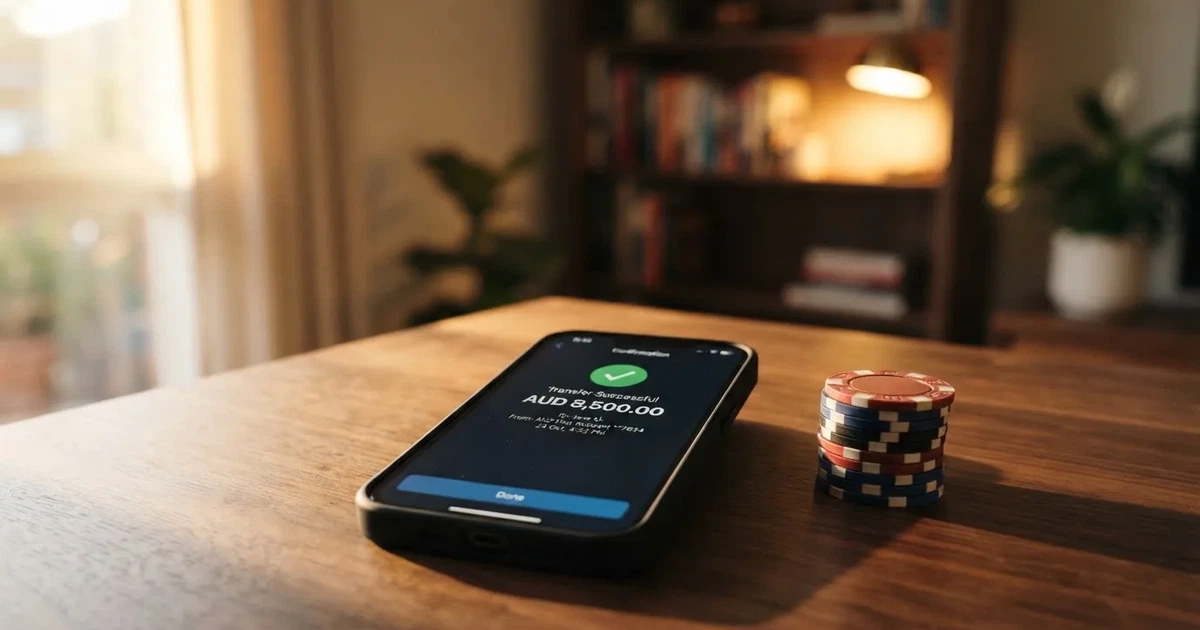
An “instant bank transfer casino” in Australia is, in practice, two different things on the same page. The first is a payment rail — PayID and Osko, the New Payments Platform underneath them, BPAY as the older alternative — that moves a direct transfer between Australian bank accounts in under a minute, around the clock, including weekends. The second is an offshore casino site that markets itself as accepting that rail, then sits one blocking round away from being unreachable from an Australian IP address. The page that follows is about how those two things interact, and where the choice still is once the rail is separated from the site.
The Australian rule on online casino play has not moved in years. The Interactive Gambling Act 2001 makes it an offence to provide online casino games, online pokies or in-play betting to a person physically in Australia. The ACMA enforces it by issuing formal warnings to operators and by asking Australian internet service providers to block offending websites. The provider is the one the law targets, not the individual punter; that distinction is the difference between an unsafe choice and an illegal act, and the rest of this page sits inside it.
Table of Contents
- How a Direct Bank Transfer Actually Reaches an Offshore Casino
- What the Rail Clears, What the Site Still Has to Do
- Why a Bank Transfer Carries a Clearer Trail Than a Card or a Wallet
- What the Interactive Gambling Act Actually Forbids, and What It Does Not
- What Responsible Play Looks Like When the Site Is Offshore
- The Banks, the Wallets and the Choices That Are Actually Still Open
- The Blocking Record: What the ACMA Has Asked ISPs to Hide
- The Brands the ACMA Has Formally Warned
- Side-by-Side: What the ACMA Record Actually Carries
- Choosing Inside the File, Choosing Outside It
- Frequently Asked Questions
How a Direct Bank Transfer Actually Reaches an Offshore Casino
The mechanism behind the marketing is short. An Australian player opens the cashier, enters a deposit amount, and is shown either a PayID, a BSB plus account number, or a BPAY biller code and customer reference number. The player approves the transfer in their own banking app. The funds move along the New Payments Platform or the BPAY scheme and arrive at the receiving account almost immediately; the casino credits the balance once its own transaction review is finished. None of this requires a card, a wallet or a third-party processor, which is why the rail is sold as “instant” and why a paper trail exists for every cent that moves.

What the rail does not do is legitimise the receiving site. The ACMA has, across multiple rounds in 2026 and the years immediately before it, asked ISPs to block exactly the kind of operator that advertises an instant bank transfer deposit. A direct transfer reaches an account; the question of what that account is attached to is settled by the ACMA’s enforcement file, not by how quickly the funds arrive.
The PayID layer is the one most players meet first. Paying to a PayID shows the name on the receiving account before the transfer is sent; AP+, the operator of PayID and Osko, points out that being asked to transfer to a PayID on an illegal gambling site is almost certainly a scam site. The verification works the other way too: a real PayID on a real business account shows a real name, which is why the warning is worth heeding.
What the Rail Clears, What the Site Still Has to Do
Three timings matter, and only the first one is “instant”. The New Payments Platform routes the transfer in under a minute across participating banks, whether the payment is addressed to a BSB and account number or to a PayID. The casino’s own transaction review then runs, which can be anything from a few minutes to a working day depending on the operator. Once the review passes, the credited balance is available to play. The rail has done its job by step one; the operator owns steps two and three.
The implication for a player is that “instant bank transfer casino” is really “instant deposit rail, casino-controlled credit window”. A player who funds an account and tries to play within sixty seconds may still see a pending balance. A player who funds and waits half an hour will, on a well-run site, see the balance cleared. The slow operator is the slow operator; the rail does not fix it.
The reverse — a withdrawal — is where the marketing collapses entirely. The same PayID or Osko transfer that settled the deposit can carry the payout back, and on the rail side it still moves in under a minute. What determines when it arrives is whether the operator approves the withdrawal at all. Offshore sites run their own house rules on identity checks, source-of-funds reviews and bonus-cleared status; any of those can hold a payout for days or weeks, and none of them is appealable to an Australian body. The rail is fast in both directions; the operator decides whether the second trip happens.
Why a Bank Transfer Carries a Clearer Trail Than a Card or a Wallet
A direct bank transfer writes itself into the account ledger the moment it settles. The statement shows the destination name, the BSB or PayID identifier, the time and the amount; it is a record the punter does not have to ask for, and it is the same record a tax office, a bank dispute team or a problem-gambling counsellor would ask to see. Cards leave a statement entry, but it is summarised under a merchant descriptor that often shows nothing more than a parent company’s trading name. E-wallets sit behind a login; the wallet statement shows an internal transfer, not the underlying bank movement. None of those substitutes for the line the bank itself writes.
That paper trail is what makes the bank transfer a workable self-monitoring tool. A player who has set a budget can read the cashflow directly off the statement without exporting anything. A player who has decided to stop can show a counsellor or a family member exactly what has moved and where. A player who suspects a scam can hand the descriptor to their bank and have the institution start a trace. None of these acts depends on the casino’s cooperation, which is the point — once the rail is a direct bank transfer, the player owns the record the way the casino does.
Australian banks have built their own safeguards on top of the same trail. Westpac’s gambling block works at card level: it refuses authorisation of transactions registered under the merchant category code “Betting/Casino Gambling” on eligible personal credit and debit cards. ANZ’s gambling block, activated in the ANZ app, also blocks gambling transactions made through a digital wallet such as Apple Pay on an eligible card, and once turned on it cannot be removed for 48 hours. Commonwealth Bank’s gambling lock sits inside the CommBank app and blocks most gambling transactions, with the same caveat the other banks carry — that some gambling purchases will get through and some non-gambling ones will be refused in error. None of these tools covers a direct transfer to an unknown PayID, which is why the trail matters more than the block on a rail like this one.
What the Interactive Gambling Act Actually Forbids, and What It Does Not
The IGA, as amended in 2017 and again in 2023, makes it an offence for a provider to offer those prohibited services to a person physically in Australia. No state or territory licenses those products. What is licensable is wagering on races and sport placed before the event, lotteries and keno; in practice that is licensed by the Northern Territory Racing and Wagering Commission, which regulates 52 of Australia’s online bookmakers and has no full-time staff of its own. The minimum age is 18.
The IGA targets the provider, not the punter. The page can be precise about this because the statute is. A player in Australia who opens an account with an offshore casino is not committing an offence under the IGA. The casino is. The consequence for the player is not prosecution; it is the absence of every safeguard the Australian licensing framework is built to provide. There is no Australian complaints body to approach, no local dispute resolution, no recourse if a withdrawal is refused or a bonus is voided. The site can be blocked with a balance still on it. H2 Gambling Capital’s 2025 report estimates Australians lose about A$3.9 billion a year to illegal gambling sites, and that the share of gambling going through legal channels fell from 74% in 2021 to 64%.
Payments tell the same story from a different angle. Since 11 June 2024, Australian-licensed online wagering services cannot accept payment by credit card or other credit-related products, with penalties of up to A$247,500 for operators that breach the rule. The ban reaches digital wallets linked to credit instruments; it does not reach an Australian-licensed operator’s normal deposit rails of debit card, bank transfer, PayID, Osko and BPAY. An offshore casino asking an Australian for a credit card or a crypto deposit is operating outside the Australian rules and is also outside the consumer protections those rules were written to provide.
The 2026 reform sits one step ahead. The Interactive Gambling Amendment (Gambling Reform) Bill 2026 passed Parliament on 19 August 2026; its advertising and inducement measures commence 1 January 2027. The law is on the books for 2026 but the advertising provisions are not yet in force. A reader who sees inducement language on an offshore site today is reading the regime as it stood before those measures apply.
What Responsible Play Looks Like When the Site Is Offshore
Australian responsible-gambling infrastructure is built for Australian-licensed wagering. BetStop, the National Self-Exclusion Register, has been live since August 2023, but it binds only Australian-licensed online and phone wagering services. An offshore casino is not connected to it; self-excluding through BetStop does not stop an offshore site from accepting a deposit, and an offshore site has no obligation to honour the registration. The National Gambling Helpline on 1800 858 858 is free, 24/7 and offers chat through Gambling Help Online; it works whatever the site, because the support is provided to the player rather than delivered through the casino.
The offshore site’s own responsible-gaming tools — deposit limits, cooling-off periods, time-out toggles — are voluntary settings on a site that is already operating outside Australian law. A player who has hit a limit they set themselves has done the right thing; the tool does not add anything an Australian framework would recognise. The paper trail of a direct bank transfer, by contrast, is something the player owns outright. Reading it back is a check the casino cannot disable.
AUSTRAC’s threshold-transaction-report rule requires reporting of transfers of A$10,000 or more, but applies only to physical cash. Ordinary electronic bank transfers are not subject to that per-transaction reporting requirement, regardless of amount. A direct bank transfer to an offshore site is not, by itself, a flagged transaction. It is, however, a recorded one.
The Banks, the Wallets and the Choices That Are Actually Still Open
The payment picture for an Australian player in 2026 runs through three layers, each of which behaves differently for gambling.
The card layer carries the gambling blocks. Westpac, ANZ and Commonwealth Bank each offer card-level gambling blocks that refuse authorisation on the merchant category code for casinos and bookmakers. ANZ’s block extends to Apple Pay and Google Pay transactions on the same card; Westpac’s sits at the plastic. The blocks are voluntary, they are imperfect, and ANZ’s takes 48 hours to reverse once set. For a player who wants the bank to be the gatekeeper, this is the layer that does the work.
The wallet layer is constrained from the other direction. The IGA’s 2023 amendments bar Australian-licensed wagering from accepting credit-related products, which the Reserve Bank’s 2025 review treats as reaching digital wallets linked to credit. Apple Pay itself carries no consumer fees for in-store, online or in-app purchases; the transaction limits and PIN requirements are set by the card issuer or merchant, not by Apple. By the end of 2025, Apple Pay, Google Pay and Samsung Pay collectively accounted for around 45% of all card payments in Australia by number. That is the share that is reachable by an issuer block; it is not the share that an offshore casino can rely on to clear a credit-funded deposit.
The transfer layer is the one this page is built around. PayID and Osko move funds in under a minute, 24/7 including weekends, addressed either to a BSB and account number or to a PayID. PayID-based instant transfers are available at over 100 Australian financial institutions. More than 25 million PayID identifiers had been registered on Australia’s New Payments Platform as of April 2025; the platform itself went live to the public on 13 February 2018 and is owned by New Payments Platform Australia Ltd, whose 13 shareholders include the Reserve Bank of Australia and the major banks. Participants must keep the platform’s monthly outages to under two minutes; in 2021 the ACCC authorised merging NPP Australia with BPAY and eftpos into Australian Payments Plus. BPAY, the older bill-payment rail, has been operating since 18 November 1997, is available in the online banking of over 140 Australian institutions and is offered by over 95,000 businesses. Owned equally, via parent company Cardlink Services Limited, by ANZ, Commonwealth Bank, NAB and Westpac, BPAY works on the older Biller Code and Customer Reference Number model — the payer types the codes printed on the bill, the money reaches the biller. It is slower than PayID but reaches the same end.
For an Australian player in 2026, the choice between the three layers is the choice between a block the bank enforces and a trail the bank records. The card layer offers the strongest default refusal; the transfer layer offers the strongest paper trail; the wallet layer sits between them and is governed by whichever card sits underneath it. None of the three turns an offshore casino into an Australian-licensed wagering service.
The Blocking Record: What the ACMA Has Asked ISPs to Hide
The first ACMA blocking request was made in November 2019; by the round reported on 26 June 2026, the ACMA had asked Australian internet service providers to block a cumulative total of 1,751 illegal gambling and affiliate marketing websites, with more than 230 unlicensed gambling services having left the Australian market since enforcement was strengthened in 2017. Spread over the roughly 79 months between the first request and the June 2026 round, that is a blocking rate sitting in a band around 22 sites a month across the lifetime of the regime — high in the early enforcement years, lower as the long tail of repeat offenders was hit, higher again in recent rounds as new operators appeared.
The same June 2026 round named 12 sites in a single batch: 7Signs, ChromaBet, Donbet, Duospin, Freshbet, Slots Gem, Jacks Club, Lucky Start, Pointsbetz.com, Spinrise, Vinyl Casino and Wildsino. A 12-site batch on its own is a rate the lifetime average does not capture; it is what enforcement looks like in a normal month of 2026, not an outlier. The shape of the record is one of steady blocking with occasional concentrated rounds, and the figure to carry away is the band rather than any single monthly count.
The ACMA also runs a parallel enforcement line through formal warnings to operators. The warnings are published, dated and named. They cover the operators behind the sites the page reviews below; they are the reason those operators appear on this page at all.
The Brands the ACMA Has Formally Warned
The eleven brands below are not a ranking. Each is on the page because the ACMA issued a formal warning to the operator behind it for offering prohibited interactive gambling services to Australians. The licence the site displays in its footer does not change that; no Australian state or territory licenses online casino games, online pokies or in-play betting. The point of reading down the list is to see what the ACMA’s enforcement file actually contains, not to find a place to play.
RocketPlay — warned twice, two different operators
The ACMA issued a formal warning to Pulsup Ltd over Rocketplay.com.au in March 2026, and earlier, in May 2022, to Dama N.V. covering six brands, of which Rocketplay was one. The two warnings cover two different operators and two different points in the brand’s history; the fact that Rocketplay has cycled through two operators is itself the finding. A site whose operator changes while the brand carries on is one where the ACMA’s warning has, in effect, been handed to a different legal entity than the one currently behind the cashier. The pattern shows up across the list below.
Level Up Casino — part of Dama N.V.’s 2022 batch
Level Up Casino was named in the May 2022 ACMA formal warning to Dama N.V., alongside Bambet, Dazard, Rocketplay, Wild Tornado and Cobra Casinos. The warning is the single regulatory action on the public record; there is no ACMA-published follow-up naming Level Up specifically in 2026 or 2025, which is itself a fact about the brand. Where it is referenced in third-party listings, the references describe the Dama N.V. group rather than the Level Up site on its own.
Woo Casino — first named in the March 2025 Dama N.V. warning
The ACMA formally warned Dama N.V. over Woo Casino in March 2025 and again over Spirit Casino in May 2025. The Woo warning is the earlier of the two and the first time the brand appeared on the ACMA’s enforcement record under its own name. A brand that surfaces in a single warning rather than as part of a multi-brand batch tends, on this record, to be one the ACMA has treated as a standalone case rather than a group action.
Spirit Casino — second Dama N.V. warning in two months
Spirit Casino was named in the May 2025 ACMA formal warning to Dama N.V., two months after the Woo Casino warning. The two warnings, taken together, show Dama N.V. occupying a larger share of the ACMA’s 2025 enforcement than any single other operator group.
National Casino — Consolutetish S.R.L., July 2025
The ACMA formally warned Consolutetish S.R.L. over National Casino in July 2025. Consolutetish S.R.L. was warned in the same month over Bizzo Casino; the two warnings together are the only public record of Consolutetish S.R.L. on the ACMA’s enforcement file. National Casino and Bizzo Casino are the two brands named; the operator is the entry the ACMA recorded.
Bizzo Casino — a second formal warning after the 2022 TechSolutions one
The ACMA formally warned Consolutetish S.R.L. over Bizzo Casino in July 2025, the second formal warning tied to the brand since 2022, when TechSolutions (CY) Group Limited and TechSolutions Group N.V. were the named operators. Two warnings, two different operators, the same brand still trading. The same operator-cycle finding as RocketPlay, in a different year.
Ignition Casino — Bamboo Media, July 2025
The ACMA formally warned Bamboo Media over Ignition Casino in July 2025. Ignition Casino had not appeared on the ACMA’s enforcement file before that round, by the published record; the warning is the first. The Consolutetish S.R.L. and Bamboo Media warnings were issued in the same month, suggesting the ACMA was running a coordinated round rather than handling each operator separately.
Instant Casino — EOD Code SRL, February 2025
The ACMA formally warned EOD Code SRL over Instant Casino in February 2025. Third-party listings reference the brand alongside payment-method pages, which is the only public signal of how Instant Casino presents itself to players; the ACMA’s warning is the regulatory record.
Jackbit — Ryker B.V., April 2026
The ACMA formally warned Ryker B.V. over Jackbit and CasinOK in April 2026. Two brands, one operator, one warning; CasinOK is named in the same action rather than in a separate one.
Casino Intense — Sterplay Holding Ltd, April 2025
The ACMA formally warned Sterplay Holding Ltd over Casino Intense in April 2025. Third-party listings reference the brand alongside payment-method pages and industry coverage. The single warning stands on its own on the ACMA’s published record.
Sky Crown — Hollycorn N.V., on the record since 2022
The ACMA issued a formal warning to Hollycorn N.V. over Sky Crown and Blue Leo; the published PDF dates the action to September 2022. Sky Crown has not been re-warned in the rounds since, by the ACMA’s published record; the original warning is the only entry.
Side-by-Side: What the ACMA Record Actually Carries
The four matters below are the ones the ACMA’s published record carries for each brand. The columns are what the file actually shows; the gaps are part of the file too, and are more useful than a cell with a number in it would be.
| Brand | ACMA action and date | Operator named by the ACMA | Bank transfer support |
|---|---|---|---|
| RocketPlay | Formal warning, March 2026 (Pulsup Ltd); earlier formal warning, May 2022 (Dama N.V.) | Pulsup Ltd | — |
| Level Up Casino | Formal warning, May 2022 (Dama N.V.) | Dama N.V. | Listings references only |
| Woo Casino | Formal warning, March 2025 (Dama N.V.) | Dama N.V. | — |
| Spirit Casino | Formal warning, May 2025 (Dama N.V.) | Dama N.V. | — |
| National Casino | Formal warning, July 2025 (Consolutetish S.R.L.) | Consolutetish S.R.L. | Listings references only |
| Bizzo Casino | Formal warning, July 2025 (Consolutetish S.R.L.); earlier formal warning, 2022 (TechSolutions) | Consolutetish S.R.L. | — |
| Ignition Casino | Formal warning, July 2025 (Bamboo Media) | Bamboo Media | — |
| Instant Casino | Formal warning, February 2025 (EOD Code SRL) | EOD Code SRL | Listings references only |
| Jackbit | Formal warning, April 2026 (Ryker B.V.) | Ryker B.V. | — |
| Casino Intense | Formal warning, April 2025 (Sterplay Holding Ltd) | Sterplay Holding Ltd | Listings references only |
| Sky Crown | Formal warning, September 2022 (Hollycorn N.V.) | Hollycorn N.V. | — |
The first column reads as a chronology of the ACMA’s enforcement rounds in 2026 and the years just behind it. The second column tells the same story from the operator side, and is where the Dama N.V. cluster and the Consolutetish S.R.L. cluster stand out: one operator group behind five of the eleven warnings, one operator group behind two warnings on the same day. The third column is empty for most rows by design — the ACMA’s file does not record the rail a player would use to fund an account, and treating an affiliate listing as proof of support would be the wrong move.
Choosing Inside the File, Choosing Outside It
The honest summary of the eleven brands is that there is no choice inside the file. Each operator has been formally warned by the ACMA for offering prohibited services to Australians; each is one blocking round away from being unreachable from an Australian IP. The differences between them are differences in the regulatory record, not differences in player experience, and the regulator’s record is the only Australian-authored source the page has.
A reader who wants to wager from Australia has Australian-licensed options in sports and racing before the event, lotteries and keno, which are regulated by the Northern Territory Racing and Wagering Commission. None of those products is an online casino game. The “instant bank transfer casino” that readers search for does not exist as a licensed Australian product. The bank transfer rail exists; the licensed casino at the end of it does not.
The bank’s own blocks — Westpac’s card-level refusal, ANZ’s 48-hour-reversible card and wallet block, Commonwealth Bank’s app-level lock — are the safest choice on the player side, because they take the decision out of the cashier and put it on the issuing bank. The paper trail of a direct transfer is the second-safest choice, because it puts the decision back in the player’s hands after the fact. What is not a choice is treating an ACMA warning as a recommendation, a marketing badge or a sign that the regulator has endorsed the brand in some other way.
Frequently Asked Questions
Is it legal for an online casino to accept a direct bank transfer from a player in Australia?
No. Under the Interactive Gambling Act 2001, it is an offence for a provider to offer online casino games, online pokies or in-play betting to a person physically in Australia. The provider is the target of the law, not the player; that is the legal position, and it is independent of how the transfer itself moves. A direct bank transfer changes nothing about the licence status of the receiving site.
How does a bank transfer deposit at an offshore casino differ from a card deposit?
The bank transfer settles through PayID or Osko in under a minute, while a card deposit runs through the card network and may carry a surcharge or a gambling block from the issuing bank. The transfer writes a full descriptor on the bank statement; the card purchase often shows only the parent company’s trading name. Both rails deliver funds to the operator; only the bank transfer is reliably traceable end to end.
Does a bank transfer leave a clearer paper trail than a card or e-wallet deposit?
Yes. The bank statement shows the destination name, the identifier used, the time and the amount, all written by the bank rather than reconstructed from a third-party statement. A card purchase or an e-wallet transfer can be traced, but only by asking the card network or the wallet provider to retrieve the underlying record. For a player who wants to track spend, hand a record to a counsellor or file a dispute, the direct transfer is the cleaner source.
How long does an instant bank transfer usually take to actually clear at a casino site?
The transfer itself clears in under a minute through PayID or Osko, around the clock including weekends. The casino then runs its own transaction review before crediting the balance, which can take a few minutes or longer depending on the operator. The marketing of “instant” describes the rail; it does not describe the operator’s review. Withdrawals face the same split — fast on the rail, slow on the operator’s approval.
Can a bank flag or block a transfer sent to an offshore casino site?
Australian banks do not currently block direct transfers to offshore casinos the way Westpac, ANZ and Commonwealth Bank block card transactions under their merchant category code. AUSTRAC’s threshold transaction reporting applies to physical cash, not to electronic transfers, so a direct bank transfer is not flagged by amount alone. The paper trail is what the player can read back; the block is what the card-issuing bank can enforce.