
What offshore PayID pokies actually offer Australian players
PayID is Australia’s home-grown answer to instant payments — a way to send money to a phone number, an email address, an ABN or an Organisation Identifier rather than to a string of digits. The offshore pokies market has adopted it enthusiastically. Search for “online pokies PayID Australia” and you will find brand after brand promising instant deposits, same-day withdrawals, and the safety of a system that is already built into Australian banking.
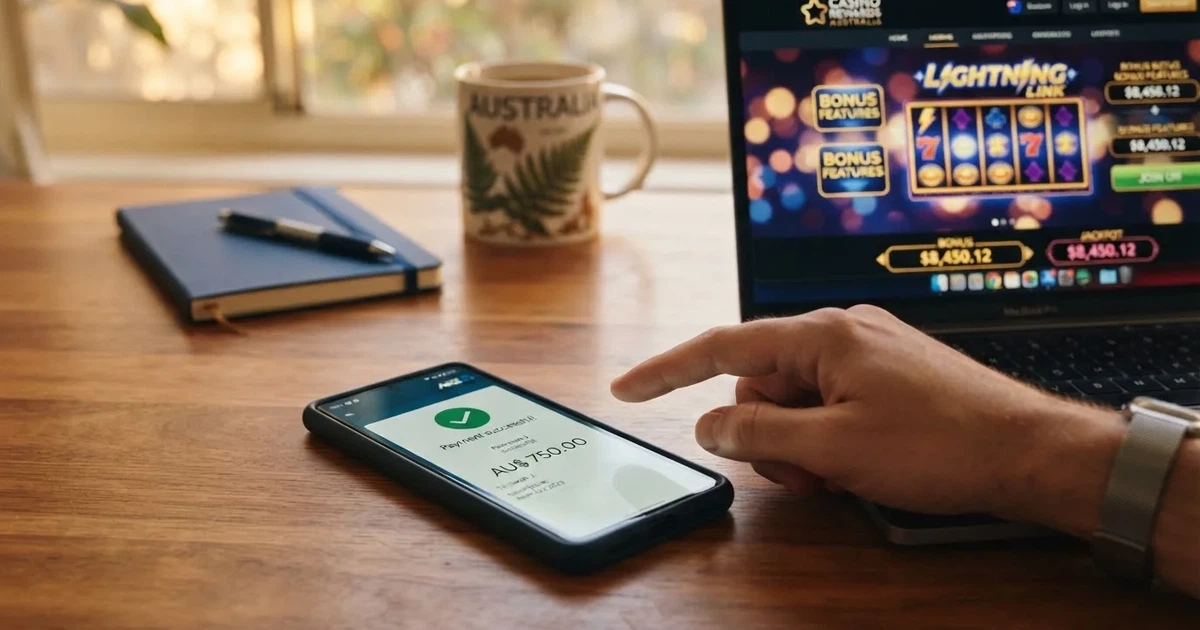
The pitch is one thing. The legal floor is another. Online casino games cannot be licensed by any state or territory in Australia. The brands that take PayID from Australians do so as offshore operators, sitting outside Australian consumer law from the moment a player signs up. This page sets out what PayID actually is, what the offshore sites claim, what the Australian Communications and Media Authority has done about them, and where a reader comparing offers ends up.
As of 29 October 2026, verified against the ACMA’s register of formal warnings and blocking requests.
Fundamentals of the offshore PayID pokies market
The pitch around PayID pokies runs through a small set of repeated lines. The deposits are instant. The withdrawals are fast. The system is built into Australian banking, so it must be safe. And because the offshore casino accepts PayID alongside a Curacao or Anjouan licence, it presents itself as familiar territory for an Australian punter.

Each of those claims is partly true and partly beside the point. PayID is genuinely instant on the Australian end — settlements through Osko on the New Payments Platform arrive in under a minute, 24/7, including weekends and public holidays. PayID is offered by more than 100 Australian financial institutions and is already built into their online banking. There were more than 25 million registered PayIDs in Australia as of April 2025. What PayID is not, on its own, is a guarantee about the casino sitting on the other end of the transfer. It is a payment rail, not a licence, not a complaint channel, and not a refund mechanism.
That distinction is the first thing a reader comparing offers should hold in mind. PayID’s genuine strength is the way it lets the payer see the account-holder name before confirming the transfer — the check that protects against scams and mistaken payments. Australian Payments Plus, the body that operates the scheme, warns in plain language that anyone asked to transfer funds to a PayID on an illegal gambling site is almost certainly looking at a scam site, what AP+ calls a “scambling” website. PayID itself will never contact a customer directly, and any email or text claiming to be from PayID is a scam. The rail itself is honest. The market around it is not.
The broader numbers put the scale in view. H2 Gambling Capital’s 2025 estimate puts Australian losses to illegal online gambling at about A$3.9 billion a year, with the share of gambling going through legal channels falling from 74% in 2021 to 64% in the 2025 figures. The legal/licensed Australian market is sports and racing wagering before the event, lotteries and keno. Most of the country’s online bookmakers — 52 of them, including Sportsbet, Bet365 and Ladbrokes — are licensed by the Northern Territory Racing and Wagering Commission, a body that has no full-time staff and meets once a month in Darwin. Online casino games and online pokies sit outside that licence frame entirely.
When an offshore brand puts “PayID accepted” on its landing page, it is selling the convenience of the rail. It is not, and cannot be, selling a licence to take that money from an Australian. No state or territory issues one. That single fact is what every other number on this page hangs off, and what every operator block below turns on.
Prohibition in plain terms: what the Interactive Gambling Act actually says
The legal frame is short, old, and largely settled. The Interactive Gambling Act 2001, strengthened by the Interactive Gambling Amendment Act 2017, makes it an offence to provide online casino games, online pokies or in-play betting to a person physically in Australia. The 2017 amendments gave the ACMA its current enforcement powers: the ability to direct Australian internet service providers to block illegal sites, to issue formal warnings to the operators behind them, and to seek civil penalties. What is licensable in Australia is wagering on racing and sport placed before the event, lotteries and keno — and the minimum age across the country is 18. Online casino games and online pokies are not, and never have been, on the licensable list.

The detail that surprises most readers is who does the licensing. In practice, the Northern Territory Racing and Wagering Commission oversees 52 of the country’s online bookmakers, because the Territory’s tax arrangements attract operators even though most of their customers are not in the NT. That single regulator, with one monthly meeting and no full-time staff, runs the licence portfolio for the country’s biggest wagering brands. None of those licences covers online casino games.
The enforcement record is the part of the story that moves. By the ACMA’s own count reported in June 2026, 1,751 illegal gambling and affiliate marketing websites had been blocked since the first blocking request was issued in November 2019. More than 230 unlicensed gambling services have left the Australian market entirely since enforcement was strengthened in 2017. The June 2026 round alone named 12 more sites: 7Signs, ChromaBet, Donbet, Duospin, Freshbet, Slots Gem, Jacks Club, Lucky Start, Pointsbetz, Spinrise, Vinyl Casino and Wildsino.
The pace of blocking, taken across the full period since November 2019, runs at an average of roughly 22 sites per month over the 79 months from the first blocking request to the June 2026 report. That average hides a wide spread. Early rounds stopped single figures; recent quarters have produced multi-batch lists. The honest reading sits in a band — somewhere between 20 and 25 sites blocked per month on the long-run average, with the recent pace visibly running at the upper end and the early years at the lower. State it as an average, not a guarantee. An individual month may show nothing, then a single round may name a dozen.
The ACMA also issues formal warnings. A formal warning is published on the ACMA website, names the operating company behind a brand, and gives that operator a chance to comply before further action. Every one of the eleven sites reviewed later in this article has been the subject of at least one. Some have been warned more than once across different operating companies, which is the pattern the regulator’s register makes visible.
Two consequences for the reader. First, the individual player is not prosecuted under the IGA. The Act targets the provider. Second, an offshore casino that the ACMA has blocked can disappear from Australian internet overnight with a balance still on the account, and there is no Australian complaints mechanism to chase. The Interactive Gambling Amendment (Gambling Reform) Bill 2026 passed Parliament on 19 August 2026, and its advertising and inducement measures commence on 1 January 2027 — law with a start date, not yet in force on this page. On tax, gambling winnings of a recreational player are not assessable income under section 6-5 of the ITAA 1997, and losses are not deductible, unless the person carries on a business of gambling. That is a model only; an Australian punter with a real question belongs on the phone to the ATO, not on an offshore cashier page.
Responsible gaming when the offer is offshore
The Australian player-protection framework is built around the licensed market. Its main pieces do not follow the punter into an offshore casino.
BetStop, the National Self-Exclusion Register, has been live since August 2023. It binds every Australian-licensed online and phone wagering service — the same bookmakers the NTRWC regulates. It does not bind an offshore pokies site. A punter who has registered with BetStop can still open an account with a Curacao-licensed brand accepting PayID and deposit from a separate bank. The block stops at the border the IGA already drew.
The National Gambling Helpline is 1800 858 858 — free, 24/7, with chat available through Gambling Help Online. The helpline is the right first call for anyone who feels an offer has crossed from entertainment into something they cannot control. It does not know whether a particular offshore site has paid out, but it knows where local help is and can connect a caller to face-to-face counselling. The service is local. The offshore casino is not.
The major Australian banks run their own gambling blocks that go some way beyond BetStop. Westpac’s gambling block operates at card level — it refuses authorisation of payments registered under the merchant category code “Betting/Casino Gambling” on eligible personal credit and debit cards. ANZ’s block, activated in the ANZ app, does the same and also covers digital wallet transactions such as Apple Pay on an eligible card. Once ANZ’s block is on, removing it requires a 48-hour waiting period — a deliberate friction point. ANZ also warns that not every gambling transaction will be blocked, and that some non-gambling transactions may be blocked in error. The blocks are imperfect, but they catch a meaningful slice of card-based gambling activity before it leaves the account.
For an offshore PayID pokies account, the picture is narrower. PayID transfers move through direct bank-to-bank credit, not through the card networks. A bank gambling block will not stop a PayID payment unless the customer has separately set up a PayID payee restriction with their bank — a feature some institutions offer, but not all. The punter’s most reliable Australian-side levers are: turn on the bank’s transaction alerts, set a daily transfer limit on the account, and keep the gambling budget in a separate account from the rent money.
The mobile wallet layer adds another wrinkle. By the end of 2025, Apple Pay, Google Pay and Samsung Pay transactions collectively accounted for around 45% of all card payments in Australia by number. Wallet transactions are card transactions underneath — the wallet tokenises the underlying debit or credit card. Where the card is a credit card, the IGA 2023 prohibition applies. Where the card is a debit card and the issuing bank has a gambling transaction block that covers wallets (ANZ’s does; Westpac’s is set at card level), the block catches the transaction. Apple states clearly that transaction limits and PIN requirements for Apple Pay purchases are set by the card issuer or merchant, not by Apple itself. The honest rule is not “wallets are blocked” or “wallets are fine” — the rule is whatever the underlying card and the issuing bank decide. Apple does not charge fees to consumers for using Apple Pay in stores, online or in apps, so any surcharge on an Apple Pay deposit comes from the merchant’s own card-processing fees, not from Apple.
Settlement: how PayID actually clears
PayID runs on the New Payments Platform, which the Reserve Bank of Australia launched in February 2018 to let households, businesses and government agencies make simply-addressed, near real-time payments around the clock. The RBA is both the regulator and overseer of the NPP and the owner of the Fast Settlement Service that settles NPP transactions individually, in close to real time, 24 hours a day. Osko is the brand under which participating Australian banks offer those instant transfers through the NPP — an Osko payment arrives in under a minute, 24/7, whether addressed to a BSB and account number or to a PayID.
That is the genuine settlement speed. An Australian depositing through PayID from a participating bank sees the money leave the source account and arrive at the receiving account in seconds — over 100 Australian financial institutions offer PayID through their online banking, and there were more than 25 million registered PayIDs as of April 2025. The receiving party, in an offshore pokies context, is then credited by the casino’s own back office on its own schedule. The casino does not get faster because PayID is fast. PayID gets the money to the casino quickly, and the casino decides what it does with the deposit from there.
The withdrawal direction is the place the marketing tends to stretch. Offshore pokies sites often advertise “instant PayID withdrawals”, sometimes with a one-hour or two-hour window. The bank-side settlement for the incoming Osko transfer is genuinely instant. The casino-side processing — verification checks, anti-fraud review, internal approval queues — runs on whatever schedule the operator chooses. The cleanest reading: the rail is fast, and the operator is not the rail. Two different promises, from two different parties, and only one of them a reader can verify in their own banking app.
A few payment specifics that shape how Australians can and cannot fund offshore pokies. Under the Interactive Gambling Act 2001 as amended in 2023, Australian-licensed online wagering services cannot accept credit cards or credit-related products as payment, with penalties of up to A$247,500 for operators that break the rule. PayID is a debit-pulled payment from a bank account, not a credit product, so the prohibition does not reach it directly. Credit cards have been out for licensed wagering since 11 June 2024. Digital currency is out as well. The legal deposit routes for a licensed Australian wagering service are debit card, bank transfer, PayID/Osko and BPAY.
Surcharging on card transactions also bears on this picture. The Reserve Bank’s July 2025 review proposes removing surcharges only on eftpos, Mastercard and Visa card transactions, explicitly leaving American Express outside the scope of the proposed surcharge ban. AmEx runs a three-party network that traditionally issues cards and processes transactions itself, rather than the four-party model Visa and Mastercard use — it was established in 1850 as a freight-forwarding company and launched its first charge card on 1 October 1958. For an Australian punter, the practical meaning is that surcharging on Amex-funded deposits is still permitted under the proposed reform, where it would not be on Visa or Mastercard. That detail matters more on an offshore site than on a local one, because the offshore cashier sets its own surcharges.
The take-away for a reader comparing offers: when an offshore pokies brand advertises “instant PayID” deposits and “instant PayID” withdrawals, the deposit speed is the rail talking. The withdrawal speed is the brand talking. They are different promises, from different parties, and the rail’s promise is the one a reader can verify in their own banking app.
The landscape of eleven sites the ACMA has named
The brands below have each been the subject of at least one formal warning from the ACMA under the Interactive Gambling Act 2001, on dates that range from 2022 to 2026. None of them is licensed to offer online casino games or online pokies to Australians — that licence does not exist under Australian law, and the brands reviewed here sit outside it by definition. The table below sets out the warning and the operating company named at the time. It is not a ranking and it is not a recommendation.
| Brand | ACMA warning (date) | Operator named by ACMA | PayID status as reported |
|---|---|---|---|
| RocketPlay | Formal warning, March 2026 (Pulsup Ltd); earlier Dama N.V., May 2022 | Pulsup Ltd / Dama N.V. | not reported in any consulted source |
| Level Up Casino | Formal warning, May 2022 | Dama N.V. | listed as a PayID example on Westpac’s help page |
| Woo Casino | Formal warning, March 2025 | Dama N.V. | not reported in any consulted source |
| Spirit Casino | Formal warning, May 2025 | Dama N.V. | not reported in any consulted source |
| National Casino | Formal warning, July 2025 | Consolutetish S.R.L. | listed as a PayID reference on AUSTRAC and Wikipedia |
| Bizzo Casino | Formal warning, July 2025; earlier TechSolutions, 2022 | Consolutetish S.R.L. / TechSolutions | not reported in any consulted source |
| Ignition Casino | Formal warning, July 2025 | Bamboo Media | not reported in any consulted source |
| Instant Casino | Formal warning, February 2025 | EOD Code SRL | listed as a PayID reference on Ecopayz and PayID |
| Jackbit | Formal warning, April 2026 | Ryker B.V. | not reported in any consulted source |
| Casino Intense | Formal warning, April 2025 | Sterplay Holding Ltd | listed as a PayID reference on AUSTRAC, ITnews and NAB |
| Sky Crown | Formal warning, September 2022 | Hollycorn N.V. | not reported in any consulted source |
The PayID column is intentionally thin. Several of the brands appear in third-party PayID listings as an example of an account the rail can be used to fund — that is a listing, not the brand’s own claim, and the brands themselves do not put “PayID accepted” on their landing pages the way Australian-facing operators tend to. For most of the eleven, no consulted source carries any PayID status at all. Treat the column as an honest gap rather than a yes or a no.
Each of the eleven is reviewed below by name. The reviews set out the ACMA warning, the operating company at the time of the warning, and what the brand’s offshore profile leaves a reader weighing. They do not print bonus codes, signup offers or affiliate links — those are the part of an offshore offer an Australian punter would do better to leave alone.
RocketPlay
RocketPlay has been warned twice. The first formal warning went to Dama N.V. in May 2022, naming RocketPlay alongside five other Dama brands — Bambet, Dazard, Level Up, Wild Tornado and Cobra Casinos. The second came in March 2026, addressed to Pulsup Ltd over Rocketplay. The brand has moved between operating companies. The ACMA’s register of formal warnings records both.
RocketPlay presents itself as a Curacao-licensed casino offering a large slots library, a sportsbook, and a long list of payment methods. None of that addresses the central fact for an Australian reader, which is set out in the prohibition section above. The Curacao licence RocketPlay displays sits outside the IGA frame, and an Australian consumer with a complaint has no Australian body to take it to.
The brand has appeared on affiliate lists claiming PayID acceptance; the consulted sources do not confirm that independently. Treat the claim as marketing, not as fact. The cleaner reading: an Australian reader who values Australian consumer protection has no path to it through this brand, and the ACMA’s record shows RocketPlay has been on the regulator’s mind for nearly four years. The verdict is that the brand has cycled through two operating companies while remaining on the regulator’s register, and a reader who reads the register would not pick this brand to start with.
Level Up Casino
Level Up Casino was named in the same Dama N.V. warning of May 2022 as RocketPlay and the other Dama brands of that period. The warning is the brand’s only formal entry on the ACMA’s register of formal warnings.
The brand pitches a tiered loyalty programme, fast withdrawals, and a Curacao licence. None of those claims converts the IGA situation. Level Up’s status in Australian payment listings is thin — Westpac’s PayID help page lists it among examples of merchants the bank has flagged in the context of scam warnings. That is a listing, not a brand-side claim of PayID acceptance, and the page does not run an active PayID deposit flow from a participating Australian bank.
The verdict for an Australian reader is short: a four-year-old ACMA warning with a Curacao licence on the wall and no Australian dispute mechanism at the other end. The rail entry is a rail note, not a brand endorsement.
Woo Casino
Woo Casino picked up a fresh ACMA formal warning in March 2025, again addressed to Dama N.V. — the same operating company behind the 2022 batch. The ACMA’s register separates the 2025 warning from the 2022 one by both date and the specific brand under it.
The brand presents itself as a stylised, design-led casino with a wide library of slots and a sportsbook attached. The Australian-facing situation has not changed: no state or territory licences online casino games, and the ACMA has now warned the operating company twice across its portfolio. A reader who values local recourse has no local recourse through Woo.
Consulted sources carry no PayID status for Woo. The brand’s payment pages list cards, e-wallets and a handful of cryptocurrencies; PayID does not appear on the public material. The honest gap is the gap. Read it as data, not as denial. The verdict is a Dama brand with two ACMA entries on its operating company, no Australian protection, and no PayID flow on the public deposit page — and the new entry is barely a year old.
Spirit Casino
Spirit Casino was warned in May 2025, also addressed to Dama N.V. — the third Dama brand in this group, after the 2022 batch and Woo Casino in March 2025. The cluster of Dama warnings gives a reader a sense of how an operating company can accumulate entries on the ACMA’s register across multiple brand names.
The brand is a Curacao-licensed casino with a smaller, more focused game library than some of its Dama siblings. The pitch emphasises fast withdrawals and a clean mobile interface. None of that converts the legal position set out earlier.
No consulted source confirms Spirit Casino’s PayID status. The brand’s payment pages lean on cards and e-wallets; nothing on the public material lists PayID as an accepted method. Treat the absence as honest data rather than a denial. The verdict: a Dama brand with a 2025 ACMA entry, no Australian protection, and no PayID presence on the public deposit flow — and the operating company now sits on the ACMA’s register three times across its portfolio, with the brand rotation leaving the warning count intact.
National Casino
National Casino was warned in July 2025, addressed to Consolutetish S.R.L. — a different operating company from the Dama cluster. AUSTRAC and Wikipedia entries reference National Casino among the operators that have appeared on payment-rail listings in Australia; that is a listing, not the brand’s own claim.
The brand offers a deep slots library and a tiered welcome package, licensed in Curacao. The Australian situation is unchanged: no licence for online casino games exists here, the ACMA has named the operating company, and there is no Australian dispute body.
For an Australian reader, the verdict sits in the rail listing rather than the brand’s own pages. National Casino is a single ACMA warning with a Curacao licence on the wall and a third-party listing rather than a brand-claimed PayID deposit flow. The protection a reader can rely on is the protection built into the Australian side of the transfer — the PayID name check, the bank’s transaction alerts, and the bank’s own gambling block if it is switched on.
Bizzo Casino
Bizzo Casino was warned in July 2025 by the ACMA, addressed to Consolutetish S.R.L. — alongside National Casino. The brand has a longer ACMA history: the regulator had already issued a formal warning to TechSolutions (CY) Group Limited and TechSolutions Group N.V. over Bizzo in 2022, before the brand moved to a new operating company.
The brand is a Curacao-licensed casino with a busy game library and a strong promotional calendar. The fact that matters for an Australian reader is unchanged: the ACMA has now named Bizzo twice, across two different operating companies.
No consulted source confirms Bizzo’s PayID status. The brand’s public payment pages list cards and e-wallets; PayID does not appear as an active deposit method on those pages. Read the absence as data, not as denial. The verdict is that Bizzo is the brand on this list with two ACMA entries in two separate years, and the operator-company rotation has not moved it off the regulator’s register. The warning count is two. The licence is still offshore.
Ignition Casino
Ignition Casino was warned in July 2025, addressed to Bamboo Media. The brand is one of the better-known offshore poker and casino brands among Australian-facing traffic; the ACMA warning is the brand’s first on the register.
The brand pitches itself as a poker-focused casino with a wide slots library and a Curacao licence. The Australian legal position is the same as for the rest of this list: online casino games and online pokies cannot be licensed here, and the Curacao licence Ignition displays sits outside the IGA frame.
No consulted source carries Ignition Casino’s PayID status. The brand’s public material does not list PayID among active deposit methods. The honest reading for an Australian reader is the same one a reader reaches on every brand in this group: an offshore licence on the wall, a 2025 ACMA warning, and no Australian consumer protection at the other end. The regulator has now spoken, and the register carries the brand.
Instant Casino
Instant Casino was warned in February 2025, addressed to EOD Code SRL. It is a Curacao-licensed casino that uses a fast-withdrawal pitch in its name. The ACMA warning came early in 2025 and is the brand’s only entry.
Instant Casino is one of the eleven brands that appears on PayID-side listings — Ecopayz and the PayID page both reference it as an example of a merchant account the rail can be used to fund. That is a rail-side listing, not a brand-side claim of PayID acceptance; Instant Casino’s own payment pages do not put PayID at the top of the deposit options.
For an Australian reader, Instant Casino is an early-2025 ACMA warning with a Curacao licence on the wall. The PayID status sits on the rail side rather than the brand side, which means the brand has not built the rail into its deposit flow. The verdict: a brand whose name sells speed that the rail does not deliver on the brand’s side, and the rail-side listing is a rail note, not an endorsement of the casino.
Jackbit
Jackbit was warned in April 2026, addressed to Ryker B.V. — alongside CasinOK in the same formal warning. Jackbit is the most recent brand in this list to enter the ACMA’s register of formal warnings.
The brand presents as a crypto-friendly casino and sportsbook with a Curacao licence and an emphasis on rapid withdrawals. The Australian legal position is the same as for the rest of the list, with one twist worth noting: cryptocurrency is not a legal deposit route for licensed Australian wagering, and Jackbit leans heavily on crypto. An Australian punter who chooses crypto on Jackbit sits even further outside the local rule book than on a debit-card-funded offshore site.
No consulted source confirms Jackbit’s PayID status. The brand’s public material emphasises crypto and e-wallets; PayID does not appear as a primary deposit method. The verdict is the freshest ACMA entry on this list, with a payment profile that pushes the reader toward crypto rather than toward the Australian banking rail — and crypto is not a legal deposit route for licensed Australian wagering.
Casino Intense
Casino Intense was warned in April 2025, addressed to Sterplay Holding Ltd. The brand has appeared in AUSTRAC, ITnews and NAB listings as a PayID-related entry — a rail-side listing rather than a brand-side claim.
The brand presents as a Curacao-licensed casino with a smaller, focused game library and an emphasis on fast payouts. The Australian legal position is unchanged.
For an Australian reader, Casino Intense is a 2025 ACMA warning with a rail-side PayID listing. The distinction matters: the listing is a note about the rail, not about the brand’s deposit flow. The verdict: a reader who sees Casino Intense on a PayID listing should treat it as a PayID-side observation rather than a brand-side promise, and the ACMA warning sits between the reader and the brand regardless of the rail note.
Sky Crown
Sky Crown was warned in September 2022, addressed to Hollycorn N.V. — alongside Blue Leo in the same formal warning. Sky Crown is the oldest entry on this list by ACMA date, and Hollycorn is one of the operating companies that has accumulated several formal warnings across its brand portfolio.
The brand is a Curacao-licensed casino with a wide slots library and a tiered welcome package. The Australian situation remains what it has been for every brand on this list: no state or territory licences online casino games, the ACMA has named the operating company, and there is no Australian consumer protection at the other end.
No consulted source confirms Sky Crown’s PayID status. The brand’s public payment pages lean on cards and e-wallets; PayID does not appear on the public material. The honest reading for an Australian reader is that an offshore licence on the wall and a four-year-old ACMA warning are both there, and there is no Australian dispute body to chase if a withdrawal stalls. The verdict is the oldest ACMA entry in this group, with an operator-company name that has accumulated entries across its other brands as well. The register has had Sky Crown on it for four years.
Frequently asked questions
| Payment Method | Usage in Offshore Sites | Australian Legal Status |
|---|---|---|
| Debit Card | Commonly accepted | Restricted for licensed wagering |
| PayID | Marketed for convenience | Debit-pulled (not credit) |
| Cryptocurrency | Often pushed | Banned for licensed wagering |
Why do so many pokies sites specifically advertise PayID rather than a regular bank transfer?
PayID turns a transfer into a one-step action through online banking, with the receiving party’s name shown before the send. That is faster and cleaner than typing in a BSB and account number, and works at more than 100 Australian institutions. Offshore sites feature it because the rail is convenient and familiar — not because PayID endorses the casino.
Is a PayID pokies site described as “trusted” any safer than one that isn’t?
“Trusted” is a marketing word, not a licence category. Every brand reviewed on this page holds an offshore licence (typically Curacao or Anjouan), not an Australian one. The relevant checks are independent: the ACMA’s register of formal warnings, AUSTRAC entries, and the brand’s payment and withdrawal terms.
Can an Australian legally use PayID to fund an offshore pokies account?
The Interactive Gambling Act 2001 targets the provider of prohibited interactive gambling services, not the individual player. Australians are not prosecuted for using PayID to fund an offshore pokies account. The legal consequence sits at the other end of the transfer: the offshore operator is providing a service it is not licensed to provide to Australians, and the ACMA can block the site.
How does an instant-PayID pokies claim compare with the real Osko settlement times banks describe?
Osko, the brand Australian banks use for instant transfers through the New Payments Platform, settles in under a minute, 24/7, including weekends. PayID sits on top of Osko and inherits that speed on the rail side. What the offshore casino does after the deposit arrives — verification, anti-fraud review, internal approval — is on the operator’s own clock, not the rail’s.
What should someone check about a site before trusting its own claim to be licensed for PayID pokies?
Three checks do most of the work. First, the ACMA’s register of formal warnings — if the brand or its operating company is on it, the regulator has already named them. Second, AUSTRAC’s list of named remittance and wagering-related entities. Third, the bank’s own gambling block and PayID payee management — turning the block on and adding a daily transfer limit are the Australian-side levers a punter actually controls.