
Best Video Slots Australia: Mechanics, Markets and What the ACMA Has Shut Down in 2026
The phrase “best video slots Australia” travels two ways and the reader is owed the straight difference between them. On one side sits the offshore online casino industry, a global trade in modern multi-reel games with bonus rounds, free-spin features and progressive jackpots, sold to Australians by brands holding licences from Curaçao, Anjouan or Kahnawake. None of that trade is lawful inside Australia. The Interactive Gambling Act 2001 makes the supply a criminal offence, and the Australian Communications and Media Authority has spent seven years shutting it down site by site. On the other side sit the licensed gaming machines Australians actually play: the “pokies” in pubs and clubs of NSW, Victoria, Queensland, South Australia and the ACT, and the electronic gaming machines inside Crown Melbourne, The Star Sydney, Crown Perth and the smaller state casinos. Those machines are modern, they are video-format, and they are taxed, regulated and tied to harm-minimisation rules that no offshore site matches.
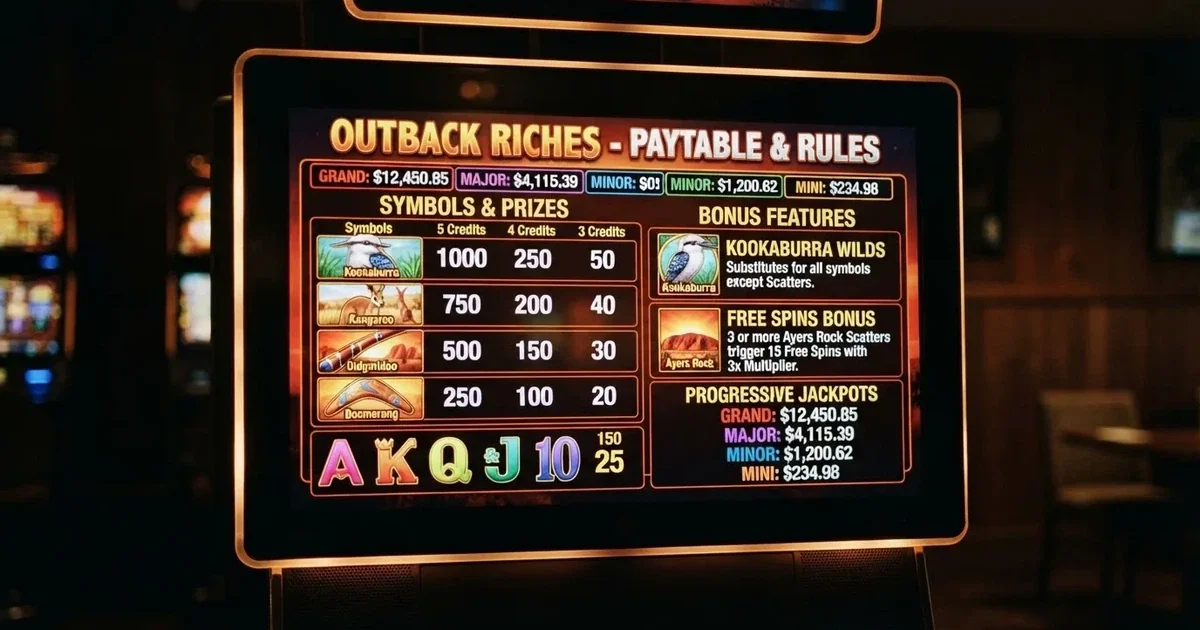
This page is built on the second reading. The first is named and named plainly, because a comparison that hides the legal status of one of its sides is a comparison that misleads. The shelf of brands the ACMA has acted against closes one block of the page, the mechanics of a modern video slot close another, and the live legal and consumer-protection landscape in Australia closes the rest.
Currency stamp: data is current as of 29 October 2026 and was checked against the ACMA’s published register of formal warnings and blocking requests.
Table of Contents
- Video Slots as a Format: What Sets Them Apart From a Three-Reel Pokie
- Australian Licensed Video Slots: Where the Legal Play Actually Sits
- Bonus Offers Around Video Slots: What the Words “Free Spins” and “Bonus Rounds” Actually Cost
- Mobile and App: How Video Slots Perform on an Australian Phone
- Responsible Gambling Around Video Slots in Australia
- Frequently Asked Questions
Video Slots as a Format: What Sets Them Apart From a Three-Reel Pokie
A modern video slot is defined by its reels, its paylines and the bonus mechanics layered on top. The classic three-reel machine Charles Fey built in San Francisco in the late 19th century carried five symbols per reel — horseshoes, diamonds, spades, hearts and the Liberty Bell — and three bells in a row paid ten nickels. A modern video slot can carry five reels or more with fifty symbols on each, and a top combination can be set at odds of 300 million to one. The volume of combinations is what makes a video slot a different product, not merely a faster one, and it is what allows the developer to build in features that a 1,000-combination mechanical game cannot carry.

Those features have names a reader will meet everywhere: free spins, bonus rounds, cascading reels, expanding wilds, multipliers, pick-me games and progressive jackpots. A bonus round is a self-contained game inside the slot — a wheel spin, a treasure chest to open, a set of free spins with an attached multiplier — that triggers when a defined combination lands on the reels. Free spins are the most common: a fixed number of paid-for spins awarded by the slot itself, with the stake carried over from the spin that triggered them. Cascading reels replace winning symbols with new ones and let a single stake produce several payouts in a row. Expanding wilds stretch across a whole reel to complete combinations. Multipliers increase the value of a line win by a set factor. Pick-me games replace the reels with a screen of items to choose from, each hiding a prize. Progressive jackpots pool a fraction of every stake across a network of machines, which is how a single game pays out sums that no fixed-payline slot can match.
A video slot is not necessarily a “better” slot. The mechanics move volatility — the gap between the typical spin and the rare one — around. A classic three-reel machine tends to pay small wins often. A modern video slot pays small wins rarely and large wins very rarely, and the bonus features are the engine for the rare outcomes. Two slots from the same provider can sit at opposite ends of that range, and the catalogue is built so a player can choose where on it they want to sit. A reader who wants long sessions of small outcomes is choosing a low-volatility slot; a reader who wants the rare large payout is choosing a high-volatility slot. The same payline count, the same reel count, the same provider — the only variable that changes is the maths of the game underneath.
The point worth holding onto: a video slot is a format, not a quality grade. Asking for “the best video slots” is asking for the best-arranged version of a particular kind of maths. That maths is what the catalogue below is organised around.
Paylines, Reels and Symbols: A Reader’s Glossary
A payline is a line of symbols across the reels that pays out when a defined combination lands on it. A classic three-reel slot has a single horizontal payline down the centre. A modern video slot can carry dozens: horizontal, diagonal, zig-zag and V-shaped lines that count wins from any of several starting positions. A “243 ways to win” slot drops the paylines entirely and pays for any combination of three or more matching symbols on adjacent reels from the left — a different way to count, not a different number of combinations. A “Megaways” slot, licensed by Big Time Gaming to other developers, varies the symbol count on each reel from spin to spin and can produce up to 117,649 ways to win on a single spin. The payline count is one of the catalogue facts the reader will see most often, and it is a structural fact, not a quality fact: a 243-ways slot is not necessarily better than a 25-payline slot and is not necessarily worse.
The reel count is the second structural fact. Three reels is the classic machine; five reels is the modern video slot; six and seven appear in newer Megaways releases. The symbol count per reel is the third, and it is the one most readers do not see. A slot with five reels and three rows of symbols displays fifteen positions on every spin. A slot with six reels and seven rows displays forty-two. The number of positions is what drives the number of possible outcomes, and it is what lets the developer build a top prize with odds of millions-to-one against.
Bonus Features: Where the Marketing Spends Its Words
Free spins, bonus rounds, multipliers, pick-me games and progressive jackpots are the surface of every promotional page for every video slot. They are also the surface a reader should understand before any offer is taken up. A free-spin feature pays for a set of spins at the slot’s stake; a bonus round pays a different prize; a multiplier multiplies the line win it attaches to; a progressive jackpot carries its own contribution rate and is paid out under its own rules.
The house edge — the long-run percentage of every dollar wagered that the machine keeps — is the cleanest measure of what a slot costs the player. Slots are not baccarat, where the edge is fixed at 1.06% on the Banker bet or 14.36% on the Tie, and they are not blackjack, where optimal play pulls the edge to 0.28% under liberal Las Vegas Strip rules or 0.43% under Atlantic City rules. A slot’s house edge is set by the developer and varies from game to game. Australian state regulators do not impose a minimum-payout law of the kind that exists in the United States, where Nevada requires at least 75%, Mississippi 80% and New Jersey 83%. Australian pub and club machines are programmed to a return-to-player rate that the state regulator approves, and that rate varies by jurisdiction. The point is structural: a slot’s cost is set in the maths of the game and disclosed in the help screen, and no amount of bonus feature compensates for a low return-to-player.
Volatility, RTP and Why the Same Provider’s Slots Feel Different
Volatility is the size of the swing around the average return. A low-volatility slot pays small wins often and keeps the bankroll close to its starting point; a high-volatility slot pays small wins rarely and keeps the bankroll below its starting point until the rare large win lands. Return-to-player, written RTP, is the long-run percentage of every dollar wagered that the game returns to players in prizes. The two are independent: a high-volatility slot can sit at a higher RTP than a low-volatility one, or at a lower one. The developer sets both, and the same provider’s catalogue will carry games at every point of the spread.
This is the answer to the question “why do video slots vary in volatility even within the same provider’s catalogue?” The provider builds several products to suit several bankrolls, and a player who wants long sessions of small wins is choosing a different game from a player who wants the rare large payout. The features are the visible difference; the maths underneath is the real one.
Australian Licensed Video Slots: Where the Legal Play Actually Sits
The legal video slots a person in Australia can play are the licensed electronic gaming machines. They sit in two places. The first is the pub and club floor — what locals call “pokies” — in NSW, Victoria, Queensland, South Australia, Western Australia, Tasmania, the Northern Territory and the ACT. The second is the licensed casino floor: Crown Melbourne, Crown Perth, The Star Sydney, The Star Gold Coast, Skycity Adelaide, Skycity Darwin and the casino at Wrest Point in Tasmania, plus the Jupiters and Treasury properties on the Queensland coast.
The numbers give the scale. As at mid-2023 NSW had 87,298 pokies-style machines outside casinos, Victoria 26,380 across 2021-22, Queensland 21,122 in October 2023, South Australia 11,672 in September 2023 and the ACT 3,587 in November 2023. New South Wales alone carries the bulk of the country’s pub and club fleet. NSW legalised slot machines in 1956, and by 2010 Australia operated an estimated 97,103 gaming machines outside casinos, a per-capita rate roughly five times that of the United States. The state regulators — Liquor & Gaming NSW, the Victorian Gambling and Casino Control Commission, the Queensland Office of Liquor and Gaming Regulation, Consumer and Business Services in South Australia and the ACT Gambling and Racing Commission — set the rules for harm minimisation: stake limits, mandatory break periods, self-exclusion registers and the visible clocks a player sees at the machine.
The casino floor carries its own category. Crown Melbourne runs three baccarat variants — Traditional Baccarat, Crown Baccarat and 2 to 1 Baccarat — under rules approved by the VGCCC, and the same regulator approves Crown’s blackjack variants, including the “Free Bet” option with the “Pot of Gold” side bet introduced on 25 March 2024 and the renaming of “Perfect Pairs” to “Crown Pairs” on 23 December 2024. The NSW Casino Control Act 1992, section 66, requires the casino operator to make a copy of the approved rules of any game available on request. The licensed machines are the video slots a person in Australia can sit down and play without committing an offence, and the regulatory frame around them is what no offshore operator matches.
Why “Online Video Slots Australia” Is a Contradiction in Terms
Every offshore brand offering video slots to Australian accounts is offering a service the Interactive Gambling Act 2001 prohibits. The 2017 amendments tightened the offence; the ACMA has spent seven years enforcing it. In a single round reported on 26 June 2026, twelve more illegal gambling websites were referred to Australian internet service providers for blocking: 7Signs, ChromaBet, Donbet, Duospin, Freshbet, Slots Gem, Jacks Club, Lucky Start, Pointsbetz, Spinrise, Vinyl Casino and Wildsino. The blocking action runs alongside formal warnings to the operators behind each site.
The Australian market for legal online gambling is narrower than the offshore product looks. What is licensed is wagering on racing and sport placed before the event — not in-play — plus lotteries and keno. The Northern Territory Racing and Wagering Commission regulates 52 of Australia’s online bookmakers, including Sportsbet, Bet365 and Ladbrokes, and the Commission is the de facto online wagering regulator for the country for tax reasons: it has no full-time staff and meets once a month in Darwin. A reader searching for “online video slots Australia” is searching for a product the law does not license. The page has to say so plainly.
Offshore Sites Australians Will See Advertised, and What the ACMA Has Done About Them
The brand names below are brands the ACMA itself has acted against under the Interactive Gambling Act. They are not a recommendation, not a shortlist and not a ranking. They are a record of formal warnings, the dates the ACMA published them, and the operators behind them. A reader comparing one of these to another is comparing brands the regulator has already named for the same conduct: offering prohibited interactive gambling services to people in Australia.
| Brand | ACMA action and date | Operator named by the ACMA | Subject support |
|---|---|---|---|
| RocketPlay | Formal warning, March 2026 | Pulsup Ltd (Rocketplay); earlier Dama N.V., May 2022 | — |
| Level Up Casino | Formal warning, May 2022 | Dama N.V. | BGaming lists the brand |
| Woo Casino | Formal warning, March 2025 | Dama N.V. | — |
| Spirit Casino | Formal warning, May 2025 | Dama N.V. | — |
| National Casino | Formal warning, July 2025 | Consolutetish S.R.L. | Wikipedia lists the brand |
| Bizzo Casino | Formal warning, July 2025 | Consolutetish S.R.L.; earlier TechSolutions, 2022 | — |
| Ignition Casino | Formal warning, July 2025 | Bamboo Media | — |
| Instant Casino | Formal warning, February 2025 | EOD Code SRL | — |
| Jackbit | Formal warning, April 2026 | Ryker B.V. (also CasinOK) | — |
| Casino Intense | Formal warning, April 2025 | Sterplay Holding Ltd | ABC, ACMA and Crown Melbourne sources name the brand |
| Sky Crown | Formal warning, September 2022 | Hollycorn N.V. (also Blue Leo) | — |
The pattern the table shows is structural, not anecdotal. Three operators — Dama N.V., Hollycorn N.V. and TechSolutions — have been warned more than once for the same conduct. The ACMA’s March 2026 warning to Pulsup Ltd over Rocketplay is the second warning Rocketplay itself has received, the first having gone to Dama N.V. in May 2022. The regulator’s response is not a single action but a continuing one. By June 2026, a total of 1,751 illegal gambling and affiliate marketing websites had been blocked since the first blocking request in November 2019, and more than 230 unlicensed gambling services had left the Australian market since enforcement was strengthened in 2017.
The legal status does not change when an offshore site shows a Curaçao or Anjouan licence. That licence is a permission to operate from the licensing jurisdiction, not a permission to provide a prohibited service to Australians. The Interactive Gambling Act’s reach is over the act of providing the service to a person in Australia, irrespective of where the provider is incorporated or what licence it carries elsewhere. A reader who sees a “100% licensed” badge on an offshore site is seeing a fact about the licensing jurisdiction, not a fact about Australian law.
The Blocking Rate: How Fast the ACMA Is Closing the Pipeline
The arithmetic the page is built around is the rate at which the ACMA has been blocking illegal sites since the first blocking request was issued in November 2019. From that date to June 2026, 1,751 sites were blocked. The blocking action runs in waves: the round reported on 26 June 2026 added twelve more sites. Earlier rounds in 2023 and 2024 added similar batches; the November 2019 request opened the register.
The blocking rate works out at roughly 250–300 sites per year on the long-run average — closer to the high end in years when enforcement was tightened, closer to the low end in years between formal crackdowns. The 26 June 2026 round, at twelve sites, sits below the long-run average per round but is not a one-off; earlier rounds have carried comparable or larger counts, and the regulator’s pattern is to escalate in waves rather than trickle-block continuously. The condition on the rate is that it depends on what the ACMA considers provable under the Interactive Gambling Act: sites that hold themselves out as targeting Australians, sites with AUD accounts, sites that accept Australian payment methods. A site that simply exists offshore and does not solicit Australians can sit outside the ACMA’s reach entirely.
The rate matters to the reader because it tells them what kind of shelf life an offshore account has. A site blocked in 2024 is not reachable from an Australian ISP in 2026; a site warned in March 2026 may still be reachable but will not be for long. The arithmetic is the page’s conclusion: a player who opens an account with a brand not yet on the ACMA’s list is buying themselves weeks or months, not years, before the same fate arrives.
Bonus Offers Around Video Slots: What the Words “Free Spins” and “Bonus Rounds” Actually Cost
A “free spins” offer at an offshore casino is a marketing term for a set of paid-for spins on a named slot, awarded by the operator and usually tied to a deposit, a bonus code or both. A “bonus round” inside a slot is the in-game feature that triggers on a defined combination. The two phrases share the words “bonus” and “free” and are not the same thing. The free-spin offer is what the operator is selling. The bonus round is what the slot itself does. They share no maths.
The cost of a free-spin offer sits in the wagering requirement that comes with it. A wagering requirement is the multiple of the bonus, the deposit, or both, that the player must turn over before any winnings become withdrawable. A A$200 bonus with a 35x wagering requirement means A$7,000 of qualifying bets before the bonus is “cleared”. A A$100 free-spin package on a slot at A$1 per spin with 30x wagering on the winnings means the player must wager 30 times whatever the free spins paid out before the balance becomes cash. The maths is mechanical and the cost is real.
Two more layers stack on top. A maximum-cashout cap limits how much of a bonus win the player can withdraw — a common rule on no-deposit free-spin offers, where the bonus itself is free but the withdrawal is not. A “game weighting” rule assigns different games different contributions to the wagering requirement; slots usually count 100%, table games count less, and a handful of slots are excluded entirely. The “free spins” headline hides each of these mechanics. A reader who treats the headline as the offer is reading the marketing page.
A further point the marketing page will not draw attention to: a wagering requirement attached to a free-spin offer is paid out of real money first. The bonus is the buffer; the player’s own deposit is the fuel. A player who reads the bonus as a “free” bet has missed what the bonus actually pays for. The bonus pays for the privilege of playing through the wagering requirement on the operator’s house, with the operator’s rules. The maths is the operator’s.
The House Always Has an Edge, and the Bonus Does Not Reverse It
A bonus does not reverse the house edge. A bonus with a 35x wagering requirement, on a slot with a 96% return-to-player, costs the player roughly the bonus times (1 minus the return-to-player) times the wagering multiple divided by the bonus — a number that depends on the bonus size and the slot’s RTP. The headline “free spins” is a cost-bearing product, not a free one, and the cost sits in the maths of the requirement. The marketing page does not draw attention to this because the marketing page is selling the bonus, not auditing it.
A reader who wants the cost in plain prose: a A$200 bonus with a 35x wagering requirement, on a slot with a 96% RTP, costs the player the expected value of A$7,000 of slot turnover at a 4% house edge — A$280 in expected loss across the wagering period. The free-spin bonus that costs A$280 to clear is not a free-spin bonus. It is a A$200 credit the player pays A$280 to use, on average, over the volume of spins the requirement demands.
Inducements Under the Australian Rules
Australia has been tightening the inducement side of the picture. The Interactive Gambling Amendment (Gambling Reform) Bill 2026 passed Parliament on 19 August 2026, and its advertising and inducement measures commence on 1 January 2027. That is law with a start date, not yet in force on a 2026 page. The substance of the bill is to restrict the inducements Australian-licensed wagering operators can offer, and the restrictions on bonus offers are part of that frame. A 2026 reader is reading a page written before those measures take effect.
Payments: The Quiet Tell of an Offshore Operator
A licensed Australian wagering operator cannot accept credit cards, credit-related products or digital currency as payment for online wagering — that rule took effect on 11 June 2024, with penalties up to A$247,500 for operators who take them. The legal deposit routes for licensed wagering are debit card, bank transfer, PayID/Osko and BPAY. A site asking an Australian for a credit card number or a crypto wallet address is operating outside the Australian rules, and that is one of the quiet tells of an offshore site dressed in licensed clothing.
Mobile and App: How Video Slots Perform on an Australian Phone
A modern video slot on a mobile browser is the same game as the desktop version. The maths is the same; the RNG is the same; the paytable is the same. The differences are in the surface: a 16:9 desktop layout reshaped to a portrait phone screen, touch controls replacing the mouse, and a connection over mobile data instead of Wi-Fi. A reader who has played a slot at a desktop site and then opened the same slot on the phone browser of the same site is playing the same game with a different controller.
A dedicated app is a different offer. A native iOS or Android app is built by the operator and distributed through the App Store or Google Play, and Apple’s and Google’s content rules bar real-money gambling apps in many jurisdictions. For Australian-licensed wagering the apps are limited — the licensed bookmakers offer apps for racing and sport, not for casino games, because casino games are not licensed for online supply. The offshore operator’s app sits in a grey zone: distributed as a web app installed through the browser, sideloaded as an APK from the operator’s own site, or unavailable because the App Store and Google Play will not host it. A reader who sees a polished mobile casino app advertised in Australia is most likely looking at an offshore operator that has sidestepped the platform’s rules.
The page that opens with a question about whether the mobile browser game is the same as the desktop game has one clean answer: yes, the maths and the catalogue are the same; the controller and the screen shape are different. The casino app as a category sits separately, and the reader should know which kind they are looking at.
Load Times, Battery and Data Use
A video slot on a mobile browser loads a stream of graphics assets: the reel symbols, the bonus-round art, the soundtrack. The first load pulls the full set; subsequent spins pull only the changed assets. A reader on a slow connection will see longer first-load times; a reader on a fast connection will see the first load in a few seconds and subsequent spins near-instantly. Battery and data use scale with screen-on time and graphics intensity, and a high-volatility slot with bonus-round animation is more expensive than a low-volatility three-reel game. The reader’s phone bill and battery state are a structural cost of mobile play.
Responsible Gambling Around Video Slots in Australia
Video slots are the highest-harm product in Australian gambling, by several measures: the number of machines, the per-capita rate of play, the share of problem-gambling presentations attributed to them. The harm-minimisation rules around licensed machines reflect that: mandatory break periods, stake caps, the visible clocks on the machine face and the on-screen display of the player’s session time and net position. None of those rules apply offshore.
BetStop, the National Self-Exclusion Register, has been live since August 2023. It binds Australian-licensed online and phone wagering services — not the pub and club pokie, not the offshore casino. The pub and club self-exclusion registers sit at state level: Liquor & Gaming NSW’s Self-Exclusion Order, the Victorian VCGLR register, the Queensland Self-Exclusion Register and the others. A reader who wants to exclude themselves from every legal machine in Australia has to register with each state separately, and an offshore casino is not connected to any of them.
The National Gambling Helpline is 1800 858 858, free, 24 hours a day, with chat support at Gambling Help Online. The line is the right first contact for anyone whose gambling has become a problem, and the help is independent of any operator. A reader who is concerned about their own play or someone else’s should reach the line before the next session, not after.
Why Offshore Sites Cannot Offer the Australian Protection Frame
The Australian consumer-protection frame for gambling is built around licensed operators. Complaints bodies, dispute resolution, self-exclusion registers, the ban on credit-card and crypto deposits, the inducement rules from 2027 — all of it sits inside the licensed perimeter. An offshore operator is outside that perimeter. A withdrawal refused by an offshore operator has no Australian complaints body to appeal to; a player who signs up with an offshore site has no recourse under Australian consumer law. The page is built on this point: an offshore casino is a product the law has decided Australians cannot be supplied with, and the reason it has decided that is the harm profile of the product and the absence of protection on the offshore side.
Frequently Asked Questions
What makes a video slot different from a classic three-reel pokies machine?
A classic three-reel pokies machine carries three reels and a single horizontal payline, with limited symbol combinations — Fey’s late-19th-century design offered roughly 1,000 possible combinations across five symbols. A modern video slot can use five or more reels with fifty or more symbols per reel, producing combinations numbered in the millions and odds on a top prize as long as 300 million to one. The video slot’s bonus rounds, free-spin features and cascading reels are possible only because the symbol volume lets the developer layer additional mechanics on top.
Do video slots typically include bonus rounds that classic machines don’t have?
Yes. Bonus rounds — wheel spins, pick-me screens, free-spin features with attached multipliers — are a defining feature of the modern video slot and have no equivalent on a three-reel mechanical machine. The mechanics of the bonus round depend on the game, but the category itself is what separates the modern format from the older one, and most multi-reel video slots ship with at least one bonus feature attached.
Are video slots on a mobile browser the same game as the desktop version?
Yes. The maths, the random number generator and the paytable are identical between desktop and mobile-browser play. The differences sit in the surface: a portrait phone screen, touch controls instead of a mouse, and the connection over mobile data. A native app distributed by an offshore casino is a different product and is not the same as the browser version; for Australian-licensed wagering the apps available cover racing and sport, not casino games, because casino games are not licensed for online supply in Australia.
How many paylines does a typical modern video slot use?
The payline count varies. Many video slots carry 20 to 30 paylines across five reels. Some drop the payline concept entirely and pay for any combination of matching symbols on adjacent reels from the left — the “243 ways to win” structure. The Megaways mechanic, licensed by Big Time Gaming, varies the symbol count on each reel from spin to spin and can produce up to 117,649 ways to win on a single spin. The number is a structural fact about the game’s maths, not a quality grade.
Why do video slots vary in volatility even within the same provider’s catalogue?
Providers build several products to suit several bankrolls. A low-volatility slot pays small wins often and keeps the bankroll close to its starting point; a high-volatility slot pays small wins rarely and depends on rare large wins. The same provider’s catalogue will carry games at every point of the spread because the audience is not uniform: a player who wants long sessions of small outcomes is choosing a different game from one who wants the rare large payout. The features are the visible difference; the volatility is the maths underneath.
Which Australian state has the most licensed gaming machines outside casinos?
New South Wales, by a wide margin. As at June 2023 NSW had 87,298 pokies-style machines outside casinos. Victoria had 26,380 across 2021-22, Queensland 21,122 in October 2023, South Australia 11,672 in September 2023 and the ACT 3,587 in November 2023. NSW alone carries the bulk of the country’s pub and club fleet, a position it has held since the state legalised slot machines in 1956.