
What “Best Australian Pokies Online” Really Means in 2026
Anyone typing best Australian pokies online 2026 into a search bar is asking a question the Australian legal system has already answered. There is no licensed online pokies product in Australia. Every site that takes a real-money spin from someone in this country is operating outside Australian law — most from Curaçao, Malta, or a similarly permissive offshore jurisdiction — and the Australian Communications and Media Authority (ACMA) has spent the past decade publicly naming and blocking them. The page below sets out the cost of that situation: what a player actually gets when they sign up, what they cannot get, and what an honest reading of the rules, the blocking list, and the help services looks like in 2026.
Data current as of 29 October 2026, checked against ACMA formal warnings, the Interactive Gambling Act 2001 register, and the National Self-Exclusion Register.
Table of Contents
- Mobile Pokies and Apps: Why the App Store Is the Wrong Place to Look
- What an Online Pokies Paytable Actually Tells You
- The Australian Online Pokies Landscape: What the ACMA Has Actually Done
- Legality: The Interactive Gambling Act and What It Actually Prohibits
- Responsible Play: What Works in Australia and What Does Not
- Payments and Payout Speed: What Offshore Sites Accept and What They Actually Pay
- Bonuses, Free Spins and Sign-Up Offers: What the Marketing Word Is Worth
- Brands the ACMA Has Formally Warned: What Each One Costs
- How Fast the Blocklist Is Growing
- Frequently Asked Questions
Mobile Pokies and Apps: Why the App Store Is the Wrong Place to Look
The phrase Australian pokies app implies an installable application from a local operator, vetted by the App Store or Google Play the way a banking app is. That product does not exist. The Google Play store has not permitted real-money gambling apps serving Australia since 2021, and Apple’s App Store in this country carries only lotteries and betting apps from licensed wagering providers — never online casino or pokies titles. A person who searches the storefronts for a “pokies app” finds either geo-restricted shells that refuse Australian accounts or generic HTML5 wrappers for an offshore brand that the operator has dressed up as a download.

What does exist is the mobile browser site. Every offshore casino reviewed in the section below runs an HTML5 client that loads in Safari or Chrome, holds a session through the phone’s browser cache, and offers the same game library as the desktop version. The draw is straightforward: no install, no app permissions, no storage footprint, and nothing for a partner or a family member to spot by glancing at the home screen. The cost is the inverse — the page sits one address bar away from a thousand other pages, and a single mistyped character can land a player on a look-alike domain that the ACMA has not yet blocked.
A licensed alternative lives inside the betting apps, which is a different product in two important ways. Sportsbet, Bet365 and Ladbrokes are licensed in the Northern Territory under their wagering permits and ship fully featured mobile apps to Australian stores. They carry racing and sports markets, fixed odds, and a handful of live-dealer table games streamed from licensed overseas studios — but no slot reels. The pokies-style games inside those apps are limited to virtual racing products and a small number of approved instant-win titles; nothing on the screen resembles a five-reel spin. The cleanest way to read this: an Australian who wants a regulated mobile gambling experience can have racing and sports, and an Australian who wants pokies-style spins has no regulated mobile option at all.
The single safety feature a mobile browser site cannot borrow from the licensed wagering world is BetStop, the National Self-Exclusion Register. BetStop covers licensed Australian wagering services only. An offshore casino has no obligation to honour a self-exclusion lodged with BetStop, and most will not. A player who has registered with BetStop and then opens an offshore site in their phone browser is, from that site’s perspective, simply a new account.
What an Online Pokies Paytable Actually Tells You
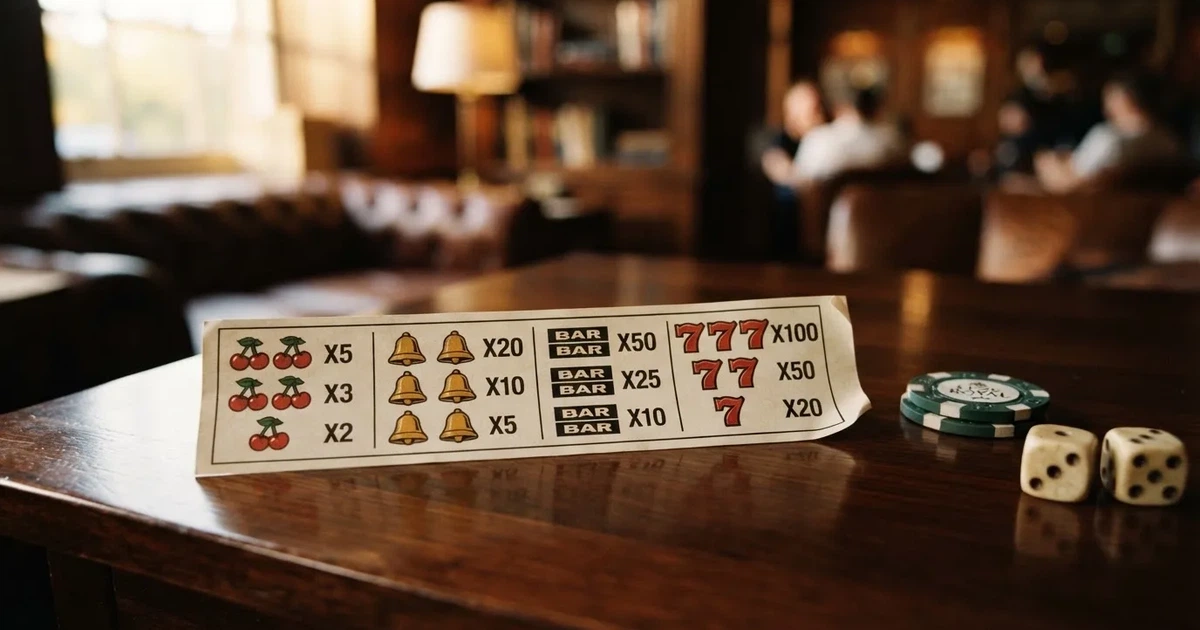
A paytable is the small “i” icon or help button inside a pokie that lists what each symbol pays and on what lines. Before any comparison of brands, a quick walk through what those lines actually mean — because the marketing language around them flatters the player, and the math underneath does not.

A standard five-reel video pokie shows three rows of symbols and pays left-to-right along fixed or selectable win lines. Each symbol carries a multiplier of the line stake: a low-pay symbol — a 9, a 10, a Jack — pays two to four coins for three of a kind at the minimum line bet, while the high-pay symbols — themed icons, the game’s logo, the wild — pay twenty to several hundred for five. The scatter is the exception: scatters pay anywhere on the reels, regardless of lines, and three or more usually trigger a free-spins round. Free spins do not pay the player extra money; they pay the player the chance to spin at the operator’s expense for a fixed number of rounds, often with a multiplier attached to any line wins that land during them.
The number that matters is return-to-player (RTP), expressed as a percentage over millions of simulated spins. An RTP of 96% means the game returns A$96 for every A$100 wagered across that simulation — the other A$4 is the house edge, which is the operator’s gross margin before its own costs. Volatility is a separate axis: a high-volatility pokie pays less often but in larger bursts, while a low-volatility pokie pays often in small amounts. Neither axis changes the long-run return; they change how a session feels. A player who has set aside A$100 for a session and wants to extend it as long as possible should look for the lower-volatility game, because the bankroll survives longer even though the eventual return is the same.
Land-based pokies inside Australian pubs and clubs are governed by jurisdiction-specific minimum RTPs. New South Wales, the Northern Territory, Queensland and most of Victoria require a minimum return of 85%, with Crown Melbourne sitting at 87%; the ACT and Tasmania require 87%; South Australia 87.5%; and Western Australia, which banned poker machines in pubs and clubs when Crown Perth opened in 1985, requires 90% on the casino floor. An offshore online pokie runs on whatever RTP its developer chose, which is usually 94% to 96.5% — better than the pub floor on paper, but only the developer’s word backs the figure, and the simulation was run on the developer’s own equipment.
The honest framing: a paytable is a contract between the player and the machine, written in the developer’s favour by design. Read it for the symbol values, read it for the bonus trigger conditions, read it for the maximum payout per line. Do not read it as a forecast.
Minimum Return-to-Player by Jurisdiction
| Jurisdiction | Minimum RTP |
|---|---|
| New South Wales | 85% |
| Northern Territory | 85% |
| Queensland | 85% |
| Victoria | 85% (87% Crown Melbourne) |
| Australian Capital Territory | 87% |
| Tasmania | 87% |
| South Australia | 87.5% |
| Western Australia | 90% |
The Australian Online Pokies Landscape: What the ACMA Has Actually Done
The cleanest picture of what is available to an Australian player online is the picture the regulator has drawn itself. The ACMA’s job under the Interactive Gambling Act 2001 is to investigate offshore operators, issue formal warnings, and ask Australian internet service providers to block services that ignore them. The published record of that work — formal warnings, blocking requests, and the cumulative count — is the only source that does not have a marketing department behind it.
The cumulative count as of June 2026 stands at 1,751 illegal gambling and affiliate websites blocked since the first blocking request in November 2019. More than 230 unlicensed services have left the Australian market since enforcement was strengthened in 2017. Those are not theoretical numbers; they are the running ledger of providers who either complied, blocked themselves at the Australian border, or were cut off by an ISP.
A second figure comes from H2 Gambling Capital’s 2025 estimate: Australians lose about A$3.9 billion a year to illegal gambling sites, and the share of gambling going through legal channels fell from 74% in 2021 to 64%. The shift is the part to dwell on. Legal channels have lost ground while illegal ones have grown, which means the ACMA’s enforcement is doing real work and the demand underneath it has not gone away.
| Brand | ACMA action and date | Operator named by the ACMA | Subject support |
|---|---|---|---|
| RocketPlay | Formal warning, March 2026 | Pulsup Ltd | — |
| Level Up Casino | Formal warning, May 2022 | Dama N.V. | — |
| Woo Casino | Formal warning, March 2025 | Dama N.V. | — |
| Spirit Casino | Formal warning, May 2025 | Dama N.V. | — |
| National Casino | Formal warning, July 2025 | Consolutetish S.R.L. | — |
| Bizzo Casino | Formal warning, July 2025; earlier 2022 | Consolutetish S.R.L. (2025); TechSolutions (2022) | — |
| Ignition Casino | Formal warning, July 2025 | Bamboo Media | — |
| Instant Casino | Formal warning, February 2025 | EOD Code SRL | — |
| Jackbit | Formal warning, April 2026 | Ryker B.V. | — |
| Casino Intense | Formal warning, April 2025 | Sterplay Holding Ltd | — |
| Sky Crown | Formal warning, September 2022 | Hollycorn N.V. | — |
The names in that table are the brands the ACMA has formally warned, not a ranking and not a recommendation. The publishers behind them are shell companies in Curaçao, Cyprus and other permissive jurisdictions; the licence a site displays is real, but it is a licence to operate in the licensing country, not a licence to serve Australian residents. Reading the table as a “who got warned when” list is the only reading that does not give any brand a marketing line it has not earned.
How the Blocking Rate Has Changed Since 2019
The arithmetic that tells a player the most is the one no marketing page publishes. The ACMA’s first blocking request went out in November 2019; by June 2026 the cumulative count of blocked sites stood at 1,751. That works out to an average of roughly 269 sites blocked per year, or about 22 per month. The monthly figure is not a forecast — the ACMA has never published a monthly cadence, and rounds vary widely — but it is the cleanest way to translate a six-and-a-half-year enforcement record into a per-week expectation. An Australian player trying to predict whether a site they have been using will be reachable next month should assume the answer is yes for a long while and no with little warning. The blocks come in batches, the batches follow formal warnings, and the formal warnings happen on the ACMA’s schedule, not on anyone else’s.
Where the Comparators Should Actually Look
A fair comparator between offshore pokies sites, if a player were going to make one, would weigh four things none of which is “best welcome bonus.” First, the licence jurisdiction the operator is regulated under, and which country’s consumer law that licence engages — a Curaçao sub-licence engages roughly no consumer law the player can practically invoke. Second, the payment routes the site actually supports for an Australian account, because the credit-card and crypto bans that bind licensed wagering do not bind offshore sites, and the deposit-and-withdrawal path is where most complaints originate. Third, the identity-verification regime, since an offshore site that KYC-checks a player before the first withdrawal is at least a site that can return funds. Fourth, the time between a withdrawal request and the funds landing, because an offshore site that pays in 48 hours is a meaningfully different proposition from one that pays in 14 days, and the difference is not visible in the welcome offer.
Legality: The Interactive Gambling Act and What It Actually Prohibits
The Interactive Gambling Act 2001 (IGA), strengthened by the Interactive Gambling Amendment Act 2017, makes it an offence to provide certain interactive gambling services to a person in Australia. The list is specific: online casino games, online pokies and in-play betting are prohibited, and no state or territory issues a licence for any of them. What is licensable is wagering on races and sport placed before the event, lotteries and keno — in practice licensed by the Northern Territory through the NTRWC, which regulates 52 of Australia’s online bookmakers including Sportsbet, Bet365 and Ladbrokes. The NTRWC itself has no full-time staff and meets once a month in Darwin.
The IGA targets the provider, not the player. An Australian who opens an offshore site is not committing an offence under the Act. The provider — typically a Curaçao or Cyprus company — is, and the ACMA’s job is to make the cost of providing the service exceed the revenue. The mechanism is escalation: formal warning, then referral to the Department of Infrastructure for civil penalty proceedings, then a request to Australian ISPs to block the service. The cost falls on the operator. The cost for the player is the absence of any Australian recourse if a withdrawal is refused, the account is closed, or the site disappears between deposits.
The Interactive Gambling Amendment (Gambling Reform) Bill 2026 passed Parliament on 19 August 2026. Its advertising and inducement measures commence on 1 January 2027 — law with a start date, not yet in force on a page read in 2026, but worth knowing because the new regime tightens what an offshore affiliate site can publish to an Australian audience. Treat that as a forward note, not as a current rule.
A reading that misses the point is the one that treats “offshore licence” as a substitute for “Australian licence.” A Curaçao e-Gaming licence, a Kahnawake licence, an Anjouan licence — these are real licences that engage real compliance obligations in their issuing country. None of them engages an obligation to an Australian player. A site that displays a Curaçao badge has permission to operate from Curaçao; it has not been granted permission to serve Australia, because no Australian regulator has the power to grant that permission for online casino or pokies content. The badge tells the player where the operator is regulated. It does not tell them they are protected.
Responsible Play: What Works in Australia and What Does Not
The Australian responsible-gambling architecture is built around two services, and the difference between them is what determines whether they help a player in this market.
Gambling Help Online is the free, confidential, 24-hour national counselling service, reachable on 1800 858 858 and via web chat. It is funded by the Commonwealth and operates regardless of which gambling product a caller is using. A player who feels play is becoming compulsive can call at any hour and speak to a counsellor who can refer them to face-to-face support in their state. The service is the right first call, regardless of whether the play is on licensed wagering, on a pub pokie, or on an offshore site.
BetStop, the National Self-Exclusion Register, has been live since August 2023 and binds every Australian-licensed wagering provider. A player who registers with BetStop is barred from opening new accounts or logging into existing ones at every licensed sportsbook and race bookmaker in the country, for a period of their choosing from three months to a lifetime. The catch is in scope: BetStop binds Australian-licensed wagering services. It does not bind an offshore casino, an offshore sportsbook holding a non-Australian licence, or a pub pokie. A self-excluded player who walks into a Crown casino or a suburban RSL is not barred at the door; the venue operates its own exclusion regime, separate from BetStop.
A player who is also using offshore sites needs to ask each site individually for self-exclusion, and the sites vary in how seriously they treat the request. The honest answer is that no offshore brand carries an enforceable duty to honour a request, and the player who has lost the ability to stop is the player who should be talking to Gambling Help Online before they look for an offshore workaround. The architecture as it stands treats offshore play as outside the protective net by design, which is correct as a matter of law and inadequate as a matter of welfare.
Western Australia’s hard line on poker machines is a useful counter-example. WA is the only Australian state where pubs and clubs do not host poker machines, having banned them when Crown Perth opened in 1985. The state’s Gaming and Wagering Commission then approved roughly 2,500 machines inside Crown Perth itself, which is the only legal machine floor in the state. The ban was a policy choice; the casino-sized exception was a political compromise. Reading WA as “no pokies” misses the second half; reading it as “pokies for the casino only” is what the state actually is.
Payments and Payout Speed: What Offshore Sites Accept and What They Actually Pay
The payment rails for an Australian player on an offshore pokies site are not the payment rails for licensed wagering, and the difference matters because the ban on credit cards and crypto that applies to licensed operators does not bind offshore sites. A licensed Australian wagering account can be funded by debit card, bank transfer, PayID/Osko and BPAY; credit cards, credit-related products and digital currency have been banned as payment for licensed online wagering since 11 June 2024, with penalties of up to A$247,500 for operators that accept them. An offshore site will, depending on the brand, accept Visa, Mastercard, a handful of cryptocurrencies, and occasionally an e-wallet — sometimes all of the above, with the bonus terms adjusting for which one the player picks.
The PayID angle deserves a paragraph because the search terms attach to it. PayID is the Australian real-time payment rail that pairs a mobile number or email with a bank account, settled through the Osko network. For an Australian player sending a deposit to an offshore casino, PayID works only if the offshore casino holds an Australian bank account willing to receive it — and that willingness is itself a marker of how exposed the operator is to Australian enforcement. The PayID deposit is fast and free on the player’s side; it lands in the casino’s account in seconds. Whether it can be withdrawn through the same rail depends on the operator’s banking arrangements, and most do not support PayID withdrawals because their receiving bank is offshore.
A withdrawal is the moment that exposes the gaps. The standard offshore flow is deposit by card or crypto, play, request withdrawal, upload identity documents, wait for the operator to process. The processing time varies from a few hours to several weeks depending on the operator, the amount, and whether the player’s account has been flagged for additional checks. A first withdrawal is almost always slower than subsequent ones because of the KYC queue. A player who has won a meaningful amount and wants it back in their Australian bank account will typically receive it as an international bank transfer, which carries both the operator’s processing fee and the receiving bank’s foreign-exchange margin. PayID here is usually one-way: in fast, out slow.
The honest framing on payout speed is to read the operator’s published terms for the processing window and then assume the worst-case figure is the one to plan around. A site that advertises “instant withdrawals” usually means instant approval, not instant arrival — the funds still need to clear the banking system on the way back to an Australian account.
Bonuses, Free Spins and Sign-Up Offers: What the Marketing Word Is Worth
The welcome bonus, the deposit match, the free-spins package, the no-deposit chip — these are the offers that do most of the heavy lifting in offshore pokies marketing, and the cost of claiming them is the one piece of arithmetic the marketing page is least likely to publish.
A typical welcome package pairs a deposit match with a free-spins bundle. The deposit match is described as “100% up to A$500 plus 200 free spins,” which reads as the casino doubling the first deposit and handing the player 200 free games. The mechanics are different. The match is paid in bonus funds, not real funds, which means the player cannot withdraw the bonus or any winnings derived from it until a wagering requirement has been satisfied. The wagering requirement is a multiplier — 35x to 50x of the bonus is the offshore norm — applied to the bonus amount, the deposit amount, or both, depending on the site’s terms. A A$500 bonus at 40x on the bonus alone is A$20,000 of wagering before any of the bonus funds convert to withdrawable cash. The free spins carry their own conversion cap: winnings from the 200 free spins typically convert to bonus funds, which then need to clear the same wagering requirement.
The cost is paid in the gap between the player’s expectation and the terms. A punter who reads “A$500 bonus” and treats it as A$500 of free play will, on average, deposit A$500, lose A$500 worth of their own money before clearing the wagering, and walk away with whatever the bonus balance cleared to — which is rarely the full headline figure. The casino’s “free” money is the operator’s house edge compounded across the required turnover. The “free spins” are spins paid by the operator at the lowest line value, on a single chosen game, with a max-cashout cap.
A national context is worth one sentence: the Interactive Gambling Amendment (Gambling Reform) Bill 2026, which commences 1 January 2027, tightens inducement rules around offshore-facing advertising. The change is forward-looking and does not yet bind the offers a player sees today; what it signals is that the regulator considers the inducement language to be part of the harm, not separate from it.
The cleanest single piece of advice is to read the bonus terms in full before depositing, and to read the wagering multiplier, the game-contribution table, the max-bet-per-spin cap during wagering, and the max-cashout cap on free-spin winnings. The four numbers are the entire offer, and every other line is decoration.
Brands the ACMA Has Formally Warned: What Each One Costs
The brands below are the operators the ACMA has published a formal warning over in the public register. Each carries that record with it, not as a recommendation against, but as the only piece of evidence that does not originate with the operator’s own marketing. None is licensed to serve Australian residents. A player who opens an account with any of them is dealing with an offshore provider, with the consumer protection that implies.
The order below follows the ACMA’s published action record; the heading for each carries the brand name and the year of the most recent ACMA action.
RocketPlay (March 2026)
The ACMA’s most recent formal warning over RocketPlay was issued in March 2026 to Pulsup Ltd. An earlier warning over the brand went to Dama N.V. in May 2022. The site displays a Curaçao licence; the licence does not engage Australian consumer law, because no Australian regulator has jurisdiction over the service. A player who deposits here should plan around the ACMA’s blocking list as the long-run constraint, not the welcome bonus as the short-run incentive.
Level Up Casino (May 2022)
The ACMA warned Dama N.V. over Level Up Casino in May 2022 as part of a six-brand batch. Level Up appears in third-party game-provider listings under BGaming’s distribution catalogue, which is a distribution relationship, not a regulatory endorsement. The site operates from a Curaçao-issued licence. The 2022 warning date is older than most of the brands here, which means the operator has had the longest of any to either comply or move.
Woo Casino (March 2025)
The ACMA issued a formal warning over Woo Casino in March 2025, naming Dama N.V. as the operator. The site runs a Curaçao licence and markets aggressively to Australian search traffic through affiliate pages. The relevant cost here is the gap between the marketing promise and the Australian legal position: any balance held at the time of a blocking action becomes effectively unrecoverable.
Spirit Casino (May 2025)
The ACMA warned Dama N.V. over Spirit Casino in May 2025, two months after the Woo Casino warning. Spirit Casino runs under the same Dama N.V. group structure as Woo and Level Up, and the rapid sequence of warnings suggests the ACMA treated them as part of one enforcement programme. A player dealing with a single corporate group facing three formal warnings in four years is, by any reasonable read, dealing with a brand that has been told what the rules are and has continued operating.
National Casino (July 2025)
The ACMA issued a formal warning over National Casino in July 2025, naming Consolutetish S.R.L. as the operator. National Casino appears in third-party Wikipedia coverage of the Australian gambling landscape, which is a measure of how visible the brand has become to Australian search traffic, not an endorsement. The site holds a Curaçao licence.
Bizzo Casino (July 2025; earlier 2022)
The ACMA warned Consolutetish S.R.L. over Bizzo Casino in July 2025. Bizzo had already been the subject of a 2022 formal warning to TechSolutions (CY) Group Limited and TechSolutions Group N.V. Two warnings to two different operating companies, four years apart, indicates that the brand has continued operating through restructured corporate vehicles. The cost of that pattern falls on the player, who has to navigate a different corporate identity each time a complaint arises.
Ignition Casino (July 2025)
The ACMA warned Bamboo Media over Ignition Casino in July 2025. Ignition has historically positioned itself toward a North American audience but has continued to accept Australian sign-ups through affiliate channels. The relevant figure is the audience mismatch: a brand that does not design its product for the Australian market is unlikely to design its responsible-gambling tooling for it either.
Instant Casino (February 2025)
The ACMA issued a formal warning over Instant Casino in February 2025, naming EOD Code SRL as the operator. The early-2025 warning date places this brand among the first in the most recent ACMA enforcement round, which means the site has had the longest post-warning window to demonstrate compliance. The deposit-and-play window remains open at the operator’s discretion.
Jackbit (April 2026)
The ACMA warned Ryker B.V. over Jackbit and CasinOK in April 2026. Jackbit is the newer of the two brands named in the same action, and the joint warning suggests the ACMA treats them as a single corporate group. A player dealing with a group facing a current-year warning has the freshest possible exposure to enforcement escalation.
Casino Intense (April 2025)
The ACMA warned Sterplay Holding Ltd over Casino Intense in April 2025. The brand appears in third-party coverage from ABC News and ACMA itself as a recurring presence in the Australian enforcement record. The April 2025 warning places it in the middle of the recent enforcement wave.
Sky Crown (September 2022)
The ACMA issued a formal warning over Sky Crown and Blue Leo to Hollycorn N.V. in September 2022, naming both casino services in the same action. The 2022 warning date is the oldest in the recent record, and the longest gap since the last formal action is the cleanest measure of how slowly enforcement has reached this brand. The site remains outside Australian jurisdiction.
How Fast the Blocklist Is Growing
The arithmetic the rest of the page hangs on is the blocking rate: 1,751 illegal sites blocked between the ACMA’s first blocking request in November 2019 and the June 2026 report. That works out to an average of roughly 269 sites per year, or around 22 per month across the six-and-a-half-year window. The figure is an average — the ACMA publishes blocking rounds in batches, and a quiet quarter can be followed by a forty-site round the next month — but it is the cleanest reading the public record supports.
The number that follows from it is a conditional one. A player using an offshore site that has not yet been blocked has, on the average rate, an indefinite window before action is taken — but the conditional is the wrong way around. The sites that get blocked are the ones that ignore formal warnings; a site that is currently unblocked but has just been warned is closer to the block list, not further from it. The honest framing is that the blocklist grows by an average of about 22 sites per month, and the probability that any single named brand is on next quarter’s list rises each time it ignores a formal warning.
Frequently Asked Questions
Is “Australian pokies online” a licensed product recognised by any state regulator?
No. Online pokies are prohibited under the Interactive Gambling Act 2001 for anyone in Australia. No state or territory issues a licence for them; the only legal pokies in Australia are the electronic gaming machines inside licensed pubs, clubs and casinos, which are regulated state by state. A site that calls itself “Australian” in its branding is not licensed in Australia; the word describes the target audience, not the regulator.
Is there a legal Australian online pokies app, as opposed to a mobile browser site?
No. Google Play has not permitted real-money Australian gambling apps outside licensed wagering since 2021, and the App Store carries only lottery and licensed betting apps. The licensed wagering apps — Sportsbet, Bet365, Ladbrokes — offer racing, sport and a small number of live-dealer table games, but no slot reels. Every offshore pokies site operates as a mobile browser site, not a downloadable app.
What’s the difference between a site advertising “Australian pokies online” and the pokies in a pub or club?
The difference is regulatory. Pub and club pokies are licensed and regulated by state and territory authorities, with jurisdiction-specific minimum RTPs ranging from 85% in NSW, the NT, Queensland and most of Victoria, up to 90% in Western Australia, and consumer-protection recourse if a machine malfunctions. Offshore online pokies are not licensed in Australia; they hold licences in their operating jurisdictions (typically Curaçao), and no Australian regulator has authority over them. The product may look similar; the legal wrapper around it is not.
Do sign-up bonuses on offshore pokies sites come from a local Australian operator?
No. Every sign-up bonus on an offshore pokies site comes from an offshore operator — typically a Curaçao- or Cyprus-registered company. The bonus is paid in bonus funds subject to a wagering requirement (commonly 35x to 50x) before any winnings convert to withdrawable cash. Free-spin winnings typically carry a max-cashout cap and convert to bonus funds on the same wagering terms. Reading the four numbers — wagering multiplier, game contribution, max-bet during wagering, max cashout — is the entire offer.
Can a PayID-friendly offshore pokies site still be operating from outside Australia?
Yes. PayID is a payment rail, not a regulatory one. An offshore site that accepts PayID deposits does so through an Australian bank account willing to receive them; the rail is fast and free for the player on the way in, but does not engage any Australian consumer protection on the way out. Most offshore sites do not support PayID withdrawals because their receiving bank is offshore. The deposit speed and the regulatory status are separate questions.
Does the word “Australian” in a pokies site’s name indicate its actual licensing jurisdiction?
No. The name is marketing, not regulation. The brands in this market include names that read as Australian, target Australian search terms, and accept Australian sign-ups while operating from Curaçao, Cyprus, or similar permissive jurisdictions. The licence a site displays is a licence to operate in the issuing country; it is not a licence to serve Australia, because no Australian regulator has the power to grant one for online casino or pokies content. The publisher, the licence number, and the licensing country’s regulator are the three lines to read.