
Fast withdrawal casino Australia 2026: what the marketing page does not tell you
Australian players searching for a fast withdrawal casino usually want the same thing: a payout that lands before dinner, not after the weekend. The promise is real, in the sense that offshore sites really do process crypto withdrawals inside an hour and instant-bank withdrawals in minutes. What the marketing page does not lead with is that every one of those sites is operating against the Interactive Gambling Act 2001, and that the speed on offer comes bundled with a balance the regulator cannot protect. Fast withdrawal casino Australia 2026 — More on this topic at crypto casino au .
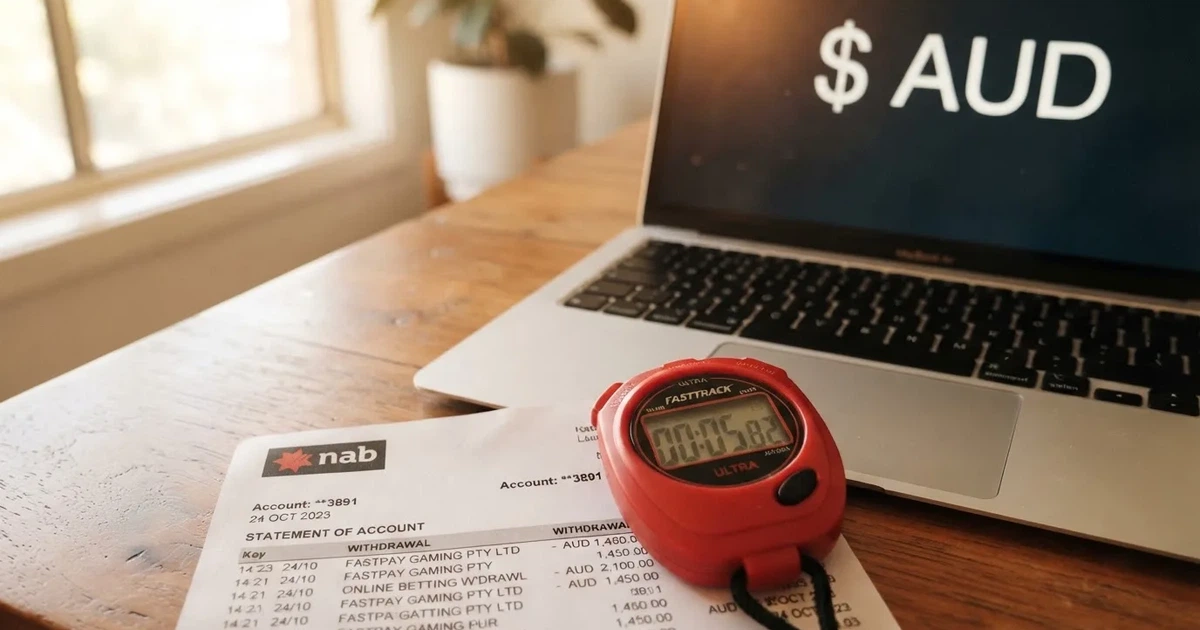
The figures on this page were checked against the ACMA’s published enforcement record and Australian Payments Plus documentation as of 29 October 2026.
Table of Contents
- What “fast withdrawal” actually means at an offshore casino
- The legality that does not bend around a payout speed
- Responsible gambling on a site that is not licensed to take Australian play
- Crypto and the no-verification pitch
- Payments, payout speed and the Australian rails
- The brands the ACMA has warned — and what fast withdrawal actually costs each
- What the ACMA blocking rate actually shows
- The fast-withdrawal offer on a licensed Australian wagering service
- What the ACMA’s enforcement record says about the next year
- How to read the figures on this page
- Frequently asked questions
What “fast withdrawal” actually means at an offshore casino
A withdrawal advertised as fast is fast in the sense a courier is fast: the moment it leaves the operator’s wallet. The pipeline runs in three stages, and the clock the punter sees is only the middle one.
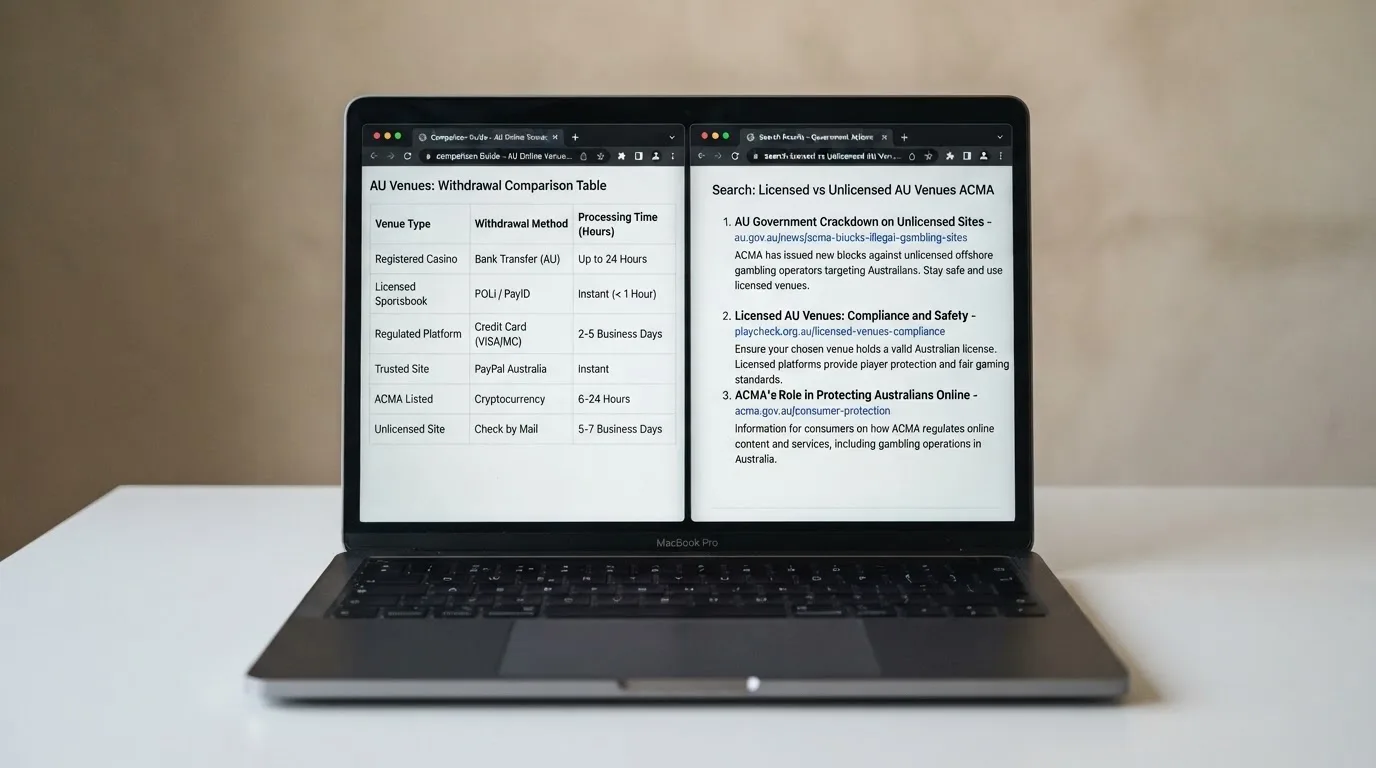
The first stage is internal review. Even on sites that market “no verification” withdrawals, the operator still runs the request against its anti-fraud and anti-money-laundering rules. Done by an algorithm, it takes seconds. Done by a human during a peak hour, it can take the working day the marketing forgot to mention. The second stage is the transfer itself: crypto on a healthy network confirms in minutes, an Osko or PayID transfer between Australian banks lands in under a minute, an international wire still wanders through correspondent banks for one to three business days. The third stage is whatever the receiving bank or wallet does before the money is spendable, and on a credit card it is a chargeback risk review that can hold the refund for up to a week.
The headline number a casino quotes is the middle stage only, and only on its best day. The honest question is not “how fast do you pay” but “how fast on the worst payout, with the largest amount, on the worst rail, into an account the player has used before.” Most sites do not publish a number for that combination, because the answer is rarely the one in the banner.
The punter pays for speed in three currencies at once: the wagering requirement attached to the deposit that earned it, the absence of Australian recourse if the operator declines the withdrawal after the fact, and the legal exposure of the operator itself. The Interactive Gambling Act 2001 targets the provider, not the player, but the provider’s exposure is the punter’s risk — a site under enforcement pressure is a site that may not be reachable next month.
The legality that does not bend around a payout speed
Online casino games and online pokies cannot be licensed anywhere in Australia. The Interactive Gambling Act 2001, tightened in 2017, makes it an offence to provide those services to a person physically in Australia, and no state or territory licensing body issues a casino licence of that kind. What is licensed is wagering on racing and sport before the event, lotteries and keno — in practice administered through the Northern Territory Racing and Wagering Commission, which oversees 52 of Australia’s online bookmakers including Sportsbet, Bet365 and Ladbrokes, and which meets once a month in Darwin with no full-time staff of its own.
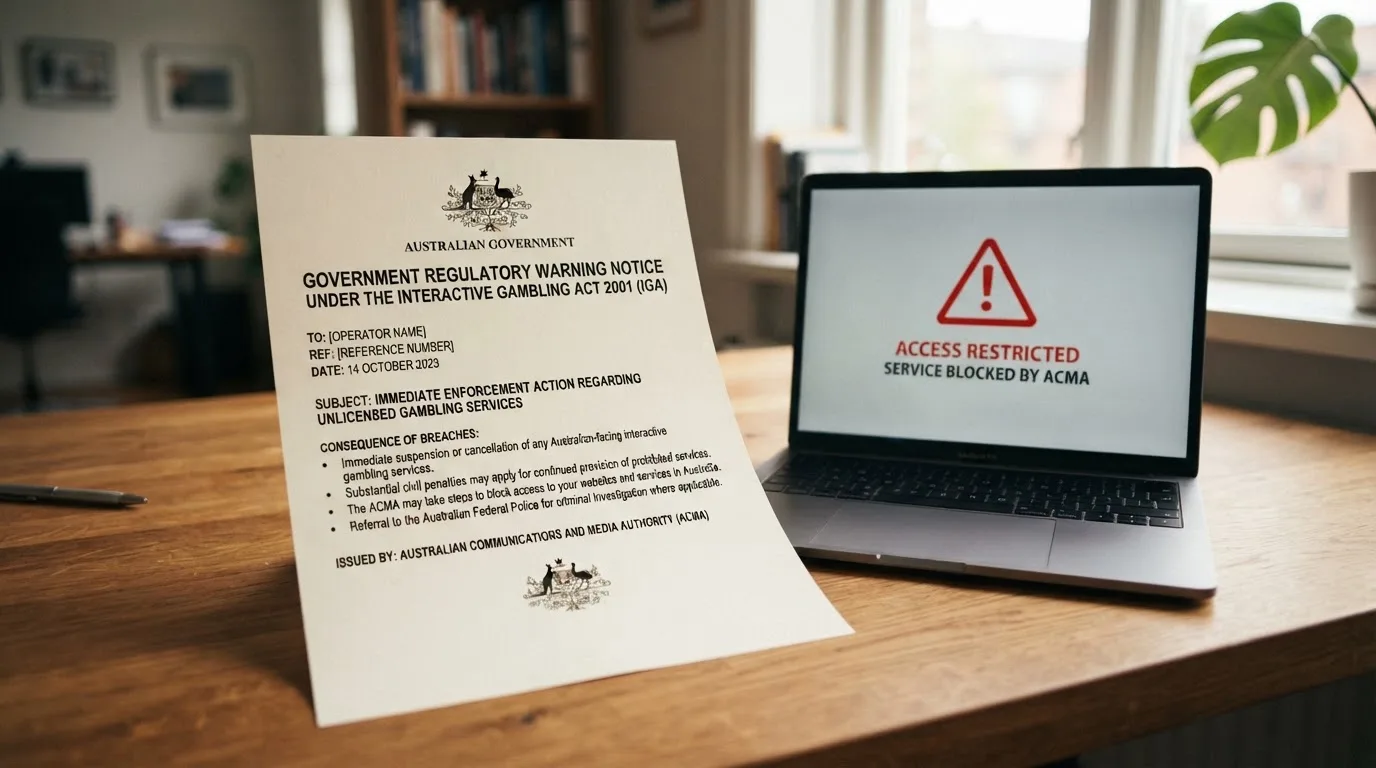
The Australian Communications and Media Authority is the body that investigates breaches, issues formal warnings and asks internet service providers to block illegal services. By the end of June 2026, the ACMA had directed ISPs to block 1,751 illegal gambling and affiliate marketing websites since the first blocking request in November 2019, and more than 230 unlicensed services had left the Australian market since enforcement was strengthened in 2017. The June 2026 round alone added twelve names: 7Signs, ChromaBet, Donbet, Duospin, Freshbet, Slots Gem, Jacks Club, Lucky Start, Pointsbetz, Spinrise, Vinyl Casino and Wildsino.
H2 Gambling Capital’s 2025 estimate puts Australians’ annual losses to illegal gambling sites at roughly A$3.9 billion, and tracks the share of gambling going through legal Australian channels falling from 74 per cent in 2021 to 64 per cent. Those numbers describe the same market the fast-withdrawal pitch is aimed at. The pitch works because it is convenient; it persists because the regulator can block the site but not the brand behind it.
The Interactive Gambling Amendment (Gambling Reform) Bill 2026 passed Parliament on 19 August 2026, with its advertising and inducement measures commencing on 1 January 2027. That is a law on the books with a start date, not yet in force on this page; the headline restriction — no Australian-licensed online casino, ever — is unchanged.
Responsible gambling on a site that is not licensed to take Australian play
BetStop, the National Self-Exclusion Register, has been live since August 2023 for Australian-licensed online and phone wagering services. It binds licensed bookmakers and lottery operators; it does not bind an offshore casino that has no relationship with the register. A player who has registered with BetStop and then opens an account at one of the offshore brands reviewed here is relying on that brand’s own self-exclusion tool, which the brand can rewrite, ignore or repurpose at any time, and which the ACMA has no standing to enforce.
The same gap applies to the National Gambling Helpline on 1800 858 858, which is free and operates 24/7, with chat at Gambling Help Online. The counselling is real and Australian, the connection to the offshore account is not.
A bank-side block is more durable, and is worth turning on whether or not a player intends to keep using an offshore site. Westpac’s gambling block works at card level and refuses authorisation of any transaction carrying the merchant category code for betting or casino gambling on eligible personal credit and debit cards. ANZ’s equivalent, activated in the ANZ app, blocks gambling transactions made through a digital wallet such as Apple Pay on an eligible card, not just the physical card; once switched on, ANZ requires a 48-hour waiting period before the block can be removed, and warns in the same page that not every gambling transaction will be blocked and some non-gambling transactions may be caught in error. Commonwealth Bank offers a gambling lock on eligible cards through the CommBank app, with the same caveat that no block is comprehensive.
The marketing word for these offshore offers is “secure online casino with fast withdrawal”. The speed is real. The security is the operator’s word for itself, and the consumer protection is the same offshore complaint channel the operator owns.
Crypto and the no-verification pitch
A fast withdrawal crypto casino takes the marketing of speed one step further: no card processor in the middle, no bank to call, no identity check on the way out. The crypto part is honest. The “no verification” part is half-honest at best.
Two things happen when a withdrawal is requested in bitcoin or USDT at one of these brands. The blockchain transaction does confirm in minutes on a healthy network, and once it has three or six confirmations it cannot be reversed by the operator — that is the genuine speed advantage over a card refund, which a bank can claw back. What still happens is the same internal review the fiat payout faces: the operator checks the deposit against its anti-fraud rules, screens the destination wallet against its own block list, and may pause for source-of-funds documentation if the withdrawal is large or the wallet is new. The crypto rail makes the leg from operator to player’s wallet faster; it does not make the operator’s compliance step faster.
The player-side cost is on a different axis. A bank-side block cannot stop a transfer out of a self-custody wallet, because the transaction never touches a merchant category code: it is just a transfer to another address. That makes crypto the rail that an Australian bank block, an Apple Pay limit and a credit-card ban cannot reach, which is exactly why every offshore operator advertising to Australians now leads with it. It is also the rail with the weakest recovery story if the operator decides the withdrawal looks suspicious after the fact, because the player has no card issuer to charge back to and no Australian exchange to complain through.
The Interactive Gambling Act 2001 as amended in 2023 explicitly bans digital currency as a payment method for Australian-licensed online wagering. An offshore site asking for a crypto deposit is therefore signalling, in the language of the law itself, that it is operating outside the Australian framework.
Payments, payout speed and the Australian rails
The reason a fast-withdrawal pitch has weight in Australia is that the country has unusually fast domestic payment rails to point at. Osko, run by Australian Payments Plus, settles a bank transfer between participating Australian banks in under a minute, around the clock, including weekends and public holidays, whether the payment is addressed to a BSB and account number or to a PayID. PayID-based instant transfers are available at more than 100 Australian financial institutions, and more than 25 million PayID identifiers had been registered on the New Payments Platform by April 2025. PayID also shows the name of the account holder before the transfer is sent, which AP+ flags as a useful anti-scam check: a site asking an Australian to send money to a PayID on an unlicensed gambling service is, in AP+’s own framing, almost certainly a scam site.
The New Payments Platform went live to the public on 13 February 2018 and is owned by New Payments Platform Australia Ltd, a non-profit whose shareholders include the Reserve Bank of Australia and the major banks. Participants are required to keep monthly outages to no more than two minutes — the kind of uptime guarantee an offshore casino’s payment page does not make. AP+ itself is the merged entity that combined NPP Australia, BPAY and eftpos under ACCC authorisation in September 2021.
BPAY, the bill-payment service available through the online banking of more than 140 Australian institutions, was launched on 18 November 1997 and is offered by over 95,000 businesses. None of those figures help a punter at an offshore casino, because BPAY was built for one purpose — paying Australian bills — and offshore casinos do not issue Biller Codes.
The rails exist. The offshore sites do not run on them. What an Australian player experiences as a “fast withdrawal” at an offshore site is the speed of a cryptocurrency network, or the speed of an international wire that happened to clear quickly, or the speed of a payment processor the operator chose for that payout. The Osko benchmark of under a minute is the speed an Australian bank offers for transfers between Australian accounts; the speed an offshore casino offers is whatever its processor and the operator’s review queue happen to do on the day.
The brands the ACMA has warned — and what fast withdrawal actually costs each
The eleven brands below are the operators the ACMA has issued formal warnings against for offering prohibited interactive gambling services to Australians. The order follows the ACMA’s own publication sequence. None of these is a lawful option for an Australian resident.
| Brand | ACMA action and date | Operator named by the ACMA | Subject support |
|---|---|---|---|
| RocketPlay | Formal warning, March 2026 | Pulsup Ltd | Listings reference it |
| Level Up Casino | Formal warning, May 2022 | Dama N.V. | Listings reference it |
| Woo Casino | Formal warning, March 2025 | Dama N.V. | No data |
| Spirit Casino | Formal warning, May 2025 | Dama N.V. | No data |
| National Casino | Formal warning, July 2025 | Consolutetish S.R.L. | Listings reference it |
| Bizzo Casino | Formal warning, July 2025 | Consolutetish S.R.L. | Listings reference it |
| Ignition Casino | Formal warning, July 2025 | Bamboo Media | No data |
| Instant Casino | Formal warning, February 2025 | EOD Code SRL | Listings reference it |
| Jackbit | Formal warning, April 2026 | Ryker B.V. | No data |
| Casino Intense | Formal warning, April 2025 | Sterplay Holding Ltd | Listings reference it |
| Sky Crown | Formal warning, September 2022 | Hollycorn N.V. | No data |
The audit is on the operator set, not on the speed claim. A punter who reaches one of these sites is choosing a faster payout over an Australian licence that does not exist for casino play. The trade is real; it is also one-sided.
RocketPlay
The ACMA’s most recent action against RocketPlay is a formal warning issued in March 2026 to Pulsup Ltd over the RocketPlay domain. A separate ACMA warning, dated May 2022, named Dama N.V. across six brands including RocketPlay itself. Two warnings, four years apart, on the same brand, point to an operator that has continued to take Australian traffic through at least one corporate reorganisation. RocketPlay appears in third-party industry listings, but those listings are not endorsements of its Australian standing. A punter who values speed over recourse has a faster route here than at almost any domestic wagering service; a punter who values recourse has, in the ACMA’s own record, the reason not to use it.
Level Up Casino
Level Up Casino was named in the same May 2022 ACMA warning to Dama N.V. that covered five other brands in one letter. The warning is the only ACMA action listed against the brand in the research, but the parent operator Dama N.V. was warned again in March 2025 over Woo Casino and in May 2025 over Spirit Casino — three ACMA letters across three years to one operator, with Level Up Casino sitting inside the first. A punter who arrived at Level Up Casino through an affiliate link is paying for an aggregator’s payout speed, not an Australian regulatory framework.
Woo Casino
Woo Casino is the brand over which Dama N.V. received its second ACMA formal warning, in March 2025. The first Dama N.V. warning, in May 2022, did not name Woo Casino. Two months later, in May 2025, the same operator was warned over Spirit Casino. The trajectory is the cost a player pays for fast withdrawal at this corner of the market: an operator that the ACMA keeps having to write to is an operator whose Australian-facing site the regulator is willing to take offline, which is a different proposition from a slow payout.
Spirit Casino
Spirit Casino sits at the other end of the same Dama N.V. pattern: a brand the ACMA wrote to Dama N.V. about in May 2025, two months after the Woo Casino letter. The brevity of the gap is itself the information. The operator’s Australian-facing sites were re-emerging quickly enough that the regulator’s correspondence did not have time to age.
National Casino
National Casino was named in the ACMA’s July 2025 formal warning to Consolutetish S.R.L., alongside Bizzo Casino. National Casino’s listing coverage touches the ACMA, AUSTRAC and BetStop documents — three Australian regulatory or self-exclusion sources that reference the brand by name. The combination is what an Australian player is buying into at “fast withdrawal” offshore sites: a brand that has accumulated three regulatory mentions in one calendar year.
Bizzo Casino
Bizzo Casino carries the rare distinction of two formal ACMA warnings, four years apart. The 2022 warning named TechSolutions (CY) Group Limited and TechSolutions Group N.V. as the recipients. The July 2025 warning named Consolutetish S.R.L. — a different corporate entity, the same brand. Affiliate listings still route Australian traffic to it. A brand that has drawn two warnings across a corporate reorganisation is a brand the ACMA has had to write about twice, which is two more letters than a legitimate Australian wagering service would receive.
Ignition Casino
Ignition Casino was named in the same July 2025 ACMA warning as National Casino and Bizzo Casino, with Bamboo Media as the operator. The brand sits alongside two others in one regulator’s letter, which makes the marketing of “fast crypto withdrawal” harder to read as an accident: the regulator is writing to a group, not to a single rogue site.
Instant Casino
Instant Casino was the subject of an ACMA formal warning to EOD Code SRL in February 2025. The brand appears in third-party listings that include ecoPayz and PayID coverage, which is how Australian traffic is routed to it. The PayID coverage in particular is worth pausing on: a brand that lists PayID is signalling an Australian audience without being licensed for one.
Jackbit
Jackbit was named, with CasinOK, in an ACMA formal warning to Ryker B.V. in April 2026. It is the most recent ACMA action in the operator set, and the operator’s response is the only signal available. A brand warned in the same month a player is reading this page is the brand the regulator has just written about.
Casino Intense
Casino Intense was named in an ACMA formal warning to Sterplay Holding Ltd in April 2025. The brand’s third-party listings intersect AUSTRAC, BetStop and general gambling-industry coverage, which is the marketing trail an Australian-facing site tends to leave. Crypto-led brands are not exempt from the prohibition; the rail does not change the licence status.
Sky Crown
Sky Crown was named, with Blue Leo, in the September 2022 ACMA formal warning to Hollycorn N.V. It is the oldest action in the set, and the brand’s continued listing for Australian traffic four years later is the cost of the offshore market’s persistence. The ACMA blocked 1,751 sites between November 2019 and June 2026; a brand that has survived that long is not necessarily the brand the player should read as safe.
What the ACMA blocking rate actually shows
The arithmetic that matters for a player weighing the offshore pitch is how fast the regulator has been catching up. The first ACMA blocking request went out in November 2019. By the end of June 2026, the ACMA had directed ISPs to block 1,751 illegal gambling and affiliate marketing websites, with more than 230 unlicensed services having left the Australian market since 2017. Spread across roughly six and a half years, that is a band of roughly 270 sites blocked per year on average, or about 22 per month — a number that includes the affiliate marketing pages alongside the casino brands themselves, and that accelerated after the 2017 amendments and again after each round of public reporting.
The band is the honest way to state it. A single monthly average hides the lumpiness of enforcement: the ACMA’s blocking rounds are not monthly, they come in batches of ten to twenty sites at a time, and the gap between rounds is the time operators use to spin up new domains on the same brand. The 12-site round reported on 26 June 2026 is consistent with the running rate, not a one-off. The cost to a player of choosing an offshore site today is not the chance of being blocked tomorrow — it is the certainty of being routed, eventually, onto a domain the regulator has not yet noticed, and being paid out by an operator that may or may not still be reachable in the months that follow.
The fast-withdrawal offer on a licensed Australian wagering service
A licensed Australian online bookmaker — Sportsbet, Bet365, Ladbrokes and the 49 others licensed through the Northern Territory Racing and Wagering Commission — does not offer online casino games or pokies at all. It offers wagering on racing and sport before the event, with debit card, bank transfer, PayID and Osko as the legal deposit routes, no credit card and no digital currency. The withdrawal from a winning wager goes back through the same rails, and lands in an Australian bank account in the time Australian Payments Plus sets for the rail used — under a minute for Osko and PayID transfers between participating banks.
That is the speed a fully licensed Australian service can offer on its permitted products. It is also the speed that the offshore marketing pages are trying to imply they offer, with the difference that the offshore site is taking bets on products the licensed Australian bookmaker cannot.
The punter who reads “fast withdrawal” and concludes that the offshore casino pays faster than an Australian bookmaker is comparing two products that the law treats as different. An Australian bookmaker’s withdrawal is fast on a payment rail the regulator audits. An offshore casino’s withdrawal is fast on a payment rail the operator chose, in a jurisdiction the player cannot reach.
What the ACMA’s enforcement record says about the next year
The blocking-rate arithmetic above is the regulator’s pace against an industry that responds by re-launching under new domains. The 230-plus services that have left the Australian market since 2017 are the operators that chose not to come back; the 1,751 blocked domains are the operators that did, with the ACMA catching up. The set reviewed above is the small slice the ACMA has had time to write a formal warning about in the last four years, and every brand in it is still being listed for Australian traffic.
The cost to a player in 2026 is not theoretical. The IGA Amendment (Gambling Reform) Bill 2026 commences advertising and inducement measures on 1 January 2027, which means the affiliate marketing pages routing Australians to these brands are operating on borrowed time at the regulatory level. The crypto rail that bypasses an Australian bank block does not bypass an Australian bank’s list of high-risk counterparties, and an offshore operator that already draws two ACMA letters is a few enforcement rounds away from a domain the regulator can name to every major Australian payment processor.
How to read the figures on this page
Every number on this page comes from the ACMA’s published enforcement record, Australian Payments Plus documentation, or the H2 Gambling Capital 2025 report. Where research carries no figure for a brand’s payout time, no figure appears. Where the ACMA has only published a formal warning without naming a casino brand, no brand has been added to the table to balance the row. The pace of enforcement, the cost of the offshore pitch and the names in the operator set are the data the regulator makes public; everything else is the casino’s own marketing copy, and the audit will not invent a number to fill what the marketing copy leaves out.
Frequently asked questions
What actually makes one casino’s withdrawal faster than another’s?
The internal review queue. Crypto and Osko transfers themselves are fast in the same way — minutes once released. The variable is how long the operator holds the request before releasing it, which depends on whether identity and source-of-funds checks are already on file, whether the withdrawal is large enough to trip a manual review, and whether the request arrives during the operator’s peak hours.
Does a crypto casino really skip manual review on a fast withdrawal?
No. The crypto rail makes the on-chain confirmation fast — typically minutes — but the operator still runs the request through its anti-fraud and anti-money-laundering checks before releasing it. What crypto changes is the leg after the operator approves the withdrawal, not the leg before.
Is there a maximum amount that still counts as a fast withdrawal?
Yes, in practice. Most operators reserve instant or near-instant processing for withdrawals below a threshold the player has to dig into the terms to find; above that threshold the withdrawal moves into a manual review queue, and the marketing promise no longer applies. The threshold is not the same across the operator set.
Why does a withdrawal that is usually fast sometimes take days?
Three reasons, in roughly that order: a first withdrawal from a new account, which always carries a verification step regardless of the rail; a large amount that crosses the operator’s manual-review threshold; or a banking-side delay on the receiving end, especially for cards and international wires. Crypto withdrawals are the least exposed to the third reason and the most exposed to the first. See also Highest Payout Online Casino Australia .
Do identity checks done earlier actually speed up a later withdrawal?
Yes, and the cost is the player’s privacy on a site that is not licensed to take Australian play in the first place. Once an operator has the documents it asks for, subsequent withdrawals of similar size to similar destinations usually clear in the time the rail allows. The trade is between speed on a prohibited site and the absence of an Australian privacy framework around the documents the player has handed over.
Can a fast withdrawal be reversed after it has been approved?
On a card, yes — the issuing bank can claw back a refund, which is one reason offshore operators prefer crypto for big payouts. On an Osko or PayID transfer, no, once it has settled. On the blockchain, no, once it has the required number of confirmations. The irreversibility of the second and third rails is what makes them attractive; it is also what makes them the rail of last resort when something goes wrong, because the player’s recovery options end at the operator’s “approved” button.