
Casinos that accept Google Pay in Australia, 2026: the choice behind the choice
The page is current as of 29 October 2026 and was checked against the ACMA’s published formal-warning register and the Reserve Bank of Australia’s most recent card-payments review.
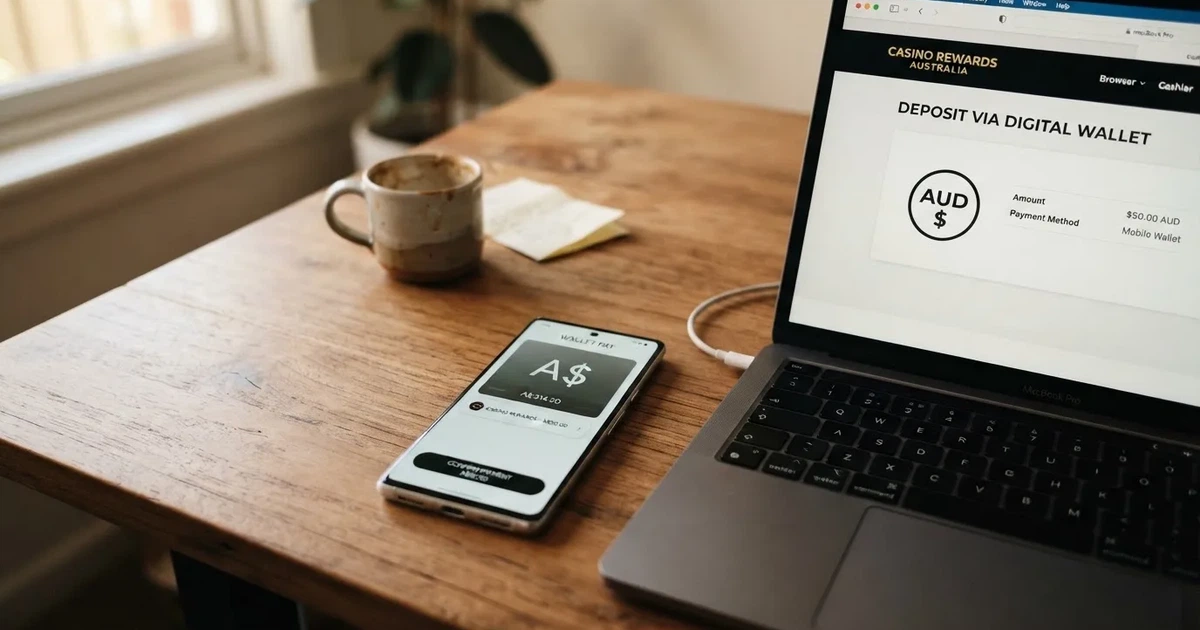
A punter who wants to use Google Pay at an online casino in Australia this year starts in a peculiar spot. Every casino-style site they are likely to find in a search result lists Google Pay as a deposit option, often alongside a “fast withdrawal” tick on the homepage. None of those sites may lawfully take an Australian resident. That gap between what the cashier page promises and what the Interactive Gambling Act 2001 permits is the single most important fact on this page, and it shapes every comparison that follows.
This guide is not a directory of brands to play at. It is a clear-eyed reading of what the Google Pay casino landscape looks like in 2026: how the payment method works at an offshore cashier, why a withdrawal still takes longer than the deposit page implies, what the ACMA has done about the brands marketing hardest to Australians, and how a player can keep a firm grip on the side of their finances that the casino page never quite reaches. Where licensed Australian wagering is the only legal route, the page names it. Where an offshore brand is one the ACMA has already warned, the page names it and stops short of steering anyone to its cashier.
The cluster of sites below is not a ranked shortlist. It is a set of brands the regulator itself has named in writing, and the comparison that follows is about how those brands have run into Australian law, not about which one offers the better bonus.
Table of Contents
- Why “Google Pay casino Australia” is an awkward search
- How a Google Pay deposit actually settles at an offshore cashier
- Withdrawals: why the wallet works one way only
- The legal frame for 2026, in plain terms
- Keeping a grip: the responsible-gaming side
- The wider picture: how much money moves through illegal channels
- The brands the ACMA has named: a comparison of formal warnings
- What the comparison actually tells a reader
- Close: the choice the reader is actually making
- Frequently asked questions
Why “Google Pay casino Australia” is an awkward search
The Australian payments story is one of the most mobile-heavy in the world. By the end of 2025, Apple Pay, Google Pay and Samsung Pay together accounted for around 45 per cent of all card payments in Australia by number, according to the Reserve Bank. That is a number worth sitting with: it describes how Australians pay for groceries, fuel and train tickets, not how they pay for casino games. The mobile wallet is everyday infrastructure, and it travels with a punter into the cashier page.

Google Pay arrived in Australia in 2016 (then under the Android Pay name) and works the way most readers will already know: it stores a tokenised card number on an NFC-enabled Android phone running Android 5.0 or later, and it transmits a one-time credential to the merchant rather than the real card details. A casino cashier that lists Google Pay is not running Google’s network. It is taking a card-funded wallet payment through its own processor, with Google acting as the payment pass-through on the consumer’s phone.
That is the same flow a casino cashier would have run with Visa or Mastercard ten years ago. The wallet changes the look on the phone, not the nature of the transaction at the merchant. The punter still has a Visa or Mastercard debit card behind the wallet, and that card still has to be one the casino’s processor is willing to accept. A punter who is curious about Google Pay support is, in practice, curious about which cards an offshore cashier is willing to take, with a familiar logo on the phone screen.
The awkward part is that the casino side of this picture is heavily policed. The Interactive Gambling Act 2001, tightened by the Interactive Gambling Amendment Act 2017, makes it an offence to provide online casino games, online pokies or in-play betting to a person physically in Australia. Lotteries, keno and pre-event wagering on sport and racing can be licensed — in practice by the Northern Territory Racing and Wagering Commission, which oversees 52 online bookmakers including Sportsbet, Bet365 and Ladbrokes, runs without full-time staff and meets monthly in Darwin. Casino-style products are not licensed anywhere in Australia. A brand’s offshore licence in Curaçao or Malta changes nothing about the IGA position: the prohibition is on the supply, not on the document on the wall.
So the natural reading of a Google Pay casino cashier page — “here is a licensed casino, here is a familiar payment option, here is a deposit button” — runs head first into the IGA. The rest of this guide reads that collision in detail.
How a Google Pay deposit actually settles at an offshore cashier
The mechanics on the player’s side are simple, and that simplicity is part of what makes the cashier page persuasive. From the phone, the punter taps Google Pay, confirms with face or fingerprint, and the cashier registers the deposit within seconds. Underneath, the flow is the same one Visa or Mastercard would have used: the wallet tokenises the card, the casino’s processor approves the transaction against the card-issuer, and the funds land in the casino’s merchant account. The punter does not see any of that.
The minimum deposit is where the wallet shows up clearly. Most Google Pay-friendly offshore sites sit their minimum at A$10, occasionally at A$15 or A$20. That is the same minimum a card deposit would carry, because the wallet does not change the merchant’s policy. A punter moving from one of these sites to another will see the same A$10 to A$20 band, regardless of which wallet logo appears in the cashier. Sites that push the minimum to A$30 are usually doing so because of the card processor rather than the wallet.
A deposit that is approved on the phone and “pending” on the cashier page is doing what card transactions have always done: the casino has reserved the funds but has not yet credited the playable balance. A 10-to-30 minute gap between approval and credited balance is normal on these sites, and it has nothing to do with Google Pay specifically — it has to do with the casino’s own merchant-account settlement window. A punter who sees only the phone-side approval and reads it as instant credit has misread the flow.
What the deposit side does well, and where it falls short
The good part is that the card number never travels. When a card is added to Google Wallet, the issuing bank generates a unique Device Account Number, a token specific to that phone, and that token is what the merchant sees. A data breach at an offshore casino exposes the token, not the card number. For a punter worried about card fraud at sites the regulator has already flagged, that tokenisation is the genuine safety layer Google Pay brings to the cashier — it is not the casino’s own security, and it does not make the casino safer to play at, but it does keep the underlying card out of the merchant’s files.
The shortfall is on the merchant side. A casino that lists Google Pay but does not actually support instant card processing can still hold the deposit in its own review queue. The wallet has done its job on the phone; the casino has the rest of the day. A punter who sees only the wallet experience and not the merchant experience is reading the wrong half of the flow.
A bank-side block also travels with the wallet. ANZ’s self-service gambling block, applied in the ANZ app, blocks gambling transactions made through a digital wallet on an eligible card, not just the physical card. Westpac’s gambling block refuses authorisation at the merchant-category-code level — “Betting/Casino Gambling” — on eligible personal credit and debit cards, and that refusal is on the card, not on the merchant’s website. NAB and ANZ both let customers turn a gambling block on inside their banking apps without phoning the bank. For a punter who has already decided to deposit, a bank-side block is a much firmer gate than anything on the casino side, because the merchant never sees the attempt.
Withdrawals: why the wallet works one way only
A Google Pay withdrawal at an offshore casino is a different animal from a Google Pay deposit, and the difference is where most of the disappointment on this subject sits.
A deposit is a card-funded wallet payment, settled by the casino’s processor. A withdrawal is not a wallet payment. The casino cannot push funds back into a Google Pay token — the wallet does not have a deposit endpoint on the merchant side. What it does instead is refund the original card. The funds come back to the Visa or Mastercard debit card that funded the deposit, less any processor fees the casino has set. The “withdrawal via Google Pay” tick on a cashier page, where it appears, is a refund to the funding card with the wallet’s logo on the player’s statement.
That is why a Google Pay withdrawal takes longer than the deposit. The casino still has to clear its own internal review — the anti-money-laundering check, the bonus-wagering check, the source-of-funds check — before it pushes the refund. The wallet has nothing to do with this stage. A 24-hour pending period followed by a 1-to-5-business-day card refund is the band the research sees at most of these sites, with the longer end reserved for accounts that have triggered a manual review.
A punter who has read “instant withdrawals via Google Pay” on a homepage banner is reading marketing copy, not a settlement window. The wallet cannot speed up the part of the withdrawal the casino controls. Where the site offers an actual e-wallet withdrawal — a Skrill, Neteller or Jeton wallet — the speed advantage is real, because those wallets do accept push payments from the merchant side. Google Pay is not in that category.
Three caveats the cashier page will not tell a player
The first caveat is on the credit-card side. Since 11 June 2024, Australian-licensed online wagering services cannot accept credit cards or credit-related products, and that prohibition includes credit-funded wallet payments. An offshore site is outside the prohibition, but a punter funding a wallet from a credit card is still running a personal credit transaction, with all that implies for interest and repayments. The IGA does not stop it; the bank does not police it; the punter carries it.
The second is on the surcharging side. The Reserve Bank’s July 2025 review proposes removing surcharges only on eftpos, Mastercard and Visa transactions, explicitly leaving American Express outside the scope of the proposed ban. Amex has its own three-party model — it issues cards and processes transactions itself, unlike Visa and Mastercard’s four-party model — and the regulator has been clear that an Amex surcharge sits outside this reform. A wallet that funnels through an Amex-funded card may carry a surcharge the wallet logo does not advertise. Apple Pay itself does not charge consumers; any fee is the merchant’s card-processing fee, not Apple’s.
The third caveat is the one a player does not want to read. None of these withdrawals carry Australian consumer protection. If the casino refuses a withdrawal, holds it for weeks, or simply stops responding, the punter has no Australian complaints body to escalate to, no local regulator to notify, and no Australian court with clear jurisdiction over a Curaçao or Maltese operator. The punter’s recourse is the card chargeback — which works best in the first 60 days, after the casino has had its review window — and the licence-issuer complaint process, which is rarely responsive.
The legal frame for 2026, in plain terms
The Interactive Gambling Act 2001 makes it an offence to provide certain interactive gambling services to a person physically in Australia. The list is specific: online casino games, online pokies, in-play betting on sport, and a small set of other “prohibited interactive gambling services”. What can be licensed is wagering on races and sport placed before the event, lotteries and keno. State and territory regulators do the licensing in practice, and the Northern Territory takes the bulk of online wagering licences — Sportsbet, Bet365 and Ladbrokes sit under the NTRWC — for tax reasons. Online casino games have no licensing route in any Australian jurisdiction.
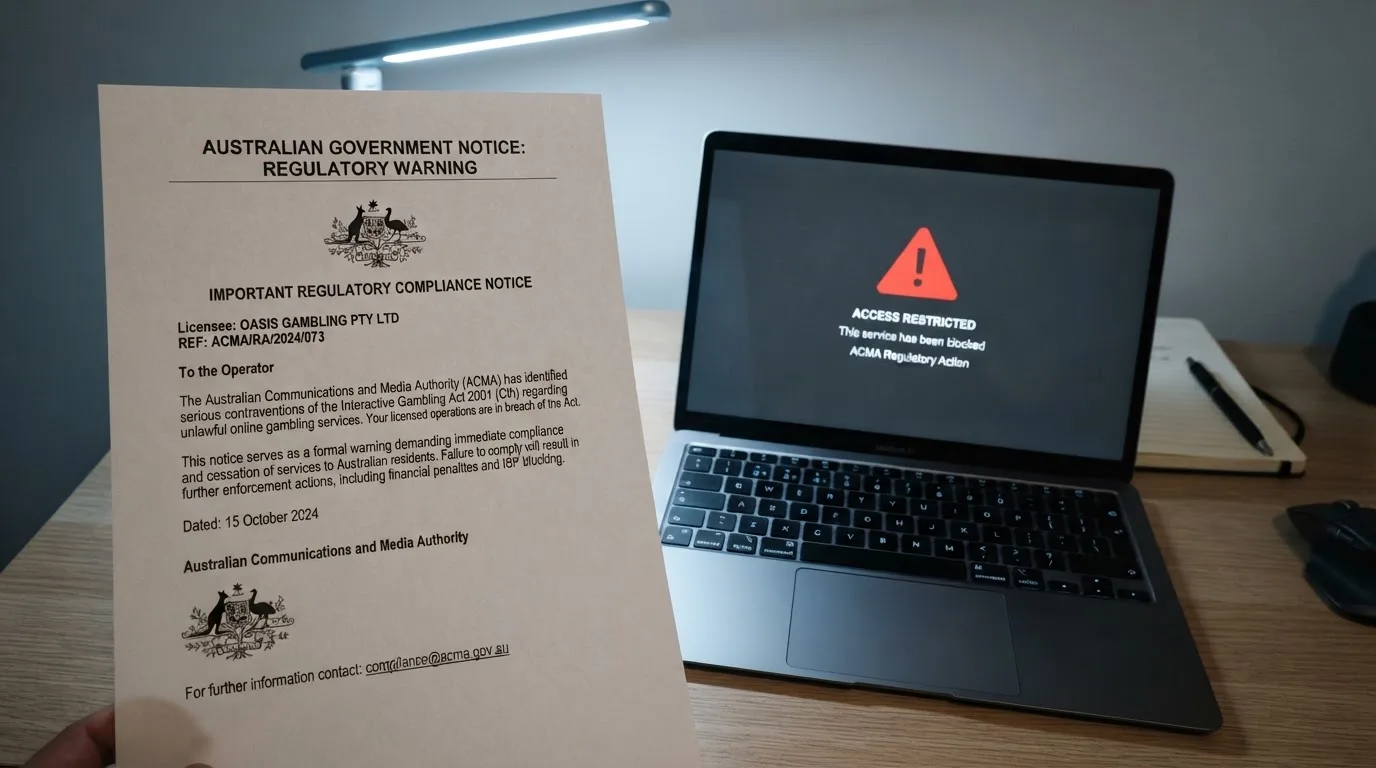
The ACMA is the enforcement body. It investigates, issues formal warnings, and directs Australian internet service providers to block illegal sites. In a round reported on 26 June 2026, the ACMA asked ISPs to block twelve more illegal gambling websites: 7Signs, ChromaBet, Donbet, Duospin, Freshbet, Slots Gem, Jacks Club, Lucky Start, Pointsbetz, Spinrise, Vinyl Casino and Wildsino. That round sits inside a much larger pattern. As reported in June 2026, a total of 1,751 illegal gambling and affiliate marketing websites had been blocked since the first blocking request in November 2019, and more than 230 unlicensed gambling services had left the Australian market since enforcement was strengthened in 2017.
The individual punter is not prosecuted. The IGA targets the provider. The consequence for the player is not a knock on the door; it is the absence of the protections an Australian licence brings — no local complaints body, no requirement that withdrawals actually clear, no obligation to honour advertised terms, and a real risk that the site is taken offline with a balance still on it.
What “no Australian licence” means in practice
A punter who deposits at an offshore casino is operating outside the Australian regulatory frame. The site is licensed somewhere — usually Curaçao, sometimes Malta, occasionally the Kahnawake Gaming Commission — and that licence is what governs the relationship. The punter’s options if a withdrawal is refused are governed by that licence’s complaint process, not by an Australian body.
This is the part of the page where a reader should slow down. The wallet logo on the cashier page does not change the legal position. The casino’s own homepage does not change the legal position. The IGA prohibition is on the supply of a prohibited service to a person in Australia, and a Google Pay deposit does not exempt either party from it.
What Australian-licensed wagering looks like with a mobile wallet
For the licensed side of the market — wagering on sport and racing — the deposit picture is different. A punter using an Australian-licensed bookmaker can fund with debit card, bank transfer, PayID/Osko or BPAY. PayID and Osko, sitting on Australia’s New Payments Platform, settle in under a minute between participating banks, 24/7 including weekends, and PayID shows the recipient’s name before the transfer is sent. PayIDs were registered at more than 25 million identifiers on the platform as of April 2025, and the platform itself went live on 13 February 2018.
Credit cards and credit-related products cannot be used at Australian-licensed online wagering services since 11 June 2024. Penalties for operators that breach the prohibition run up to A$247,500. A wallet funded from a credit card is not a workaround: the prohibition sits with the merchant, not with the consumer’s funding instrument. Apple Pay, Google Pay or Samsung Pay funded from a debit card is, in principle, an eligible route at an Australian-licensed bookmaker that lists it. Crypto is not.
The licensed market does not offer online casino games or online pokies. A punter who wants casino-style play in Australia is doing so through a pub, club or land-based casino. The pub-pokies and club-pokies machines are state-regulated and operate under different rules from the online market. A page about Google Pay at online casinos is, structurally, a page about an unlicensed product — and that is the frame that should sit in the reader’s mind before any deposit button.
Keeping a grip: the responsible-gaming side
The licensed Australian market has two layers of protection the offshore market does not have. The first is BetStop, the National Self-Exclusion Register, live since August 2023. BetStop binds Australian-licensed online and phone wagering services, and a punter on the register cannot open new accounts or use existing ones at participating brands. It does not bind offshore operators, and an account at an offshore casino is not affected by a BetStop registration. The punter who wants the strongest possible self-exclusion has to consider what BetStop covers and what it does not.
The second is the bank-side block. NAB, ANZ and Westpac all let customers apply a gambling block to eligible personal credit and debit cards inside the banking app, without phoning the bank or visiting a branch. ANZ’s block, applied through the ANZ app, also blocks gambling transactions made through a digital wallet on an eligible card, not just the physical card. Westpac’s block refuses authorisation at the merchant-category-code level — the “Betting/Casino Gambling” code — on eligible personal credit and debit cards. Removing ANZ’s block requires a 48-hour waiting period; the bank warns that not all gambling transactions will be blocked and that some non-gambling transactions might be blocked in error. A punter who cannot rely on willpower alone, and does not want to rely on a casino’s own self-exclusion, can rely on the bank.
The National Gambling Helpline is 1800 858 858, free and available 24/7, with chat support through Gambling Help Online. The helpline is a service for anyone whose gambling has become a problem — whether that gambling happens at an Australian-licensed bookmaker, at a pub poker machine, or at an offshore casino the ACMA has already warned about. There is no shame in calling it, and no threshold a punter has to cross first.
A punter who has decided to play at an offshore casino despite the IGA position can still take three practical steps. First, set a bank-side gambling block on the card funding the wallet, knowing that the block sits at the card level and not at the casino level. Second, register with BetStop even though the offshore site is not bound by it, because the licensed side of the market is. Third, keep the casino’s own responsible-gaming tools active — deposit limits, session reminders, time-outs — with the understanding that the casino can change or remove those tools unilaterally, because it is outside the Australian regulatory frame.
The wider picture: how much money moves through illegal channels
H2 Gambling Capital’s 2025 report estimates that Australians lose about A$3.9 billion a year to illegal gambling sites, and that the share of gambling going through legal channels fell from 74 per cent in 2021 to 64 per cent. That is a significant shift in a short window: legal-channel share down ten percentage points, illegal-channel losses in the billions. The estimate is one firm’s modelling, not a regulator’s audited figure, but the direction of travel is consistent with what the ACMA’s blocking rounds describe — site after site entering the regulator’s sights, brand after brand receiving a formal warning, and the IGA prohibition going unenforced at the consumer level.
The regulatory response is the blocking programme. The arithmetic is worth doing. Between November 2019 — the first blocking request — and June 2026 — the most recent count — the ACMA has directed ISPs to block 1,751 illegal gambling and affiliate marketing websites. That is six and a half years and 1,751 sites. As a blocking rate, that works out to roughly 269 sites blocked per year on average, or about 22 per month, over the full life of the programme. The early years were slower — the first requests came in late 2019 and the rounds gathered pace through the early 2020s — and the recent rounds have been faster, with the June 2026 round alone covering twelve sites. As a band rather than a single figure: somewhere between the early-programme rate and the most recent round’s pace. The exact number for any given year depends on which month of which round one is counting from, and the ACMA publishes the running total rather than an annual figure. The honest reading is that the programme has accelerated, that each round covers a dozen or so sites, and that the total is now well above 1,700.
A punter looking at that picture can see two things at once. The first is that the regulator is acting — 230-plus services have left the Australian market entirely since 2017, and the monthly blocking list keeps growing. The second is that the supply keeps replacing itself. A site blocked today is replaced by a fresh domain tomorrow, with the same operator behind it and a slightly different brand on the homepage. The blocking programme is a sieve with a leak: it slows the supply, it does not stop it.
The brands the ACMA has named: a comparison of formal warnings
Eleven brands sit on the ACMA’s formal-warning register with a Google Pay or mobile-wallet angle. Each has been the subject of a written warning under the Interactive Gambling Act 2001 for offering prohibited interactive gambling services to Australians. None of these brands may lawfully take an Australian resident. The table below summarises what the ACMA has said about each, and when.
| Brand | ACMA action and date | Operator named by the ACMA | Google Pay or wallet coverage in research |
|---|---|---|---|
| RocketPlay | Formal warning, March 2026; earlier warning to Dama N.V. over the RocketPlay brand, May 2022 | Pulsup Ltd (RocketPlay) | — |
| Level Up Casino | Formal warning, May 2022 | Dama N.V. | — |
| Woo Casino | Formal warning, March 2025 | Dama N.V. | — |
| Spirit Casino | Formal warning, May 2025 | Dama N.V. | — |
| National Casino | Formal warning, July 2025 | Consolutetish S.R.L. | — |
| Bizzo Casino | Formal warning, July 2025; earlier warning to TechSolutions, 2022 | Consolutetish S.R.L. | — |
| Ignition Casino | Formal warning, July 2025 | Bamboo Media | — |
| Instant Casino | Formal warning, February 2025 | EOD Code SRL | — |
| Jackbit | Formal warning, April 2026 | Ryker B.V. | — |
| Casino Intense | Formal warning, April 2025 | Sterplay Holding Ltd | — |
| Sky Crown | Formal warning published September 2022 | Hollycorn N.V. | — |
Three patterns sit inside the table. The first is operator concentration: Dama N.V. sits behind four of the eleven brands — RocketPlay, Level Up, Woo and Spirit — and Consolutetish S.R.L. sits behind two — National and Bizzo. A punter who reads the brand as the company is reading the wrong layer; the operator is the parent. A warning to one brand is, in practice, a warning to the same operator’s other brands at the same time.
The second is the spread of dates. The earliest warning in this set is the September 2022 warning to Hollycorn N.V. over Sky Crown. The latest is the March 2026 warning to Pulsup Ltd over RocketPlay. The set spans roughly three and a half years, and the gap between a warning and a re-entry is often only a few months. Dama N.V. was warned in May 2022 over six brands including RocketPlay; four years later, a different operator (Pulsup Ltd) is using the RocketPlay brand in a fresh configuration and attracting its own warning. The blocking programme catches the brand; the supply rotates underneath it.
The third is the absence of a wallet verdict. Research carries no Google Pay-specific confirmation for any of these brands. A punter searching for “RocketPlay Google Pay” or “Woo Casino Google Pay” will find affiliate pages and cashier screenshots. The ACMA’s register does not adjudicate on payment methods. It adjudicates on the supply of a prohibited service to Australians. The wallet question is downstream of the legal question, and the legal question is settled.
What the comparison actually tells a reader
The honest reading of this comparison is that it does not pick a winner. It cannot. Eleven brands, each named by the ACMA for the same kind of conduct, do not form a ranking. They form a register, and the register’s lesson is that the supply side of the Google Pay casino market in Australia is not a list of reputable operators with one or two bad apples. It is a list of operators that the regulator has repeatedly found acting outside the IGA.
A punter who arrived at this page looking for the “best Google Pay casino in Australia” is looking for a question the regulator has already answered. The answer is the one the ACMA’s formal warnings sit on top of: there is no best Google Pay casino, because there is no Google Pay casino licensed to take Australian residents. The licensed Australian product — wagering on sport and racing at NTRWC-licensed bookmakers — does not offer Google Pay as a category, because the licensed bookmakers take debit cards, bank transfers, PayID/Osko and BPAY, and not credit-funded wallets. A punter who wants Google Pay is, by definition, looking at the unlicensed side of the market.
The other reading is structural. A punter who insists on using Google Pay for casino-style play is making two decisions at once: to use a mobile wallet (a sound security choice at the card level), and to play at an offshore site the ACMA has warned about (an unsound legal choice). These two decisions can be separated. The wallet can be used at Australian-licensed bookmakers for pre-event wagering on sport and racing, with the bank-side block in place. The casino-style play, if it happens, cannot happen legally online in Australia at any wallet.
The arithmetic of blocking, in one sentence
Between November 2019 and June 2026 the ACMA directed ISPs to block 1,751 illegal gambling and affiliate marketing websites — a rate that works out, as a band, to roughly twenty to thirty sites per month on average across the programme’s life, with recent rounds sitting toward the higher end of that band.
Close: the choice the reader is actually making
A punter who has read this far has three honest options on the table. The first is to use the licensed Australian market — Sportsbet, Bet365, Ladbrokes and the rest of the NTRWC bookmakers — for pre-event wagering on sport and racing, funded by debit card, bank transfer or PayID/Osko, with a bank-side gambling block applied before the first deposit. The licensed market has BetStop, the National Gambling Helpline, and the consumer protections the IGA does not extend to offshore sites. It does not have online casino games or online pokies.
The second is to step away from the unlicensed market entirely. The ACMA’s formal-warning register lists eleven brands that have all marketed to Australians despite the prohibition. The register is not exhaustive — it lists the brands the regulator has acted against in writing, and the wider list of unlicensed sites is much longer. A punter who decides the legal position is enough to make the call has decided it; the rest of the page is not for them.
The third is to keep playing at an offshore site, knowing the position. The punter who takes this option should put the bank-side block on first, set a hard deposit ceiling that the bank cannot see but the casino cannot raise, and treat any balance at the site as money the casino can keep. The wallet is the safest part of the cashier page. The cashier page is the least safe part of the casino.
The Google Pay logo on the cashier page is a piece of consumer-facing infrastructure Google built for contactless retail, and it does that job well. It is not a regulatory mark. It does not mean the casino is licensed. It does not mean the casino will pay out. It does not mean the casino is safe. It means the underlying card will not be exposed at the merchant. That is a real, narrow, and worthwhile benefit — and it is not a reason to use it at a casino the regulator has warned Australians away from.
Frequently asked questions
Is it legal for an online casino to accept Google Pay from a player in Australia?
No. The Interactive Gambling Act 2001 makes it an offence to supply online casino games, online pokies or in-play betting to a person in Australia. A casino’s acceptance of Google Pay, or any other payment method, does not change that. The licensed Australian wagering market covers pre-event sport and racing, lotteries and keno — not online casino games.
What is the smallest deposit a Google Pay casino site usually asks for?
Most offshore Google Pay-friendly sites sit their minimum deposit between A$10 and A$20. The wallet does not set the minimum — the casino’s own cashier policy does. A small handful of sites push the minimum to A$30, usually because of card-processor constraints rather than the wallet.
Does a Google Pay withdrawal clear any faster than a card withdrawal at these sites?
No, because a Google Pay withdrawal at an offshore casino is a refund to the funding card, not a wallet push. The wallet cannot speed up the casino’s own review queue. A 24-hour pending period plus a 1-to-5-business-day card refund is the typical band, with the longer end reserved for accounts that triggered a manual review.
Can Google Pay be used at every offshore pokies-style site, or only some of them?
Google Pay is widely listed at offshore casino cashiers but is not universal. Research does not confirm a Google Pay listing for any specific brand in the ACMA’s formal-warning set. A cashier page that shows the Google Pay logo means the casino’s processor has wired up wallet support; a cashier page that does not show it means it has not.
Does depositing with Google Pay add an extra fee at these casino sites?
Google does not charge consumers for using Google Pay. Any fee on the deposit is the casino’s own, not Google’s. The Reserve Bank’s July 2025 review proposes removing surcharges on eftpos, Mastercard and Visa transactions, leaving American Express outside the scope — so an Amex-funded wallet may still carry a surcharge the wallet logo does not advertise.
What should a player do if a Google Pay deposit does not appear in a casino account?
Wait ten to thirty minutes for the merchant-side settlement window, then check the casino’s pending-transactions page. If the deposit is still missing after an hour, contact the casino’s support with the Google Pay reference ID. If the casino does not respond, the next step is a card chargeback — most effective in the first sixty days — and the relevant card-issuer’s dispute process.