7 reel slots in Australia — the format, the prohibition, and the operators the regulator has warned
 Available in US
A player typing “best 7 reel slots Australia” is usually after one of two things: a clear explanation of what a 7-reel machine actually is, or a route into playing one for real money online. The first is reasonable to give. The second runs into a hard wall — under the Interactive Gambling Act 2001, no online casino game, including any 7-reel slot, can be licensed for Australian players anywhere, and the regulator has spent the last several years making that wall higher rather than lower. The Australian Communications and Media Authority asked ISPs to block another 12 offshore sites in the round reported on 26 June 2026, and the running total of blocked pages and affiliate marketing has now reached 1,751 since the first blocking request in November 2019. What follows explains both halves of that — the format and the prohibition, with the figures that make each one concrete. Current as of 23 September 2026; operator and licence claims cross-checked against ACMA formal-warning and blocking publications.

Table of Contents
- The landscape of 7-reel play in Australia
- Legality and the regulator’s record against offshore sites
- Responsible play and the help that does exist
- Bonuses and free spins on a 7-reel game
- ACMA action against operators offering 7-reel slots to Australian players
- Specific games, providers and the live-dealer shelf
- Where this leaves the player
- FAQ
The landscape of 7-reel play in Australia
The “7-reel slot” is an unusual format outside a few catalogues of classic-style games. Most modern video slots run five reels, with a handful at six or seven. A seven-reel machine replaces the familiar three-by-five layout with seven spinning strips of symbols, which on a clean grid means forty-nine symbol positions per spin rather than fifteen. The maths that flows from that is what most often draws players to it: a classic three-reel machine with about ten symbols per reel offers roughly 1,000 distinct combinations, while a modern video slot can carry fifty or more symbols per reel and push the odds on the top combination as high as 300 million to one. A 7-reel title sits between those extremes in complexity — more combinations than the three-reel bell-and-lever machines that Charles Fey developed in San Francisco in the late 19th century, far fewer than a fully featured Megaways layout.
Australia has a long and unusual relationship with slot machines in the physical sense. New South Wales legalised the machines in 1956; by 2010 the country operated an estimated 97,103 gaming machines outside casinos, a per-capita rate about five times that of the United States. Outside casinos, the count breaks down as 87,298 in New South Wales (June 2023), 26,380 in Victoria (2021–22), 21,122 in Queensland (October 2023), 11,672 in South Australia (September 2023) and 3,587 in the ACT (November 2023). Pub and club machines — what Australians call pokies — are overwhelmingly five-reel video games. Genuine seven-reel cabinets do exist in manufacturer catalogues, but they are the exception in Australian venues rather than the rule, and the format matters less to a pub punter than the betting denominations and the return-to-player setting the venue runs.
| Aspect | Status in Australia |
|---|---|
| 7-reel slot format | Found in offshore catalogues; rare in venues |
| Licensed online slots | Prohibited for any reel count |
| Offshore availability | Not legal, targets Australians, often warned by ACMA |
| Venue pokies | Over 150,000 machines; 5-reel format is standard |
Online the picture is reversed. The format is plentiful: software studios put out classic and novelty slots with seven reels because the reel count makes for a distinctive look and a longer spin animation, which suits a marketing pitch that wants the game to feel different from the next one. The legality is the issue, not the catalogue. No state or territory regulator licenses online casino games, which means no Australian-licensed site offers any 7-reel title, real-money play or otherwise. Anything an Australian finds that claims to take a real-money bet on a 7-reel slot is operating outside Australian law, and that includes every site on the regulator’s action list discussed further on.

A 7-reel machine is also not the same thing as the seven-payline or 243-ways games that flood the lobbies of offshore sites. Reels are the vertical strips that spin; paylines are the patterns on the screen that determine a winning combination. A 7-reel game can carry one payline straight across the middle, or it can carry dozens of patterns and bonus-trigger lines. The reel count is a mechanical property of the cabinet, not a measure of how many ways the game pays.
What the paytable actually shows
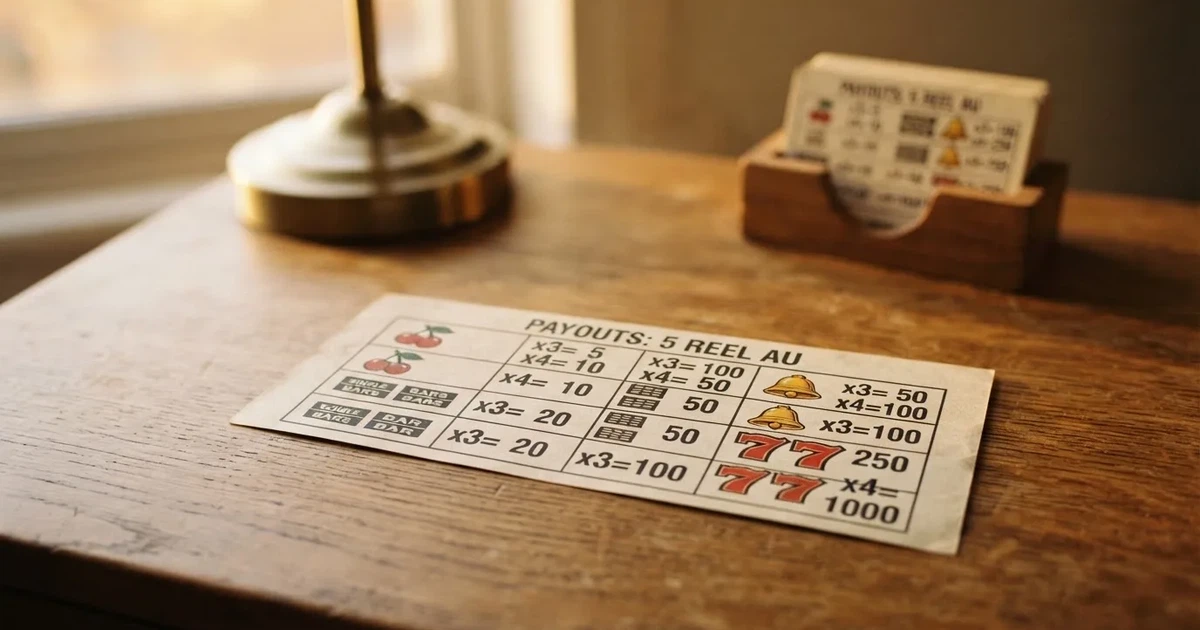
Every slot, 7-reel or otherwise, runs off a paytable that lists each symbol and what it pays for a winning combination of two, three, four, five, six or seven in a row. Higher-paying symbols — the thematic icons — pay most; lower-paying symbols are usually card values from nine to ace. The paytable also lists the scatter symbol, the wild symbol and any bonus trigger. On a 7-reel game the wild and scatter rules matter more than on a 5-reel title, because there are more positions where a special symbol can land and more ways a feature can be triggered. A player who reads only the return-to-player number has missed the part of the paytable that actually decides what the game does on any given spin.
Legality and the regulator’s record against offshore sites
The Interactive Gambling Act 2001 (IGA), strengthened by the Interactive Gambling Amendment Act 2017, makes it an offence to provide online casino games, online pokies or in-play betting to a person physically in Australia. What is licensable is wagering on races and sport placed before the event, lotteries and keno — in practice licensed by the Northern Territory Racing and Wagering Commission, which oversees 52 of Australia’s online bookmakers, including Sportsbet, Bet365 and Ladbrokes, for tax reasons. The NTRWC has no full-time staff and meets once a month in Darwin. A 7-reel slot is an online casino game under that definition and falls outside the licensable category. The minimum age for any form of licensed wagering is 18.
Enforcement against offshore operators has stepped up across several years. The ACMA investigates complaints, issues formal warnings, and directs Australian internet service providers to block illegal services. The blocking tool has been the most visible part of that — the regulator has now had 1,751 illegal gambling and affiliate marketing websites blocked since the first blocking request in November 2019, and more than 230 unlicensed services have left the Australian market since enforcement was strengthened in 2017. The round reported on 26 June 2026 alone added twelve names: 7Signs, ChromaBet, Donbet, Duospin, Freshbet, Slots Gem, Jacks Club, Lucky Start, Pointsbetz, Spinrise, Vinyl Casino and Wildsino. None of those offered a 7-reel-specific product, and the names matter less than the pattern, which is that the regulator keeps adding to a list that already runs into the high four figures.
The formal-warning track runs in parallel. The ACMA does not need a court order to publish a warning naming an operator, and the warnings it has issued over the past four years cover most of the offshore brands that target Australian players with online casino games. The eleven brands listed in the comparison block further down are all on that record.
The Interactive Gambling Amendment (Gambling Reform) Bill 2026 passed Parliament on 19 August 2026. Its advertising and inducement measures commence on 1 January 2027 — law with a start date, not yet in force on a page written before that date.
What “playing on an offshore site” actually costs the player
The IGA targets the provider, not the individual player. No Australian has been prosecuted for opening an account on a blocked site and placing a real-money spin. That is the part the offshore marketing material likes to highlight, and it is technically true. The other half is the part it leaves out. An offshore casino gives no Australian consumer protection, no complaints body and no avenue of recourse if a withdrawal is refused or a balance is voided. If the ACMA has the site blocked while money is still on the account, that money sits with a Curaçao or Anjouan-registered company and the Australian regulator has no power to recover it. This is the asymmetry: the offshore brand carries no criminal liability for accepting the bet; the player carries the full risk of a counterparty that does not have to answer to Australia.
H2 Gambling Capital’s 2025 report estimates that Australians lose about A$3.9 billion a year to illegal gambling sites, and that the share of gambling going through legal channels fell from 74% in 2021 to 64%. The legal share is still the majority, but the offshore slice is large enough that a regulator with limited enforcement tools is unlikely to clear it. What a player stands to lose on an individual session is a function of the game’s house edge, the stake and the time spent — a sharper problem on games with rapid spins and a feature loop, and one the next section addresses.
Payments that signal whether a site is operating under Australian rules
Since 11 June 2024, credit cards, credit-related products and digital currency have been banned as payment for licensed online wagering, with penalties up to $247,500 for operators that breach the rule. The legal deposit routes for a licensed Australian wagering service are debit card, bank transfer, PayID/Osko and BPAY. An offshore casino will accept any of those plus credit cards and crypto, because it is not bound by the Australian ban. The presence of a credit-card logo or a Bitcoin wallet on the cashier page is therefore not a quirk of the site — it is a fingerprint of a brand that is operating outside the Australian framework entirely. A punter who treats that as a sign of convenience has mistaken the absence of Australian rules for the presence of a better offer, which is the wrong way around.
Responsible play and the help that does exist
For players who do end up gambling — on the licensed wagering side, in a pub, or on an offshore site that the IGA does not actually stop them reaching — the help infrastructure is real and is built around Australian conditions. The National Gambling Helpline on 1800 858 858 is free, runs around the clock, and chat is available through Gambling Help Online. BetStop, the National Self-Exclusion Register, has been live since August 2023. It binds Australian-licensed online and phone wagering services, which is the right tool for someone who wants to keep their wallet out of a Sportsbet or Ladbrokes account. The limit that matters here is that BetStop does not connect to an offshore casino — the offshore brand has no integration with the Australian register, so a self-excluded player can still open an account on a Curaçao-licensed site and place bets there. Anyone who has registered with BetStop because they want to stop should treat that offshore route as still open and act accordingly.
A player whose gambling starts to feel compulsive or stressful should not wait for a single large loss to make the decision for them. The 24/7 helpline takes calls on a no-name basis, and the chat service runs through the same counsellors. Neither tool requires the caller to have stopped playing first.
Bonuses and free spins on a 7-reel game
Bonus offers attached to 7-reel titles look similar to those on 5-reel games, because the offer mechanics are properties of the casino, not the slot. A welcome package typically combines a deposit match with a batch of free spins on a named slot, and the headline is the number of spins and the per-spin value rather than the game itself. Two qualifications matter more than the spin count. The first is the wagering requirement, which is the multiple of the bonus (or sometimes the deposit plus the bonus) that the player has to turn over before any winnings become withdrawable. The second is the maximum cashout cap, which limits how much of a no-deposit or free-spin win can actually be taken out. Where an offshore site publishes these numbers at all, the audit habit is to look at both rather than the headline.
For Australian players the offer itself is the secondary question. Any bonus an offshore casino hands out sits on a site that has been the subject of an ACMA formal warning or a blocking request, which is the comparison block below. The wagering requirement and the cap are still worth knowing, because they explain what the bonus actually costs once claimed, but the offer does not exist in a vacuum. A 35x playthrough on a deposit match means a player has to turn over thirty-five times the bonus amount before withdrawal, and on a game at 96% return-to-player the expected loss across that turnover is 4% of it — so on a A$100 bonus with a A$3,500 turnover, the expected cost sits around A$140 before any winnings are extracted. That arithmetic is not the only thing wrong with claiming an offshore bonus, but it is the arithmetic that runs once a player has decided to do so regardless.
What follows is the comparison the page sets out to give: each brand in the order the regulator’s record has placed it, with the warning that brought it to the page.
ACMA action against operators offering 7-reel slots to Australian players
What a “best of” comparison looks like when the product is prohibited is necessarily different from the usual ranking. There is no way to test the games on a site an Australian is not supposed to use, no bonus to size up honestly, and no real-money RTP that has any standing under Australian consumer law. What the regulator has published is the only comparable record — the ACMA’s formal-warning publications name the operator behind each brand, the date of the warning and the basis for it. The table below carries that record as it stands. Every row is the regulator’s statement, not an endorsement.
| Brand | ACMA action and date | Operator named by the ACMA | Subject support |
|---|---|---|---|
| RocketPlay | Formal warning, March 2026 | Pulsup Ltd (RocketPlay); earlier Dama N.V., May 2022 | No data |
| Level Up Casino | Formal warning, May 2022 | Dama N.V. | Listings only |
| Woo Casino | Formal warning, March 2025 | Dama N.V. | No data |
| Spirit Casino | Formal warning, May 2025 | Dama N.V. | No data |
| National Casino | Formal warning, July 2025 | Consolutetish S.R.L. | Listings only |
| Bizzo Casino | Formal warning, July 2025; earlier 2022 | Consolutetish S.R.L.; earlier TechSolutions Group | No data |
| Ignition Casino | Formal warning, July 2025 | Bamboo Media | No data |
| Instant Casino | Formal warning, February 2025 | EOD Code SRL | No data |
| Jackbit | Formal warning, April 2026 | Ryker B.V. | No data |
| Casino Intense | Formal warning, April 2025 | Sterplay Holding Ltd | Listings only |
| Sky Crown | Formal warning, September 2022 | Hollycorn N.V. | No data |
Two things stand out from that record. The first is repetition: Dama N.V. has come up three times across the dataset — RocketPlay, Level Up and Woo/Spirit — and Hollycorn N.V. and Consolutetish S.R.L. each have multiple brands named to them. The offshore sector runs on a small number of company shells that own dozens of brands, which means a warning to one of them is rarely the end of the matter under that corporate roof. The second is the date range: every brand in the table has had an ACMA warning within the last four years, and most within the last twelve months. The regulator has not been inactive on this category of operator, and the list is more like a snapshot of a continuing action than a finished case file.
What the regulator’s blocking record means in practice
The arithmetic the page makes explicit is the blocking rate itself. The ACMA’s first blocking request was issued in November 2019, and the cumulative total reached 1,751 websites by 26 June 2026. That is a span of about six and a half years, or roughly 78 months. The straight-line rate of 1,751 ÷ 78 works out to around 22 sites blocked per month across that whole period, and the more recent rounds — twelve sites in a single round reported on 26 June 2026 — sit comfortably above that average. The band that the regulator’s own reporting supports is something between twenty and twenty-five new blocked pages per month over the full enforcement period, with no sign of the rate falling. That is not a forecast — it is a description of how the tool has been used, and it explains why a brand on the warning list today has a meaningful probability of finding itself on the blocking list within a quarter or two.
RocketPlay
RocketPlay carries two ACMA warnings in the dataset, which makes it a useful illustration of how the formal-warning regime repeats on the same operator shell. The first warning, issued in May 2022, named Dama N.V. as the operator behind a cluster that also covered Bambet, Dazard, Level Up, Wild Tornado and Cobra Casinos. The second, in March 2026, named Pulsup Ltd as the operator of RocketPlay. The same brand, two operators, four years apart. The product on offer — a 7-reel slot real-money lobby — was prohibited in both periods, which is the part that does not change. Research carries no specific information on the 7-reel catalogue under that brand, so the page does not assert one. The verdict the comparison reaches is on the operator record: a brand that has been warned twice in four years, with the second warning naming a different corporate vehicle than the first, is not a brand whose presence on a new list signals a fresh entrant — it signals a familiar pattern under a new letterhead.
Level Up Casino
Level Up Casino sits inside the May 2022 warning to Dama N.V., the same warning that named RocketPlay, Bambet, Dazard, Wild Tornado and Cobra Casinos. The brand is documented in listings as a Bgaming-software casino, which is the only subject-specific data point research carries on this brand — the “listings only” notation in the table means the source is Bgaming’s own cataloguing, not the operator’s own claim, and the page does not assert anything stronger than that. The licence the site displays, like every other site in this comparison, sits outside Australia, because no online casino licence exists in Australia. The verdict on Level Up is the same shape as on RocketPlay: a single brand in a cluster of six, named to one operator in a single 2022 round, with no later warning that the data records — which is not the same as a clean record, but is a quieter one.
Woo Casino
Woo Casino was the subject of a formal warning to Dama N.V. issued in March 2025. It is the third Dama N.V. brand in the comparison, alongside RocketPlay and Spirit Casino, which makes Dama N.V. the operator with the largest footprint on the ACMA’s record in the past two years. Research carries no subject-specific data on Woo Casino — no game catalogue claim, no software-provider listing beyond the operator shell — so the page does not attach the brand to a 7-reel product it cannot source. The verdict here is on the operator pattern rather than the brand itself: three brands under one corporate roof in three different months is the kind of repetition that makes the warning a useful record but does not make the brand an interesting one.
Spirit Casino
Spirit Casino is the fourth Dama N.V. brand in the comparison — RocketPlay, Level Up, Woo Casino and Spirit Casino all name the same operator across the dataset, and Spirit’s warning was issued in May 2025. The fact that one operator shell carries four brands through four separate ACMA actions across roughly four years is the strongest signal in this comparison of how the offshore sector is organised. Research carries no subject-specific data on Spirit Casino, so the brand is presented on its operator record alone. The verdict on Spirit is the conclusion the operator record forces: an offshore casino under a repeatedly-warned operator shell is a brand the Australian framework has not been able to reach by warning alone, and the comparison cannot put it on a “best” list without mis-describing what a best list is for.
Bizzo Casino
Bizzo Casino carries two warnings across the dataset, which makes it the third brand with a repeated record. The earlier warning, in 2022, named TechSolutions (CY) Group Limited and TechSolutions Group N.V. The later, in July 2025, named Consolutetish S.R.L. — the same operator shell behind National Casino. Two operators, two years, two warnings. Research carries no subject-specific data on Bizzo Casino, so the entry relies solely on the regulator’s documentation. The verdict is on the comparison the table actually supports: the brand sits in the same operator shell as a peer brand further down, which makes the corporate-vehicle repetition worth more than any product-specific claim either brand could make.
National Casino
National Casino shares the July 2025 warning to Consolutetish S.R.L. with Bizzo Casino, so the two brands have identical operator and date records. Research carries a listings-only subject-specific data point, sourced from a Wikipedia entry, which is not enough for the page to assert anything beyond the listing itself. The verdict on National Casino is on the brand’s place in the operator pattern — half of a paired warning with Bizzo, under the same shell — which is the strongest case in the comparison for treating offshore brand names as marketing labels rather than as separable corporate entities.
Ignition Casino
Ignition Casino was the subject of a July 2025 warning to Bamboo Media, a different operator name from anything else in the comparison. Research carries no subject-specific data on Ignition Casino, so the comparison relies on the ACMA’s published record. The verdict on Ignition is on the freshness of the warning — July 2025 is recent enough that the regulator’s enforcement tool has not had time to escalate to a blocking direction against this particular brand, which is the typical position of a brand on the warning list, and not the typical position of a brand worth recommending.
Instant Casino
Instant Casino is the brand that triggered the ACMA’s February 2025 warning to EOD Code SRL, which is a separate operator name again. Research carries no subject-specific data on Instant Casino, so the brand is presented on the operator record alone. The verdict on Instant is on the warning date — a brand warned twelve months before the latest blocking round is a brand that the regulator has had time to escalate against if it intended to, and the absence of a blocking direction in the published record is a piece of information even if it is not a positive one.
Jackbit
Jackbit was the subject of an April 2026 warning to Ryker B.V., shared with CasinOK in the same operator block. Research carries no subject-specific data on Jackbit, so the brand is presented on the operator record alone. The verdict on Jackbit is on the recency of the warning — a brand warned within the last quarter is one the regulator has just identified, and the comparison table does not need to assert anything stronger than that.
Casino Intense
Casino Intense was the subject of an April 2025 warning to Sterplay Holding Ltd. Research carries a listings-only data point drawn from general Australian news and regulator publications, which is not a subject-specific claim about a 7-reel product and the page does not assert one. The verdict on Casino Intense is on the operator record — a single brand in a single warning round, under an operator name that does not appear elsewhere in the comparison — which is the closest the comparison comes to a quieter brand, but is not the same as a clean one.
Sky Crown
Sky Crown is the brand the regulator named in its September 2022 formal warning to Hollycorn N.V., shared with Blue Leo. Sky Crown is also the oldest entry in the comparison — the September 2022 warning predates every other row — which is the longest span in the dataset without a fresh warning under the same operator shell, and also the longest span without a clean record. Research carries no subject-specific data on Sky Crown, so the brand is presented on the operator record alone. The verdict on Sky Crown is the comparison’s clearest case for treating “no recent action” as distinct from “no action”: a brand whose last warning is now over three and a half years old has not been re-warned, but has also not been relicensed, because no relicensing path exists for an Australian player.
Specific games, providers and the live-dealer shelf
A 7-reel online slot is, mechanically, a slot like any other — a random-number generator, a symbol set, a paytable and a return-to-player percentage set by the software studio. The provider that builds the game is the entity that decides whether the reel count is three, five, six or seven, and a small number of studios hold most of the 7-reel catalogue on the offshore market. Bgaming, for example, has a 7-reel entry in its lineup that shows up in listings under brands like Level Up Casino. Microgaming’s catalogue, which dates back to the 1990s and covers most of the formats the offshore sector runs, includes 7-reel games in its classic-styled series. Pragmatic Play and NetEnt, the two largest studios by game count, run mostly 5-reel and 6-reel layouts and have not pushed hard into the 7-reel format. The reason is partly aesthetic — a 7-reel grid on a phone screen ends up with a narrower symbol strip per reel, which can read as cramped — and partly commercial, because the studio’s marketing departments sell 5-reel and 6-reel Megaways-style titles more easily than they sell a 7-reel novelty.
On a live-dealer shelf the 7-reel question does not arise. A live casino table is a streamed table game — baccarat, blackjack, roulette — and the games that show up under the “live casino” tab on an offshore site are the same ones a Crown Melbourne or Star Sydney punter can play on the floor. Baccarat and blackjack each have a published house edge that is independent of the casino running the game: with optimal strategy, blackjack’s edge is about 0.28% under liberal Las Vegas Strip rules and about 0.43% under Atlantic City rules; baccarat runs at 1.06% on the Banker bet, 1.24% on the Player bet and 14.36% on the Tie. These are not 7-reel numbers, but they are the numbers the offshore lobby will quote on its live tab, and they are the numbers a player who treats an offshore casino as a baccarat or blackjack venue is actually playing against.
What the page does not do is point at any specific 7-reel title by name and recommend it. The format exists, the offshore catalogue includes it, and the Australian regulator prohibits every site that hosts it. Those three statements together are the whole of the comparison a player can act on.
Where this leaves the player
A 7-reel slot is a real machine format with a long history and a small but identifiable presence in the offshore online catalogue. In Australia, every site that offers it has either been formally warned by the ACMA, blocked at the ISP level, or both. Eleven such brands sit on the formal-warning record, and several more land on every blocking round the regulator publishes. The H2 Gambling Capital estimate of A$3.9 billion a year in losses to illegal sites is the size of the demand the offshore sector is meeting, and the regulator’s own enforcement tool has been running at a steady twenty-to-twenty-five blocked pages per month across the past six and a half years.
For a player who wants to play slots without crossing the prohibition, the licensed options are limited but real. The pub and club machines in NSW, Victoria, Queensland, South Australia and the ACT together number over 150,000 — the 7-reel format is rare in those venues, but the five-reel format is universal. For online play, only the licensed wagering services (Sportsbet, Bet365, Ladbrokes and the rest of the NTRWC’s fifty-two) are within the law, and those services run racing and sport markets rather than casino games. A 7-reel online slot for Australian players, played for real money, on a site that answers to an Australian regulator, does not exist as a product and is not on a path to existing.
FAQ
What makes a 7-reel slot different from a standard five-reel video slot?
The reel count is mechanical: a 7-reel machine spins seven strips of symbols rather than five, producing forty-nine symbol positions on a clean grid rather than fifteen. The combinatorial space is larger than on a 3-reel classic and smaller than on a Megaways-style 5-reel layout. The paytable, the bonus rules and the random-number generator work the same way as on any other video slot.
Can 7-reel slot machines be found in licensed Australian pubs and clubs?
Australian pubs and clubs run pokies in very high numbers — over 150,000 across the mainland states and the ACT — and almost all of them are five-reel video games. A genuine 7-reel cabinet does exist in some manufacturer line-ups, but it is the exception rather than the rule in Australian venues. A punter who wants 7-reel play on a licensed floor is asking a venue to stock a format the venue has no commercial reason to stock.
Do 7-reel slots typically pay out differently than newer five-reel formats?
The return-to-player is a setting chosen by the operator and the venue, not a function of the reel count. A 7-reel game can run at any return-to-player percentage the operator configures, just as a 5-reel game can. What changes with reel count is the combinatorial structure — the number of distinct outcomes the random-number generator can produce — which affects volatility and the shape of the paytable, not the long-term return.
Is a 7-reel slot online the same game as a 7-reel machine on a casino floor?
A 7-reel online slot is built around a random-number generator with no physical reels, and the seven strips are a visual choice on a software grid. A 7-reel cabinet on a casino floor uses physical or virtual reels in a hardware shell and runs the same RNG logic underneath. The play experience is similar but the regulatory treatment is different — a licensed venue’s machine sits under a state regulator, and an offshore site’s RNG sits under whatever offshore licence the operator holds, which is not an Australian one.
Are 7-reel slots for real money available legally from an Australian-based site?
No. The Interactive Gambling Act 2001 prohibits the provision of online casino games, including online pokies of any reel count, to a person in Australia, and no state or territory issues a licence for them. Anything an Australian finds offering real-money 7-reel play is operating outside Australian law, which is the basis on which the ACMA has issued formal warnings and directed blocking against the brands listed earlier in the page.
Is reel count still a useful way to compare volatility between older and newer slots?
It is one input, not a sufficient one. A 3-reel classic has low combinatorial complexity and tends toward low volatility, a 7-reel game sits in the middle, and a Megaways-style 5-reel game with thousands of ways can swing wildly in either direction. The reel count gives a rough bracket; the paytable and the volatility setting give the rest. A player who compares games on reel count alone is reading a single field on a multi-field form.
Prepared by the Crypto Casino Hub AU editorial staff.