
Live Dealer Casinos and Australian Players: A 2026 Reality Check
The phrase “live dealer casino” sounds like a single product, and the search results treat it like one: a ranked list, a welcome bonus, a sign-up button. From inside Australia that framing is wrong. The Interactive Gambling Act 2001 makes it an offence to provide an interactive casino-style service to anyone in Australia, no state or territory licences it, and the ACMA’s enforcement record over the past several years is built from exactly the brands an offshore shortlist is most likely to recommend. This page sets out what live dealer play actually is, why the legal frame forbids it for Australians, and what the ACMA has done about each brand a reader is likely to encounter. The closing shelf then names eleven of those brands and explains why each one is on the wrong side of the line.
Currency stamp: current as of 29 October 2026, verified against the ACMA’s published formal-warning register.
Table of Contents
- How a Live Dealer Casino Actually Works
- The Australian Legal Frame
- Responsible Gambling for Australian Readers
- Crypto, Bitcoin and the Anonymous Live Dealer Promise
- Welcome Bonuses and What They Actually Cost
- The Shortlist of Brands the ACMA Has Named
- What the Shortlist Actually Shows
- What Australians Can Do Instead
- Where an Australian With a Gambling Problem Gets Help
- Frequently Asked Questions
How a Live Dealer Casino Actually Works
A live dealer game is not a slot with a dealer drawn onto it. A studio or a land-based casino runs real equipment — a shoe, a roulette wheel, a blackjack shoe — and streams the result to the player’s screen. Optical camera recognition reads what the dealer does and turns each card dealt, each number spun, into data the player’s software can pay out on. The player sees the same thing a casino pit sees, just from another room.
That is the underlying mechanic. The product people are really paying for is three things stacked on top of it: the social presence of a human dealer rather than a random number generator; the trust of watching a card come out of a shoe rather than off a server; and the game-show atmosphere studios now wrap around the table — multipliers on the roulette wheel, side bets, augmented-reality overlays. None of that changes the underlying mathematics. The cards still favour the house by a small but real margin, the multipliers are paid from a slimmer paytable, and the side bets exist because they hold a fatter edge than the main game.

The dominant supplier is Evolution, founded in 2006 and now running more than 700 gambling platforms worldwide on its live casino feed, streamed round the clock from its studios. The group also owns NetEnt (acquired in December 2020), Red Tiger, Big Time Gaming, Nolimit City and Ezugi. Pragmatic Play Live is the other large supplier most shortlists lead with; studios in Bucharest and elsewhere feed the same kind of catalogue.
The Three Games Every Studio Leads With
Baccarat, blackjack and roulette. That trio accounts for the overwhelming majority of live tables online. Each carries a different mathematical profile, and each one is worth knowing before a player commits a session to it.
Baccarat’s house edge is 1.06% on the Banker bet, 1.24% on the Player bet and 14.36% on the Tie. The Banker bet is mathematically the cheapest the table offers, which is why the dealer button moves around the table and why most serious play on baccarat is on Banker. The Tie bet is the one the felt and the side-bet menus try hardest to sell, and it is the one a player who has done the arithmetic should leave alone. Cards count at face value from 2 to 9, tens and face cards at zero, aces at one, and totals run modulo 10. Punto banco — the variant most studios deal — was developed in Havana in the 1940s and runs from a six- or eight-deck shoe on fixed drawing rules; the casino banks both hands and players do not make strategy decisions after the bet.
Blackjack is the opposite shape. With optimal strategy the house edge is about 0.28% under liberal Las Vegas Strip rules (dealer stands on soft 17, double on any two, double after split, resplit aces, late surrender) and about 0.43% under Atlantic City rules. Number cards carry their number, jack-queen-king carry ten, ace carries one or eleven, a starting two-card total of 21 is the strongest hand, and the dealer must keep drawing until reaching 17 or higher. The catch is “optimal strategy” — basic strategy deviations are required to keep the edge under half a per cent, and most players do not play that accurately, which is part of how the casino makes its money. Spanish 21, Double Exposure, Blackjack Switch and Super Fun 21 are common variants, each one trading a rule to make the game look friendlier to the player while keeping the long-run house take.
Roulette is the simplest to read. European single-zero roulette has a house edge of 2.70%; American double-zero roulette runs at 5.26%. The difference is one extra green pocket, but it costs the player almost twice the edge. Most live studios lead with European; American is usually a secondary offering. The version with the worst paytable is the triple-zero wheel some American-style live feeds now stream, which is 7.69% to the house.
Game Shows and Side Bets
The newest shelf of live product is the game show: Crazy Time, Monopoly Live, Dream Catcher, Lightning Roulette, Deal or No Deal. They use a presenter, a wheel or a money ladder, and multipliers that hit often enough to feel rewarding. They are built on slots-style RNG underneath, dressed in a studio format, and their house edges are materially worse than the table games they sit beside. Lightning Roulette, for instance, advertises payouts of up to 500× on straight-up numbers but pays those wins from a stripped paytable that lifts the overall house edge above 10%. It is a different product from roulette wearing a roulette name.
Side bets carry the same warning. Perfect Pairs and 21+3 in blackjack, the Banker and Player pairs in baccarat, the dozens-and-columns bets in roulette — each one is faster, more exciting and worse for the player than the main game. They exist because the felt and the marketing want them and because the house edge on them is bigger.
The Australian Legal Frame
What the Interactive Gambling Act 2001 Actually Prohibits
The Interactive Gambling Act 2001 (the IGA), tightened by the Interactive Gambling Amendment Act 2017, makes it an offence for an operator to provide an interactive casino-style service to anyone physically in Australia. That covers online blackjack, online roulette, online baccarat and every live-dealer variant streamed into the country. It covers the affiliate sites that market them. It does not cover wagering on sports or races placed before the event, lotteries and keno — those are licensable in Australia and they are licensed, in practice by the Northern Territory.
The 2017 amendment also brought “in-play” online betting on sports into the prohibition list, leaving pre-match wagering as the legal sport-betting channel. Live dealer casino games were already prohibited, but the 2017 amendment is what gave the ACMA the enforcement tools it now uses — formal warnings, blocking requests to ISPs, and the power to refer persistent offenders on.
Crucially for a reader evaluating any shortlist: no state or territory issues a licence for online casino games, and no foreign licence changes that. A Curaçao number, a Costa Rica number, an Anjouan number — none of those authorise the operator to take a bet from someone in Australia. The licence displayed at the bottom of a site describes where the operator is registered, not where the player is allowed to be.
What the ACMA Has Actually Done
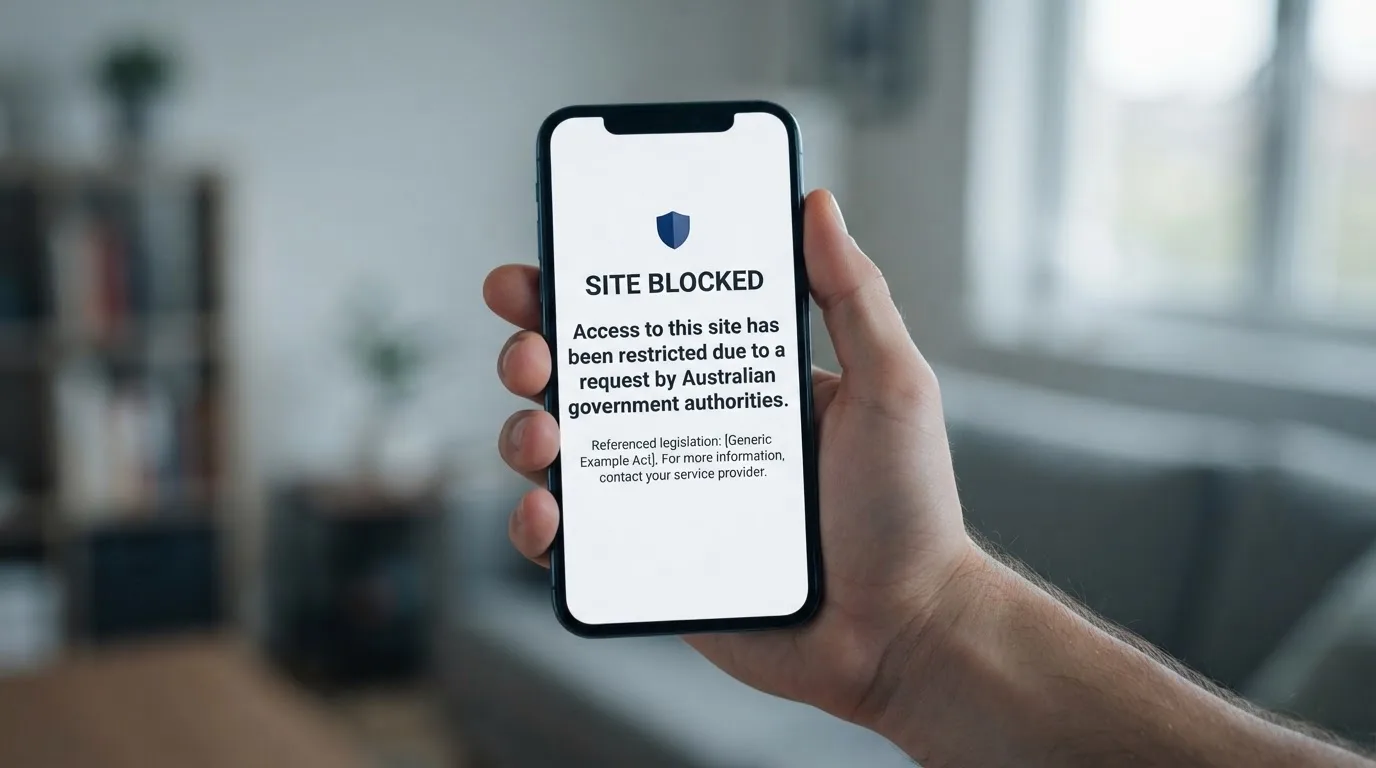
The ACMA’s enforcement record is the most concrete thing on this page, because it names the operators and the brands. As reported in June 2026, a cumulative 1,751 illegal gambling and affiliate-marketing websites have been blocked since the first blocking request in November 2019, and more than 230 unlicensed services have left the Australian market since enforcement was strengthened in 2017. In the round reported on 26 June 2026 the ACMA directed Australian ISPs to block twelve more sites: 7Signs, ChromaBet, Donbet, Duospin, Freshbet, Slots Gem, Jacks Club, Lucky Start, Pointsbetz, Spinrise, Vinyl Casino and Wildsino.
The blocking rate is the arithmetic behind this record. The 1,751 blocked sites spread across roughly six-and-a-half years of active enforcement — the first blocking request went out in November 2019, and the running total was published in June 2026. That works out to roughly 270 sites blocked per year on average, or about 22 a month. The figure is not a clean line: rounds come in bursts, and the ACMA has stepped up the pace since 2024. The honest reading is a band rather than a single number — somewhere between 15 and 35 sites a month, depending on which slice of the timeline you measure, with the direction of travel towards more.
The eleven operators covered in the shortlist further down this page are not blocked sites — they are formal-warning recipients, a different stage of the same enforcement ladder. A formal warning is what comes before a blocking request, and a blocking request is what comes before a referral. The point of naming them is that the ACMA has already gone on the public record about each one.
The Player-Side Reality
The IGA targets the operator, not the player. No Australian has been prosecuted for placing a bet on an offshore casino. What an offshore site does not give a player is the entire consumer-protection layer Australian-licensed services are required to provide: no Australian complaints body, no recourse if a withdrawal is refused, no guarantee the site will still exist in a week. If the ACMA directs an ISP to block a site while the player has an unsettled balance, that balance is at the operator’s discretion — and the operator is, by definition, on the wrong side of the line already.
That is the asymmetry. The licensed side has a complaint pathway, a regulator, and a self-exclusion register that actually binds the operator. The offshore side has marketing, a foreign licence, and the option to walk away.
The 2026 Reform and What It Will and Will Not Do
The Interactive Gambling Amendment (Gambling Reform) Bill 2026 passed Parliament on 19 August 2026. Its advertising and inducement measures commence 1 January 2027 — that is law passed but not yet in force on a 2026 page. When the inducement provisions commence, the legal exposure for affiliates and marketers of offshore casinos tightens materially. What the reform does not do is change the underlying prohibition on offering online casino games to Australians. That has been the position since 2001 and the 2026 reform does not reopen it.
Responsible Gambling for Australian Readers
BetStop and What It Actually Covers
BetStop, the National Self-Exclusion Register, went live in August 2023. It lets a person exclude themselves from every Australian-licensed online and phone wagering service at once, with exclusion periods from three months to a permanent ban. BetStop binds every operator licensed under the Australian regime — the bookmakers, the wagering services, the lotteries that have signed up.
What BetStop does not cover is any offshore casino. A person registered with BetStop can still load up a Curaçao-licensed site and place a bet, because that operator is not connected to the Australian register and has no obligation to honour it. For a reader whose gambling has become a problem, the practical effect is that BetStop removes the legal half of the market but leaves the prohibited half open. The protection is real, and it is partial.
Tools to Look for, and Tools to Be Sceptical Of
A responsible gambling page should offer deposit limits, loss limits, session-time limits, time-out, self-exclusion and access to a helpline. Each one is a small piece of friction the operator introduces against its own commercial interest, and the legitimate Australian-licensed wagering services offer all of them. Offshore sites typically offer some of them — usually deposit limits, often a self-exclusion button that the player can reverse by emailing support. The standard question is whether the limit is enforced at the deposit stage (cannot be raised without cooling-off) or only on request (can be raised by an account manager in five minutes).
The free national helpline is 1800 858 858, twenty-four hours, with chat at Gambling Help Online. Financial counsellors are reachable through the National Debt Helpline at 1800 007 007. None of those numbers is a marketing line for a casino, and the helpline itself is the most concrete responsible-gambling measure available to an Australian reading this page.
Crypto, Bitcoin and the Anonymous Live Dealer Promise
What the Australian Payment Rules Do to Crypto
Since 11 June 2024, credit cards, credit-related products and digital currency have been banned as payment for licensed online wagering in Australia, with penalties of up to A$247,500 for operators. The legal deposit routes for licensed wagering are debit card, bank transfer, PayID/Osko and BPAY. A site asking an Australian for a credit card or a crypto deposit is, by definition, not running under the Australian licence.
This is what the offshore crypto casino pitch runs against. The pitch is that the wallet is the verification — no ID, no bank link, no trace. That is half right: a Bitcoin or stablecoin deposit does not require a name attached to it at the moment of transfer. It is half wrong because the on-chain record is permanent and visible, and the Australian exchange a player is most likely converting from is required to identify the customer. The anonymity is between the wallet and the casino, not between the player and the rest of the world.
What Crypto Actually Does to the Player
The practical differences from a normal payment are three. First, the deposit is faster — minutes rather than days, with no bank in the loop. Second, the casino has no chargeback lever and the player has no card-issuer recourse, which is the same problem an offshore site has in any currency but more so because there is no card. Third, the volatility of the deposit is on the player: a Bitcoin deposit worth A$200 when sent can be worth A$140 or A$260 by the time the player tries to withdraw, and the casino pays out in whatever it pays out in.
Bitcoin and the stablecoins are the currencies most offshore live dealer sites advertise. Ethereum, Litecoin and Tether (USDT) are the next tier. None of them changes the legal position: the casino is still offering a prohibited service to a person in Australia, and the player is still on the wrong side of the consumer-protection layer.
Welcome Bonuses and What They Actually Cost
The Mechanics of a Live Dealer Welcome Offer
A live casino welcome bonus is usually a matched deposit — the casino adds a percentage of the first deposit as bonus money, with a wagering or turnover requirement attached. The wagering requirement is the multiplier applied to the bonus (or to the deposit plus bonus) before winnings can be withdrawn. A A$100 bonus with a 35× turnover requirement means the player has to place A$3,500 in bets before the bonus balance becomes withdrawable cash.
A second mechanic is the game-weighting table. Live dealer games often contribute less than 100% to the wagering requirement — baccarat might contribute 10%, roulette 20%, blackjack 5% or even 0%. That is the casino’s way of steering bonus play toward slots, where the house edge is higher and the bonus is cleared faster. A player who wants to clear the bonus on live dealer tables is usually clearing at a fraction of the speed the headline number suggests.
The Real Cost of a Bonus in Spins and Time
Working through the numbers on a representative offer: a A$200 bonus with a 40× turnover requirement produces A$8,000 in required wagering. At a A$10 stake per spin on a live roulette table, that is 800 spins. A live dealer spin takes roughly twenty to thirty seconds when the player is the only decision-maker and longer at a busy blackjack table — call it an average of forty seconds per spin across the mixed play a bonus usually requires. Eight hundred spins at forty seconds each is just under nine hours of table time. The house edge on the European roulette wheel is 2.7%, which means the expected loss across those 800 spins at A$10 each is A$216 — more than the bonus itself, and that is before the player’s own decisions on side bets and table selection.
That is the move behind every “free” bonus headline. The wagering requirement plus the house edge produces a cost that is usually larger than the bonus paid out, on average over many players. The marketing word — “free”, “bonus”, “reward” — survives because the casino does not write the arithmetic on the page that displays it.
Max-Cashout Caps and Game Restrictions
Two clauses kill most bonus value before the wagering requirement does. The first is the maximum cashout cap: the casino limits how much of the bonus balance can be withdrawn, even after the wagering requirement is met. A 5× or 10× cashout cap on a A$200 bonus puts a ceiling of A$1,000 to A$2,000 on what the bonus can ever pay out, regardless of what happens at the table. The second is the game restriction: some live tables are excluded from bonus play entirely, and bets placed on them do not contribute to the wagering requirement. The combined effect is that the headline number is the best-case outcome, not the expected one.
The Shortlist of Brands the ACMA Has Named
The eleven brands below are not a recommendation. They are operators the ACMA itself has issued formal warnings against for offering prohibited interactive gambling services to Australians. Each one carries an offshore licence of some flavour, none of those licences authorises service to Australia, and each one has been on the public record.
The comparison below names each brand, the ACMA action against it, the operator behind the brand at the time of the action, and whether a research-grade source catalogues the brand as a live dealer provider. Where the live dealer subject is not catalogued by an authoritative source, the table shows it as unknown — a present absence is information.
Summary of ACMA Enforcement Record
| Brand | Formal Warning Year | Principal Operator |
|---|---|---|
| RocketPlay | 2026 | Pulsup Ltd |
| Woo Casino | 2025 | Dama N.V. |
| Spirit Casino | 2025 | Dama N.V. |
| National Casino | 2025 | Consolutetish S.R.L. |
| Bizzo Casino | 2025 | Consolutetish S.R.L. |
| Brand | ACMA action and date | Operator named by the ACMA | Live dealer catalogue |
|---|---|---|---|
| RocketPlay | Formal warning, March 2026 | Pulsup Ltd (Rocketplay); earlier Dama N.V., May 2022 | — |
| Level Up Casino | Formal warning, May 2022 | Dama N.V. | Listed (BGaming) |
| Woo Casino | Formal warning, March 2025 | Dama N.V. | — |
| Spirit Casino | Formal warning, May 2025 | Dama N.V. | — |
| National Casino | Formal warning, July 2025 | Consolutetish S.R.L. | Listed (Wikipedia) |
| Bizzo Casino | Formal warning, July 2025; earlier warning 2022 | Consolutetish S.R.L.; earlier TechSolutions | — |
| Ignition Casino | Formal warning, July 2025 | Bamboo Media | — |
| Instant Casino | Formal warning, February 2025 | EOD Code SRL | — |
| Jackbit | Formal warning, April 2026 | Ryker B.V. | — |
| Casino Intense | Formal warning, April 2025 | Sterplay Holding Ltd | Listed (ABC, ACMA, Crown Melbourne) |
| Sky Crown | Formal warning, date as published by ACMA | Hollycorn N.V. | — |
RocketPlay
Dama N.V. ran RocketPlay when the ACMA issued its first formal warning covering the brand in May 2022, alongside Bambet, Dazard, Level Up, Wild Tornado and Cobra Casinos. The ACMA went back to RocketPlay in March 2026, this time against Pulsup Ltd and the .com.au variant of the domain. The fact that the same brand drew warnings against two different operators in roughly four years is the pattern enforcement records reveal: the licence on the site changes, the player-facing brand does not. The live-dealer catalogue does not list RocketPlay in any research-grade source, and the brand’s own positioning has been slot-led rather than live-led.
The verdict is the verdict the ACMA record already supplies: this is an operator twice over the line, and a player who lands here is on a site the regulator has already named.
Level Up Casino
One of the six Dama N.V. brands named in the May 2022 warning, alongside RocketPlay, Bambet, Dazard, Wild Tornado and Cobra Casinos. BGaming — one of the better-known slot and crash-game studios — does list Level Up Casino among the operators carrying its games. The Dama N.V. group has been a regular on the ACMA’s record across 2022, 2025 and 2026, and the fact that a single operator group accounts for multiple brands on this shortlist is itself a measure of how concentrated the offshore market is. The site itself has run a live casino section in its catalogue.
The verdict is the same shape as RocketPlay’s. A brand on a regulator’s record since 2022 and listed by a research-grade game studio is a brand that has had years to come into compliance and has not.
Woo Casino
Dama N.V. drew the ACMA’s attention again in March 2025, this time over Woo Casino. Woo is one of the better-known brands in the Dama N.V. portfolio and one of the longer-running ones in the offshore Australian market. The brand carries an Evolution-powered live casino section, which is the catalogue shape the player-facing shortlists lead with. The licence Woo displays is a Curaçao number, and a Curaçao number is what an offshore casino has when it has nothing else.
The verdict sits one level below the warning itself. The ACMA has named the operator; the brand is built on a live product the player-facing industry treats as the standard. Both of those things can be true at once, and both of them are.
Spirit Casino
Dama N.V.’s May 2025 warning covered Spirit Casino, alongside Woo Casino from the month before. Spirit is the newer of the two brands, launched into the same live-casino-led catalogue pattern that the rest of the Dama N.V. portfolio runs on. The brand’s own marketing leads with the Evolution lobby, the Pragmatic Play Live tables, and a tournament and cashback structure that looks, at first read, like every other mid-tier offshore casino.
The verdict is that the same operator group, on its third ACMA warning in three years, is not an isolated event — it is a track record.
National Casino
Consolutetish S.R.L. drew a formal warning from the ACMA in July 2025, covering National Casino and Bizzo Casino. Wikipedia catalogues National Casino among the brands operating in the offshore Australian market. The licence displayed is a Curaçao number. The brand runs an Evolution live casino lobby and a Pragmatic Play Live sub-lobby, with baccarat, blackjack, roulette and a game-show catalogue underneath.
The verdict is on the operator rather than the catalogue. Consolutetish S.R.L. is the entity the ACMA named, and Consolutetish S.R.L. sits across two of the brands on this shortlist — a single operator behind two warnings in a single month.
Bizzo Casino
Bizzo Casino sits on the same July 2025 Consolutetish S.R.L. warning as National Casino, and on an earlier 2022 warning to TechSolutions (CY) Group Limited and TechSolutions Group N.V. Two different operators, two different years, the same brand. The pattern is the same one RocketPlay shows: the licence on the site changes, the player-facing brand does not. Bizzo’s own catalogue has been slot-led with a live casino overlay — a smaller live lobby than the bigger brands, but the same supplier mix.
The verdict is one of the most pointed on the shortlist. A brand with two formal warnings under two different operators over three years is a brand the ACMA has had to warn more than once.
Ignition Casino
Bamboo Media was the operator the ACMA named in the July 2025 formal warning over Ignition Casino. Ignition’s positioning has historically been the United States-facing market, with a Bitcoin-friendly cashier and a smaller live casino section than the European-facing brands. The catalogue on the Australian-facing mirror of the site runs an Evolution lobby underneath the slot-led front page.
The verdict is the only one of its shape on the shortlist. Ignition’s primary market is not Australia, and the brand’s appearance here is the result of a single ACMA action against an operator running the brand into this market as well. A reader who lands here from an Australian search is on a brand whose primary customers are elsewhere.
Instant Casino
The February 2025 formal warning was issued to EOD Code SRL over Instant Casino. The brand has run a relatively new marketing profile in the Australian market, leading with a same-day payout promise and a comparatively limited catalogue — slot-led with a small live dealer section. The licence displayed is a Costa Rica number, which is one of the less-common offshore registrations and one of the less-regulated.
The verdict is the cheapest one on the shortlist to state. Instant Casino has been on the ACMA’s record for less time than most of the brands above it, and the catalogue is thinner than most of them. Both of those facts cut the same direction for a reader.
Jackbit
Ryker B.V. drew the April 2026 formal warning covering both Jackbit and CasinOK. Jackbit’s positioning is crypto-led — Bitcoin, Ethereum, Litecoin, USDT and a handful of altcoins at the cashier, with a marketing message built around the wallet-rather-than-ID pitch. The live casino section underneath runs the usual Evolution and Pragmatic Play Live mix.
The verdict is the one a reader could reach from the catalogue. A brand that markets itself on the absence of identification is a brand whose consumer-protection story is structurally weak — the ACMA warning is downstream of that, not upstream.
Casino Intense
Sterplay Holding Ltd drew the April 2025 formal warning over Casino Intense. ABC News, the ACMA itself and Crown Melbourne’s own materials each catalogue Casino Intense as one of the offshore brands running a live casino section into the Australian market. Casino Intense carries one of the smaller live lobbies on the shortlist — fewer tables, fewer suppliers, a more focused catalogue.
The verdict is the one most readers will not expect. Casino Intense is a smaller brand on a smaller catalogue, and a smaller catalogue is what produces a quieter operation — quieter, not safer, and the ACMA warning is the evidence.
Sky Crown
Hollycorn N.V. drew a formal warning from the ACMA over its Sky Crown and Blue Leo casino services. Hollycorn is one of the larger operator groups in the Curaçao-licensed market, with multiple brands running into Australia over the past several years. Sky Crown’s catalogue is slot-led with a live casino overlay, and the operator group’s broader portfolio has been the subject of ACMA actions on more than one occasion.
The verdict is on the operator group rather than the brand alone. Sky Crown is one brand on a wider Hollycorn record, and the ACMA’s relationship with the operator group is not a one-off.
What the Shortlist Actually Shows
Eleven brands, three of them from a single Dama N.V. portfolio, two from Consolutetish S.R.L., the rest distributed across single-brand operators. Eight of the eleven are present in the ACMA record from 2024 onward, the rest from 2022. The single feature the brands share is the offshore registration, and the single fact the ACMA record shares across all of them is that the offering of online casino games to Australians is the conduct at issue.
The fact that the ACMA has formally warned each brand does not mean the brand has been blocked. The blocking step is what comes after a formal warning, and the brand may have come into compliance, changed its marketing, or simply shifted to a new operator entity in the meantime. What the formal warning does mean is that the ACMA has gone on the public record, with the operator’s name and the brand’s name, about the conduct.
That is the material a reader needs to evaluate a shortlist. The rest of the catalogue — the live casino suppliers, the welcome bonuses, the crypto cashier, the mobile app — is the part an offshore casino spends the most money telling a reader about, and the part the ACMA does not address.
What Australians Can Do Instead
The legal Australian market for live dealer games does not exist online. The legal Australian market for casino table games exists at licensed venues: Crown Melbourne in Victoria, The Star in Sydney, The Star Gold Coast, and a smaller set of state-based casinos and clubs. Crown Melbourne runs three baccarat variants — Traditional Baccarat, Crown Baccarat and 2 to 1 Baccarat — approved by the Victorian Gambling and Casino Control Commission under the Casino Control Act 1991. NSW’s Casino Control Act 1992 puts the same approval requirement on baccarat and other table games at The Star Sydney. Each venue publishes its approved rules and the regulator’s record of changes — the Crown Melbourne blackjack variant renaming logged by the VGGCC on 23 December 2024 and the “Free Bet” option with the “Pot of Gold” side bet on 25 March 2024 are recent examples.
For online wagering that is legal in Australia, the licensed operators are the bookmakers regulated by the Northern Territory Racing and Wagering Commission — Sportsbet, Bet365, Ladbrokes and the rest of the fifty-two-odd licensed bookmakers. The commission runs on a small staff and meets once a month, but the licence is real and the consumer protection pathway goes through the regulator and through BetStop. Pre-match sports and race wagering, lotteries and keno are the categories in which an Australian can place a bet online under Australian law.
Where an Australian With a Gambling Problem Gets Help
BetStop is the National Self-Exclusion Register, live since August 2023, and it binds every Australian-licensed online and phone wagering operator. The minimum exclusion period is three months, the maximum is permanent, and registration can be done online. For the offshore half of the market, BetStop does not bind, and the protection it offers is therefore partial — real, and partial.
The National Gambling Helpline is 1800 858 858, free, twenty-four hours a day, with webchat at Gambling Help Online. Financial counselling is available through the National Debt Helpline on 1800 007 007. None of those services is connected to a casino brand, and the contact itself does not appear on any marketing page.
Frequently Asked Questions
How many live tables did Evolution operate from its Riga studios by 2013?
Evolution reached 100 live tables at its Riga studios in 2013, at the time the largest single-site casino operation in Europe. The company opened a Malta studio the following year and now operates across multiple studio locations, streaming to more than 700 gambling platforms worldwide.
Does a live dealer casino accept cryptocurrency deposits?
Offshore live dealer casinos commonly do. Bitcoin, Ethereum, Litecoin and Tether (USDT) are the most frequently advertised, and some sites list a longer list of altcoins at the cashier. Australian-licensed wagering services have been banned from accepting digital currency since 11 June 2024, with penalties of up to A$247,500 for operators.
Is it legal for a live dealer casino to accept Australian players?
No. The Interactive Gambling Act 2001 prohibits offering online casino games — including live dealer games — to anyone in Australia, and no state or territory licences them. The player is not the target of the law, but the operator is, and the offshore site gives no Australian consumer protection, no complaints body and no recourse if a withdrawal is refused.
What responsible-gambling tools should a live dealer casino site provide?
A serious operator offers deposit limits, loss limits, session-time limits, time-out, self-exclusion and access to a helpline. The standard question is whether the limits are enforced at the deposit stage or only on request, and whether the self-exclusion is reversible. Australian-licensed wagering services are required to offer the full set and to honour BetStop; offshore sites typically offer some but not all.
What is usually attached to a live dealer casino welcome bonus?
A wagering or turnover requirement, a maximum cashout cap, and a game-weighting table that reduces the contribution of live dealer games toward clearing the bonus. A 35× to 40× turnover requirement on the bonus is typical, baccarat and roulette often contribute at 10% to 20%, and blackjack sometimes at 0% — the combination produces a real cost that is usually larger than the bonus paid out.
Can Australians find a shortlist of licensed live table games anywhere other than online?
Yes. The licensed Australian casino venues run baccarat, blackjack and roulette at approved tables under state-based casino control legislation. Crown Melbourne in Victoria, The Star in Sydney, and The Star Gold Coast each run approved table-game floors, with the rules and changes published by the Victorian Gambling and Casino Control Commission and the NSW Liquor and Gaming authority respectively.