
Pokies in Perth 2026 — the licensed floor and the offshore gap
Perth’s pokies question has one honest answer and several louder ones. The honest one: there is one venue in Western Australia where a person can sit at an electronic gaming machine under state law, and it is Crown Perth in Burswood, on the river east of the city centre. The louder ones are offshore websites that advertise “Perth pokies”, “pokies in Perth CBD”, or “24 hour pokies Perth open now” — none of which can lawfully take a bet from a person in Australia, whatever their Curacao or Malta licence says. This page lays out the licensed floor first, then the offshore gap, then what the player actually pays and is paid.
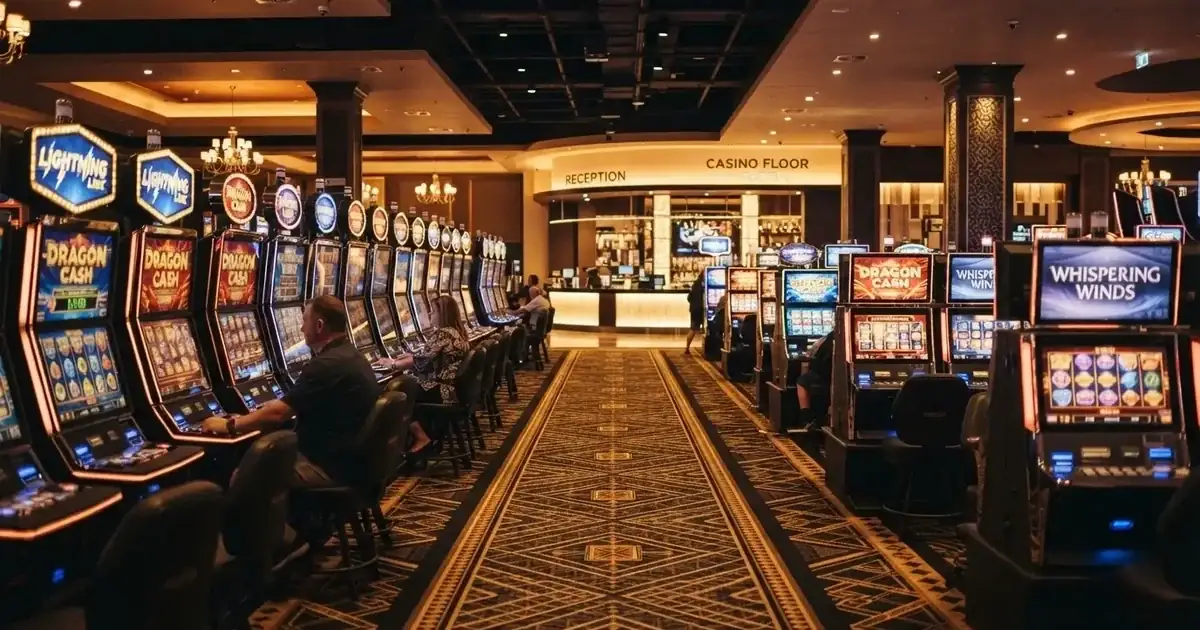
Currency and data currency note. All figures and licence claims on this page are checked as of 29 October 2026 against the public register of the Australian Communications and Media Authority (ACMA), the Gaming and Wagering Commission of Western Australia, and the Department of Racing, Gaming and Liquor for Western Australia.
Table of Contents
- What a “pokie” actually is in Perth
- Paytables, RTP and what Crown Perth’s machines actually do
- How this shortlist is put together
- What a Perth punter sees, and what the regulator sees
- Responsible gambling supports that apply in Perth
- The licensed venues in Perth — what is actually on the floor
- Payments and payout speed — what Crown Perth does, what offshore sites claim
- The ACMA’s blocking rate, as a band
- A short version of the ACMA’s recent action
- What a Perth player does in practice
- Where Perth sits in the wider Australian market
- Frequently asked questions
What a “pokie” actually is in Perth
The machine is the same anywhere in Australia — a video slot with reels, a paytable and a theoretical return-to-player percentage. What changes by state is where the machine is allowed to be, who regulates it, and how much it has to pay back over the long run.

In Western Australia, the answer to “where” is unusually narrow. The state has never permitted poker machines in pubs or clubs. Crown Perth in Burswood is the only venue in WA where a person can legally play an electronic gaming machine — the state’s gaming regulator, the Department of Racing, Gaming and Liquor, sets a minimum long-term return-to-player of 90% on those machines, the highest such floor among Australian states. Casino tax sits at a 12.42% flat rate on gross gaming revenue plus a 2% Burswood Park Levy.
The comparison with the eastern states sharpens that. South Australia runs around 11,672 gaming machines outside Adelaide Casino across 471 venues, with a minimum return-to-player of 87.5% and a A$5.00 general maximum bet outside the casino; Adelaide Casino itself has no maximum-bet limit. Queensland had 21,122 gaming machines in 351 venues in October 2023. Western Australia’s choice is to forgo that footprint entirely and concentrate the activity at a single resort venue. A Perth player who walks into a suburban pub or a footy club will not find a machine in the corner of the lounge room. That is a deliberate policy, not a gap in coverage.
Why the offshore options on a Google results page are not what they say
Search “pokies in Perth” today and the top results are largely sites the ACMA has acted against. The framing of “best pokies in Perth” in those pages borrows Australian vocabulary — “pokies”, “Perth”, “Aussie players” — to land an Australian reader, then routes the deposit off-shore. The Interactive Gambling Act 2001, tightened by the Interactive Gambling Amendment Act 2017, makes it an offence to provide online casino games, online pokies or in-play betting to a person physically in Australia. No state or territory licences that activity. The IGA targets the provider, not the punter, but the practical consequences for an Australian player are real: no Australian consumer protection, no Australian complaints body, no recourse when a withdrawal stalls, and a real chance the site gets blocked mid-week with a balance on it.

The enforcement record runs through the ACMA’s blocking rounds and formal warnings. As reported in June 2026, the ACMA had asked Australian internet service providers to block 1,751 illegal gambling and affiliate websites since the first blocking request in November 2019, and more than 230 unlicensed services had left the Australian market since 2017. In the round reported on 26 June 2026, twelve more sites were added to the block list: 7Signs, ChromaBet, Donbet, Duospin, Freshbet, Slots Gem, Jacks Club, Lucky Start, Pointsbetz, Spinrise, Vinyl Casino and Wildsino. The pattern is not a single sweep; it is a steady cycle of warnings followed by blocking once a site ignores the warning.
Paytables, RTP and what Crown Perth’s machines actually do
Perth punters asking “best paying pokies in Perth” are usually asking two things: which machines return the most, and how that number compares to other cities. Both questions are answerable only in long-run statistical terms; a single session cannot tell anyone what a machine is doing on average.
Return-to-player is the theoretical share of money wagered that the machine returns to players over millions of spins. Crown Perth’s machines are required by Western Australian law to run at a minimum 90% RTP — higher than South Australia’s 87.5% floor for non-casino machines and higher than most pubs-and-clubs jurisdictions elsewhere. Adelaide Casino’s own machines sit under a different regime (South Australia’s Independent Gambling Authority) and have no maximum-bet cap, which changes the volatility profile rather than the long-run return. The aggregate losses figure for South Australian gaming machines outside Adelaide Casino ran to about A$0.92 billion in 2022-23 — roughly A$497 per adult — and that figure is what a higher-RTP, single-venue jurisdiction is implicitly buying less of.
A 90% floor does not mean a player loses A$10 on every A$100. It means that across an enormous number of spins, the machine retains 10 cents of every dollar. A player who buys in for A$200 and walks away with A$120 has beaten the average by A$120, not the floor by A$120; another player who walks away with nothing has lost A$200, and the next 999,999 spins are what brings the average back. RTP is a population statistic, not a session forecast. The honest reading of “best paying pokies in Perth” is that the licensed venue offers the best statutory floor in Australia; the honest reading of any single spin is that it pays what it pays.
Volatility and what that changes
RTP is half the picture. The other half is volatility — how the return is distributed across outcomes. A high-volatility title keeps most spins small and concentrates the returns in rare feature rounds; a low-volatility title pays more often but in smaller amounts, with the long-run return converging faster to the stated RTP. A player who buys in for a short session on a high-volatility machine can hit a feature and walk away ahead; they can also sit through two hundred dead spins and have nothing to show for it. A low-volatility session is flatter — fewer surprises, fewer swings, and a result that hugs the average more closely.
Perth players do not have a separate volatility profile from players elsewhere; the same titles run on similar math wherever the jurisdiction allows them. The difference is the bet envelope: Western Australia sets tighter rules on minimum-return floors and (for the casino venue) leaves bet ceilings to the operator, which in practice means a wider range of denomination choices at Crown Perth than at, say, a South Australian club capped at A$5.00 per spin.
Cashless play at the venue
Perth’s licensed floor has been moving toward cashless card-based play for some time, in line with harm-minimisation reforms pushed by the WA regulator. Cashless card play puts a per-session cap on what a player can put through a machine in a defined window, and ties each transaction to the player’s identity card rather than to banknotes. The change cuts the visibility of money moving at the venue and ties it into the same pre-commitment logic that drives BetStop at the national level — though BetStop covers licensed wagering services, not casino-floor play. A punter at Crown Perth who wants to set their own session limits does it through the venue’s own card system; an offshore “Perth cashless pokies” advertisement is a different product, and one the ACMA’s blocking list exists to keep out of Australian inboxes.
How this shortlist is put together
A “top 11” comparison of pokies venues in Perth sounds straightforward until you remember there is one licensed venue. The list on this page is not a ranking of competing machines. It is a list of brands the ACMA itself has acted against for offering prohibited online casino services to people in Australia, alongside a reminder that none of them can lawfully take a Perth deposit. The ordering tracks the date of the most recent formal ACMA action over the brand, and a column in the table below shows the operator named by the ACMA in that warning.
A list of this kind is useful for one reason: a Perth punter searching “pokies in Perth Australia” sees these brands on page one of Google, and the question worth answering is not “is this brand good” but “is this brand allowed to take my money in the first place”. The fact bank attached to this page records each warning; the table below transcribes the regulator’s own line on each brand. Where research carries no data on the brand’s Australian deposit or withdrawal support, the entry stays empty — there is no third-party source for it, and an invented figure would be a lie.
What separates one entry from the next
Three criteria matter:
- The ACMA’s own characterisation. A formal warning is the regulator’s first public step under the Interactive Gambling Act 2001, before a site is referred for blocking. It is a public record, dated and named.
- The operator named in the warning. The ACMA names the corporate entity behind the brand, which is often a different company from the trading name the player sees on a banner ad.
- Subject support — whether the brand’s Australian-facing operations are confirmed in any other regulator’s listing. Most of these brands have no presence in any Australian register, and the absence of a listing is itself the relevant fact.
What does not separate them: bonus size, free-spin count, game library size, payout time. None of those figures can be sourced away from the affiliate marketing pages that originate them, and carrying them here would re-state the marketing the regulator is acting against.
The table
| Brand | ACMA action and date | Operator named by the ACMA | Subject support |
|---|---|---|---|
| RocketPlay | Formal warning, March 2026 | Pulsup Ltd (Rocketplay); earlier Dama N.V., May 2022 | — |
| Level Up Casino | Formal warning, May 2022 | Dama N.V. | listings only (Wikipedia, Victorian regulator listing) |
| Woo Casino | Formal warning, March 2025 | Dama N.V. | listings only (Wikipedia) |
| Spirit Casino | Formal warning, May 2025 | Dama N.V. | — |
| National Casino | Formal warning, July 2025 | Consolutetish S.R.L. | listings only (Abc.net.au, federal infrastructure listing) |
| Bizzo Casino | Formal warning, July 2025; earlier warning 2022 | Consolutetish S.R.L. (2025); TechSolutions Group (2022) | — |
| Ignition Casino | Formal warning, July 2025 | Bamboo Media | — |
| Instant Casino | Formal warning, February 2025 | EOD Code SRL | — |
| Jackbit | Formal warning, April 2026 | Ryker B.V. | — |
| Casino Intense | Formal warning, April 2025 | Sterplay Holding Ltd | listings only (Abc.net.au, ASGAM, SA Consumer and Business Services) |
| Sky Crown | Formal warning, September 2022 | Hollycorn N.V. | listings only (Wikipedia) |
A “listings only” note means a brand surfaces in third-party directories that have nothing to do with Australian licensing — Wikipedia’s coverage of offshore operators, the Victorian regulator’s archived material on a related entity, news pieces in which the brand name appears in passing. None of those listings is an Australian licence. A dash in the subject support column means research found no third-party listing worth recording; it does not mean the brand is licensed.
What a Perth punter sees, and what the regulator sees
The picture has two frames. From the punter’s side, Google returns a dozen offshore brands that say “pokies Perth” in their title tags, and the first impression is that there is a competitive market. From the regulator’s side, the same dozen brands are the subject of formal warnings, blocking requests, and a steady cycle of re-entry under new corporate names. The ACMA has been working through the same list of operators for years — Dama N.V. alone has been warned over RocketPlay, Woo Casino, Spirit Casino and a clutch of other brands; the formal warning over Pulsup Ltd’s Rocketplay.com.au in March 2026 is a continuation, not a first contact.
Two figures anchor the gap between the two frames. H2 Gambling Capital’s 2025 report estimates that Australians lose about A$3.9 billion a year to illegal gambling sites, and that the share of gambling going through legal channels fell from 74% in 2021 to 64%. The drop is the offshore share getting louder. The A$3.9 billion is what those offshore brands earn from Australian pockets while operating outside the framework that runs Crown Perth, Sportsbet and the local TAB.
The legal channel, and what it covers
The legal channel is narrow on purpose. The IGA permits online wagering on races and sport placed before the event, lotteries and keno — in practice licensed by the Northern Territory Racing and Wagering Commission, which regulates 52 of Australia’s online bookmakers including Sportsbet, Bet365 and Ladbrokes. The NTRWC is a small body: no full-time staff, a monthly meeting in Darwin, the regulator of a multi-billion-dollar online wagering market by historical accident as much as design. Online casino games and online pokies are not covered. The local TAB takes bets on races and sport; lotteries are run by state-owned operators; everything else sits outside the line.
A Perth punter who wants to place a bet on the Melbourne Cup or a Saturday AFL game has a lawful, regulated route to do it. A Perth punter who wants to spin a reel on a Curacao-licensed “pokies” site does not. The asymmetry is the framework the regulator is enforcing, not an oversight of it.
Responsible gambling supports that apply in Perth
The supports a Perth punter can actually use are the ones tied to the Australian framework, not to offshore websites. The headline service is the National Gambling Helpline at 1800 858 858 — free, 24 hours a day, with online chat at Gambling Help Online. Both are accessible from Perth and cover problem gambling support, financial counselling referral, and self-exclusion advice.
The state-level layer in Western Australia is the Department of Racing, Gaming and Liquor, which administers the Casino Control Act and the gaming-machine regime. The casino-side voluntary exclusion scheme is administered through Crown Perth itself; a person who self-excludes from the Burswood floor cannot enter the gaming area for the period of the exclusion. Crown Perth also runs pre-commitment card systems tied to cashless play.
The national self-exclusion register is BetStop, live since August 2023. BetStop binds Australian-licensed online and phone wagering services — so a self-excluded punter cannot open a new account with Sportsbet or the local TAB. BetStop does not bind offshore casino sites, because those sites are not licensed in Australia in the first place. The self-exclusion register sits on the legal-channel side of the line; the offshore side has no equivalent.
What the IGA does not do, and why it matters
The IGA targets the provider, not the punter. An Australian player who opens an account at an offshore casino has not committed an offence; the operator has. The practical consequence is that the regulator’s enforcement actions — blocking, formal warnings — close off the site, not the punter. The punter’s protection framework (BetStop, the helpline, the venue-level self-exclusion) is layered on the Australian-licensed side, and stops being relevant when the player steps across the line.
A Perth player who has excluded themselves through BetStop and then tried to gamble on an offshore site will find that the offshore site did not check the register in the first place — because the site is not connected to the register, and there is no technical mechanism by which it could be. The behavioural protection is in the punter’s own hands once they cross the line; the regulatory protection stops at the border.
The licensed venues in Perth — what is actually on the floor
Western Australia’s licensed pokies footprint is, as noted, a single venue: Crown Perth. The resort sits in Burswood, on the Swan River east of the Perth CBD, and has been operating since 30 December 1985 when it opened as Burswood Island Casino, at the time the largest casino in Australia. Publishing and Broadcasting Limited acquired control of the casino in 2004 and vested its gaming interests, including Burswood, into Crown Limited — the James Packer-controlled operator — in 2007. The property carries three hotels: Crown Metropol (405 rooms), Crown Promenade (291) and Crown Towers (500 rooms, opened December 2016), plus a convention centre and over thirty restaurants and bars.
The casino’s licence was the subject of regulatory scrutiny through the early 2020s. In July 2025, the Gaming and Wagering Commission of Western Australia recommended that Crown Perth keep its gaming licence, after the casino made remedial efforts to come back into compliance with the government’s gaming regulations. The venue’s floor carries electronic gaming machines under WA’s 90% RTP minimum, alongside table games under the casino’s own licence regime.
For comparison: Adelaide Casino (commercially SkyCity Adelaide) sits in the heritage-listed Adelaide Railway Station building on North Terrace, with 90 gaming tables and 950 gaming machines, and is the sole licensed casino in South Australia under the Casino Act 1997. Its table-game monopoly was extended to 30 June 2035 under a licence formalised on 11 October 2013, which also allows expansion to up to 200 gaming tables and 1,500 gaming machines subject to redevelopment. Treasury Casino in Brisbane closed on 25 August 2024 to make way for the new Star Brisbane at the A$3.6 billion Queen’s Wharf precinct, which began a staged opening on 29 August 2024. Casino Canberra, in the ACT’s first legal casino, occupies land excised from Glebe Park under a 99-year lease and has no hotel, theatres or retail.
Identification and the 100-point check
A punter on the Burswood floor is asked for identification before being allowed onto the gaming floor. Western Australian casino venues apply a 100-point identification check on entry — the same framework used by Australian financial institutions, with documents weighted by reliability (passport 100 points, Australian driver’s licence 75 points, Medicare card 25 points, and so on down to utility bills). The check is the venue’s gate, not the regulator’s — Crown Perth’s own procedures and the Casino Control Act’s requirements sit behind it.
This is what a “Perth pokies venue” actually requires at the door. It is also why an offshore “pokies in Perth” website that asks only for an email address and a credit card is operating outside the framework a Perth punter walking into Burswood would walk through. The contrast is part of the answer.
Payments and payout speed — what Crown Perth does, what offshore sites claim
Perth players asking “Perth pokies payout percentage” or “maximum cash payout pokies Perth” are usually asking two different things: what the machine returns over time, and how quickly they can walk out of the venue with winnings.
The first question is the RTP floor — 90% in Western Australia, the highest minimum in Australia. The second question is operational. Crown Perth’s gaming machines pay out as machine-printed tickets, redeemable at the venue’s cashier or fed back into another machine. Larger payouts — anything above a defined ceiling — are paid by the cashier against identification and the player’s venue card, on the spot. There is no third-party payment processor in the loop; the money moves inside the venue and onto the cashier’s tray.
The offshore sites advertising “Perth pokies payout” describe something quite different: a deposit in Australian dollars via crypto or an international card processor, and a withdrawal routed back through the same channel after the site’s own “verification” process. The advertised withdrawal windows are measured in hours; the realistic ones, for the brands on the ACMA list, are measured in weeks — and a withdrawal may simply not arrive if the regulator has blocked the site in the meantime. The point is not that all offshore sites are scams; the point is that the only consumer-protection regime an Australian player has applies on the Australian side of the line, and the offshore side has none of it.
Why a credit card is no longer part of the picture, on either side
Since 11 June 2024, credit cards, credit-related products and digital currency have been banned as payment for licensed online wagering in Australia, with penalties up to A$247,500 for operators. The legal deposit routes for licensed wagering are debit card, bank transfer, PayID/Osko and BPAY. An offshore site asking an Australian for a credit card or a crypto deposit is operating outside the Australian rules; an Australian-licensed wagering site asking for the same is in breach. The rule was designed to slow the bleed into illegal sites, and it changed the onboarding flow at every licensed Australian bookmaker in the same week.
Perth punter implications are practical. A Crown Resorts account or a Sportsbet account opened from a Perth address will accept debit card, bank transfer, PayID/Osko and BPAY — and not credit card or crypto. An offshore “pokies Perth” deposit page that asks for a Visa credit card is, by definition, asking for a payment method the Australian rules do not allow a licensed operator to take.
The ACMA’s blocking rate, as a band
The arithmetic behind the regulator’s progress is straightforward but worth doing. As reported in June 2026, the ACMA had blocked 1,751 illegal gambling and affiliate marketing websites since the first blocking request in November 2019 — a span of roughly six and a half years. That works out to a long-run rate of about 270 sites blocked per year, or roughly 22 to 23 per month, since the regime started. The 12 sites added in the round reported on 26 June 2026 is close to that monthly average — the regulator’s work is not a one-off sweep but a continuing pace, with individual rounds varying in size around the steady trend.
The condition on that band is the source: the figure is a regulator-published cumulative count of blocking requests to Australian ISPs, not a count of unique illegal services. A single operator that re-enters under several brands can account for several entries on the list; an affiliate marketing site that aggregates offshore operators can be blocked without the underlying operator sites being blocked separately. The 1,751 figure is the cleanest public number, and it is the one to use as a headline; the granular composition is harder to pin down without a per-entry audit, which the ACMA does not publish.
Why the rate matters for a Perth reader
The blocking rate tells a Perth punter two things at once. The first is that the offshore landscape is not a single fixed menu of brands; it is a moving target, with new sites entering as old ones are blocked. A list compiled in 2024 may not match a Google results page in 2026. The second is that the regulator’s pace is steady — a formal warning in 2024, a blocking round in 2025, a fresh batch of warnings in 2026 — and that the same operator entities tend to reappear under fresh trading names. The 230 unlicensed services that have left the Australian market since 2017, in the same June 2026 report, are the long-run counterpart to that pace: services that took the warning seriously and stopped accepting Australian players, even if they kept operating in other jurisdictions.
The gap between the 1,751 sites blocked and the A$3.9 billion lost annually to illegal sites is the gap the regime has not closed. The legal channel covers licensed wagering; the offshore channel covers everything the IGA does not, and the offshore channel earns most of its Australian revenue from casino-style products — the same products Perth punters Google when they search “pokies in Perth” at 11pm on a Saturday. The closing of that gap is a policy question, not an enforcement question, and it is the one the current numbers leave open.
A short version of the ACMA’s recent action
The formal-warning record over the past two years gives the regulator’s own picture of the offshore landscape in Perth’s region.
In May 2022, the ACMA warned Dama N.V. covering six brands: Bambet, Dazard, Level Up, Rocketplay, Wild Tornado and Cobra Casinos. In September 2022, the ACMA warned Hollycorn N.V. over Sky Crown and Blue Leo. The Dama N.V. list re-entered the picture in March 2025 over Woo Casino and in May 2025 over Spirit Casino. In February 2025, the ACMA warned EOD Code SRL over Instant Casino. In April 2025, the regulator warned Sterplay Holding Ltd over Casino Intense. In July 2025, the ACMA warned Bamboo Media over Ignition Casino and Consolutetish S.R.L. over National Casino and Bizzo Casino — the latter having already been the subject of a 2022 warning to TechSolutions (CY) Group Limited and TechSolutions Group N.V. In March 2026, the ACMA warned Pulsup Ltd over Rocketplay.com.au — a re-entry of the RocketPlay brand under a new corporate name, on a different domain. In April 2026, the ACMA warned Ryker B.V. over Jackbit and CasinOK.
The pattern: the same operator entities cycling through new brands, sometimes on new domains, sometimes on the same brand under a different corporate wrapper. A Perth reader who has seen a “pokies” banner for one of these names in 2022 and again in 2026 is not looking at a different operator; they are looking at the same operator in a fresh wrapper. The ACMA’s warning record is the cleanest place to check.
The 2026 reform package, and what changes next
The Interactive Gambling Amendment (Gambling Reform) Bill 2026 passed Parliament on 19 August 2026. Its advertising and inducement measures commence on 1 January 2027 — law with a start date, not yet in force on a 2026 page. The bill’s centre of gravity is the inducement side of online wagering — bonus bets, “deposit match” promos, “free bet” sign-up offers — and the rule on inducements is the bit that lands hardest on Perth-facing marketing. A punter searching “Perth pokies bonus” in the second half of 2026 is still seeing the same marketing the new bill will restrict from 1 January 2027; from that date, the shape of what licensed Australian wagering operators can offer changes materially. The offshore side is unaffected; the IGA already prohibits what they do.
For a Perth punter in 2026, the practical takeaway is that the licensed wagering market is about to lose a layer of promotional intensity, and the offshore market is unaffected. That shifts some of the noise from the legal side of the line back to the offshore side — which is, of course, where the noise was concentrated before licensed wagering’s promotional arms race took off in the late 2010s. The 1 January 2027 commencement date is the cleanest single marker on the year ahead.
What a Perth player does in practice
A Perth punter looking for a real machine has one option: Crown Perth in Burswood. A Perth punter looking for licensed wagering has the local TAB and the 52 Northern Territory-licensed bookmakers. A Perth punter looking for online pokies has no lawful option, and any site that offers them is on the ACMA’s list of brands already warned or already blocked.
The honest framing of “best pokies in Perth 2026” is therefore narrower than the search term implies. The best licensed floor in Perth is the only licensed floor. The best-paying machines in Perth are the ones running at the 90% RTP minimum — the highest statutory floor in Australia. The best venue for cashless play is the Burswood resort, with its card-based pre-commitment framework. There is no comparison table to draw between competing Perth venues because there is no competing Perth venue.
The comparison that does matter is between the licensed floor and the offshore alternatives. The licensed floor offers consumer protection, statutory RTP floors, on-site dispute resolution, and a regulatory framework the player can read. The offshore alternatives offer none of those things, and the regulator’s own list of 1,751 blocked sites is the cumulative record of how that gap has played out. The 11 brands in the table above are a snapshot of that record — and a snapshot, not the whole list.
What “best” can honestly mean in Perth
“Best pokies in Perth” can honestly mean three things, and the searcher usually means a fourth.
The first is the highest RTP machine at the licensed venue. Crown Perth’s 90% floor is the highest minimum in Australia, but the machines on the floor include titles running above the floor. A punter who wants the highest theoretical return is asking the venue which titles sit at the top of the venue’s RTP range; the venue’s own staff can answer, and the regulator’s data backs the floor.
The second is the lowest-volatility title for a long session. A punter buying in for a flat evening on the floor is asking for the title whose return distribution hugs the average most tightly. That question is one the venue can answer by machine category.
The third is the cashless, pre-committed, session-limited experience — the venue’s own card system, with a player-set cap. The fourth, which the search engines monetise, is “best bonuses”, and that is the offshore product the regulator is acting against. The honest answer to the fourth is that the bonuses are marketing bait for a product the player cannot legally use from Perth, with no consumer protection on the other side.
Where Perth sits in the wider Australian market
Perth’s footprint in the national gambling picture is small by design. Western Australia’s choice to concentrate EGMs at a single venue, with a higher RTP floor than any other state, is a deliberate policy that produces lower aggregate losses than states where poker machines sit in pubs and clubs. South Australia’s 11,672 non-casino machines in 471 venues, Queensland’s 21,122 machines in 351 venues, and the corresponding loss figures, are what Western Australia has chosen not to replicate.
The cost of that policy is concentrated at Crown Perth. The benefit is that the regulatory perimeter around pokies in Perth is short, and the regulator’s job — checking that Crown Perth’s licence is in good standing, that the 90% floor is being met, that the venue’s harm-minimisation framework is working — is the perimeter of the state’s pokies policy. The July 2025 recommendation by the Gaming and Wagering Commission of Western Australia that Crown Perth keep its licence, after the casino’s remedial efforts, is the most recent expression of that perimeter doing its job.
A Perth punter reading about “best pokies in Sydney” or “best pokies in Melbourne” is reading about markets with thousands of machines in hundreds of venues. A Perth punter reading about “best pokies in Perth” is reading about one venue. Both readers are reading about real, licensed, regulated play; the difference is the perimeter.
Final picture for a Perth punter
A Perth punter’s options in 2026 are narrower than the Google results page suggests, and that is the point. The licensed floor is at Burswood, with a regulatory regime tighter than any other Australian state. The licensed wagering market is the Northern Territory-licensed bookmakers, with the local TAB as the on-the-ground option. The offshore market is the ACMA’s blocking list, with a steady enforcement pace and a 1,751-site cumulative count as the headline number. The “best pokies in Perth” question is the licensed venue, and the “best paying” part of it is the 90% RTP floor — the highest statutory minimum in Australia.
The A$3.9 billion lost annually to illegal offshore sites, the 64% legal-channel share (down from 74% in 2021), and the 1 January 2027 commencement of the new advertising and inducement rules are the year’s three numbers worth carrying forward. They are the numbers that frame the Perth punter’s decision in the year ahead, and they are the numbers that explain why the regulator’s pace — 12 sites added in a single round, more than 230 services having left the market since 2017 — is steady rather than dramatic. Steady is what enforcement looks like when the regime is working as designed.
Frequently asked questions
Which venues in Perth are licensed to operate pokies?
Crown Perth in Burswood is the only venue in Western Australia licensed to operate electronic gaming machines. Western Australia has never permitted poker machines in pubs or clubs; the entire licensed EGM footprint in the state sits at the Burswood resort, under the Department of Racing, Gaming and Liquor and the Gaming and Wagering Commission of Western Australia. Any other site advertising “Perth pokies” is offering an offshore online casino product, which cannot lawfully take a bet from a person in Australia under the Interactive Gambling Act 2001.
Are pokies in Perth available around the clock?
The Crown Perth gaming floor’s hours are set by the venue under its casino licence, and the floor is not a 24-hour operation. The “24 hour pokies Perth open now” framing in offshore marketing borrows the language of an Australian round-the-clock pub without the underlying licence — no venue in Western Australia operates EGMs around the clock because no venue other than Crown Perth operates them at all. Offshore sites advertising round-the-clock “Perth pokies” are online casino products, blocked by the ACMA’s enforcement rounds.
What identification do venues in Perth require before letting someone play pokies?
Crown Perth applies a 100-point identification check at the gaming-floor entrance, using the same weighting framework applied by Australian financial institutions: passport (100 points), Australian driver’s licence (75 points), Medicare card (25 points), with lower-weighted documents accumulating to the threshold. The minimum age is 18, set under the Casino Control Act. Offshore “pokies Perth” sites typically request only an email address and a payment method — a different identification regime, with no Australian regulatory framework behind it.
Can visitors to Perth use self-exclusion schemes at local pokies venues?
Crown Perth administers a casino-level voluntary exclusion scheme that bars an excluded person from the gaming floor for the period of the exclusion. The national BetStop register, live since August 2023, binds Australian-licensed online and phone wagering services but does not extend to casino-floor play. A visitor from another state who is on BetStop will be stopped at the licensed wagering side of the line; an exclusion from the casino floor itself must be arranged with the venue directly. Self-exclusion has no mechanism for blocking play on offshore sites, which are not connected to any Australian register.
How does the payout percentage on Perth pokies compare with other Australian cities?
Western Australia requires a minimum long-term return-to-player of 90% on gaming machines — the highest statutory floor among Australian states. South Australia sets 87.5% outside Adelaide Casino; Queensland and New South Wales run at lower minimums for their pubs-and-clubs machines. Adelaide Casino itself, sitting under the Casino Act 1997, has no statutory maximum-bet limit but runs under its own commercial regime. Crown Perth’s machines sit at or above the 90% floor; the licensed floor in Perth therefore offers the highest long-run return of any Australian jurisdiction’s machine base, and the comparison is structural rather than per-machine.
Is it legal for an online casino to advertise ‘pokies’ in Perth the same way a pub or club does?
No. The Interactive Gambling Act 2001, as amended in 2017, makes it an offence to provide online casino games or online pokies to a person in Australia, regardless of the offshore licence the operator displays. The ACMA issues formal warnings and directs ISPs to block illegal sites — 1,751 websites blocked since November 2019, with twelve more added in the round reported on 26 June 2026. An online casino advertising “pokies” to a Perth audience is offering a prohibited service; the marketing framing does not change the legal status of the product.