
BGaming casinos in Australia: where the search leads in 2026
A search for “best BGaming online casinos Australia” turns up offshore casino brands that market BGaming’s slots as a quality mark — but no site carrying BGaming content is licensed to offer online casino games to anyone in Australia under the Interactive Gambling Act 2001. This page works through what the search is really pointing at: the studio itself, what the regulator has done about the offshore brands that use it, and why the comparison the search implies cannot be made the way the search seems to promise.
Data current as of 29 October 2026 and cross-checked against the Australian Communications and Media Authority’s published register of formal warnings and blocking actions.
Table of Contents
- How mobile and app play enters the picture
- What BGaming actually makes, and why the brand gets used as a sales hook
- The ACMA’s record on the brands the search returns
- What “online casino” means in Australian law
- What the protections that do exist actually cover
- What bonuses and free spins look like on the offshore side
- How the comparison would be built if the comparison could be built
- What a BGaming slot’s paytable actually tells a reader
- How payout speed and payment options shape the experience
- What BGaming’s relationship with other studios looks like
- What the operator write-up carries that the table does not
- What a reader should take from this page
- Frequently asked questions about BGaming casinos in Australia
How mobile and app play enters the picture
A reader looking for “BGaming casino app” or “BGaming mobile casino” usually wants one of three things: a downloadable app, a browser version that runs cleanly on a phone, or a curated list of brands that work well on a small screen. None of those three things exist as a licensed Australian product. Every site that hosts BGaming slots sits outside the Interactive Gambling Act 2001, runs on its own offshore licence (most often Curaçao), and is reachable from Australia only because the .au blocking regime has not yet caught up with its domain. Mobile play there is browser-based by default; some brands wrap the same site in a thin app shell to push notifications, which changes nothing about the legal posture.
What a mobile-friendly version of an offshore BGaming casino typically shows: a single-column lobby, portrait-orientation reels, demo mode on most titles, and an account/sign-up flow that asks for an email, a password and an address — and then, at withdrawal, an identity check the deposit page never mentioned. The studio side is more consistent. BGaming builds its titles in HTML5, so the same game file runs on Android Chrome, iOS Safari and desktop without a separate download. That is the part of “BGaming mobile slots” that is genuinely portable. The payment screen, the bonus terms and the eventual withdrawal are governed by the operator, not the studio, and that is where mobile play turns into a customer-service problem that an app icon cannot fix.
Two practical consequences for a reader holding a phone in Australia. First, the app store route is largely closed — Apple and Google have removed or refused the apps of brands the ACMA has acted against, and what stays listed is rarely the brand the search actually names. Second, data use on a phone is heavier than the desktop equivalent because the lobby streams thumbnails and the live-dealer window (where one exists) holds an open socket. For a reader who has already decided to play, that is a budget line worth knowing before the first session starts.
What BGaming actually makes, and why the brand gets used as a sales hook
BGaming is a B2B game studio, not an operator. Its parent company, Stable Games Ltd, is registered in Valletta, Malta, and the brand itself debuted in 2018, though the team behind it had been building games since 2012. The company holds a Malta Gaming Authority Critical Gaming Supply Licence (MGA/B2B/785/2020, issued 18 March 2021) for Type 1 B2B gaming services. That licence covers BGaming’s right to supply games to operators; it does not authorise BGaming to take bets from individual players, and it does not authorise any of the operators carrying BGaming content to serve Australian residents.
The catalogue runs to 250+ certified titles across video slots, video poker, lottery, card, scratch, crash and casual games. A handful of mechanics carry the brand signature. TRUEWAYS offers up to 262,144 ways to win on a single spin; MultiDice X is the dice-game engine behind several crash-style titles; Merge UP collapses adjacent matching symbols into a higher-value tile, a mechanic borrowed from match-3 mobile games. BGaming’s own figure puts the operator count at 3,000+ brands carrying the studio’s output, with Blaze, Pin-Up and Gamdom named as public reference partners. That reach is the reason the studio’s name ends up in marketing copy: a BGaming logo on a third-party site is, in practice, a way of saying “the game library isn’t a no-name library.”
The studio is also, by most metrics, small relative to the names that surround it. Aristocrat Leisure, the Sydney-listed slot-machine manufacturer (ASX: ALL, since 1996), reported 2025 revenue of A$6.30 billion on 7,400 employees, and runs the only large-scale Australian gambling-technology operation that publicly posts numbers. BGaming publishes nothing comparable; the public footprint is the licence number, the games page and the partner list. That asymmetry is part of why BGaming slots travel onto offshore sites aimed at Australian readers: the studio will supply almost any operator that clears basic compliance, and small offshore brands will use the studio’s name the way a corner deli uses a recognised butter brand — as a signal of quality without a quality relationship.
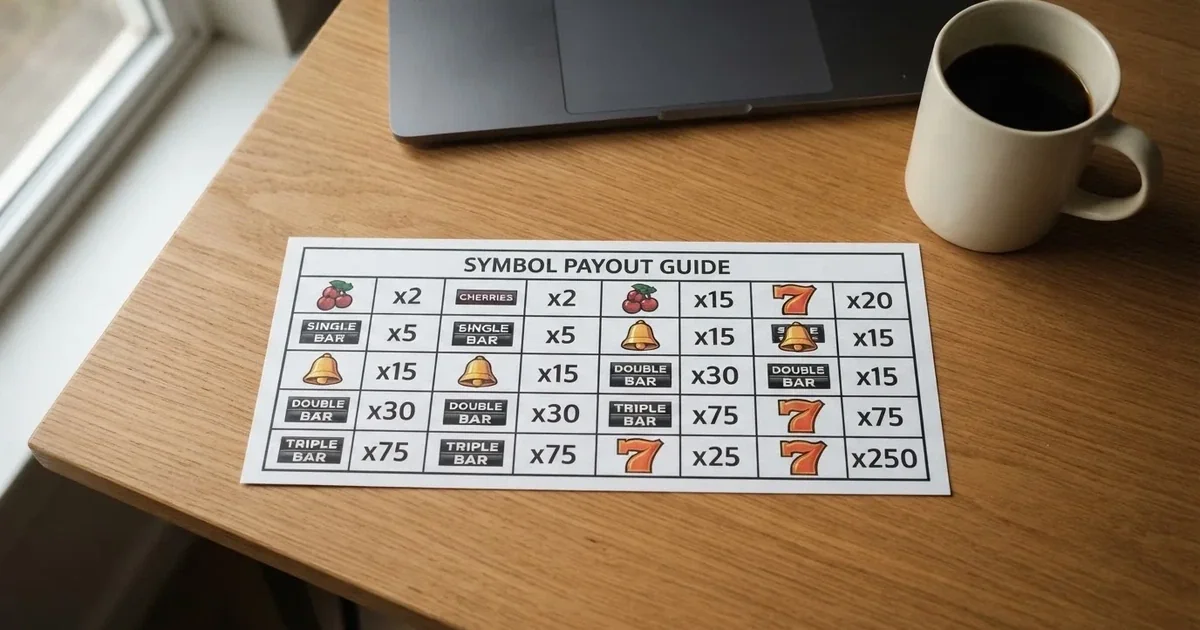
A paytable on a BGaming slot looks, mechanically, like any other video-slot paytable: a grid of reels (usually 5), a fixed number of paylines or a ways-to-win figure, a symbol hierarchy from low-paying suits or numbers through to the theme-specific premium icons, a wild symbol that substitutes, and a scatter symbol that triggers the free-spins round. The RTP figure (the percentage of wagered money the game returns to players over the long run) is published in the help screen of every certified title, and the volatility rating — the gap between the size and the frequency of wins — sits beside it. What changes between BGaming titles and the next studio’s output is mostly aesthetic: the art direction, the music bed, and the named bonus feature. The maths underneath sits inside the same regulatory envelope.
The wider Australian-licensed context the studio never enters
Aristocrat is the local reference point because it is the only Australian-headquartered gambling-technology company of any scale, and because its regulated online arm — Aristocrat Interactive, formed in April 2024 by combining the Anaxi unit with the newly acquired NeoGames group, which includes Aspire Global, BtoBet and Pariplay — operates in markets outside Australia. The contrast is the point. Aristocrat’s 2025 normalised net profit after tax and amortisation came in at A$1.55 billion on A$6.30 billion of revenue. The studio whose name the search actually asked about does not file at that scale and does not sell to Australians at all. The two companies share a continent and an industry and almost no commercial overlap.
The ACMA’s record on the brands the search returns
The featured set here is not a ranking and not a recommendation. It is eleven brands the Australian Communications and Media Authority has itself named in formal warnings under the Interactive Gambling Act 2001, ordered as the regulator’s record presents them. Every one of them has offered BGaming content or content from comparable offshore studios to Australian residents, and every one of them operates on a licence issued somewhere other than Australia.
RocketPlay
The ACMA issued a formal warning to Pulsup Ltd over Rocketplay.com.au in March 2026; an earlier warning covered the same brand under Dama N.V. in May 2022. Two actions, four years apart, on the same domain. The studio on the other side is consistent enough — the BGaming portfolio shows up in the lobby — but the operator has changed hands, which is the offshore pattern: a brand gets warned, the wrapper gets re-registered to a fresh company, and the site keeps running until the next round.
Level Up Casino
A May 2022 warning to Dama N.V. covered Level Up alongside five other Dama brands. The studio line is what Wazdan’s own listings page reports, which is enough to say the brand carries third-party content but not enough to attribute specific BGaming titles without guessing.
Woo Casino
A formal warning to Dama N.V. in March 2025, in the same enforcement round that touched Spirit Casino. The site continues to operate; the warning is a regulatory step, not a takedown.
Spirit Casino
A formal warning to Dama N.V. in May 2025. Newer to the ACMA register than its Dama sibling Woo Casino, with the same parent on the warning letter.
National Casino
The ACMA warned Consolutetish S.R.L. in July 2025 over National Casino. Betsoft and Pragmatic Play both list the brand among their operator partners, which is the kind of cross-studio presence that signals an aggregator rather than a single-supplier boutique.
Bizzo Casino
Consolutetish S.R.L. received a July 2025 warning, on top of an earlier 2022 warning to TechSolutions (CY) Group Limited and TechSolutions Group N.V. The repeat is the more telling data point here — the brand has cycled through two operators and sits on the warning list twice.
Ignition Casino
A July 2025 warning to Bamboo Media over Ignition Casino. The brand name overlaps with a long-running US-facing site; the Australian-facing variant lives at a different domain and shares only the label.
Instant Casino
The ACMA warned EOD Code SRL in February 2025, in one of the earlier rounds of the year.
Jackbit
A formal warning to Ryker B.V. in April 2026 covered both Jackbit and CasinOK on the same enforcement letter.
Casino Intense
A formal warning to Sterplay Holding Ltd in April 2025. The 1spin4win, Betsoft and Gambling Commission UK footprints in research show the brand is set up to look licensed without being licensed to take Australian play.
Sky Crown
The ACMA’s formal warning to Hollycorn N.V. over Sky Crown and Blue Leo dates to September 2022, the older end of the register.
The full table at a glance
| Brand | ACMA action and date | Operator named by the ACMA | Subject support |
|---|---|---|---|
| RocketPlay | March 2026 (Pulsup Ltd); May 2022 (Dama N.V.) | Pulsup Ltd, Dama N.V. | — |
| Level Up Casino | May 2022 | Dama N.V. | listings-only (Wazdan) |
| Woo Casino | March 2025 | Dama N.V. | — |
| Spirit Casino | May 2025 | Dama N.V. | — |
| National Casino | July 2025 | Consolutetish S.R.L. | listings-only (Betsoft, Pragmatic Play) |
| Bizzo Casino | July 2025 (Consolutetish); 2022 (TechSolutions) | Consolutetish S.R.L., TechSolutions Group | — |
| Ignition Casino | July 2025 | Bamboo Media | — |
| Instant Casino | February 2025 | EOD Code SRL | — |
| Jackbit | April 2026 | Ryker B.V. | — |
| Casino Intense | April 2025 | Sterplay Holding Ltd | listings-only (1spin4win, Betsoft, UK Gambling Commission) |
| Sky Crown | September 2022 (Blue Leo on same letter) | Hollycorn N.V. | — |
Every “—” in the right-hand column is deliberate. Research found no first-party source confirming BGaming content on that specific brand; what those brands offer instead is the wider portfolio of offshore-friendly studios, and the BGaming label in their marketing is the kind of claim a reader cannot verify without opening an account.
What “online casino” means in Australian law
Online casino games and online pokies are prohibited interactive gambling services under the Interactive Gambling Act 2001, as tightened by the Interactive Gambling Amendment Act 2017. The Act makes it an offence to provide those services to a person physically in Australia; it does not criminalise the individual player, but it removes every protection that an Australian licence would normally confer. No state or territory issues a licence for online casino games. What the licensing system does cover is wagering on races and sport placed before the event, lotteries and keno — in practice licensed through the Northern Territory Racing and Wagering Commission, which regulates 52 online bookmakers including Sportsbet, Bet365 and Ladbrokes. The NTRWC has no full-time staff and meets once a month in Darwin; it is the closest thing Australia has to a federal wagering regulator, and it does not cover what this search asks about.
Enforcement runs through the ACMA. The Authority investigates complaints, issues formal warnings (the letters the table above lists), and can direct Australian internet service providers to block illegal sites at the network level. In the round reported on 26 June 2026, the ACMA asked ISPs to block 12 more websites: 7Signs, ChromaBet, Donbet, Duospin, Freshbet, Slots Gem, Jacks Club, Lucky Start, Pointsbetz.com, Spinrise, Vinyl Casino and Wildsino. That brought the running total to 1,751 illegal gambling and affiliate marketing websites blocked since the first blocking request in November 2019, with more than 230 unlicensed gambling services having left the Australian market since enforcement was strengthened in 2017. Across that period the ACMA has moved at a steady pace — a few dozen new blocks a year, a handful of formal warnings each quarter — without ever sweeping the offshore casino sector clean.
What the block rate looks like in plain numbers
Between the first blocking request in November 2019 and the running total reported on 26 June 2026, 1,751 sites have been added to the ACMA’s block list. That works out to roughly 1,751 ÷ 79 ≈ 22 sites blocked per month on average over the full period, though the rate is far from even — early rounds added hundreds at a time as the ISPs first wired up the technical machinery, and recent rounds add a dozen or so each quarter as the regulator targets specific operators. The headline to take from this is that the ACMA’s pace is steady enough to keep new arrivals off the open web, and slow enough that a single offshore brand can run for months, sometimes years, before its domain lands on a block list. A reader who reached the brand through a Google result in the last quarter is, by construction, looking at a site the regulator has not yet caught up with.
The size of the market the law is up against
H2 Gambling Capital’s 2025 report estimates that Australians lose about A$3.9 billion a year to illegal gambling sites, and that the share of gambling going through legal channels fell from 74% in 2021 to 64%. The A$3.9 billion figure is the size of the gap the Interactive Gambling Act is trying to close; the falling share is the sign that, despite the blocks and the warnings, the illegal side has been growing faster than the legal side. None of that makes the offshore brands safer to use; it makes the regulator’s job harder, and it explains why a search like the one this page responds to still returns working sites at all.
The Interactive Gambling Amendment (Gambling Reform) Bill 2026
Parliament passed the Interactive Gambling Amendment (Gambling Reform) Bill 2026 on 19 August 2026. The headline measures — tighter rules on advertising and inducements — commence 1 January 2027, which puts the bill into the awkward category of law passed but not yet in force on a page read in the months either side of 2026. For a reader landing on this page between August 2026 and the end of the year, the new advertising rules are a known direction of travel rather than a live constraint. The prohibitions on providing online casino games to Australians are already in force under the original 2001 Act; the 2026 amendment tightens what surrounds those prohibitions rather than reopening the question of whether they apply.
What the protections that do exist actually cover
The Australian-licensed safety net is built for wagering, not for casino. BetStop, the National Self-Exclusion Register, has been live since August 2023 and binds every Australian-licensed online and phone wagering service: a player who registers with BetStop is locked out of every locally licensed bookmaker for the period they choose, and the operator cannot reopen the account until the exclusion ends. None of that reaches an offshore casino. The brand’s self-exclusion tool, where one exists, sits inside that brand’s own account menu and is enforced only against that brand’s own domain; switching to a sibling brand under a different licence is not blocked, and the ACMA’s block list does not consult a player’s exclusion status before deciding what to take down.
The 24/7 help line is the part of the system that does not care where the gambling happened. Gambling Help Online runs chat and callback support around the clock, and the National Gambling Helpline at 1800 858 858 is free from anywhere in Australia. Both are confidential, both are staffed by counsellors rather than salespeople, and both will talk to someone whose gambling has been on offshore sites without requiring them to file a complaint or name a brand first. For a reader who has reached the bottom of this page and recognised themselves in the picture it draws, those are the two numbers worth keeping.
The legal age for any form of licensed gambling in Australia is 18. Credit cards, credit-related products and digital currency are banned as payment for licensed online wagering since 11 June 2024, with penalties of up to A$247,500 for operators that breach the rule; legal deposit routes for licensed wagering are debit card, bank transfer, PayID/Osko and BPAY. A site asking an Australian customer for a credit card or a crypto deposit is, by that test alone, operating outside the Australian rules — which is a quick way to spot an offshore brand without reading the small print.
A note on what an offshore site does not give a player
An offshore licence is real in the jurisdiction that issued it and useless in Australia. A Curaçao-licensed brand will accept a complaint through the Curaçao Gaming Control Board; that complaint will not enforce an Australian consumer outcome. A Malta-licensed brand falls under the Malta Gaming Authority; the MGA’s complaint process is more rigorous than Curaçao’s but it still has no power over an Australian customer’s bank. If a withdrawal is refused, the practical recourses are: a chargeback through the card issuer (often blocked by the operator’s terms), a complaint to the issuing jurisdiction’s regulator (slow and uncertain), or a civil claim in the operator’s home jurisdiction (expensive enough that the recovery has to be worth the lawyer’s time). The honest framing is that offshore play removes the protections an Australian licence would normally provide and substitutes the operator’s own goodwill for them.
What bonuses and free spins look like on the offshore side
The bonus structure an Australian reader sees on an offshore BGaming casino is, in shape, identical to the structure licensed bookmakers offer: a deposit match, free spins on a named slot, sometimes a no-deposit free-spin bundle for opening an account, occasionally a cashback percentage on weekly losses. The numbers are larger because the regulator is not the ACMA. A 100% match up to A$500 plus 200 free spins on a BGaming slot is a typical headline, and the same brand will then attach a 40x wagering requirement to the bonus, a 7-day expiry, a maximum-bet cap during the wagering period, and a list of games that do not count toward the requirement at all.
Wagering requirements are where the marketing word “bonus” stops meaning what it appears to mean. A 40x multiplier on a A$100 bonus means A$4,000 of qualifying bets before the bonus becomes withdrawable cash. On a slot with a 96% RTP, A$4,000 of qualifying bets returns, on average, A$3,840 — a A$160 expected loss to clear a A$100 bonus. Free spins carry the same arithmetic in miniature: 200 free spins at A$0.20 per spin is A$40 of qualifying bets, which on a 96% RTP returns about A$38.40, and the winnings still ride the wagering requirement unless the terms say otherwise. Read the small print, because the headline is the part of the offer the operator chose to put on the page; the small print is the part the auditor will look at.
The comparison a reader actually wants — “which bonus is worth taking” — does not survive a regulator’s view of the brands. Every bonus on every brand in the ACMA’s register is offered by a site that does not have an Australian licence, and the offer itself sits inside a wagering requirement that converts the headline number into an arithmetic problem. The honest read is that bonuses on these sites are marketing tools designed to extend session length rather than gifts to the player, and the only useful comparison is between taking the bonus (and accepting the wagering arithmetic) and depositing without it (and keeping the deposit intact).
How the comparison would be built if the comparison could be built
If the search term used — “best BGaming online casinos Australia” — pointed at a licensable product, the comparison would run on five axes. Game library: how many BGaming titles, whether TRUEWAYS and Merge UP are present, what else sits alongside them in the lobby. Bonus structure: deposit match percentage, free-spin count, wagering multiplier, max-bet cap during wagering, game-weighting exclusions. Payments: deposit and withdrawal methods, withdrawal time, fees, identity-check requirements. Mobile: app availability, browser performance, data use. Licence: which regulator issued it, complaint route, dispute resolution. The reader wants those five scores on each of eleven brands, ideally in a single table.
That table cannot be built for Australia. The brands do not hold Australian licences; the bonuses they advertise are governed by the wagering arithmetic the previous section walked through; the licence axis is identical for every brand (offshore, outside Australian consumer protection); the mobile axis is mostly uniform (HTML5 lobby, browser-based, optional app shell); and the game-library axis, where research actually carried some data, shows mostly cross-studio aggregator content rather than a curated BGaming-only catalogue. The comparison the search implies would conclude with a long list of similar offers on similar offshore sites with similar gaps in Australian consumer protection, which is not a ranking and not a recommendation, and which is why this page does not produce one.
What the comparison does produce is a way to read the ACMA table. RocketPlay is the most recently warned brand in the set (March 2026); Sky Crown is the oldest (September 2022). The newer warnings cluster around 2025-2026 (Spirit, National, Bizzo, Ignition, Instant, Jackbit, Casino Intense, RocketPlay), which is consistent with the ACMA stepping up enforcement against a new generation of offshore brands after the 2024 payment-method ban squeezed the older ones. The older warnings (Level Up, Sky Crown, Blue Leo) are reminders that warning letters do not, by themselves, take sites down — they sit on the regulator’s record while the brands continue to operate.
What a BGaming slot’s paytable actually tells a reader
A paytable is the help screen of any slot machine, online or offline, and it carries the same six pieces of information regardless of the studio that built it. The first is the symbol hierarchy: low-paying icons (usually card suits or numbers), mid-tier theme icons, and the premium symbols whose full-line hits pay the headline amounts. The second is the line configuration: a fixed number of paylines, a “ways to win” figure, or a cluster-pays mechanic that pays on groups rather than lines. The third is the wild and scatter rules: which symbols substitute, which trigger free spins, which trigger a bonus game. The fourth is the bonus structure: how many free spins, what multiplier, whether the bonus round can retrigger. The fifth is the RTP — the long-run return to player, expressed as a percentage. The sixth is the volatility rating: a label like “low”, “medium” or “high” indicating how heavily wins are concentrated into a few large payouts versus spread across many small ones.
BGaming’s portfolio spans the full range. The studio’s signature mechanics — TRUEWAYS up to 262,144 ways, Merge UP, MultiDice X — are paytable features as much as they are art-direction choices. A title with TRUEWAYS pays on any combination of matching symbols on adjacent reels from the left, regardless of position; that produces more, smaller wins per spin. A title with a fixed 25-payline configuration produces fewer, larger wins. The volatility label tells a reader which they are getting; the RTP tells them how much the house keeps on average over the long run. Both numbers come from the studio’s own certification file, and the same file underpins the help screen a player actually sees.
The phrase “best paying BGaming slots” is one a reader will see in marketing copy and never in a regulator’s file. Without a named title and a published RTP, “best paying” is a sales word, not a comparison. The few specific titles research carries with concrete RTP and volatility — Betsoft’s Good Girl Bad Girl 2 (96.22%, Very High volatility, 5 reels, 20 paylines) and The Slotfather (95.69%, Medium volatility, 5 reels, 30 paylines) — show the typical spread: 95-96% RTP, volatility from medium to very high, five reels, somewhere between 20 and 30 paylines. A reader who knows which BGaming title they want to check can read its paytable directly in the game’s help screen; a reader who doesn’t has no way to turn “best paying” into a number without first naming the game.
How payout speed and payment options shape the experience
An offshore BGaming casino’s payment page is the place where the operator’s promises meet the banking system’s reality. The deposit half is fast by design: most brands accept Visa, Mastercard, a handful of e-wallets (Skrill, Neteller, MiFinity), a range of cryptocurrencies (Bitcoin, Ethereum, Litecoin, Tether), and sometimes an instant bank-transfer option. The deposit clears inside the casino’s own ledger in seconds, which is what the site advertises as “instant deposits”. The withdrawal half is slower, and the gap is where the complaints sit.
Identity verification is the most common reason a withdrawal stalls. The first withdrawal — and any withdrawal above a threshold the operator sets, often A$2,000 equivalent — triggers a Know Your Customer (KYC) check: a government photo ID, a proof of address, and sometimes a screenshot of the payment method used to deposit. The check itself is normal; the problem is that offshore brands vary widely in how quickly they process the file. Some clear KYC inside 24 hours; others take three to five business days, and a small minority use the verification step as a delay tactic, especially on larger withdrawals. E-wallet withdrawals are typically faster than bank transfers once KYC is cleared; crypto withdrawals are the fastest in absolute terms but introduce the volatility risk of the coin chosen.
The Australian-specific constraint is the credit-card ban. Since 11 June 2024, credit cards and credit-related products cannot be used for licensed online wagering; the ban extends to digital currency for licensed operators. An offshore brand asks for whichever method it accepts, and the Australian customer’s bank has no obligation to block the transaction. The result is that an Australian reader can still deposit with a credit card on an offshore site — the bank may or may not decline it — but the deposit sits outside every consumer-protection mechanism that applies to Australian-licensed play. If the operator refuses the withdrawal, the credit-card chargeback route exists in principle and is hard to win in practice, because the operator’s terms usually waive that right.
What BGaming’s relationship with other studios looks like
BGaming sits in a middle tier of the offshore-friendly studio world. Above it, the studios with the biggest operator footprints are Pragmatic Play, Evolution (for live dealer), NetEnt and Play’n GO. Below it, smaller studios like 1spin4win — founded in 2021, headquartered in Curaçao, with a 190+ slot catalogue built in HTML5 for low-bandwidth connections — operate in much the same B2B space, supplying games to 1,000+ casino brands and aggregators. 1spin4win reports its total bet sum grew 46% in the first half of 2025 compared with the first half of 2024, which is the kind of growth figure small studios cite when they want to show they are gaining share without disclosing the absolute base.
A reader looking for “BGaming casinos” will, on most offshore sites, find BGaming titles sitting alongside output from those neighbouring studios: Betsoft’s 200+ RNG games, Booming Games’ slot catalogue (the studio holds a Malta B2B licence numbered MGA/B2B/459/2018 plus a UK Gambling Commission account #57254, and additionally licences from Sweden’s Spelinspektionen, Ontario’s AGCO and regulators in Romania, Denmark, Greece, Belgium, Germany and Brazil), 1spin4win’s 190+ titles, and the live-dealer tables from Evolution and Pragmatic Play. The aggregator model means a single brand’s lobby is rarely a single studio’s output; the marketing label says “BGaming casino” the way a buffet might say “Italian restaurant” because the pasta station is open.
This is also why the BGaming brand ends up on so many offshore sites aimed at Australian readers. The studio will supply almost any operator that clears basic compliance, and small offshore brands will use the studio’s name as a quality marker. The studio’s own marketing says its games appear on 3,000+ operators, which is the upper bound of how widely the brand can travel; the operators carrying that label in their lobby are, by construction, the offshore end of the market, not the licensed Australian end.
What the operator write-up carries that the table does not
The eleven brands the ACMA has warned are not a ranking and not a recommendation. They share a status under Australian law — every one of them is offering a service the Interactive Gambling Act 2001 prohibits them from offering to Australians — and the only meaningful differentiator the ACMA’s record surfaces is timing. The newer warnings (RocketPlay in March 2026, Jackbit in April 2026) tell a reader the regulator is still actively pursuing this category of operator; the older warnings (Sky Crown in September 2022, Level Up in May 2022) tell a reader that a warning letter does not, by itself, end a brand’s availability in Australia. Between those two poles, the rest of the table is the regulator’s workload: a steady stream of formal warnings, with the same parent companies turning up more than once (Dama N.V. across three of the eleven brands, Consolutetish S.R.L. across two, TechSolutions across two).
What the operator write-up cannot show is which brand a player should choose, because no Australian licence framework gives a reader a way to evaluate the choice. The bonus terms are not published in research, the payment pages change faster than the regulator’s letters, the customer-service reputation of each brand is a function of dozens of independent reviews on sites the ACMA does not curate, and the eventual withdrawal experience depends on factors the marketing page never mentions. The honest position this page takes is that the choice between the eleven is the wrong comparison to make; the comparison the reader actually needs is between the offshore set and the licensed wagering alternatives the Northern Territory Racing and Wagering Commission regulates — which is licensed to take sports bets before the event, not to host BGaming slots, and which is the closest the Australian framework gets.
What a reader should take from this page
The search term that brought a reader here assumes a licensed Australian product that does not exist. BGaming is a real studio with a real catalogue, a real Maltese B2B licence, and a real footprint on thousands of offshore casino brands. None of those offshore brands is licensed to offer its games to Australian residents; every one of them sits on a regulatory record of formal warnings from the ACMA, and the A$3.9 billion Australians lose to illegal sites each year is the size of the market those brands are competing for. The bonus offers they advertise, the mobile apps they wrap around their lobbies, and the payout speeds they promise are real in the sense that the brands operate and pay some players some of the time. They are not real in the sense an Australian reader typically means: the consumer protections, the dispute-resolution routes, the regulator’s willingness to enforce a complaint outcome.
The arithmetic behind the bonuses is the part the marketing pages skip, and it is the part a reader should hold onto if anything. A 40x wagering requirement on a A$100 bonus expects A$4,000 of qualifying bets; on a 96% RTP slot, that produces an expected loss of about A$160 to clear a A$100 bonus. The free-spin bundles carry the same shape at smaller scale. The numbers are not hidden — they are published in every bonus’s terms and conditions — and the gap between the marketing headline and the terms is where the offer’s real cost sits.
For a reader who has recognised themselves in the picture this page draws, the right next step is a phone call or a chat session that does not require deciding what to do first. Gambling Help Online runs chat and callback support around the clock. The National Gambling Helpline is 1800 858 858, free, 24/7, and will pick up whether the gambling has been on licensed Australian sites or on offshore brands. Both are confidential and both are staffed by counsellors rather than salespeople, and neither requires a reader to know which offshore brand they were on, how much they lost, or whether they want to stop.
Frequently asked questions about BGaming casinos in Australia
Is BGaming itself an online casino?
No. BGaming is a game studio, not an operator. The brand debuted in 2018 under Stable Games Ltd of Valletta, Malta, and the team behind it had been building games since 2012. The company holds a Malta Gaming Authority Critical Gaming Supply Licence (MGA/B2B/785/2020, issued 18 March 2021) for Type 1 B2B gaming services — that licence authorises BGaming to supply games to operators, not to take bets from players. The casino brands that carry BGaming content in their lobbies are separate businesses licensed in their own jurisdictions; BGaming is one of several studios whose games those brands aggregate.
Are there any Australian-licensed online casinos with BGaming slots?
No. Online casino games and online pokies are prohibited interactive gambling services under the Interactive Gambling Act 2001, as strengthened by the Interactive Gambling Amendment Act 2017. No Australian state or territory issues a licence for them. The closest Australian-licensed alternatives are sports and race wagering operators licensed through the Northern Territory Racing and Wagering Commission, which cover pre-event betting on sport and racing, lotteries and keno — not online casino games, not BGaming slots, not anything from any other studio’s casino catalogue.
How does a BGaming slot’s paytable usually look?
A typical BGaming slot is a five-reel video slot with either a fixed payline count (often 20 to 30) or a “ways to win” mechanic — BGaming’s proprietary TRUEWAYS mechanic goes up to 262,144 ways. The paytable shows the symbol hierarchy (low-paying card suits or numbers, mid-tier theme icons, premium theme icons), the wild and scatter rules, the bonus structure (free spins, multipliers, retriggers), the published RTP figure, and a volatility label. The mechanics — Merge UP collapses adjacent matching symbols into higher-value tiles, MultiDice X is the engine behind several crash-style titles — are presented in the help screen alongside the more standard slot features.
Does BGaming run its own casino, or only license games to others?
BGaming only licenses games. The studio does not operate any casino brand of its own; the relationship is strictly B2B, with BGaming supplying certified games to operators that integrate them into their own lobbies. BGaming’s own figure puts the operator count at 3,000+ brands carrying the studio’s output, with Blaze, Pin-Up and Gamdom named as public reference partners.
Why do offshore casinos use BGaming as a selling point to Australian visitors?
Because BGaming’s name functions as a quality signal on sites the Australian reader cannot otherwise vet. The studio holds a real Maltese B2B licence, the catalogue runs to 250+ certified titles, and the partner list is long enough that the brand has name recognition in the offshore market. For a small offshore casino trying to look credible to a reader who cannot check the operator’s own licence, the BGaming logo is a shortcut. It says “the game library isn’t a no-name library” without making claims about the operator itself.
Is it legal for a site to offer BGaming games to people in Australia?
No. Under the Interactive Gambling Act 2001 it is an offence to provide prohibited interactive gambling services — including online casino games and online pokies — to a person in Australia. The Act targets the provider rather than the individual player, but the practical effect for an Australian who plays on an offshore site is the loss of every consumer protection an Australian licence would normally confer: no Australian complaints body, no enforced dispute resolution, no guarantee that a refused withdrawal can be recovered, and the risk that the site will be blocked with a balance still on it.