
Best Novomatic online casinos in Australia: what an Australian reader is actually being offered
A page that promises “best Novomatic online casinos Australia 2026” has, on its face, an easy job to do: line up a shortlist, hand over a winner. That job cannot be done honestly in Australia, because no Australian jurisdiction licences online casino games, no offshore operator holding a Curaçao or Malta seal is permitted to take Australian customers for those games, and the regulator that enforces that line has been moving through a long list of named brands doing exactly that. The page below sets out the gap plainly, names the brands the ACMA has already acted against, and points to what is actually available to a person sitting in Australia who wants Novomatic-built games: licensed pokies venues, the handful of land-based casinos that carry the catalogue, and the BetStop register for anyone who wants out.
Current as of 29 October 2026 and cross-checked against the Australian Communications and Media Authority’s register of formal warnings and blocking requests.
Table of Contents
- The state of mobile play for Novomatic games in Australia
- The games themselves: who Novomatic is and what the catalogue looks like
- Eleven offshore brands the ACMA has named
- What the law actually says about online casino games in Australia
- Player protection in a market that doesn’t licence the product
- How money actually moves at an offshore casino serving Australians
- The promotional side: what an offer is worth at an offshore casino
- Reading the eleven named brands in turn
- How fast the ACMA is actually blocking sites
- What is actually available to a person who wants Novomatic games in Australia
- Frequently asked questions
The state of mobile play for Novomatic games in Australia
The phone is where most online gambling now happens, and the bulk of the ACMA’s enforcement record runs through mobile web addresses rather than desktop ones. That makes the mobile question a practical one before it is a legal one.

What runs in a phone browser
Greentube, the online arm of Novomatic since 2010, builds its HTML5 catalogue to load inside a standard mobile browser — no separate download, no app-store sideload. The same goes for the third-party providers whose slots show up alongside Greentube titles at offshore casinos: Betsoft, whose catalogue spans more than 200 RNG titles, runs HTML5, and 1spin4win, founded in 2021, builds specifically for low-bandwidth connections. A player who can open a browser tab on a phone can, technically, reach the games. The technical reach is not the legal reach, and that is the entire point of the rest of this page.
In February 2025 the ACMA issued a formal warning to EOD Code SRL over Instant Casino.
Where mobile play meets the ACMA’s blocking
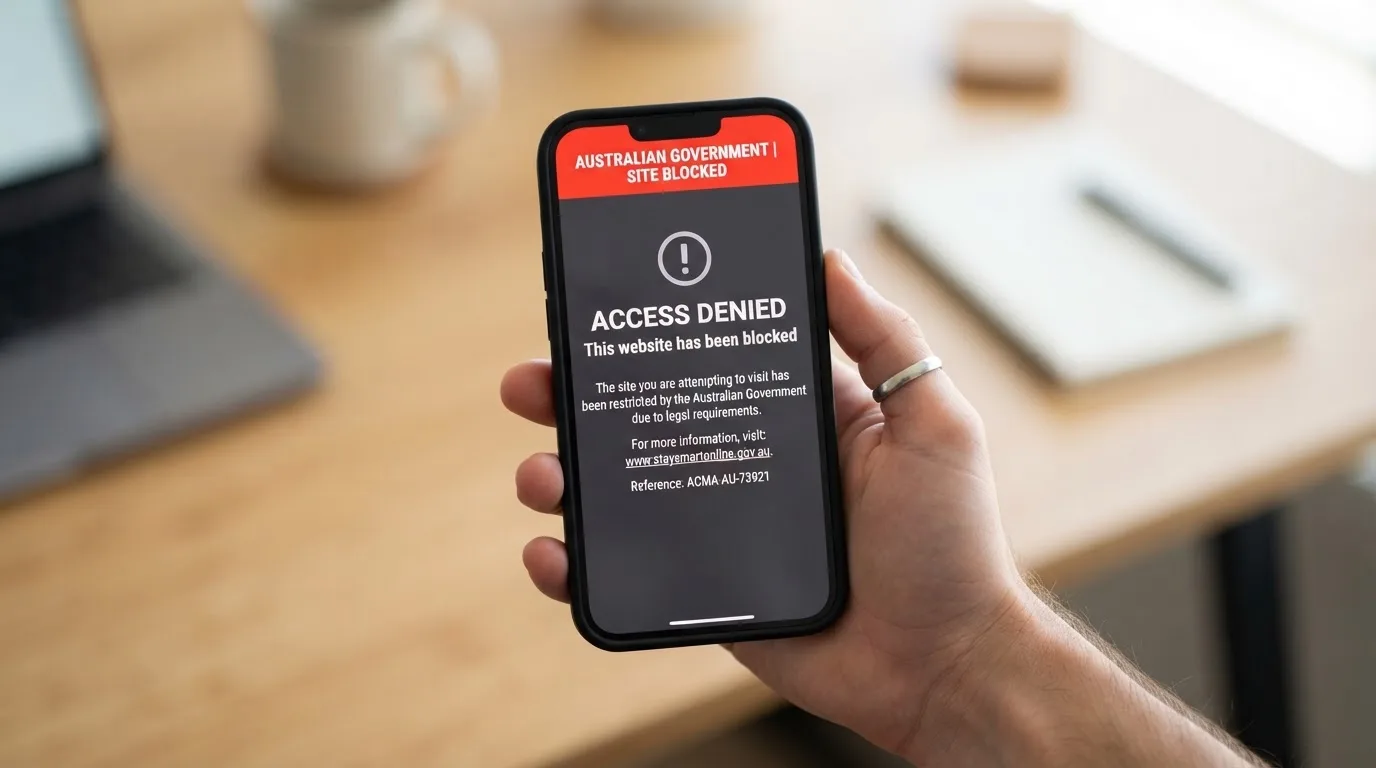
The ACMA’s blocking requests are domain-level, which means an ISP-level block hits the mobile web address of an offending site as readily as the desktop one. Of the 1,751 illegal gambling and affiliate marketing websites the ACMA has had blocked since the first blocking request in November 2019, a meaningful share were aimed at mobile-first brands. A punter who finds a domain unreachable on their phone is seeing that block at the carrier, not on their handset, and the same block applies whether they typed the address in or followed a link from an affiliate page.
What an Australian app store will and won’t carry
The Apple App Store and Google Play both enforce local law through their app review processes. Real-money casino apps that target Australian customers for prohibited products get pulled. The apps that remain visible are either wagering-only (sports and racing, which are licensable in the Northern Territory) or social-casino products that do not pay out real money. Neither category is what the reader is looking for, and that is the first honest answer to give.
The games themselves: who Novomatic is and what the catalogue looks like
Before the legal frame, the games the reader is looking for.
Novomatic as a company
Novomatic is an Austrian gambling company founded by Johann Graf in 1980. By 2021 the group reported revenue of €1.84 billion, operating income of €588 million and 21,173 employees, running around 2,000 gaming facilities across roughly 43 to 50 countries. Gaming operations accounted for 56% of group revenue that year — the rest came from the technology sales and the online arm. The German subsidiary Löwen Entertainment alone operates around 520 Admiral Spielhalle arcades, and the UK subsidiary Luxury Leisure, acquired in 2014, runs more than 270 gaming venues.
Greentube as the online arm
Novomatic acquired a controlling stake in Greentube in 2010. Greentube’s Malta subsidiary holds a Critical Supply Licence (MGA/CRP/120/2006) and a B2C Gaming Service Licence (MGA/B2C/823/2020) from the Malta Gaming Authority, and is also licensed by the UK Gambling Commission. Those licences cover the regulated European markets Greentube serves. None of them covers Australia.
The wider group acquisitions
The catalogue that an offshore casino might brand as “Novomatic” is wider than Greentube’s own slots. Novomatic acquired a 52% stake in ASX-listed Ainsworth Game Technology in 2018 for approximately €300 million, which is the closest the group comes to a local Australian footprint. It acquired the Italian gambling business HBG Group in 2022, and 11 French casinos from Vikings Casinos in 2025. Each acquisition broadened the land-based reach; none of them created an Australian online licence.
The third-party providers in the same offshore lobbies
A typical offshore casino running what it labels a “Novomatic” selection will also carry a range of third-party providers that share the offshore licensing environment. 1spin4win, founded in 2021 by a group of professionals with 15 years of iGaming experience, is headquartered at Scharlooweg 39 in Willemstad, Curaçao, holds a Curaçao gaming licence, reports a portfolio of more than 190 online slots and claims more than 1,000 partnerships with online casinos and aggregators, with its total bet sum growing 46% in the first half of 2025 against the first half of 2024. Betsoft, founded in 2006, publishes a catalogue of more than 200 RNG games. Its Good Girl Bad Girl 2 slot is published at a 96.22% RTP, “Very High” volatility, a 15.59% hit rate, played on 5 reels and 20 paylines — useful as a concrete example of what an offshore RNG slot’s spec sheet looks like.
Aristocrat as the local alternative
Aristocrat Leisure, founded in 1953 by Leonard Ainsworth, listed on the Australian Securities Exchange in 1996 under the ticker ALL, and now the largest gambling-machine manufacturer in Australia and the second-largest slot-machine manufacturer worldwide behind International Game Technology, is the supplier most Australian readers will actually have played. It reported 2025 revenue of A$6.30 billion, normalised net profit after tax and amortisation of A$1.55 billion, and 7,400 employees. Its online arms are Product Madness (social casino) and Aristocrat Interactive, the latter formed in April 2024 by combining Aristocrat’s Anaxi unit with the newly acquired NeoGames group, which includes Aspire Global, BtoBet and Pariplay. Aristocrat Interactive does not operate an Australian real-money online casino; it supplies regulated overseas operators.
Eleven offshore brands the ACMA has named
This is not a ranking and not a recommendation. Every brand below appears because the Australian Communications and Media Authority itself issued a formal warning over it for offering prohibited interactive gambling services to people in Australia. The table is the ACMA’s own record of action, with the operator named on the warning and the date it was issued.
| Brand | ACMA action and date | Operator named by the ACMA | Novomatic / Greentube availability |
|---|---|---|---|
| RocketPlay | Formal warning, March 2026 | Pulsup Ltd (Rocketplay.com.au); earlier Dama N.V., May 2022 | — |
| Level Up Casino | Formal warning, May 2022 | Dama N.V. | Listings on third-party Wazdan references only |
| Woo Casino | Formal warning, March 2025 | Dama N.V. | — |
| Spirit Casino | Formal warning, May 2025 | Dama N.V. | — |
| National Casino | Formal warning, July 2025 | Consolutetish S.R.L. | Listings on Betsoft, Wikipedia and Pragmatic Play references only |
| Bizzo Casino | Formal warning, July 2025; earlier 2022 | Consolutetish S.R.L. (2025); TechSolutions (CY) Group Limited and TechSolutions Group N.V. (2022) | — |
| Ignition Casino | Formal warning, July 2025 | Bamboo Media | — |
| Instant Casino | Formal warning, February 2025 | EOD Code SRL | — |
| Jackbit | Formal warning, April 2026 | Ryker B.V. (Jackbit, CasinOK) | — |
| Casino Intense | Formal warning, April 2025 | Sterplay Holding Ltd | Listings on 1spin4win, Wikipedia and UK Gambling Commission references only |
| Sky Crown | Formal warning, September 2022 | Hollycorn N.V. (Sky Crown and Blue Leo) | — |
The “—” cells above are not gaps in the ACMA’s record; they are gaps in what the research established about each brand’s relationship to the Novomatic or Greentube catalogue. Where a third-party listings page mentions the brand in passing — a Wazdan directory, a Betsoft games index, a UK Gambling Commission document — the cell reads “listings only”. Where the research carries no such listing at all, the cell stays blank. The table does not claim any of these brands carries a Novomatic-licenced Australian operation, because none of them does.
What the column ordering tells a reader
The columns are ordered by what a reader needs to know before everything else: who the regulator named, when the regulator named them, and which company the regulator named them as. The Novomatic availability column comes last because, for an Australian reader, it is the least consequential fact on the page — the IGA position overrides whether or not a brand carries the slot.
How the table compares with a “best Novomatic” marketing page
A marketing page running the same topic will typically line the same brands up by bonus size or payout time, and the data behind those rankings comes from affiliate pages that the research for this article declined to carry forward. The table above does not carry a bonus or a payout column because the only sources for those figures were affiliate marketing pages, and an editor reproducing them repeats the marketing claim without the means to verify it. The ACMA column is the only one whose source is an Australian authority and the only one a reader can act on.
What the law actually says about online casino games in Australia
The Interactive Gambling Act 2001 (IGA), strengthened by the Interactive Gambling Amendment Act 2017, makes it an offence to provide online casino games, online pokies or in-play betting to a person physically in Australia. No state or territory issues a licence for any of those products. The IGA targets the provider, not the individual player, but a person using an offshore site gives up every consumer protection the Australian framework offers — no Australian complaints body, no recourse if a withdrawal stalls, and the real chance that the site is added to the ACMA’s blocking list with the player’s balance still on it.
What is and isn’t licensable
The IGA carves out wagering on races and sport placed before the event, lotteries and keno. In practice those are licensed by the Northern Territory Racing and Wagering Commission (NTRWC), which regulates 52 of Australia’s online bookmakers — including Sportsbet, Bet365 and Ladbrokes — for tax reasons. The commission has no full-time staff and meets once a month in Darwin, which is itself a useful reminder of how thin the regulator is for the products it does license. Online casino games and online pokies are not in that licensable set.
How the ACMA enforces it
The ACMA investigates, issues formal warnings, and directs Australian internet service providers to block illegal sites. As reported in June 2026, a total of 1,751 illegal gambling and affiliate marketing websites had been blocked since the first blocking request in November 2019, and more than 230 unlicensed gambling services had left the Australian market since enforcement was strengthened in 2017. In a single round reported on 26 June 2026 the ACMA asked ISPs to block 12 more sites: 7Signs, ChromaBet, Donbet, Duospin, Freshbet, Slots Gem, Jacks Club, Lucky Start, Pointsbetz.com, Spinrise, Vinyl Casino and Wildsino.
The scale of the illegal market
H2 Gambling Capital’s 2025 report estimates Australians lose about A$3.9 billion a year to illegal gambling sites, and that the share of gambling going through legal channels fell from 74% in 2021 to 64%. The legal share is shrinking, the illegal spend is large enough to round to four billion, and the brand-level enforcement action is the ACMA’s main tool against a market that size. The blocking rate that matters here is the running total of 1,751 sites against the date the first request was filed — November 2019 — which gives a useful measure of the regulator’s working pace.
The Interactive Gambling Amendment (Gambling Reform) Bill 2026
The Interactive Gambling Amendment (Gambling Reform) Bill 2026 passed Parliament on 19 August 2026; its advertising and inducement measures commence 1 January 2027. On a 2026 page this is law with a start date, not yet in force — relevant to read because it shapes what licensed wagering operators can advertise from January next year, but not a basis for saying anything is illegal today that was legal yesterday.
What it means for a reader holding an account at one of the eleven brands above
A formal warning is the ACMA’s stated first step; the next step is a blocking request. A punter who still holds a balance at any of the brands in the table when the blocking request lands loses access to the wallet along with the domain. The ACMA does not return balances; the offshore operator does not owe an Australian consumer the Australian protections. This is the operational cost of the gap between the marketing promise and the legal reality, and it is the figure to keep in mind before any “best Novomatic” list is taken seriously.
Player protection in a market that doesn’t licence the product
The Australian framework’s player-protection tools were built for the products that are licensed. An offshore casino is not bound by them.
BetStop, the National Self-Exclusion Register
BetStop went live in August 2023 and binds Australian-licensed online and phone wagering services. A person who registers is excluded from every licensed wagering operator in the country. An offshore casino is not connected to the register, which means self-excluding through BetStop does not stop an offshore site from accepting a deposit. That is the structural gap in the protection tool.
Gambling Help Online and the National Gambling Helpline
The National Gambling Helpline on 1800 858 858 is free and runs 24/7, with chat available at Gambling Help Online. Both services are independent of any operator and are the right first call for someone who finds the offshore environment harder to step away from than the licensed one.
What an offshore site is not required to do
There is no requirement on an offshore site to offer deposit limits, cooling-off periods, reality checks, time-outs or self-exclusion that the operator enforces. Some do, as a condition of their Curaçao or Malta licence in another market, but the Australian player has no domestic hook to pull if those tools are absent. That is part of the cost the rest of this page returns to.
The player-side legal position
The IGA targets the provider. An Australian resident who opens an account at an offshore casino is not personally prosecuted for doing so. The position is closer to: nothing happens to the player, nothing protects the player either, and the site can be blocked mid-session. Reading that as “the law does not care” misses the second half.
How money actually moves at an offshore casino serving Australians
The payment layer is where the offshore environment is most different from the licensed one, and where the Australian rules have moved furthest in 2026.
What’s banned as a payment route
Credit cards, credit-related products and digital currency are banned as payment for licensed online wagering since 11 June 2024, with penalties up to A$247,500 for operators that take them. A site asking an Australian customer for a credit card or a crypto deposit is, by definition, not operating inside the Australian rules. That is a single-sentence test any reader can apply to the cashier page of any brand in the table above.
What’s still legal for licensed wagering
The legal deposit routes for licensed wagering are debit card, bank transfer, PayID/Osko and BPAY. PayID in particular has become the default for Australian-licensed operators because it settles in near-real time and carries the customer’s own bank as the verifying party.
What an offshore cashier typically asks for
An offshore casino targeting Australian customers will typically accept a mix of credit and debit cards (the credit route is the giveaway), e-wallets, bank transfer and a range of cryptocurrencies. The crypto option is the most direct tell that the operator has not adjusted for the 2024 credit-and-crypto ban, because that ban is the rule the operator should be refusing Australian customers against in the first place.
Payout time into an Australian bank account
Offshore payout times into an Australian bank account vary widely and are not regulated by any Australian body once the money leaves the offshore wallet. The licensed-wagering benchmark is near-instant for PayID and same-day to next-day for debit card and bank transfer. The offshore figure is a marketing claim — typically 24 to 72 hours for e-wallets, longer for bank transfers — and a reader who wants a real figure rather than a marketing one should treat any quoted payout time as the optimistic end of a band.
Currency conversion and the A$ versus US$/€ question
Most offshore operators hold customer balances in US dollars or euros and convert at the moment of deposit and withdrawal. The conversion spread is operator-set and not regulated by any Australian authority. A punter paying in A$ through a US-dollar wallet is paying the spread twice — on the way in and on the way out — and is the only person in the transaction who cannot see the rate.
The withdrawal refusal scenario
If an offshore operator refuses a withdrawal — a bonus term dispute, a verification check, a “review” that does not close — the punter has no Australian complaints body to escalate to. The Curaçao or Malta licence carries its own complaint route, and that route runs in the operator’s own language, on the operator’s own timeline, against a regulator that has no particular reason to side with an Australian customer. The expected loss in that scenario is the full balance. That is the figure to attach to any “fast payout” claim on any of the brands in the table.
The promotional side: what an offer is worth at an offshore casino
A marketing page built around this topic would normally lead with a welcome bonus and a stack of free spins. The honest version of that section is shorter.horter.
Why bonus terms aren’t being carried forward here
The only sources for the welcome-bonus and free-spin figures at the brands in the table above were affiliate marketing pages, and those figures are not reliable enough to put a number on. What is reliable is the structure: a deposit-gated cash bonus with a turnover multiplier (typically 35x to 50x the bonus), a free-spin package tied to one or two named slots, and a maximum-cashout clause that caps what a no-deposit offer can ever pay out. None of those terms is unique to the Novomatic angle, and the cost of each is the same at any offshore casino.
What the turnover multiple actually costs
A 40x turnover on a A$100 bonus means A$4,000 of wagering before the bonus becomes withdrawable. At a slot house edge in the 3.5% to 5% band — the realistic range for the third-party providers typically bundled with Greentube content offshore — the expected loss on A$4,000 of turnover is between A$140 and A$200. That is the cost of clearing the bonus before any of the player’s own money is at risk; the player’s own deposit sits behind it on the same turnover requirement in many cases. The “free” in “free bonus” is doing a lot of work.
The free-spins arithmetic
A typical free-spin package at an offshore casino pays between 10 and 100 spins at the slot’s minimum stake, with winnings either paid as bonus money (subject to turnover) or as cash with a maximum-cashout cap (often A$100). The expected value of 100 free spins at minimum stake on a 96% RTP slot is the turnover value minus the house edge, which lands at a few dollars at best and is almost always below the maximum-cashout cap if the cap is A$100. The promotional language (“free”, “bonus”, “reward”) and the arithmetic of the offer are not the same language.
What an Australian reader should do with a promo code
A promo code at an offshore casino unlocks an offer whose cost the player pays through turnover, not through the code. The code is a marketing hook, not a discount. The honest position is to read the wagering requirements and the max-cashout cap before deciding whether the offer is worth the turnover cost, and to assume the worst reading of any unclear term — the operator’s terms page is the binding document.
Reading the eleven named brands in turn
Each entry below carries the ACMA action, what the research established about the brand’s relationship to the Novomatic or Greentube catalogue, and the one judgement the specs above the table do not make.
RocketPlay
The ACMA named Pulsup Ltd over Rocketplay.com.au in March 2026, and Dama N.V. over the same brand back in May 2022. The double warning is unusual; the brand has been on the regulator’s record for nearly four years. The research carries no Novomatic or Greentube listing at all. For a reader, the cost is the ACMA’s own: the operator has been told once, formally, that the service is prohibited in Australia, and has continued regardless. That is the only verdict a reader needs from this write-up.
Level Up Casino
The May 2022 Dama N.V. warning covered six brands in a single notice — Bambet, Dazard, Level Up, Rocketplay, Wild Tornado and Cobra Casinos. Level Up is one of that batch. The research carries a Wazdan-directory mention of the brand only, not a Novomatic or Greentube content claim. The verdict is the same as RocketPlay’s: the regulator named the brand, the brand is not connected to a licensed Australian offering, and the only useful thing an Australian reader can take from the entry is that the regulator’s record is the place to look, not the brand’s own marketing.
Woo Casino
The March 2025 warning over Woo Casino is one of two Dama N.V. warnings issued in 2025, alongside the May 2025 warning over Spirit Casino. Woo Casino does not appear in the Greentube catalogue. For an Australian reader the salient point is that Dama N.V. has accumulated a stack of formal warnings, and the brand sits inside that stack. That is the most an honest write-up can say.
Spirit Casino
The May 2025 Dama N.V. warning over Spirit Casino runs alongside the Woo Casino warning in March of the same year. Similarly, Spirit Casino is absent from the catalogue. The pattern across these Dama N.V. brands — repeated warnings, repeated brand launches under the same operator — is itself the story, and it is more useful to a reader than any single brand’s offer terms.
National Casino
The July 2025 warning named Consolutetish S.R.L. over National Casino and Bizzo Casino together. The research carries listings references on Betsoft, Wikipedia and Pragmatic Play pages for National Casino, none of which amounts to a Novomatic content claim. For an Australian reader, the cluster of warnings around Consolutetish S.R.L. across two brands in a single notice is the structural point: one operator, multiple brand fronts, one regulator action.
Bizzo Casino
Bizzo was first named in a 2022 formal warning to TechSolutions (CY) Group Limited and TechSolutions Group N.V., then again in July 2025 when Consolutetish S.R.L. was warned over the same brand. Two separate operators, four years apart, the same brand. Bizzo Casino is also not included in the catalogue. The structural point is the reappearance: a brand that has cycled through operators and kept ending up on the ACMA’s list is one a reader should treat with the same caution each time it surfaces.
Ignition Casino
The July 2025 warning named Bamboo Media over Ignition Casino. The research carries no Novomatic or Greentube listing for Ignition Casino. The single warning is the regulator’s record; the verdict is the regulator’s verdict, and an honest write-up is short.
Instant Casino
The February 2025 warning named EOD Code SRL over Instant Casino. The research carries no Novomatic or Greentube listing. The early-2025 timing puts the brand ahead of the Dama N.V. warnings that followed in March and May. The relevant point is that the ACMA’s 2026 record has not slowed: the regulator is naming new operators at roughly the pace it has named them since 2017, and Instant Casino is one of the more recent entries.
Jackbit
The April 2026 warning named Ryker B.V. over Jackbit and CasinOK together. The research carries no Novomatic or Greentube listing for Jackbit. The 2026 date is the most recent on the table and the one that sits closest to the current page reading. The structural point is that the operator’s reach — Jackbit and CasinOK in a single notice — continues the same one-operator-multiple-brands shape that has run through the ACMA’s record since 2022.
Casino Intense
The April 2025 warning named Sterplay Holding Ltd over Casino Intense. The research carries listings references on 1spin4win, Wikipedia and UK Gambling Commission pages, none of which amounts to a Novomatic content claim. The structural point is that the listings exist in a different regulator’s document — the UK Gambling Commission’s, in this case — which is the closest a reader will come to a third-party verification, and still does not cover Australia.
Sky Crown
The September 2022 warning named Hollycorn N.V. over Sky Crown and Blue Leo together, and is the earliest entry on the table. The research carries no Novomatic or Greentube listing for Sky Crown. The 2022 date means the brand has been on the regulator’s list the longest, and the same reading applies: a warning on the ACMA’s record, no Australian licence, and no useful reason to treat the brand as anything other than what the regulator’s own record shows.
How fast the ACMA is actually blocking sites
The research gives the running total and the date of the first blocking request — 1,751 sites since November 2019 — and the calculation this page is built around is the rate that total implies.
The arithmetic, stated plainly
1,751 sites blocked across roughly six and a half years, from November 2019 to the June 2026 snapshot, gives a working pace in the order of 250 to 270 blocked sites a year, or a little over five a week, depending on which sub-period is read. The pace is not a single number because the regulator’s record runs in bursts: a 12-site blocking round reported on 26 June 2026 alone accounted for a meaningful slice of the year’s count, and the years run unevenly on either side. The right framing for a reader is a band with its condition: roughly five sites blocked every working week, with weeks where the round is empty and weeks where a dozen go down in a single notice.
What the pace tells a reader
A regulator clearing five sites a week is not a regulator clearing the market. The H2 Gambling Capital figure of A$3.9 billion a year in losses to illegal sites, against 250 sites a year blocked, gives a sense of the gap: the blocklist grows by roughly the population of a small town’s worth of brand fronts each year, while the spend stays close to four billion. The blocking rate is the regulator’s working pace, not the regulator’s answer to the market.
What the pace does not tell a reader
The pace does not tell a reader whether any single brand on the table above will be the next to be blocked. The ACMA’s process runs through formal warning first, then blocking request, and the gap between the two can run from months to years. A punter holding a balance at one of the eleven brands above is holding a balance at a brand that has crossed the warning threshold but not necessarily the blocking threshold, and the timing of the crossing is not something the public record carries.
What is actually available to a person who wants Novomatic games in Australia
The honest answer to the reader’s question is a list of lawful routes, not a list of offshore brands.
Licensed pokies venues
Every Australian state and territory licenses pokies venues — clubs, hotels and dedicated gaming rooms — under its own gambling regulator. The games on those floors are not Greentube HTML5 slots; they are electronic gaming machines built by local and international manufacturers including Aristocrat, Ainsworth (now part of the Novomatic group) and International Game Technology. For a reader who wants the closest thing to a “Novomatic” experience inside Australian law, the Ainsworth content is the closest match, and the venue route is the lawful one.
Land-based casinos
Australia has a small number of land-based casinos — Crown Melbourne, Crown Perth, The Star Sydney, The Star Gold Coast, Treasury Brisbane, Adelaide Casino and the Skycity complex in Darwin, among others. The slot floors at those properties carry international titles alongside Aristocrat and Ainsworth content. Greentube content appears in some international land-based operations but is not a routine sight on Australian casino floors. A punter after a specific Greentube title is unlikely to find it on a domestic slot floor.
Wagering with licensed operators
For a reader who wants the closest online experience the IGA actually permits, licensed online wagering on sports and racing is the only legal route. Those sites do not carry Novomatic slots. They carry sports markets, racing markets and the in-play products the IGA carves out. The catalogue overlap with the reader’s goal is zero, and that is the structural answer.
Self-exclusion through BetStop
For a reader who wants out rather than in, BetStop is the right first step. The register binds Australian-licensed wagering services and is the only self-exclusion tool that connects to the regulated market. The Gambling Help Online chat service and the 1800 858 858 helpline sit beside it.
Frequently asked questions
What kind of games does Novomatic make?
Novomatic is best known for its land-based slot machines and electronic gaming cabinets, the kind that line the floors of European gaming halls and Australian casinos through the Ainsworth stake. Its online arm, Greentube, ports a slice of that catalogue into HTML5 — the same games, rebuilt for browser play — and adds a smaller set of online-only titles. Third-party providers whose slots appear alongside Greentube content at offshore casinos include 1spin4win (more than 190 slots, founded 2021) and Betsoft (more than 200 RNG titles, founded 2006).
Is Novomatic used by any casino licensed to operate in Australia?
No. The Interactive Gambling Act 2001 prohibits offering online casino games to anyone in Australia, and no state or territory issues a licence for online casino games or online pokies. Novomatic’s online arm Greentube is licensed by the Malta Gaming Authority and the UK Gambling Commission — neither covers Australia. Any “Novomatic casino” an Australian reader can actually open an account with is operating outside Australian law, and the Australian Communications and Media Authority has issued formal warnings over several offshore brands carrying Novomatic-adjacent content.
Can Australians legally play Novomatic slots at an online casino?
No. Online casino games and online pokies are prohibited interactive gambling services under the Interactive Gambling Act 2001. The law targets the provider, not the individual player, but there is no licensed Australian online casino to play at, and no offshore operator holding a Curaçao or Malta seal is permitted to take Australian customers for those games. An Australian resident who opens an account at an offshore casino gives up Australian consumer protection, has no Australian complaints body to escalate to, and risks the site being blocked by their ISP mid-session.
Are Novomatic games available at land-based Australian casinos?
Indirectly, yes. Novomatic’s 2018 acquisition of a 52% stake in ASX-listed Ainsworth Game Technology brought Ainsworth under the Novomatic group, and Ainsworth content is widespread on Australian slot floors. Greentube’s own HTML5 titles are not a routine sight on domestic casino floors — they are built for the online environment and licensed for European markets. A punter after a specific Greentube title on a domestic slot floor is unlikely to find it; an Ainsworth machine is the closest match.
What should someone check before trusting a site that claims to offer Novomatic games?
Three things, in order. First, the ACMA’s register of formal warnings — if the brand is on it, the regulator has already acted. Second, the payment methods the cashier offers — a credit card or cryptocurrency option means the site is not operating inside the 11 June 2024 credit-and-crypto ban and is, by definition, not following Australian rules. Third, the licence the site displays — a Curaçao or Malta seal covers the regulated European market and does not extend to Australia; a “license pending” or no licence at all is a worse sign. If any of the three fails, the site is not a lawful option for an Australian reader.
Does Novomatic software run on mobile browsers?
Yes. Greentube builds its HTML5 catalogue to load inside a standard mobile browser — no app download required. Third-party providers bundled alongside Greentube at offshore casinos also run HTML5; 1spin4win specifically builds for low-bandwidth connections. The technical capability is not the issue. The legal reach is, and an Australian reader opening an offshore casino in a mobile browser is in exactly the position the Interactive Gambling Act 2001 addresses — a prohibited service being offered to a person in Australia.