
Where can I play pokies near me right now — and which option is even legal in Australia?
The shortest honest answer to anyone who has searched “pokies open near me Australia” in the last year: the machines you are looking for sit inside licensed pubs, registered clubs and the two big casino resorts, and they are open roughly whenever the venue is — not always 24 hours, but often well past midnight and on most public holidays. The thing you cannot legally do is play the online version of those machines from inside Australia. The Interactive Gambling Act 2001, as tightened by the 2017 amendments, makes the provision of online casino games and online pokies to a person in Australia an offence; no state or territory licenses them. That gap between the land-based floor you can walk into and the offshore site you cannot is the central fact of this page, and it is the one the rest of the choices sit on top of.
Current as of 29 October 2026. Licence claims, blocking actions and venue counts have been checked against Australian Communications and Media Authority (ACMA) notices and state gaming regulators.
Table of Contents
- The picture before you start searching
- How Australia regulates its machines — and why no offshore site can be “Australian-licensed”
- What player protection actually looks like — and why the offshore option strips it out
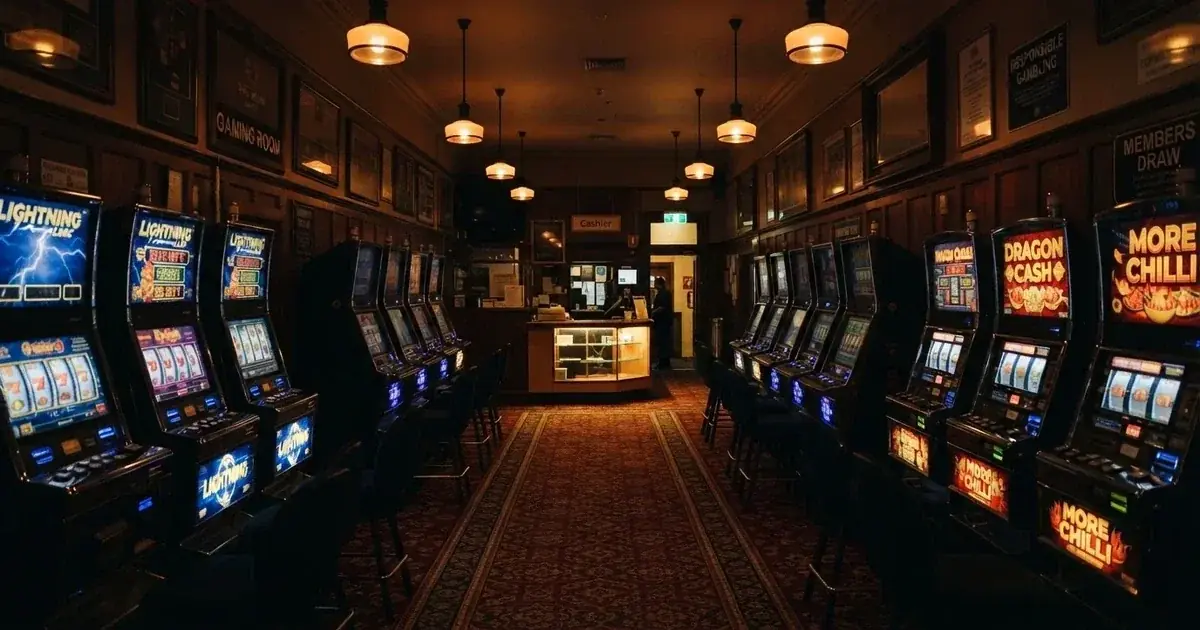
- Licensed venues, opening hours and what “open near me” actually points to
- Online operators the ACMA has warned — and what that warning actually means
- Choosing a way in — the licensed option versus the offshore offer
- Frequently asked questions
- Closing on the choice the page sits on
The picture before you start searching
Three things hold across the country. First, electronic gaming machines — “pokies” everywhere except in Western Australia, where the equivalent gaming machines operate only inside the casino — exist in every state and territory under separate regulators who set their own rules, return-to-player minimums and harm-minimisation tools. Second, the share of those machines is wildly uneven. New South Wales alone runs 87,298 gaming machines outside its casinos across 2,195 venues (Liquor & Gaming NSW data for June 2023), with player losses of A$8.18 billion reported for the 2022–23 financial year. Queensland had 21,122 machines in 351 venues in October 2023. Victoria runs 26,380 machines outside Crown Casino across 488 venues (2021–22) under a hard statewide cap of 30,000. Western Australia, by contrast, permits these machines only at Crown Perth, where the count has grown from roughly 200 in 1985 to about 2,500 — all approved by the state’s Gaming and Wagering Commission since the day the casino opened. Third, Australia holds about 3% of the world’s pub and club poker machines while carrying around 0.3% of the global population. In 2020–21 almost A$150 billion was wagered through gaming machines and A$12.18 billion was lost on them — a per-capita density unmatched anywhere else the machines operate.

That is the landscape the search sits inside. It explains why “open near me” is rarely a question about whether the country has venues — there are tens of thousands of them — but about which one is serving drinks, has the gaming room unlocked, and is not subject to a state-wide self-exclusion order against the player asking. The remaining sections work through how that landscape is regulated, how to stay inside it, and how the offshore sites that appear in the same search results have nothing to do with it.
How Australia regulates its machines — and why no offshore site can be “Australian-licensed”
Each state and territory writes its own gaming machine law, sets its own licensing regime, and decides on the harm-minimisation settings attached to every machine. The minimum return-to-player is the clearest number to take across: 85% in NSW, the Northern Territory, Queensland and (generally) Victoria, 87% at Crown Melbourne specifically and in both the ACT and Tasmania, 87.5% in South Australia, and 90% in Western Australia for the machines that exist there. If you ever see an online site claiming a “97%” payout for an “Australian” pokies game, that figure is being printed by a marketing department, not by a state regulator — the highest mandated floor in the country is the WA 90% number, and that jurisdiction runs no pub or club machines at all.
The federal layer sits on top. The Interactive Gambling Act 2001 (IGA) defines what an “interactive gambling service” is and makes it an offence to provide certain gambling services to customers physically present in Australia. The Interactive Gambling Amendment Act 2017 closed the loophole that had let offshore operators market to Australians, specifically prohibiting online casinos, online pokies and in-play betting. The IGA targets the provider, not the individual player — an Australian who opens an offshore casino account is not prosecuted — but the site itself is operating outside Australian law and an Australian consumer using one has no local complaint body and no local recourse if a withdrawal is refused.
What the country does license is wagering on racing and sport (when the bet is placed before the event), lotteries and keno. In practice, the bulk of licensed online bookmakers are Northern Territory–licensed: the Northern Territory Racing and Wagering Commission (NTRWC) regulates 52 online bookmakers, including Sportsbet, Bet365 and Ladbrokes, a fact that occasionally surprises readers who assume the biggest Australian bookmakers are Melbourne or Sydney businesses. The NTRWC itself has no full-time staff and meets once a month in Darwin — the territory grants the licences for tax reasons and the regulation runs through casework rather than continuous inspection. Online casino games are not in that licensed set, anywhere in the country.
Then come the ways the regime actually closes the gap. The ACMA investigates suspected breaches, issues formal warnings naming both the licence-holder behind the site and the trading brand, and can direct Australian internet service providers to block illegal sites at the DNS level. By June 2026 the ACMA had asked ISPs to block a running total of 1,751 illegal gambling and affiliate marketing websites, starting from November 2019 — that is the running ledger. A single June 2026 round alone added twelve more: 7Signs, ChromaBet, Donbet, Duospin, Freshbet, Slots Gem, Jacks Club, Lucky Start, Pointsbetz, Spinrise, Vinyl Casino and Wildsino. More than 230 unlicensed services have left the Australian market entirely since enforcement was strengthened in 2017. None of this changes the legal status of an Australian who visits an offshore site; it does mean the site itself keeps being chased by a regulator with both a public warning register and the power to ask for the lights to be cut.
Three operational points follow from that regulatory shape, and they are the ones that decide what a player comparing options actually has to weigh.
First, the legal floor for a land-based machine and the marketing number printed on an offshore game are not talking about the same product. A pub machine has to meet a state-mandated return-to-player percentage and pay it out across a long, audited lifetime of play; an offshore game is built around a developer’s chosen return profile and sits inside a site that has no obligation to honour any figure if the customer is in a prohibited jurisdiction. The 90% WA ceiling is higher than every pub-RTP floor in the country for a reason — at the casino, the regulator cannot inspect the machines frequently, so the figure itself does some of the consumer-protection work.
Second, the harm-minimisation settings differ enormously across state borders. Tasmania’s mandatory pre-commitment card scheme — the nation-leading reform that requires players to set a daily, weekly or monthly cap before the machine will accept their money — was signed into law in 2021 but its implementation has been pushed back repeatedly and is now scheduled for late 2025. NSW has its own “responsible gambling officer” requirements, mandatory card play limits and a confidential self-exclusion register that bars the player from every gaming venue in the state for a chosen period. None of these tools exist on the offshore site that markets itself next to the search results; nothing in this article’s reach will make them appear there.
Third, the regulator the reader has never heard of is often the regulator that did the work. The ACMA’s enforcement actions are public, dated, and named to both the trading brand and the corporate operator behind it. That is the most useful cross-check a reader comparing search results can do, because the warnings tell you not only which brand has been acted against, but the date of the action, the licence-holder named, and the section of the Interactive Gambling Act the regulator says has been breached. The brand marketing itself to you will give you none of that.
What player protection actually looks like — and why the offshore option strips it out
The first thing to clear up is that the offshore “online pokies” product is not a complementary channel to a pub machine. It is a separate product, regulated (or not) under a different legal regime, and the protections a player relies on at the pub are not transferred. The harm-minimisation toolkit you have in a licensed venue is the legal minimum, not a courtesy.
BetStop, the National Self-Exclusion Register, has been live since August 2023 and lets a player exclude themselves from every Australian-licensed online and phone wagering service with a single registration. It binds licensed operators; an offshore casino that has no Australian licence is not bound by the register, does not consult it, and will not honour the exclusion a player set up elsewhere. The National Gambling Helpline (1800 858 858) is free, runs 24 hours a day, seven days a week, and offers chat through Gambling Help Online. Both services sit inside the country the licensed pub or club operates in; neither one has any line to the customer account sitting in an offshore casino.
The payment rules tell the same story from the other side. Since 11 June 2024, Australian-licensed online and phone wagering services cannot accept credit cards, credit-related products or digital currency as a deposit — civil penalties run up to A$247,500 per offence, and the rules are enforced. A licensed operator accepting a deposit routes it through debit card, bank transfer, PayID/Osko or BPAY. An offshore casino that asks you for a credit-card deposit or a crypto top-up is not just operating outside the Australian rules on which games it offers; it is also operating outside the Australian rules on how the deposit moves. Neither a chargeback through your Australian bank nor a complaint to the Australian Financial Complaints Authority has any purchase against an offshore site that declines to engage.
The dollar cost of the gap is large enough that an industry estimate is worth holding in mind. H2 Gambling Capital’s 2025 report puts Australians’ losses to illegal offshore gambling sites at around A$3.9 billion a year, and records the share of gambling going through legal Australian channels falling from 74% in 2021 to 64% — a ten-point drop in four years driven by consumer spend the regulator cannot tax, supervise, or refuse to honour. The legal floor is in place; the leakage is the part the regulator spends its time chasing.
A practical way to think about the contrast: a player who walks into a NSW pub and asks to be barred from the gaming room is using a state-level self-exclusion register that binds the venue, the pub’s other venues if there is a chain, and the regulator’s compliance team. A player who opens an offshore account and asks the same of the offshore site has asked a service provider operating outside Australian jurisdiction to honour an Australian-style protection; whether anything happens depends on the site’s own house rules.
Licensed venues, opening hours and what “open near me” actually points to
The search for “pokies open near me” runs against a simple physical fact: the machines are inside buildings, and the buildings open on a schedule. State-level rules and venue-level decisions set that schedule, and the easiest way to read it is by venue type.
Pubs (the broader Australian “hotel” category) cluster the gaming room at the back of the building, often near the bar. In NSW, the largest market by machine count, pubs with gaming machines stay open in line with the pub’s licensed hours — many close their gaming room at midnight or 1 a.m. on weekdays and push to 2 a.m. or 3 a.m. on Friday and Saturday nights, with hot-water and food-service requirements that limit the late-night window further than the gaming entitlement alone would. The 2,195 NSW venues outside the casino carry 87,298 machines, which works out to around 40 machines per venue on average. A player in metropolitan Sydney or Melbourne looking for “open now” is choosing between hundreds of venues within a five-kilometre radius, and the practical filter is usually the venue’s kitchen hours, the local council’s late-night trading rules and whether a venue’s general manager has closed the gaming room early for a function.
Registered clubs are the other big cluster, and in regional Australia often the dominant one. Clubs sit under slightly different hour rules than pubs in most states, and a club RSL, leagues club or workers’ club will frequently run later than the local pub, particularly on weekends. Victoria’s gaming machine count outside Crown is 26,380 across 488 venues, Queensland’s is 21,122 across 351 venues — both figures distributed disproportionately across regional club networks. A regional player searching “open near me” is more often choosing between two or three registered clubs within driving distance than between dozens of pubs.
Casinos are the third option and the only place certain games are offered at all in some states. Crown Melbourne runs three baccarat variants — Traditional, Crown and “2 to 1” Baccarat — under the Victorian Gambling and Casino Control Commission, which replaced the VCGLR as the casino regulator on 1 July 2022. Crown Perth runs gaming machines under the Gaming and Wagering Commission of Western Australia, which is the only place in the state where they legally operate. The Star in Sydney sits under the NSW Casino Control regime; section 66 of the NSW Casino Control Act 1992 prohibits a casino operator from offering any game (including baccarat) unless the rules have been approved by the regulator, and a copy of the approved rules must be available to patrons on request. Casino floors generally run well past pub hours — 4 a.m. is common in Sydney and Melbourne on Friday and Saturday — and some of the table-game areas close before the rest of the floor for staff-management reasons.
The live “is it open right now” question therefore reduces to four practical checks a player can do in the time it takes to drive there. Look at the venue’s own social feed for the day’s hours, particularly the gaming room rather than the bar. Look at the council or state night-time-economy rules that apply to the suburb — late-night trading limits cap the gaming room in many inner-city postcodes. Ring the venue if the search has narrowed it to one or two options. And check the state-level self-exclusion register before you go, because the venue is bound to refuse entry if your name is on it.
The “open at 7 a.m.” request points almost exclusively to pubs and clubs in regional centres that have an early licence, and to casino floors in the major capitals. Hotel “gaming room open at 7 a.m.” does not happen in most of suburban Sydney or Melbourne on a weekday; it does happen at the casino, and it does happen at registered clubs in some regional areas. The “24 hours near me” variant is again the casino floor, plus a small number of registered clubs in some states with extended trading, and not the local pub. Anyone arriving at a suburban pub before midday on a Tuesday looking for the gaming room will find the door locked.
Two cross-state differences are worth naming because they change the answer to the same hour question. Western Australia, as covered earlier, does not run pub or club machines at all — the only “pokies near me” result for a player in Perth is Crown Perth itself. The Northern Territory, similarly, operates pokies only in licensed venues and the one casino, Lasseters in Alice Springs and Sky City in Darwin. Tasmania ran poker machines under a single monopoly licence from 1968 until November 2021, when legislation passed both Houses moved the machine oversight from Federal Group to the Tasmanian Liquor and Gaming Commission — meaning the pre-monopoly machine, the post-reform machine and the planned mandatory pre-commitment card all sit under different regulator umbrellas over a player’s lifetime. None of these differences changes the basic shape; they just set which doors the search is actually pointing at.
Online operators the ACMA has warned — and what that warning actually means
The review below does not rank. It does not recommend. It places side by side the public actions the ACMA has taken against each trading brand, the corporate operator named in the warning, and the date of the action — the only publicly verifiable record of how each brand has interacted with Australian consumer-protection law. The Interactive Gambling Act 2001 makes it an offence to provide online casino games to a person in Australia. The ACMA’s enforcement is against the provider, not against an Australian who opens an account. Reading each row tells you what the regulator has already decided; the reader’s own judgement is what follows.
| Brand | ACMA action and date | Operator named by the ACMA | Subject support |
|---|---|---|---|
| RocketPlay | Formal warning under the Interactive Gambling Act 2001 — first Pulsup Ltd (Rocketplay) March 2026; earlier Dama N.V., May 2022 | Pulsup Ltd; Dama N.V. | — |
| Level Up Casino | Formal warning under the Interactive Gambling Act 2001, May 2022 | Dama N.V. | Listed by game supplier (listings-only) |
| Woo Casino | Formal warning under the Interactive Gambling Act 2001, March 2025 | Dama N.V. | — |
| Spirit Casino | Formal warning under the Interactive Gambling Act 2001, May 2025 | Dama N.V. | — |
| National Casino | Formal warning under the Interactive Gambling Act 2001, July 2025 | Consolutetish S.R.L. | Listed in general directory (listings-only) |
| Bizzo Casino | Formal warning under the Interactive Gambling Act 2001, July 2025 (earlier 2022) | Consolutetish S.R.L.; earlier TechSolutions | — |
| Ignition Casino | Formal warning under the Interactive Gambling Act 2001, July 2025 | Bamboo Media | — |
| Instant Casino | Formal warning under the Interactive Gambling Act 2001, February 2025 | EOD Code SRL | — |
| Jackbit | Formal warning under the Interactive Gambling Act 2001, April 2026 | Ryker B.V. (Jackbit and CasinOK named) | — |
| Casino Intense | Formal warning under the Interactive Gambling Act 2001, April 2025 | Sterplay Holding Ltd | Listed in directories, including past ABC reporting (listings-only) |
| Sky Crown | Formal warning under the Interactive Gambling Act 2001 | Hollycorn N.V. (Sky Crown and Blue Leo named) | — |
The column that stays empty is the substantive one. Subject support — the verification that any of these sites can actually deliver an Australian-facing product — is no-data for almost every brand on the list. That is the actionable finding for a player weighing a search result.
RocketPlay
The ACMA has acted against the RocketPlay trading name twice, naming a different corporate operator each time. The earlier May 2022 warning put Dama N.V. on the regulator’s record as the licence-holder behind the site; the more recent March 2026 warning named Pulsup Ltd as the operator of Rocketplay. Two warnings, two different corporate owners of the same trading brand, neither one licensed to provide online casino games to a person in Australia. The site has been in the regulator’s cross-hairs for four years, which is more useful to know about the brand than any “welcome offer” page.
For a player who has been directed here from a search result: the brand itself acknowledges the regulator’s attention only by moving the corporate entity behind it. That does not change the legal status. The site is offering an online casino product to Australians, the IGA prohibits that product, and the ACMA has done the public-register version of “we have told you before, here is the date and the operator named on your licence documents.” If a player has been considering an account here, the next decision is the player’s own: the regulator has already made its call.
Level Up Casino
Dama N.V. was named in the ACMA’s May 2022 warning covering a batch of six brands that included Level Up, and the brand’s appearance on game suppliers’ listing pages is what the marketing-side of the operation has used to claim legitimacy. The listing presence only confirms that a game studio supplies the site; it does not confirm the site has any right to offer its product to a player in Australia. The legal status — online casino games prohibited under the IGA — remains unchanged.
The level-up.co and related domains have continued to appear and reappear through different corporate vehicles over the years, which is itself a signal. The Dama N.V. corporate group has been on the receiving end of multiple ACMA actions across its sub-brands, and the regulator has used the formal warning specifically to point out that the IGA’s prohibition applies irrespective of the operator’s licensing position elsewhere in the world.
Woo Casino
Woo Casino entered the ACMA’s record in March 2025, when the regulator warned Dama N.V. — the same operator named for Level Up — over the brand’s offering to Australian customers. The product category is online casino games, the prohibition comes from section 15A of the Interactive Gambling Act 2001 (as amended in 2017), and the regulator’s press release on the warning names the operator and the date. That is the public record; the site’s marketing is not.
From a player’s standpoint, Woo Casino sits in the same bucket as every other brand on this list: the product on offer is the product the IGA prohibits, and the regulator has already put the corporate operator on notice. The marketing side’s response to multiple ACMA warnings across the same corporate group is, in practice, to keep the brand in rotation and rotate the corporate vehicle. The reader is being asked to make a deposit into a site whose home regulator has explicitly told the operator that the deposit cannot lawfully be accepted from an Australian.
Spirit Casino
The May 2025 ACMA warning named Dama N.V. over Spirit Casino — the third Dama N.V. brand on this list after Level Up and Woo Casino, and part of the regulator’s pattern of action against the same corporate group. Spirit Casino’s marketing emphasised game variety and a fast-payout pitch in the year before the warning; the regulator’s response was the standard formal warning under the IGA with both the operator named and the relevant section of the Act cited.
The published date of the warning tells the reader when the regulator made its position clear; it does not tell the reader whether the brand has changed anything in response. The corporate group has, in other cases, simply moved on to a fresh trading name. Spirit Casino, at time of writing, sits in the public-warning register and not in the blocked-sites list maintained by Australian ISPs.
National Casino
Consolutetish S.R.L. took the formal warning for National Casino in July 2025, part of the same round that produced the Bizzo Casino warning. National Casino has appeared as a player-facing brand on directory and aggregator sites, which is the listings-only support research has been able to confirm — a passive appearance in someone else’s index is not a regulatory endorsement. The operator named by the ACMA is a corporate vehicle that does not appear in the licensed wagering or lottery registers maintained by any Australian state or territory.
The site’s marketing emphasis on “Australian players welcome” — common across this group — is the very claim the IGA prohibits being made to a person physically present in Australia. The ACMA’s enforcement is the regulator’s view that the brand’s offer falls inside the prohibition. A reader already on the page is being asked to take a position the regulator has already decided against the brand on.
Bizzo Casino
Two separate ACMA actions sit behind Bizzo Casino. The earlier one, in 2022, named TechSolutions (CY) Group Limited and TechSolutions Group N.V. The July 2025 warning named Consolutetish S.R.L. and placed Bizzo Casino alongside National Casino as part of the same enforcement round. Two corporate operators, two warning dates, one trading brand that keeps appearing in the search results despite the regulatory history. That is the operational shape of an offshore brand pursuing the Australian market: when one licence-holder receives a warning, the brand often moves to another.
The 2022 warning has been on the public record for several years now; the 2025 warning is fresh. From the reader’s perspective, the most useful point is that the brand has been visited by the regulator on more than one occasion, and the corporate group behind it has changed between the visits. The legal status of the product being offered is unchanged across both.
Ignition Casino
The ACMA’s July 2025 warning to Bamboo Media covered both Ignition Casino and the brand’s affiliate traffic into Australia. Bamboo Media does not appear in any Australian state or territory register as a licensed operator, and the Ignition Casino brand does not appear on the ACMA’s “this brand holds an Australian wagering licence” list because no such licence exists for casino-style games. The formal warning is the regulator’s public note that the brand’s offer to Australians is a breach of the IGA, not an opportunity for the brand to regularise its position.
From outside the corporate structure, this is what the Ignition Casino entry looks like: a brand marketed to Australians, a corporate operator who took the regulator’s warning on the brand’s behalf, and no entry in any register a reader could use to verify the claim of Australian service. The product on offer is the product the IGA prohibits.
Instant Casino
EOD Code SRL was named in the ACMA’s February 2025 formal warning to Instant Casino. EOD Code SRL was a relatively fresh corporate vehicle at that point, which is consistent with the operator-rotation pattern visible across this group. The regulator’s warning was for offering prohibited online casino games to people in Australia — the same section of the IGA, the same enforcement instrument, the same public outcome.
Instant Casino’s marketing materials at the time of the warning emphasised speed of withdrawal and a streamlined registration flow, two pitches that specifically appeal to a player looking for “pokies open near me now”. The speed of an offshore withdrawal is not a regulatory feature; it is a marketing feature, and the ACMA’s notice is the part of the page that records where the regulator stands on it.
Jackbit
The April 2026 warning to Ryker B.V. named both Jackbit and CasinOK as the operator’s Australian-facing brands. The warning falls inside the recent enforcement window — a couple of months before the running block-list total of 1,751 was reported in June 2026 — and it is the kind of action the ACMA has used most frequently as the first step in a longer escalation that ends, in some cases, with the site being added to the block list.
For the reader: a formal warning less than two months before the most recent block-list count means the brand has been at the regulator’s working level for a relatively short time, but the IGA prohibition it has been warned about is the same one that has driven every other warning on this page.
Casino Intense
Sterplay Holding Ltd received the ACMA’s April 2025 formal warning over Casino Intense. The brand has appeared in directory listings and, in past reporting by the ABC, has been treated as part of the offshore offering to Australian consumers. The “listings-only” support research was able to confirm means the brand has been written about and indexed; it does not mean the brand has any Australian licence or has been endorsed by any Australian regulator. The ACMA’s warning is the regulator’s view that the offer is a breach.
This is one of the longer-running brands in the set — the ACMA’s action is comparatively recent, but the brand has been in front of Australian customers for longer than that. The useful contrast is between appearance in directories (passive, aggregator-driven) and a regulatory record (active, regulator-driven). Casino Intense has the first and has earned the second.
Sky Crown
Hollycorn N.V. was named in the ACMA’s formal warning over both Sky Crown and Blue Leo, an action with the date carried forward from the published PDF record. Hollycorn N.V. is the same corporate group behind several brands that have appeared in ACMA enforcement; the warning puts this particular trading name on the regulator’s list and pairs it with Blue Leo. The product on offer is the same as the rest of the list — online casino games prohibited by the IGA.
Sky Crown’s marketing, in the period before the warning, leaned heavily on game variety and on the look-and-feel of an Australian-facing offer. The marketing description is not a regulatory description; the ACMA’s record is. The brand has been acted against by the regulator and continues to appear in search results; the gap between those two things is exactly the gap the IGA creates and the ACMA’s enforcement work addresses.
Choosing a way in — the licensed option versus the offshore offer
The choice, for an Australian player looking at “pokies open near me”, is between two very different things and only one of them is fully inside Australian law. A useful way to think about the difference is by what each option offers when the player runs into a problem.
The licensed venue — a pub, registered club or casino in NSW, Queensland, Victoria, Tasmania, the ACT, the Northern Territory or South Australia — sits inside a state-level regulator that has named it, knows its opening hours, audits its machines, and offers the player a complaint path. If the machine malfunctions, the venue reports it to the regulator. If the venue refuses payout on a claimed win, the player has a state-level dispute path and an appeals body. Self-exclusion is honoured across venues in the same state. The taxation is set by the state government’s gaming duty regime. And the deposit — for the table games at the casino, the only land-based option that takes a deposit rather than cash tokens — moves through Australian payment rails.
The offshore option offers none of that. The site has no Australian licence, no local dispute path, and no obligation under any of the state-level harm-minimisation settings. The deposit moves through a payment processor that the Australian rules have either banned (credit card, crypto) or operate through a financial intermediary that does not carry an Australian financial-services licence. The ACMA has either warned the operator already or is on its way to doing so, and an Australian consumer using the site has no way to bring a complaint through an Australian body that the offshore operator is bound to recognise. That is the consumer-side trade the player is making.
Within the licensed option, the hour-shape that the search result actually offers depends on which state the player is in. NSW and Queensland dominate the machine count and therefore the choice of venues; Victoria sits under a hard cap that has held the machine total flat for years; Tasmania and the ACT run smaller markets with lower RTPs in some cases; Western Australia runs no pub or club machines, leaving only Crown Perth. The casino option — Crown Melbourne, Crown Perth, The Star Sydney — extends hours well past the pub floor, and carries the widest game variety at the cost of an entry formality the local pub does not impose.
A second filter that narrows the choice further is self-exclusion. Anyone who has been barred from gaming venues at the state level is barred from every licensed venue in that state for the chosen period, regardless of opening hour or distance. BetStop extends a similar exclusion across Australian-licensed online and phone wagering; it does not reach offshore sites. The licensed option forces the exclusion on the player; the offshore option does not, because the offshore site is not bound by the register.
The third filter is age. The minimum age across every Australian jurisdiction is 18; venues are required to check identification, and a player under 18 cannot enter the gaming room or be served at the cashier. The casino floor runs the same age check at the entrance. Offshore sites generally accept anyone who can pass an automated ID upload, with the regulatory consequences falling on the operator, not on the player — but the player’s bank, payment processor or cryptocurrency exchange may decline the deposit separately, which is its own kind of rejection.
Frequently asked questions
What hours do most Australian pubs and clubs typically keep their poker machines open?
Most pub and club gaming rooms open with the venue and close one or two hours before the venue’s last bar call — typically midnight to 2 a.m. on weekdays, 2 a.m. to 4 a.m. on weekends, depending on the council’s late-night trading rules and the venue’s own licence. The casino floors at Crown Melbourne, Crown Perth and The Star Sydney run the longest, often to 4 a.m. or later.
Is there a way to check which nearby venue currently has poker machines open right now?
There is no national live-status feed for pub and club gaming rooms. The practical options are the venue’s social feed or website, the state regulator’s venue register (which lists the licence status but not the daily hour), a phone call to the venue, or the state night-time-economy rules that cap trading in your suburb. The casino floor is generally open whenever the casino’s main entrance is.
Are poker machines in a licensed pub or club the same thing as an online pokies game?
No. Pub and club machines sit inside an Australian state or territory regulator, carry a mandated minimum return-to-player (between 85% and 90% depending on jurisdiction), and operate under state harm-minimisation settings. Online pokies offered offshore have no Australian licence, no mandated RTP, and no connection to BetStop, the National Self-Exclusion Register or any state harm-minimisation rule.
Do all pubs and clubs run pokies for 24 hours, or only some venues?
Only some. Casino floors run the longest hours; a small number of registered clubs in regional centres trade gaming rooms into the early morning; pub gaming rooms almost always close with the venue. No pub in Western Australia runs gaming machines at all — pub and club pokies were banned in WA in 1985 when Crown Perth opened, and the only machines in the state are inside Crown Perth itself.
What identification, if any, does a venue ask for before letting someone play the machines?
Every Australian venue is required to check that the player is at least 18. Most pubs and clubs run a single sign-in at the gaming room door, often with a swipe-card system that records entry and time. A player on the state-level self-exclusion register is refused entry at the same point. The casino floor runs a more thorough check, including photographic ID at the entrance and a cash cage that requires ID before a large payout. The minimum age rule is 18 in every jurisdiction.
How does the number of poker machines in Australian venues compare with the rest of the world?
Australia holds about 3% of the world’s pub and club poker machines while carrying around 0.3% of the global population. In NSW alone there were 87,298 gaming machines across 2,195 venues outside the casino in June 2023, with player losses of A$8.18 billion in 2022–23. Per-capita machine density in Australia is the highest of any comparable regulated market.
Closing on the choice the page sits on
What this page adds up to is not a list of offshore sites to try; that list cannot exist under Australian law. The legal shape of the market is fixed by the Interactive Gambling Act 2001, and the consumer-side answer to the player who has reached the bottom of a search-engine results page is that the licensed option is the only option whose hours, payouts and harm-minimisation tools an Australian regulator has approved. The pub, club or casino near the player’s home is the way in; the offshore site beside the licensed venue in the search results is the way out. Closing that loop is the consumer choice this page supports, and it is the one the regulator’s enforcement work assumes the consumer is going to make.