
High roller casino bonuses for Australian players: the legal shape of the market in 2026
A player looking for the best high roller casino with bonus in Australia quickly runs into a wall the marketing pages do not show. Online casino games — pokies, table games, live dealer studios — cannot be licensed for Australian customers. The Interactive Gambling Act 2001 prohibits offering them, the Australian Communications and Media Authority enforces that prohibition with formal warnings and site-blocking requests, and no state or territory issues a licence for the product. A page that hands over a confident shortlist of “best high roller casinos Australia” is one that has skipped past this. High roller casino bonuses for Australian players — More on this topic at crypto casino au .

What follows works within that frame. It sets out what the ACMA has done, which payment routes Australian banks actually allow, which bonuses on offer to offshore sites are structured in a way that costs the player more than the marketing suggests, and where a high-stakes player who wants everything above board can lawfully go: licensed pokies venues, land-based casinos and the BetStop self-exclusion register.
Data current as of 29 October 2026, checked against the ACMA’s published register of formal warnings and blocking requests.
Table of Contents
- How high-roller play looks on a phone in Australia
- Which games and providers sit behind the marketing
- The brands the ACMA has acted against
- The Australian law that shapes every offer
- How the ACMA enforces the prohibition
- Payment routes and what the banks actually allow
- What a “high roller bonus” actually costs
- Responsible gambling: the tools that work and the ones that don’t
- Where a high-stakes player can lawfully play
- What a high-spending player should check before trusting any site
- Frequently asked questions
How high-roller play looks on a phone in Australia
The phone-screen experience is where most of this market lives now. Australians tap into offshore sites the same way they would any other browser page, because the Interactive Gambling Act 2001 makes it the provider that breaks the law, not the punter. That legal shape matters: the player is not prosecuted for using these sites, but the protections that come with a regulated market — a complaints body, a payout guarantee, a connection to BetStop — do not extend offshore either.

The payment picture is where the phone experience actually breaks. ANZ, Westpac and Commonwealth Bank all run a gambling block on their cards that works at merchant-category-code level; activating it in the relevant banking app stops most gambling transactions on that card and, in ANZ’s case, on linked digital wallets too. Once ANZ’s block is on, lifting it again waits out a 48-hour cooling-off period, and the bank warns that not every gambling transaction will be caught and that some non-gambling purchases may be blocked in error.
Apple Pay and Google Pay are now a large slice of how Australians pay for things. By the end of 2025 they and Samsung Pay together carried roughly 45 per cent of all card payments in Australia by number. Apple Pay itself does not charge a fee to the customer — any surcharge is the merchant’s card-processing cost, not Apple’s. The transaction limits and PIN rules belong to the card issuer and the merchant, not to Apple. None of that changes the underlying rule: under the Interactive Gambling Act 2001 as amended in 2023, Australian-licensed online wagering services cannot accept credit card or credit-related products, and that restriction bites against a digital wallet linked to a credit line.
The result on a phone in Australia: a player who wants to put real money into an offshore casino from a debit card or wallet has to actively turn the bank’s gambling block off, then accept that the block exists for a reason. The block is not a suggestion; it is a tool the customer’s own bank built because losses to illegal offshore sites run into the billions.
Which games and providers sit behind the marketing
High-roller pages outside Australia tend to lean on a few familiar names — Evolution for live tables, Pragmatic Play for slots, NetEnt for the catalogue. None of that is the deciding question for an Australian reader. The deciding question is whether any of those games can be offered to a person in Australia under an Australian licence, and the answer is no.
What the ACMA’s enforcement record shows is not the size of a provider’s catalogue but the pattern of how offshore operators get named. Dama N.V. picked up formal warnings in May 2022, March 2025 and May 2025 — across six brands in 2022 (Bambet, Dazard, Level Up, Rocketplay, Wild Tornado, Cobra Casinos) and then Woo Casino and Spirit Casino in the later round. Consolutetish S.R.L. drew a July 2025 warning covering National Casino and Bizzo Casino; Bizzo had already been warned in 2022 against a different corporate parent. Hollycorn N.V. picked up a warning covering Sky Crown and Blue Leo. The pattern is not one rogue brand; it is a parade of operators cycling through corporate shells while the underlying product stays the same.
What a high-stakes player actually sees on the games front is the standard offshore template: a slot library in the low thousands, live tables running around the clock, jackpot networks attached to the larger providers. The catalogues are large. The legal status of every title in them, for an Australian reader, is identical: prohibited.
For anyone whose interest is genuinely high-stakes play, the lawful Australian version sits in land-based casinos and licensed clubs. Crown Melbourne, Crown Perth, The Star Sydney and The Star Gold Coast run high-limit rooms; Skycity Adelaide and the casino at Lasseters in the Northern Territory round out the national footprint. Queensland’s Treasury Casino and Jupiters on the Gold Coast, and Wrest Point and the Country Club in Tasmania, complete the picture. The high-roller rooms there are licensed, the cash handling is regulated, and a complaint has somewhere to land. The product on the floor is pokies, table games and poker — not the offshore online catalogue, but the lawful Australian version of the same idea.
The brands the ACMA has acted against
The eleven brands below are not a ranking. Each is named because the ACMA itself issued a formal warning under the Interactive Gambling Act 2001 for offering prohibited online casino services to people in Australia. The publication of those warnings is the ACMA’s own act; the list exists to put the marketing pages a reader meets into their proper legal shape.
| Brand | ACMA action and date | Operator named by the ACMA | Subject support |
|---|---|---|---|
| RocketPlay | Formal warning, March 2026; earlier May 2022 (Dama N.V.) | Pulsup Ltd | listings-only (Gambling Insider) |
| Level Up Casino | Formal warning, May 2022 | Dama N.V. | listings-only (Westpac gambling-block page) |
| Woo Casino | Formal warning, March 2025 | Dama N.V. | — |
| Spirit Casino | Formal warning, May 2025 | Dama N.V. | — |
| National Casino | Formal warning, July 2025 | Consolutetish S.R.L. | listings-only (ACMA, AUSTRAC, BetStop) |
| Bizzo Casino | Formal warning, July 2025; earlier 2022 (TechSolutions) | Consolutetish S.R.L. | listings-only (Gambling Insider) |
| Ignition Casino | Formal warning, July 2025 | Bamboo Media | — |
| Instant Casino | Formal warning, February 2025 | EOD Code SRL | listings-only (EcoPayz, PayID) |
| Jackbit | Formal warning, April 2026 | Ryker B.V. | — |
| Casino Intense | Formal warning, April 2025 | Sterplay Holding Ltd | listings-only (AUSTRAC, BetStop, Gambling Insider) |
| Sky Crown | Formal warning, September 2022 | Hollycorn N.V. | — |
Two patterns sit underneath that table. The first is that Dama N.V. alone accounts for three entries across four years under three different brand banners, with the corporate parent named each time. The second is that a brand can be re-warned under a new corporate owner after a warning to a previous one — Bizzo Casino went from a 2022 warning against TechSolutions to a 2025 warning against Consolutetish S.R.L. without the product changing.
RocketPlay — freshest of the warnings
RocketPlay drew a formal warning in March 2026, the most recent in the set. The ACMA named the operator as Pulsup Ltd. The brand had already been warned in May 2022 under Dama N.V., with a different corporate parent. The “listings-only” entries on Gambling Insider describe a general offshore product offering — they do not assert any Australian-law status. For an Australian reader, the relevant facts are unchanged: online casino games cannot be licensed in Australia under the Interactive Gambling Act 2001, and RocketPlay sits on the ACMA’s published warning list under two operators across four years.
Level Up Casino — Dama N.V. in May 2022
Level Up Casino was named in the May 2022 round of warnings, alongside Bambet, Dazard, Rocketplay, Wild Tornado and Cobra Casinos, with Dama N.V. as the operator the ACMA named. The Westpac gambling-block page mentions the brand in its merchant-category guidance, which is how Level Up surfaces in the cross-reference listings; it is not a licence or an endorsement. The legal position is the same as every other entry on the table: prohibited product, no Australian licence, no Australian consumer protection.
Woo Casino — Dama N.V. in March 2025
Woo Casino sits in the March 2025 round. The ACMA again named Dama N.V. as the operator. There is no Australian licence to attach to this brand; the marketing claim of a Curaçao or other offshore licence does not extend the Interactive Gambling Act 2001’s prohibition. A high-stakes player reading this should treat the licence a site displays as a piece of branding, not as anything that changes what the ACMA has said.
Spirit Casino — Dama N.V. in May 2025
Spirit Casino drew its warning two months after Woo Casino, again with Dama N.V. named. Across two months in 2025 the same corporate parent picked up two more formal warnings. The product the ACMA found prohibited is the same: online casino games and online pokies offered to a person in Australia. The high-stakes label is marketing; the legal shape is unchanged.
National Casino — Consolutetish S.R.L. in July 2025
National Casino sits in the July 2025 round, with Consolutetish S.R.L. as the named operator. The ACMA, AUSTRAC and BetStop each carry entries that mention this brand in passing — not as endorsements, but in the register’s broader tracking of prohibited activity. For a high-stakes player, the relevant fact is the warning itself, not the cross-references.
Bizzo Casino — warned twice, two operators
Bizzo is unusual in that the ACMA has warned it twice. The first warning was in 2022, against TechSolutions (CY) Group Limited and TechSolutions Group N.V. The second was in July 2025, against Consolutetish S.R.L. — the same operator named in the same round for National Casino. The product on offer did not change between those warnings; the corporate parent did. Gambling Insider lists the brand among the broader set. The cycle is itself the pattern: a brand is warned, the corporate shell is changed, and the brand is warned again.
Ignition Casino — Bamboo Media in July 2025
Ignition Casino drew a July 2025 warning with Bamboo Media as the named operator. There is no Australian licence and no cross-reference entry to extend the picture. The brand name is one of the more recognisable in the offshore market, which is why it surfaces frequently on affiliate pages — recognisability is not a credential the ACMA recognises.
Instant Casino — EOD Code SRL in February 2025
Instant Casino drew the earliest formal warning in this set, in February 2025. The ACMA named EOD Code SRL as the operator. EcoPayz and PayID both list the brand in cross-reference material; neither is an endorsement of any kind. The legal status remains the same.
Jackbit — Ryker B.V. in April 2026
Jackbit sits in the April 2026 round with Ryker B.V. as the named operator. There is no Australian licence, no cross-reference entry that adds to the picture, and no consumer protection. The product is the same prohibited catalogue the ACMA has been warning against for years.
Casino Intense — Sterplay Holding Ltd in April 2025
Casino Intense drew a formal warning in April 2025 against Sterplay Holding Ltd. AUSTRAC, BetStop and Gambling Insider all carry entries that mention this brand in passing. The relevant fact is the warning; the rest is noise.
Sky Crown — Hollycorn N.V. in September 2022
Sky Crown sits in the oldest slot on the table, a September 2022 warning against Hollycorn N.V. The same operator drew a warning for Blue Leo at the same time. The intervening years have not changed the legal position.
The Australian law that shapes every offer
The Interactive Gambling Act 2001 makes it an offence to provide online casino games — pokies, table games, in-play betting on sport — to a person in Australia. The Interactive Gambling Amendment Act 2017 strengthened that framework, and the Interactive Gambling Amendment (Gambling Reform) Bill 2026, which passed Parliament on 19 August 2026, layers further advertising and inducement measures onto the existing prohibition. Those new measures commence on 1 January 2027; on a 2026 page they are law with a start date, not yet in force.
What is licensable in Australia is wagering on races and sport placed before the event, lotteries and keno. In practice, online bookmakers — Sportsbet, Bet365, Ladbrokes among them — hold Northern Territory licences via the Northern Territory Racing and Wagering Commission, which regulates 52 of Australia’s online bookmakers and operates with no full-time staff, meeting once a month in Darwin. State and territory regulators handle the licensed pubs, clubs, casinos and lotteries on the ground.
The minimum age is 18. The individual player is not prosecuted under the IGA — the prohibition targets the provider. The cost to the player is the absence of Australian consumer protection: no complaints body, no recourse if a withdrawal is refused, and a real chance the site is blocked while a balance is still on it.
The Interactive Gambling Amendment Bill 2026’s new advertising rules, which start in January 2027, will tighten what inducements Australian-licensed services can offer. Offshore sites, by definition, are outside that regime. The 2026 reform affects what licensed bookmakers can do; it does not change what an offshore casino is allowed to do for an Australian customer, which remains nothing.
How the ACMA enforces the prohibition
The ACMA’s tool set has three parts: formal warnings, blocking requests to Australian internet service providers, and referrals for civil penalty proceedings. The published record shows the first two working at pace.
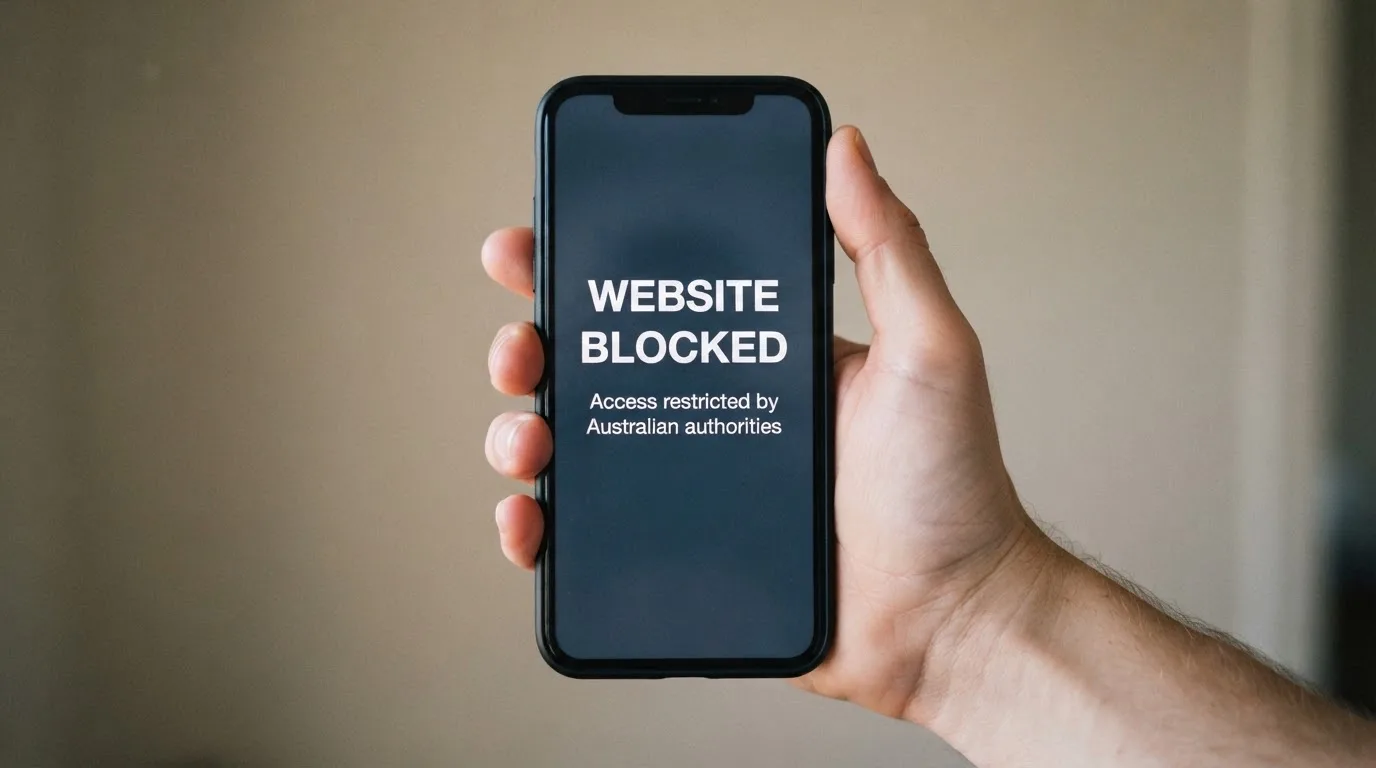
By the ACMA’s own count, as reported in June 2026, 1,751 illegal gambling and affiliate marketing websites had been blocked since the first blocking request in November 2019. More than 230 unlicensed gambling services had left the Australian market since enforcement was strengthened in 2017. In the round reported on 26 June 2026, the ACMA asked Australian ISPs to block 12 more sites in one go: 7Signs, ChromaBet, Donbet, Duospin, Freshbet, Slots Gem, Jacks Club, Lucky Start, Pointsbetz.com, Spinrise, Vinyl Casino and Wildsino.
The arithmetic that frames the whole enforcement picture is the blocking rate. The first blocking request went out in November 2019; by June 2026, 1,751 sites had been blocked across roughly 80 months. That works out to an average of around 22 sites blocked per month over the full period, though the early years ran lower and the pace has stepped up since 2017’s enforcement strengthening.
The more telling comparison is recent versus total. Between January 2025 and June 2026 — roughly 18 months — the ACMA’s blocking activity accelerated sharply. The June 2026 round alone covered 12 sites, and prior rounds in 2025 and 2026 covered comparable batches. A reasonable band for the recent pace is 15 to 25 blocks per month, against the long-run average of around 22. The condition on that band is straightforward: it holds as long as the ACMA continues issuing blocking requests at the cadence of 2024 to 2026, and there is no public commitment that the pace will hold.
H2 Gambling Capital’s 2025 report estimates Australians lose about A$3.9 billion a year to illegal gambling sites, and that the share of gambling going through legal channels fell from 74 per cent in 2021 to 64 per cent. That is what 22 blocks a month is trying to slow.
Payment routes and what the banks actually allow
The legal payment routes for Australian-licensed online wagering — debit card, bank transfer, PayID/Osko and BPAY — sit inside a specific rule set. Credit cards, credit-related products and digital currency have been banned as payment for licensed online wagering since 11 June 2024, with penalties up to A$247,500 for operators that breach the rule.
PayID is now embedded in Australian banking. PayID-based instant transfers are available at over 100 Australian financial institutions. With Osko, a bank transfer between participating banks arrives in under a minute, 24/7, including weekends, whether the transfer is addressed to a BSB and account number or to a PayID. Australia’s New Payments Platform, which sits underneath PayID and Osko, became accessible to the public on 13 February 2018, is owned by New Payments Platform Australia Ltd — whose 13 shareholders include the Reserve Bank of Australia and the major banks — and had more than 25 million PayID identifiers registered by April 2025. NPP participants must keep monthly platform outages to no more than two minutes.
What PayID does that matters for this market: paying to a PayID shows the name of the account holder before the transfer goes out. AP+ warns that being asked to transfer money to a PayID on an illegal gambling site is almost certainly a scam site. For an Australian reader that is the closest thing the payments system offers to a real-time legal alarm before the money leaves.
BPAY has been available since 18 November 1997. It sits in the online banking of over 140 Australian banks and financial institutions and is offered by more than 95,000 businesses. It is owned equally, through Cardlink Services Limited, by ANZ, Commonwealth Bank, National Australia Bank and Westpac. In September 2021 the ACCC authorised the merger of BPAY Group, eftpos and NPP Australia under Australian Payments Plus, the same operator that runs PayID and Osko. For a high-stakes player, BPAY is a bill-payment channel rather than a casino deposit channel — its cross-references to gambling sites in research listings are not endorsements.
AUSTRAC’s threshold-transaction-report rule, which requires reporting of transfers of A$10,000 or more, applies only to physical cash. Ordinary electronic bank transfers are not subject to that per-transaction reporting requirement, regardless of the amount. A high-stakes player moving large sums through PayID or bank transfer is below that reporting threshold at the transaction level.
The bank-side blocks are where the practical friction sits. Westpac’s gambling block works at card level: it refuses authorisation of transactions registered under the merchant category code “Betting/Casino Gambling” on eligible personal credit and debit cards. ANZ’s gambling transaction block, activated in the ANZ app, also blocks gambling transactions made through a digital wallet such as Apple Pay on an eligible card. Commonwealth Bank’s gambling lock on eligible cards via the CommBank app automatically blocks most gambling transactions, though the bank states it cannot guarantee all gambling-related purchases will be stopped.
American Express sits slightly outside this picture. The Reserve Bank of Australia’s July 2025 review proposes removing surcharges only on eftpos, Mastercard and Visa card transactions, explicitly leaving American Express outside the proposed surcharge ban. Amex, established in 1850 and operating as a three-party scheme rather than Visa or Mastercard’s four-party network, has historically charged higher merchant fees — which is why it sits outside that review.
What a “high roller bonus” actually costs
The marketing word is “bonus”. The arithmetic word is “turnover”. A bonus carries a wagering multiple — say 40 times the bonus amount — and the player has to run that turnover through the games before any of it becomes withdrawable cash. At a high-roller denomination, the absolute number gets large fast.
A worked example: a bonus of A$1,000 with a 40-times wagering multiple requires A$40,000 of turnover before the bonus funds convert. At a stake of A$5 per spin on a slot returning 96 per cent, that is 8,000 spins. A slot spin takes around five seconds, which works out to roughly 11.1 hours of continuous play. The expected loss on that turnover at 96 per cent return is A$40,000 multiplied by 4 per cent house edge — A$1,600. That is the bonus’s real cost: the player is paying roughly A$1.60 for every A$1.00 of bonus, before any winnings are counted.
For a player whose “high roller” status means A$200 per spin rather than A$5, the same A$40,000 turnover is 200 spins, taking about 16.7 minutes at five seconds each. The expected loss is unchanged at A$1,600. The bonus clears in a fraction of the time, which is the entire economic reason for the high-roller denomination — the operator’s cost is fixed; the player’s time cost is much smaller.
Two qualifiers ride on every version of that arithmetic. The first is that some bonuses exclude particular games from the wagering contribution, or weight certain games at a fraction of stake. The second is that the house edge varies by game — a 4 per cent slot house edge is a representative number for a high-RTP title, but live blackjack with optimal play runs closer to 0.5 per cent, and that changes the expected loss by an order of magnitude.
The honest read: a “bonus” at an offshore site is a turnover contract dressed as a gift. The marketing number is the headline; the cost is the turnover multiplied by the house edge, which is the only line in the offer that goes in one direction.
Responsible gambling: the tools that work and the ones that don’t
BetStop, the National Self-Exclusion Register, has been live since August 2023. It binds Australian-licensed online and phone wagering services — an offshore casino is not connected to it. A player who has registered with BetStop and then sits down at an offshore site is, in practical terms, in a place the register does not reach.
The tools that do work for a player trying to step back from offshore play are the bank’s gambling block and the bank’s own deposit and spend limits. Westpac, ANZ and Commonwealth Bank all run gambling blocks at merchant-category-code level. ANZ’s block takes a 48-hour wait to lift. Commonwealth Bank’s lock on eligible cards via the CommBank app blocks most gambling transactions but cannot guarantee all. The bank’s tools are imperfect; they are also the most concrete thing an Australian reader can actually use against an offshore site.
The National Gambling Helpline, 1800 858 858, is free and runs 24/7, with chat available at Gambling Help Online. For a high-stakes player whose spend has grown faster than they meant it to, that is the line that connects to funded counselling and to a state-based network that does not depend on whether the gambling was lawful.
The framework underneath all of this is the National Consumer Protection Framework for Online Wagering, which sets the minimum protections every Australian-licensed online wagering service has to meet. The framework does not reach offshore sites.
Where a high-stakes player can lawfully play
For anyone whose interest is genuinely high-stakes play and who wants it lawful, the Australian market offers land-based casinos and licensed clubs. Crown Melbourne and Crown Perth carry high-limit rooms; The Star Sydney and The Star Gold Coast round out the eastern seaboard; Skycity Adelaide and Lasseters in Alice Springs cover the centre; Treasury Casino and Jupiters cover Queensland; Wrest Point and the Country Club cover Tasmania.
These are the licensed venues. The cash handling is regulated. A complaint has somewhere to land. The product is the lawful Australian version of what the offshore pages advertise: pokies, table games, poker. The bonus structure is not a turnover contract dressed as a gift; it is the player-rewards programmes that licensed venues run, which sit inside Australian consumer law.
For the slots and tables specifically, the lawful path is through a licensed Australian venue. For sports and race betting, the lawful path is through a licensed Australian bookmaker, and the NTRWC’s roster of 52 operators in the Northern Territory is the practical shortlist. Neither is the offshore casino product; both are what the Interactive Gambling Act 2001 actually allows.
What a high-spending player should check before trusting any site
A short list that applies to any site, offshore or otherwise: which regulator issued the licence the site displays, what jurisdiction that regulator covers, whether the licence actually covers Australian customers, and whether the site is on the ACMA’s published warning list. The first three are usually a marketing claim; the fourth is a public fact.
A second layer: how the site handles withdrawals, what identity checks it runs, and whether those checks happen before a withdrawal is approved or after. Offshore sites commonly run a “verification on withdrawal” model, which puts the timing risk on the player.
A third layer: whether the site is connected to BetStop. If it is not, it is offshore. If it is offshore, none of the Australian consumer protections reach it.
For an Australian reader, the practical bottom line is the same as the legal one: the product a reader types “high roller casino bonus” into a search engine to find is, by definition, the product the Interactive Gambling Act 2001 prohibits. The marketing spends a great deal of energy making that product feel available. The ACMA’s record is the evidence of how available it actually is.
Frequently asked questions
What deposit level typically qualifies a player as a high roller at a casino?
There is no single industry threshold. Most offshore casinos start their “VIP” or “high roller” treatment somewhere between A$500 and A$1,000 in deposits over a short window, with the more generous tiers requiring sustained five-figure monthly volume. Australian-licensed venues define it through the host or VIP desk.
Do high-roller bonuses usually come with higher wagering requirements?
The wagering multiple is often lower than the small-deposit bonus — for example, 30 times rather than 40 — but the absolute turnover is much larger because the bonus amount is larger. The expected cost to the player scales with the turnover and the house edge of the games played, which does not change with the multiple alone.
Is it legal for an online casino to offer high-roller bonuses to Australians?
No. The Interactive Gambling Act 2001 prohibits offering online casino games — pokies, table games, live dealer — to a person in Australia. A bonus attached to that product is an inducement to use a prohibited service, which is itself prohibited. The individual player is not prosecuted; the provider is.
Can high-roller status be reached through a PayID deposit?
PayID is a payment rail, not a casino product. Whether the deposit clears to the offshore casino is a separate question, because Australian banks block gambling transactions at merchant-category-code level. A PayID deposit to a PayID on an illegal gambling site is, per AP+, almost certainly a scam site. Where the casino is lawful, PayID works as it does for any other merchant.
Are high-roller tables or limits offered at licensed Australian land-based casinos?
Yes. Crown Melbourne, Crown Perth, The Star Sydney, The Star Gold Coast, Skycity Adelaide and the larger state-based casinos all operate high-limit rooms, with table limits well into five figures and private salons for the largest action. The product is pokies, table games and poker under Australian licence. See also Best online casino with high cashback bonus australia 2026 .
What should a high-spending player check before trusting a casino site?
Whether the site is on the ACMA’s published warning list, whether the licence the site displays actually covers Australian customers (it does not, for casino games), whether the site is connected to BetStop (it is not, if offshore), and how the site handles withdrawal verification. None of those checks will turn an offshore casino into a lawful one; they will tell the player what they are buying.