
Picking a pokie machine in Australia in 2026: what the spec sheet costs the person playing it
Data current as of 29 October 2026, checked against the ACMA register of formal warnings and blocking actions.
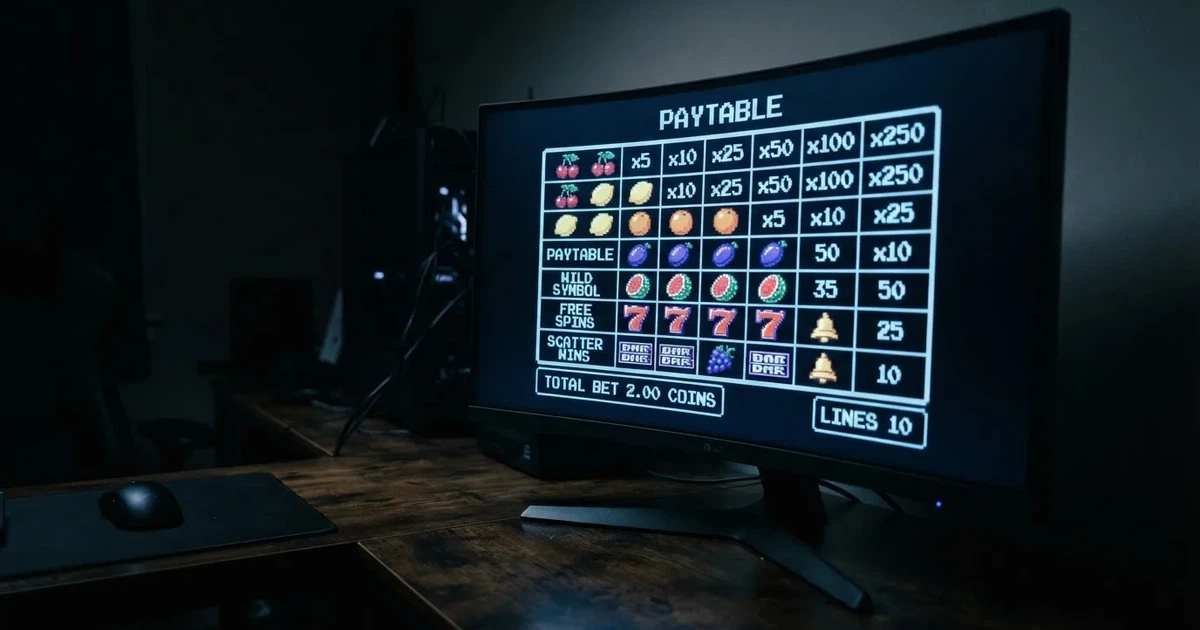
Choosing a pokie machine in Australia is, in practice, choosing between two very different worlds. The first is the licensed pub, club and casino floor, where every machine carries a regulator-set minimum return and a printed label. The second is the offshore online site, which the Interactive Gambling Act 2001 prohibits from offering those same games to anyone in Australia — and which the ACMA has been quietly dismantling, warning by warning, since 2017. A page that ranks machines without flagging that split is selling the reader a decision they cannot lawfully make. A page that buries the offshore options as a footnote wastes the part of the record the regulator itself has spent the last nine years building. This one starts with the cost to the player — how much a session actually returns, what the volatility does to the bankroll, where the betting requirements stop being worth chasing — and uses the ACMA record as evidence of what the online half of the sector actually delivers.
Table of Contents
- How a pokie machine is built, and what that costs the spin
- The land-based landscape: what each state actually offers
- The online half of the inquiry: prohibited, and what the ACMA has actually done about it
- What a player actually does when the game is online
- Responsible play, and the supports that only work for the legal market
- What the law does and does not do to a player
- The operators the ACMA has acted against, and what each one represents
- What this page does not cover
- Choosing a machine in practice
- Frequently asked questions
How a pokie machine is built, and what that costs the spin
The first decision is the only one a player controls before the reels stop. It is also the one the marketing copy spends the least time on.

Return-to-player is a long-run average, not a promise
Every modern pokie carries a return-to-player (RTP) figure — the percentage of money it pays back across millions of spins. The legal minimums are set state by state, and the spread is wider than most players realise. New South Wales, the Northern Territory, Queensland and most of Victoria sit at 85%; Crown Melbourne has to clear 87%; the Australian Capital Territory and Tasmania match that 87%; South Australia edges up to 87.5%; Western Australia sets 90% — the highest floor in the country. That 5-point gap between NSW’s 85% and WA’s 90% is not a technical footnote. Over a session of A$200 played at A$1 per spin, the difference is roughly A$10 in expected return on identical betting behaviour, and that gap is the single biggest lever a venue choice offers.
The figure the venue prints on the cabinet is the long-run average. It does not promise that session. A machine set to 90% will routinely return 60% over an evening and 120% over the next — the average only appears across the millions of spins the regulator uses to certify it. Treat the cabinet figure as the cost of admission rather than a forecast.
Volatility is the size and frequency of the swings
RTP says nothing about how the machine gets there. Two cabinets can both run at 87% and behave very differently. A low-volatility machine pays small amounts often, keeping the bankroll close to flat for hours. A high-volatility machine holds the line, then drops a larger feature or jackpot less frequently, and the bankroll oscillates more violently in between. The cabinet rarely prints volatility in a way a casual player can read, but the betting pattern will tell the story within a few hundred spins: a quiet, grindy session on one machine, a series of dead stretches punctuated by a 50x or 100x return on another.
For a player with a small bankroll, the volatility question matters more than the RTP question. A 90% low-volatility machine and an 85% high-volatility machine can cost the same expected amount per spin, but only one of them lets a A$50 session survive long enough to see the features that drive the long-run return.
Bet size, lines and the mechanics that change the math
Bet size does not change the odds of any individual spin. The odds of a symbol landing on a reel are fixed by the machine’s design; a A$1 spin and a A$5 spin have the same probability of producing a win. What changes is what counts as a win. Multi-line machines — five lines, twenty lines, the “243 ways” format — pay on combinations across several reels at once. A single-line machine pays only on the centre line. Multi-line machines look busier because they pay something on most spins, but the bulk of those pays are small, and the headline feature prizes still trigger on specific combinations regardless of how many lines are lit.
The practical effect is that multi-line play costs more per spin for the same denomination. A A$1 bet on a 25-line machine puts four cents on each line; the same A$1 on a single-line machine puts the full dollar on the one line that matters. The bankroll evaporates faster on the multi-line machine, but the player sees more “wins” — a confusion the format is designed to produce. The right comparison is total stake per spin against the cabinet’s RTP, not the number of paying lines lit up.
The land-based landscape: what each state actually offers
Pokies are a federation of state and territory regimes. The numbers below come from the most recent regulator-published tallies.
New South Wales carries the largest installed base by a wide margin — 87,298 gaming machines outside casinos, spread across 2,195 venues as of June 2023, with player losses of A$8.18 billion reported for 2022–23. Queensland ran 21,122 machines across 351 venues in October 2023. Victoria had 26,380 outside Crown Melbourne across 488 venues for 2021–22, operating under a hard statewide cap of 30,000. Western Australia is the outlier — poker machines are banned in pubs and clubs entirely; the only machines sit inside Crown Perth, where the count has climbed from roughly 200 in 1985 to about 2,500 today, all approved by the state’s Gaming and Wagering Commission.
The legal minimums above translate directly into the cabinet a player sees. NSW’s 85% floor is the country’s loosest setting outside Western Australia; WA’s 90% is the tightest. Tasmania ended the Federal Group’s monopoly over its machines in November 2021, moving oversight to the Tasmanian Liquor and Gaming Commission, and had planned nation-leading mandatory pre-commitment cards for its poker machines — the implementation was delayed until late 2025. Nationally, Australians bet almost A$150 billion through gaming machines in 2020–21 and lost A$12.18 billion on them, against a backdrop of about 3% of the world’s pub and club machines concentrated in roughly 0.3% of the global population.
The federation matters because the same machine sold under the same name in two states can carry a different minimum RTP. The brand on the cabinet is not the specification.
| Brand | ACMA action and date | Operator named by the ACMA | Subject support |
|---|---|---|---|
| RocketPlay | March 2026 | Pulsup Ltd | No data |
| Level Up Casino | May 2022 | Dama N.V. | BGaming listings only |
| Woo Casino | March 2025 | Dama N.V. | No data |
| Spirit Casino | May 2025 | Dama N.V. | No data |
| National Casino | July 2025 | Consolutetish S.R.L. | Wikipedia listings only |
| Bizzo Casino | July 2025 | Consolutetish S.R.L. | No data |
| Ignition Casino | July 2025 | Bamboo Media | No data |
| Instant Casino | February 2025 | EOD Code SRL | No data |
| Jackbit | April 2026 | Ryker B.V. | No data |
| Casino Intense | April 2025 | Sterplay Holding Ltd | ABC, ACMA, Crown listings |
| Sky Crown | September 2022 | Hollycorn N.V. | No data |
Crown Melbourne’s baccarat tables, and what a “house edge” looks like in person
For a player who walks past the pokies and onto the table-game floor, the baccarat layout offers one of the clearest illustrations of how thin the house margin actually runs on a regulated game. Crown Melbourne offers three baccarat variants — Traditional Baccarat, Crown Baccarat and 2 to 1 Baccarat — as approved table games regulated by the Victorian Gambling and Casino Control Commission, which replaced the VCGLR as Victoria’s casino regulator on 1 July 2022. Under section 66 of the NSW Casino Control Act 1992, a casino operator must not permit a game such as baccarat to be played unless the game and its rules are approved by the regulator, and a copy of the approved rules must be available to patrons on request — the same architecture applies across state casino regulators.
The baccarat house edge sits at 1.06% on the Banker bet, 1.24% on the Player bet and 14.36% on the Tie. For comparison, blackjack with optimal strategy under liberal Las Vegas Strip rules (dealer stands on soft 17, double on any two cards, double after split, resplit aces, late surrender) carries a house edge of about 0.28%; Atlantic City rules run closer to 0.43%. The point is not to recommend one game over another. It is that the same cabinet floor carries an 85% pokie, a 99.72% blackjack table and a 98.94% baccarat Banker bet, and the casino earns its money by getting most of the volume onto the pokies. Picking the table game is, mechanically, the single biggest move a player can make on the floor.
Side games worth knowing, and the maths behind them
Blackjack’s history is mostly colour — Cervantes’ Rinconete y Cortadillo describes a related game around 1601–1602, formal rules appeared in Britain in 1800, and the modern name took hold around 1899 during the Klondike Gold Rush. What survives in the math is simpler: number cards at face value, jack/queen/king at 10, ace at 1 or 11, dealer drawing to 17, and a starting two-card 21 — the “natural” — paid at the top of the line. Baccarat’s history is no less disputed, with some accounts pointing to 15th-century Italy and others to 19th-century France, and the modern punto banco variant developed in Havana in the 1940s. The variant’s draw rules are fixed: cards 2–9 count at face value, 10/J/Q/K count as zero, aces count as one, hand totals are taken modulo 10, and the shoe runs 6 or 8 decks. The casino banks the game at all times, so neither player makes a strategic decision once the bet is down — only the size of the wager on Banker, Player or Tie.
Established blackjack variants — Spanish 21 (played without 10s but with liberal player-favourable rules), Double Exposure Blackjack (both dealer cards dealt face-up), Blackjack Switch (players can swap cards between two hands) and Super Fun 21 (up to four splits) — shift the rules in specific ways, and each shift moves the house edge in a specific direction. They are worth knowing because they show the floor isn’t a single product. It is a catalogue of small variations on the same basic mathematics, and the catalogue is what the player is choosing from.
The online half of the inquiry: prohibited, and what the ACMA has actually done about it
Online pokies — the online version of the cabinet machines described above — are prohibited for people in Australia. The Interactive Gambling Act 2001 (IGA), strengthened by the Interactive Gambling Amendment Act 2017, makes it an offence to provide online casino games, online pokies or in-play betting to a person physically in Australia; no state or territory licenses them. What is licensable is wagering on races and sport placed before the event, lotteries and keno — in practice licensed by the Northern Territory, where the Northern Territory Racing and Wagering Commission (NTRWC) regulates 52 of Australia’s online bookmakers including Sportsbet, Bet365 and Ladbrokes for tax reasons, with no full-time staff and a monthly meeting in Darwin.
The IGA targets the provider, not the individual player. The provider consequences, however, have been running for nearly a decade.
The ACMA’s blocking record, and the rate at which it accumulates
According to the ACMA as reported in June 2026, a total of 1,751 illegal gambling and affiliate marketing websites had been blocked since the first blocking request in November 2019. More than 230 unlicensed gambling services had left the Australian market since enforcement was strengthened in 2017. In a single round reported on 26 June 2026, the ACMA asked Australian internet service providers to block 12 more sites — 7Signs, ChromaBet, Donbet, Duospin, Freshbet, Slots Gem, Jacks Club, Lucky Start, Pointsbetz, Spinrise, Vinyl Casino and Wildsino. The pace is not slowing: roughly 1,751 blocked sites in roughly 79 months from November 2019 to June 2026 works out to an average of about 22 blocked sites per month across the whole program, with the 12 in the latest single round sitting comfortably inside that run-rate.
H2 Gambling Capital’s 2025 report estimates that Australians lose about A$3.9 billion a year to illegal gambling sites, and that the share of gambling going through legal channels fell from 74% in 2021 to 64%. The implication is not that the law has failed. It is that the offshore market has adapted to the law, and the blocking program continues to catch up to it one round at a time. Anyone choosing an offshore site is choosing a product the regulator has decided is unlawful to offer to them, and that choice has costs the marketing page will not list.
Formal warnings, by operator and brand
The ACMA also publishes a register of formal warnings — letters sent to operators identifying the unlawful service and giving them a chance to comply before further action. The list below covers the brands this page reviews in the operator section further down, and what the ACMA itself has said about each.
| Brand | ACMA action and date | Operator named by the ACMA | Subject support |
|---|---|---|---|
| RocketPlay | March 2026 | Pulsup Ltd | — |
| Level Up Casino | May 2022 | Dama N.V. | BGaming listings only |
| Woo Casino | March 2025 | Dama N.V. | — |
| Spirit Casino | May 2025 | Dama N.V. | — |
| National Casino | July 2025 | Consolutetish S.R.L. | Wikipedia listings only |
| Bizzo Casino | July 2025 (earlier 2022 to TechSolutions) | Consolutetish S.R.L. | — |
| Ignition Casino | July 2025 | Bamboo Media | — |
| Instant Casino | February 2025 | EOD Code SRL | — |
| Jackbit | April 2026 | Ryker B.V. | — |
| Casino Intense | April 2025 | Sterplay Holding Ltd | ABC, ACMA, Crown Melbourne listings only |
| Sky Crown | September 2022 | Hollycorn N.V. | — |
Two patterns stand out in the table. First, several operators reappear under new corporate names — Dama N.V. alone has been warned over four brands across four years, and the earlier TechSolutions warning over Bizzo Casino (2022) sits alongside the later Consolutetish S.R.L. warning (July 2025). Second, the gap between a warning and a fresh offer to Australians is typically months, not years. The regulator’s pace is fast enough that a brand’s “live” status and its “lawful” status are not the same fact.
What a player actually does when the game is online
The practical reality is that no Australian-facing online casino is operating under an Australian licence for casino games. They operate under offshore licences — Curaçao, Anjouan, Kahnawake — none of which gives an Australian consumer any local recourse if a withdrawal is refused, an account is closed or a balance is forfeited during an ACMA blocking round. The protections that Australian players have at a licensed venue — a state regulator, a complaints body, audited payout figures on every cabinet, mandatory harm-minimum interventions — are absent offshore.
Payments, and the credit-card ban
Since 11 June 2024, credit cards, credit-related products and digital currency have been banned as payment for licensed online wagering in Australia, with penalties of up to A$247,500 for operators accepting them. Legal deposit routes for licensed wagering are debit card, bank transfer, PayID/Osko and BPAY. An offshore casino asking an Australian customer for a credit card or a crypto deposit is operating outside the Australian rules by definition — and that, in turn, is a marker for the kind of operation the ACMA has been blocking since 2019.
Settlement speed on a licensed wagering account is typically same-day to 24 hours for debit and PayID; bank transfer and BPAY are slower because of the rails involved. Offshore casinos quote “instant” or “24-hour” payouts in their marketing, but the experience depends on whether the operator’s payment team actually processes the request — and whether the site is reachable at the time the player tries to log in to withdraw.
Mobile play, and what an “app” actually means
A licensed Australian venue has no online product, so there is no licensed Australian pokie machine app to compare against an offshore one. What an offshore “pokie app” delivers is a mobile-optimised browser wrapper or a native binary that connects to the same offshore backend. Performance differences between an offshore app and the same site’s mobile browser are usually small — load times, animation smoothness and battery cost vary by game provider and by the player’s device more than by the delivery channel. What does not change is the regulatory position: an app delivering online pokies to a person in Australia is offering a prohibited service, and the ACMA can act against it through the operator and through the app store distribution.
Responsible play, and the supports that only work for the legal market
BetStop, the National Self-Exclusion Register, has been live since August 2023. It binds Australian-licensed online and phone wagering services — an offshore casino is not connected to it, and a self-excluded player who moves offshore is not, in practice, self-excluded. State-based registers and exclusion schemes cover the land-based venues. The National Gambling Helpline is 1800 858 858, free, 24/7, with chat available at Gambling Help Online. For anyone playing offshore, none of these reach the account that matters.
Mandatory pre-commitment is on the legislative path. Tasmania planned nation-leading mandatory pre-commitment cards for its poker machines, with implementation delayed until late 2025. The broader Interactive Gambling Amendment (Gambling Reform) Bill 2026 passed Parliament on 19 August 2026, with its advertising and inducement measures commencing on 1 January 2027 — law with a start date, not yet in force on a page written for the current year.
What the law does and does not do to a player
The IGA targets the provider. The individual player is not prosecuted. The provider-facing consequences are real and cumulative: blocking, formal warnings and eventual market exit. The player-facing consequences are not legal but are practical — an offshore site offers no Australian consumer protection, no complaints body and no recourse if a withdrawal is refused. A balance can be locked behind a blocking round the player did not know was coming.
On tax: gambling winnings of a recreational player are not assessable income under section 6-5 of the ITAA 1997, and losses are not deductible, unless the person carries on a business of gambling. That last point is the boundary — recreational yes, professional no — and it is the kind of distinction a reader should verify with the ATO rather than take from a casino guide.
The operators the ACMA has acted against, and what each one represents
Each brand below appears in the ACMA’s formal-warning record. None of them is a lawful place for an Australian to play online casino games. The reviews that follow are not recommendations; they are the record of what the regulator has said about each operator, and what that record tells a reader weighing the offshore option.
RocketPlay
Pulsup Ltd received a formal warning in March 2026 over RocketPlay; the Dama N.V. corporate group had already been warned over a Rocketplay brand back in May 2022. The brand is a useful case study in operator re-skinning — the same product, the same parent group, a fresh URL the ACMA has to act against from scratch. For a reader, the relevant question is whether a brand that has cycled through two warnings in four years is a reliable custodian of a balance.
Level Up Casino
Dama N.V. received the May 2022 warning that named Level Up alongside Bambet, Dazard, Rocketplay, Wild Tornado and Cobra Casinos. The brand’s association with the broader Dama portfolio is the main fact on the page; the specific site carries no information about its current status beyond what the regulator has already said.
Woo Casino
Dama N.V. received a further formal warning in March 2025, this time over Woo Casino. That puts the brand on the same Dama timeline as RocketPlay and Level Up — same parent, separate brand, separate warning, same underlying conduct.
Spirit Casino
Dama N.V. again, this time in May 2025 — the fourth Dama brand the ACMA has warned against in this record. The pattern across Dama’s portfolio is the takeaway, not any single brand’s offering.
National Casino
Consolutetish S.R.L. received the July 2025 warning over National Casino, alongside Bizzo Casino in the same action. National Casino had no prior ACMA warning on this record, which makes the entry point straightforward — one warning, one brand, one operator.
Bizzo Casino
Consolutetish S.R.L. received the July 2025 warning, but Bizzo had earlier been the subject of a 2022 formal warning to TechSolutions (CY) Group Limited and TechSolutions Group N.V. Two operators, two warnings, same brand — the second warning came after the corporate wrapper had changed. The repetition is the story.
Ignition Casino
Bamboo Media received the July 2025 warning over Ignition Casino, the only brand in that warning list tied to that operator. The brand sits alongside National Casino and Bizzo Casino in the same regulatory cycle but with a different corporate name behind it.
Instant Casino
EOD Code SRL received a formal warning in February 2025. Single operator, single brand, single warning — the cleanest entry on the table, and a useful comparison point for brands that have cycled through multiple operators.
Jackbit
Ryker B.V. received a formal warning in April 2026 over both Jackbit and CasinOK. Two brands in one warning is a marker of a portfolio operator, and the recency of the action means any site visit is, in practice, a test of whether the ACMA’s blocking round has caught up.
Casino Intense
Sterplay Holding Ltd received a formal warning in April 2025. The brand has fewer listed presences than most of the table, which means less information rather than more confidence — the regulator’s warning is the main fact the reader has to work with.
Sky Crown
Hollycorn N.V. received a formal warning over its Sky Crown and Blue Leo casino services, as published by the ACMA in September 2022. The brand sits at the older end of the timeline, which is worth noting only because a warning issued in 2022 does not mean the conduct has ended — the regulator’s blocking record since then shows the market is still active.
What this page does not cover
The search asks for a single “best” pokie machine. No regulator, no cabinet and no published RTP supports that question being answered with a brand name. The licensed market offers machines with minimum returns from 85% to 90%, with volatilities that vary by game family, and with state-by-state rules that change the spec on the same cabinet. The offshore market offers none of that transparency and operates against the IGA. A reader who came in looking for a single answer is going to leave with the framework that produces an answer — cabinet RTP, volatility class, bet size per spin, venue’s state regime, and whether the online route is one the regulator has decided is lawful at all.
Choosing a machine in practice
A short checklist for the player who wants to leave with something concrete:
- Read the cabinet’s printed RTP and pick the highest one available in the venue. The 85%–90% spread across states is the biggest single lever.
- Decide on a session budget before the first spin, and pick the volatility that matches it. A small bankroll wants a low-volatility machine that lets the session run long enough to hit features.
- Set the bet size so that the session budget covers at least 200 spins. Anything below that exposes the player to short-run variance the long-run RTP does not protect against.
- Treat multi-line play as a cost amplifier, not an odds improvement. More lit lines mean more stake per spin for the same denomination.
- If a casino floor is an option, the baccarat Banker bet (1.06% house edge) and the basic blackjack table (around 0.28%–0.43% house edge under favourable rules) are the lowest-margin games on the floor. The pokies earn the venue most of its money precisely because most of the play goes there.
- For any online route, the ACMA blocking record and the formal-warning register are the source of truth. A brand with one warning and a recent corporate re-shuffle is the kind of brand that should give a reader pause.
Frequently asked questions
What is the difference between a low-volatility and a high-volatility pokie machine?
Low-volatility machines pay small amounts often, keeping the bankroll close to flat over a session; high-volatility machines hold the line and pay larger amounts less frequently, with sharper swings between wins. The RTP figure on the cabinet can be identical for both; what changes is the shape of the session and how long a given bankroll survives.
Does bet size change the odds on a pokie machine?
No. The odds of any individual spin are fixed by the machine’s design and do not change with the size of the bet. What changes is what counts as a winning combination and how many lines are in play, which together move the total stake per spin. The right comparison is total stake per spin against the cabinet RTP, not the size of any individual bet.
Are mobile pokie apps the same as the licensed machines in a pub or club?
No. There is no licensed Australian online pokie machine product — the Interactive Gambling Act 2001 prohibits offering online casino games and online pokies to people in Australia. Mobile apps that deliver pokies connect to offshore operators, none of which are subject to Australian state regulators or to BetStop. The cabinet in a pub or club is a different product, governed by state-level rules.
How can someone find the payout percentage of a specific pokie machine before playing?
Look at the printed label on the cabinet itself — every licensed Australian pokie machine carries an RTP figure or a state-minimum notice, and the state gambling regulator publishes the legal minimums for each jurisdiction. The 85%–90% spread by state is public, and venues that operate multiple machines on the same model will share the same RTP. For table games, the house edge is published by the regulator and by independent references; baccarat’s Banker bet is 1.06%, blackjack under liberal Las Vegas Strip rules is around 0.28%.
Are multi-line pokie machines more likely to pay out than single-line ones?
No. Multi-line machines produce more frequent but smaller pays because they evaluate combinations across several lines at once; single-line machines pay less often but the pays are concentrated on the centre line. The probability of any given combination is fixed by the machine’s design, not by the number of lines lit. What changes is the total stake per spin and the shape of the session, not the long-run return per dollar staked.