
Pokies in South Australia, 2026: the licensed venues, the offshore sites, and the gap between them
South Australians play pokies in person at Adelaide Casino and at the pubs and clubs the state licences to host electronic gaming machines. That is the whole onshore picture: one casino licence on North Terrace, around 11,600 machines spread across 471 venues outside it, and a regulator in Consumer and Business Services that sets the minimum return-to-player rate and the maximum stake. Offshore sites that brand themselves “Australian pokies” cannot be licensed here at all. The Interactive Gambling Act 2001 makes the provision of online casino games to a person physically in Australia a civil offence, and the ACMA has spent the better part of a decade turning that provision into blocked domains and formal warnings.
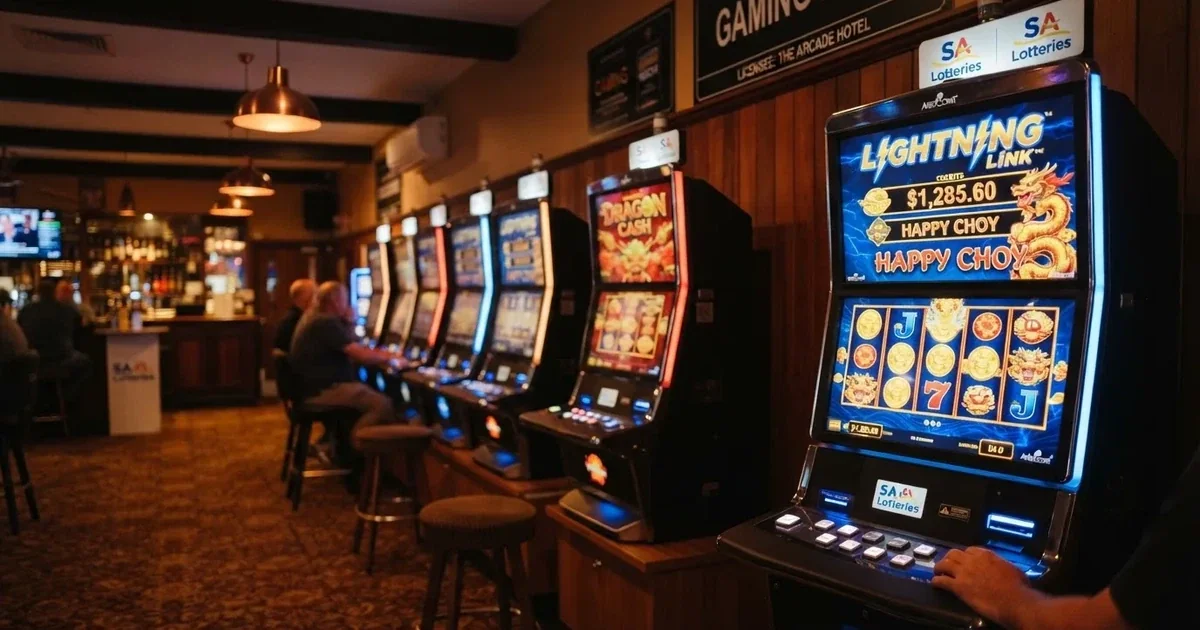
This page walks through what is actually licensed, where the machines sit, what the return-to-player figure really means against the house edge, and which of the offshore brands a reader might encounter in an ad have already been the subject of formal regulator action.
Current as of 29 October 2026 against the ACMA register and Consumer and Business Services, South Australia.
Table of Contents
- The paytable South Australians actually sit down to
- Payout percentage, what the floor actually leaves on the table
- Cashless card, the limit a player sets before they play
- Adelaide Casino, the only casino licence in the state
- Pub and club venues, the 471 places outside Adelaide Casino
- 24-hour pokies, the honest answer
- Identification and entry, what a venue actually checks
- Self-exclusion, the registers a South Australian can actually use
- The offshore sites, and what “ACMA formal warning” actually means
- The offshore brands and the ACMA action register
- RocketPlay
- Level Up Casino
- Woo Casino
- Spirit Casino
- National Casino
- Bizzo Casino
- Ignition Casino
- Instant Casino
- Jackbit
- Casino Intense
- Sky Crown
- What an offshore site costs a South Australian, in plain terms
- The blocking rate, and what it tells us about the enforcement pipeline
- How to read any “best pokies” shortlist for South Australia
- What a South Australian reader should do with this
- Frequently asked questions
The paytable South Australians actually sit down to
A “pokie” in Australia is a slot machine, and the rules it runs on in South Australia are set at state level. Consumer and Business Services, sitting inside the Attorney-General’s Department, sets a minimum gaming-machine return-to-player rate of 87.5% and a general maximum bet of A$5.00 outside the casino. Adelaide Casino itself is exempt from the A$5 stake cap, which is why the casino floor can carry higher-denomination play that the suburban pub cannot. The 87.5% floor is the regulator’s promise: across the machine’s full lifecycle, the state insists the operator cannot keep more than 12.5 cents of every dollar that goes through it. That is not the figure any single player will see on a given night; it is the figure the machine is built to average over months.
Pokies venues in South Australia are also cashless by design at the upper end. The state moved to mandatory cashless card play on electronic gaming machines outside the casino, with player-set daily limits that drop to A$100 by default for anyone who does not opt higher. That single policy change is the reason a punter who used to feed a A$50 note into a machine every ten minutes now sits down with a daily ceiling already in their account.
The paytable conversation a player should have before they sit down is short. Three numbers matter: the RTP floor, the maximum stake, and the cashless card limit the player has set for themselves. Everything else on the machine’s display is theatre.
Payout percentage, what the floor actually leaves on the table
A 87.5% RTP floor is a tight margin by international standards. It says that of every A$100 turned over at a pub or club machine in South Australia, roughly A$87.50 cycles back to players as wins over the machine’s lifetime and A$12.50 stays with the operator. Adelaide Casino, unconstrained by the A$5 stake cap, runs a different product mix at a different theoretical margin. Either way, the house edge is positive, the math runs one direction, and the time horizon over which the figure resolves is months rather than the hour a player spends on the stool.
State-level losses put the figure in plain sight. South Australians lost A$0.92 billion on gaming machines outside Adelaide Casino in 2022–23, which works out to about A$497 per adult. That is the price of playing against an 87.5% floor at the volume 11,672 machines across 471 venues generate. The figure the regulator publishes annually is the cleanest answer to the question “is it worth it” for anyone trying to decide whether to start.
Cashless card, the limit a player sets before they play
South Australia is one of two jurisdictions in the country to put a cashless card on every electronic gaming machine outside the casino. The default daily limit is A$100, and a player can opt into a higher band, up to a statutory ceiling, before play begins. The card is the reason a venue can no longer serve a punter who has hit their own daily cap, and it is the reason losses to machines outside Adelaide Casino have been tracking downward since the policy came in. A cashless card is also what the state uses to enforce its self-exclusion register, since the machine will simply refuse a banned card.
The flip side is the same coin. The card is a daily limit, not a session limit; a player who sets A$100 and walks from venue to venue still has A$100 at the next venue. The card is also not a budget for the night, only for the calendar day; a player whose limit runs out at 9 pm gets the rest of the night back at midnight.
Adelaide Casino, the only casino licence in the state
Adelaide Casino, trading commercially as SkyCity Adelaide, sits inside the heritage-listed Adelaide railway station on North Terrace. It holds 90 gaming tables and 950 gaming machines, the only casino licence in South Australia under the Casino Act 1997. The licence was extended in October 2013 to run through to 30 June 2035, with redevelopment headroom for up to 200 gaming tables and 1,500 gaming machines subject to the operator meeting its build-out milestones. The Riverbank precinct redevelopment between 2015 and 2021, a roughly A$330 million project, added the EOS by SkyCity tower with 120 hotel rooms and expanded gaming space.
Adelaide Casino is regulated by the state through the Liquor and Gambling Commissioner, with a daily compliance presence on the floor focused on host-responsibility interactions with patrons. The venue does not carry the A$5 maximum-bet cap that applies to pub and club machines; that is the practical reason its tables and high-limit machines run at a different scale than anything else in the state. Its tax contribution to South Australia ran above A$41 million in 2007–08, the most recent year the published record gives a clean figure for.
If the reader’s question is “where is the only casino floor in South Australia”, the answer is one venue. If the question is “what is the largest concentration of gaming machines”, the answer is the same venue.
Pub and club venues, the 471 places outside Adelaide Casino
The other 11,672 machines in the state sit in 471 pubs and clubs spread across metropolitan Adelaide and regional South Australia. These are the venues a player actually walks into on a Tuesday night: a suburban RSL, a hotel with a gaming room, a football club with a licensed machine count that funds the club’s junior program. Each carries its own machine allocation under state licence, and each falls under the cashless card regime, the A$5 stake cap and the 87.5% RTP floor.
A practical consequence of the structure is that the regulator’s “471 venues” figure is also the answer to “how many front doors does a South Australian walk into to play pokies outside the casino”. The figure has been roughly stable since the 2020 reforms that brought the cashless card in. Where it is going is downward, in line with the state policy of gradual machine reduction tied to gambling-harm reduction targets.
24-hour pokies, the honest answer
South Australian pubs and clubs are not 24-hour pokies venues. The state’s trading hours for licensed premises set the practical ceiling well short of round-the-clock operation, and venues with gaming machines close their gaming rooms at the same time they close the rest of the building. Adelaide Casino runs extended hours, including late-night table play, but is not a 24-hour gaming floor either. Anyone searching for “24 hour pokies South Australia open now” will not find a venue that matches the wording of the search.
The closest thing the state has to round-the-clock access is Adelaide Casino outside the small hours of the morning, and the answer to “where do I play at 4 am” is essentially “you do not, in South Australia”.
Identification and entry, what a venue actually checks
Every licensed venue in South Australia operates under the state’s responsible-gambling framework, and the framework runs on identification. A patron entering a gaming room at a pub or club is expected to produce photo ID, particularly when they want to set a non-default limit on their cashless card, register for a loyalty card, or claim a payout above a threshold. Adelaide Casino runs the same checks, with a higher floor on payouts that require formal identification.
The ID check is also the practical mechanism for self-exclusion. A player who has signed up to the state register cannot sit down at a machine without the machine refusing their card; a player who has signed up nationally cannot use BetStop-registered wagering accounts at any Australian-licensed bookmaker. A cashless card is, in this sense, the operational end of the responsible-gambling policy. The state uses it the same way the venue uses it: to keep the named player out.
Self-exclusion, the registers a South Australian can actually use
There are two registers a South Australian reader needs to know about, and they do different things.
The first is the state register, administered through Consumer and Business Services, which lets a player self-exclude from gaming venues in South Australia specifically. The second is BetStop, the National Self-Exclusion Register that has been live since August 2023 and binds every Australian-licensed online and phone wagering service. A player who signs up to BetStop is blocked at every Australian-licensed bookmaker; a player who signs up to the state register is blocked at every South Australian pub, club and casino gaming room.
Neither register touches an offshore online casino. An offshore site is not connected to BetStop, has no obligation to honour a state exclusion, and may not even check ID. A South Australian who has signed up to BetStop and then opened an account at an offshore casino advertising “pokies Australia” has not excluded themselves from that venue. The registers are domestic tools with a domestic reach; their effect stops at the border.
A player who needs help right now has a free, 24/7 line at 1800 858 858 and a chat service at Gambling Help Online. Both are operated nationally and take calls from South Australia without a transfer.
The offshore sites, and what “ACMA formal warning” actually means
Every brand named in the comparison table below has been the subject of a formal warning from the ACMA under the Interactive Gambling Act 2001. A formal warning is not a fine and it is not a prosecution; it is a written notice from the regulator that a service is, in the ACMA’s view, providing prohibited interactive gambling services to Australians, and that further enforcement action will follow if the service does not come into compliance. The ACMA publishes these warnings by name on its website, which is why each row below carries a date and an operator rather than an unverified “this site was warned”.
The offshore brands also cannot be licensed in Australia. The Interactive Gambling Act makes the provision of online casino games — slots, table games, live dealer — to a person physically in Australia a civil offence, and no state or territory issues a licence for it. Whatever licence an offshore site displays, whether Curacao, Malta or Anjouan, is not a licence to take a bet from someone in Adelaide. It is a licence to operate a casino from somewhere else, and it has no effect in Australia.
The practical consequence for a South Australian reader is that any money deposited at an offshore site is held by an operator that has already been told by the ACMA to stop doing what it is doing, has no Australian consumer protection, and may be blocked by Australian ISPs without notice — including with a balance still on the account.
The offshore brands and the ACMA action register
The list below is the set of operators the ACMA itself has published a formal warning against, in the order they are dealt with on the ACMA register. None of these are ranked against each other on quality; the ACMA warning is the only fact a comparison can fairly hang on, and the fact is the same shape for every row. The brand, the operator the warning names, the date, and any additional information the public record carries.
A note on reading the table: “subject support” describes what the public listings actually say about each brand. Where the ACMA record itself says nothing beyond the warning, the cell carries the no-data marker; where listings outside the ACMA carry something verifiable, the cell carries that source.
| Brand | ACMA action and date | Operator named by the ACMA | Subject support |
|---|---|---|---|
| RocketPlay | Formal warning, March 2026 | Pulsup Ltd | — |
| Level Up Casino | Formal warning, May 2022 | Dama N.V. | Listing mentions only |
| Woo Casino | Formal warning, March 2025 | Dama N.V. | Listing mentions only |
| Spirit Casino | Formal warning, May 2025 | Dama N.V. | — |
| National Casino | Formal warning, July 2025 | Consolutetish S.R.L. | Listing mentions only |
| Bizzo Casino | Formal warning, July 2025; prior warning 2022 | Consolutetish S.R.L. | — |
| Ignition Casino | Formal warning, July 2025 | Bamboo Media | — |
| Instant Casino | Formal warning, February 2025 | EOD Code SRL | — |
| Jackbit | Formal warning, April 2026 | Ryker B.V. | — |
| Casino Intense | Formal warning, April 2025 | Sterplay Holding Ltd | Listing mentions only |
| Sky Crown | Formal warning, September 2022 | Hollycorn N.V. | Listing mentions only |
RocketPlay carries two warnings on the public record: the May 2022 warning to Dama N.V. covered six brands including Rocketplay, and the ACMA issued a separate warning to Pulsup Ltd over Rocketplay.com.au in March 2026. Bizzo Casino carries a similar shape: a 2022 warning to TechSolutions and a 2025 warning to Consolutetish S.R.L. The double warning is the regulator’s signal that the operator entity changed but the service to Australians did not.
The full ACMA blocking register, as of June 2026, lists 1,751 illegal gambling and affiliate marketing websites blocked since the first blocking request in November 2019. The single June 2026 round alone added twelve sites: 7Signs, ChromaBet, Donbet, Duospin, Freshbet, Slots Gem, Jacks Club, Lucky Start, Pointsbetz.com, Spinrise, Vinyl Casino and Wildsino. H2 Gambling Capital’s 2025 estimate puts Australian losses to illegal gambling sites at about A$3.9 billion a year, and the share of gambling going through legal channels fell from 74% in 2021 to 64%.
RocketPlay
The ACMA issued a formal warning to Pulsup Ltd over Rocketplay.com.au in March 2026. Dama N.V., the operator entity warned in May 2022 over six brands including Rocketplay, had already been on the ACMA register before the warning to Pulsup Ltd. The March 2026 action is the ACMA telling the current operator, by name, that the service it is offering Australians is prohibited.
A South Australian who sees Rocketplay advertised is seeing a brand the ACMA has now warned twice, under two different operator names, over the same product. The licensed alternative for the same product category is the cashless-card machines in the 471 venues around the state.
Level Up Casino
The ACMA issued a formal warning to Dama N.V. in May 2022, covering six brands: Bambet, Dazard, Level Up, Rocketplay, Wild Tornado and Cobra Casinos. Level Up is one of those six. Dama N.V. has since received further warnings over Woo Casino (March 2025) and Spirit Casino (May 2025), so the operator entity is one the ACMA has spoken to four times across four brands.
A South Australian who lands on Level Up from an affiliate page is being pointed at a brand the ACMA named in a 2022 formal warning. The state-licensed alternative is the same 471 venues, the same A$5 stake cap, the same cashless card.
Woo Casino
Dama N.V. received a further formal warning from the ACMA in March 2025, this time specifically over Woo Casino. The May 2022 warning covered six brands including the operator; the March 2025 warning is the ACMA coming back to the same operator over a new brand. Woo Casino carries the same legal status under the IGA as the other Dama N.V. brands: online casino games cannot be lawfully provided to a person in Australia, and the ACMA has now told Dama N.V. that twice over Woo Casino.
Spirit Casino
The ACMA’s May 2025 warning to Dama N.V. covered Spirit Casino alongside the Woo Casino action. Spirit Casino is the third brand Dama N.V. has been warned over since the original May 2022 batch, and the warning date is the most recent of the three. A South Australian who clicks through to Spirit Casino is being pointed at a brand the ACMA named in a formal warning less than a year before this page was published.
National Casino
The ACMA issued a formal warning to Consolutetish S.R.L. in July 2025, covering National Casino and Bizzo Casino. The same formal-warning notice names two brands from one operator. National Casino had not previously appeared on the ACMA register before the July 2025 warning.
Bizzo Casino
Bizzo Casino was the subject of a 2022 formal warning to TechSolutions (CY) Group Limited and TechSolutions Group N.V., and again of a July 2025 warning to Consolutetish S.R.L. Two operator entities, two warnings, the same brand. The ACMA’s record shows the regulator following the brand across the company changes that the offshore sector uses to reset its footprint.
Ignition Casino
Bamboo Media received a formal warning from the ACMA in July 2025 over Ignition Casino. Ignition had not previously appeared on the ACMA register. The warning is the first formal action over the brand, but it sits inside the same enforcement pattern: the ACMA names the operator and the date, and the service the operator is providing Australians is the prohibited product.
Instant Casino
The ACMA issued a formal warning to EOD Code SRL over Instant Casino in February 2025. Instant Casino carries the no-data marker on subject support: the public record outside the ACMA warning carries nothing further verifiable. A South Australian reading this row should treat the ACMA warning as the whole of what can be said about the operator without inventing detail.
Jackbit
Ryker B.V. received a formal warning from the ACMA in April 2026 over Jackbit and CasinOK. Both brands appear in the same warning notice, both are tied to the same operator entity, and both have the same legal status under the IGA. The April 2026 date is the most recent formal action over an online casino brand in the ACMA’s published register.
Casino Intense
Sterplay Holding Ltd received a formal warning from the ACMA in April 2025 over Casino Intense. Casino Intense is the only brand in the comparison that also appears in public listings outside the ACMA warning record, including state regulator pages and mainstream press coverage of the offshore sector. The listings repeat the same IGA status the ACMA warning carries; they do not add a licence.
Sky Crown
The ACMA issued a formal warning to Hollycorn N.V. over its Sky Crown and Blue Leo casino services in September 2022. Sky Crown is the earliest warning in the comparison set, and it is the only Hollycorn N.V. brand that has carried a formal warning on the public register at the time this page was written.
What an offshore site costs a South Australian, in plain terms
The arithmetic of an offshore casino is the arithmetic of an unregulated balance. A player who deposits A$200 at an offshore site has put that A$200 into an account held by an operator the ACMA has told to stop serving Australians, in a currency the operator chooses, behind terms the operator writes. The site can refuse a withdrawal, can change the bonus terms mid-play, and can be blocked by an Australian ISP on the ACMA’s instruction — leaving the balance where it sits. There is no Australian complaints body the player can take the dispute to, no Australian licence the player can quote back, and no Australian consumer protection law that reaches the operator.
The licensed alternative is the cashless card. A South Australian who walks into a pub with A$200 in their account has put A$200 into a venue the state regulates, on a machine the state has audited for RTP, with a daily limit they set themselves, with a self-exclusion register that will keep them out if they ask it to. The cost per spin is the same (87.5% RTP is the floor, not the ceiling), but the consumer wrapper around it is the difference between the two products.
The blocking rate, and what it tells us about the enforcement pipeline
The ACMA’s June 2026 blocking round added twelve sites to the register, taking the cumulative total to 1,751 websites blocked since the first blocking request in November 2019. That is roughly six and a half years of enforcement, with the active phase running since the Interactive Gambling Amendment Act 2017 strengthened the regulator’s hand. Spread across that period, the ACMA has been blocking illegal gambling and affiliate marketing sites at an average rate of around 260 a year, with the figure varying round to round.
What the rate does not show is how many new sites appear for every one the ACMA blocks. The H2 Gambling Capital 2025 estimate — A$3.9 billion a year in losses to illegal sites, with the legal share of Australian gambling down from 74% to 64% — is the closest the public record carries to an answer. The ACMA is blocking a meaningful number of sites every year, and the illegal market is still absorbing billions of dollars a year from Australian players. Enforcement is real; it is also not enough on its own to clear the market.
The 2026 reform package sits in that gap. The Interactive Gambling Amendment (Gambling Reform) Bill 2026 passed Parliament on 19 August 2026, with its advertising and inducement measures commencing on 1 January 2026. The law is enacted; the measures that bite against offshore advertising to Australians are not yet in force on a 2026 page. Until 1 January 2026, the ACMA’s enforcement tools are the same ones that have been running since 2017.
How to read any “best pokies” shortlist for South Australia
A shortlist comparing pokies venues in South Australia is, at bottom, a list of licensed venues and the conditions they run under. The criteria that actually separate one option from another are narrow: the RTP floor (87.5% across the state, with Adelaide Casino exempt from the stake cap but not from the regulator’s oversight), the cashless card limit the player has set, the trading hours of the venue, and the distance the player has to travel. A shortlist that ignores those and ranks on bonus size, free spins, or sign-up offers is ranking on what the offshore sector uses to attract players, not what a South Australian can lawfully sit down to.
The licensed onshore product is roughly uniform. The choice is between Adelaide Casino (the only casino floor in the state, no A$5 stake cap, late-night trading) and a pub or club venue under the state regime (A$5 cap, cashless card, 87.5% RTP floor, venue-specific trading hours). Within the pub and club tier, the only material difference is the venue itself: where it is, how busy it is, what time it closes, what its gaming room looks like. The numbers do not move between venues.
What a South Australian reader should do with this
Start with the regulator. Consumer and Business Services publishes the venue list, the licence conditions, the cashless card framework, and the self-exclusion register. The ACMA publishes the formal warning register for offshore operators, and updates it every round. Both are public, both are current, and both answer the questions a reader is most likely to have about a venue or a brand.
If the reader’s question is “where is the best place to play pokies in South Australia”, the honest answer is the licensed venue they can walk to, on a machine running at the state-mandated 87.5% RTP floor, with a cashless card limit they set themselves, in a building that closes at the trading hours the state sets. The offshore brand in the affiliate ad cannot match that on any criterion that matters, because what the offshore brand is selling is not the same product.
Frequently asked questions
Which venues in South Australia are licensed to operate pokies?
Adelaide Casino is the only licensed casino in the state, with 90 gaming tables and 950 gaming machines under the Casino Act 1997. Outside the casino, 471 pubs and clubs hold state licences to operate around 11,672 gaming machines. Every one of those venues falls under Consumer and Business Services and runs the same cashless card system and the same A$5 maximum stake for non-casino machines.
Are pokies in South Australia available around the clock?
No. South Australian pubs and clubs close their gaming rooms with the rest of the building, well short of round-the-clock operation. Adelaide Casino runs extended hours but is not a 24-hour gaming floor either. A reader searching for 24-hour pokies in South Australia will not find a venue that matches the wording of the search.
What identification do venues in South Australia require before letting someone play pokies?
Photo ID is the standard requirement, particularly for setting a non-default cashless card limit, claiming a payout above a threshold, or registering for loyalty. Adelaide Casino runs the same checks with a higher payout floor for formal identification. The ID check is also how the state’s self-exclusion register keeps excluded players off machines, since the cashless card refuses a banned card at the terminal.
Can visitors to South Australia use self-exclusion schemes at local pokies venues?
A visitor can sign up to the state register through Consumer and Business Services, and a South Australian resident can sign up to the national BetStop register, which binds every Australian-licensed wagering service. Neither register reaches an offshore casino. A visitor who has signed up at home and then opens an offshore account during a trip has not excluded themselves from that venue; the offshore site is not connected to either register.
How does the payout percentage on South Australia pokies compare with other Australian cities?
South Australia sets a minimum gaming-machine RTP of 87.5% outside the casino, with a general A$5 maximum bet. Adelaide Casino is exempt from the A$5 cap but runs under the same regulator. Queensland operates 21,122 gaming machines across 351 venues as of October 2023, under a different state regime. The 87.5% floor is one of the tighter minimums in the country, and the cashless card is one of two such regimes nationally.
Is it legal for an online casino to advertise ‘pokies’ in South Australia the same way a pub or club does?
No. The Interactive Gambling Act 2001 makes the provision of online casino games to a person in Australia a civil offence, and no state or territory licences it. An offshore site can display a Curacao, Malta or Anjouan licence, but none of those is a licence to take a bet from someone in Adelaide. The ACMA has issued formal warnings over every brand named on this page, and the IGA’s advertising and inducement reforms commence on 1 January 2026.